
BuddhistCatholicContemplativeEvangelicalGeneral ChristianHinduJewishLatter-day SaintMuslimNew VisionsProgressive Christian
Beliefs
- Buddhist
- Catholic
- Contemplative
- Evangelical
- General Christian
- Hindu
- Jewish
- Latter-day Saint
- More Voices
- Muslim
- New Visions
- Pagan
- Progressive Christian
Topics
- Religion News
- Food and Religion
- Sports and Religion
- Religious Art
- Religious Music and Entertainment
- Religious Events
- History and Religion
- Style and Religion
- Politics and Religion
- Women in Religion
- Recreation Outdoors and Religion
- Business Finance and Religion
- Careers Workplace and Religion
- Education and Religion
- Family Parenting and Religion
- Health Fitness and Religion
- Home and Religion
- Relationships and Religion
- Technology and Religion
- Travel and Religion
Columnists
- Buddhist Columnists
- Business Finance and Religion Columnists
- Careers Workplace and Religion Columnists
- Catholic Columnists
- Contemplative Columnists
- Education and Religion Columnists
- Evangelists Columnists
- Family Parenting and Religion Columnists
- General Christian Columnists
- Health Fitness and Religion Columnists
- Hindu Columnists
- History and Religion Columnists
- Home and Religion Columnists
- Jewish Columnists
- More Voices Columnists
- Latter Day Columnists
- Muslim Columnists
- New Visions Columnists
- Nonreligious Columnists
- Pagan Columnists
- Politics and Religion Columnists
- Progressive Columnists
- Recreation Outdoors and Religion Columnists
- Relationships and Religion Columnists
- Religion News Columnists
- Religious Art Columnists
- Religious Events Columnists
- Religious Music and Entertainment Columnists
- Sports and Religion Columnists
- Style and Religion Columnists
- Technology and Religion Columnists
- Travel and Religion Columnists
- Women in Religion Columnists
Resource Library
- 2026 Calendar
- Library of World Religions
- The 100 Most Holy Places on Earth
- Patheos Answers
- Podcasts
- Videos
- Faith Leaders Database
- Anglican Episcopalian
- Bahai
- Baptist
- Buddhism
- Christianity
- Confucianism
- Eastern Orthodoxy
- Hinduism
- Holiness and Pentecostal
- ISKCON
- Islam
- Judaism
- Lutheran
- Methodist
- The Church of Jesus Christ of Latter-day Saints
- New Age
- Paganism
- Presbytarian and Reformed
- Protestantism
- Religion Behind the Scenes
- Roman Catholic
- Scientology
- Shia Islam
- Sikhism
- Sufism
- Sunni Islam
- Taoism
- Zen
- See all religions
Research Tools
 Ad-Free & Subscriber Log-In Subscription Support
Ad-Free & Subscriber Log-In Subscription Support
Follow Patheos 

- Trending:
- Forgiveness
- |
- Marriage
- |
- Consciousness
- |
- Death Penalty
- |
- Election
- |
- Halloween
 Eastern Catholic Person
- Home
- Catholic
- Icons, postsecular practice, and the prepolitical: working reflections
Icons, postsecular practice, and the prepolitical: working reflections
Last updated on: January 3, 2019 at 2:50 am by Justin Tse
Icons, postsecular practice, and the prepolitical: working reflections 2019-01-03T02:50:50-07:00 Justin Tse
Patheos Explore the world's faith through different perspectives on religion and spirituality! Patheos has the views of the prevalent religions and spiritualities of the world.
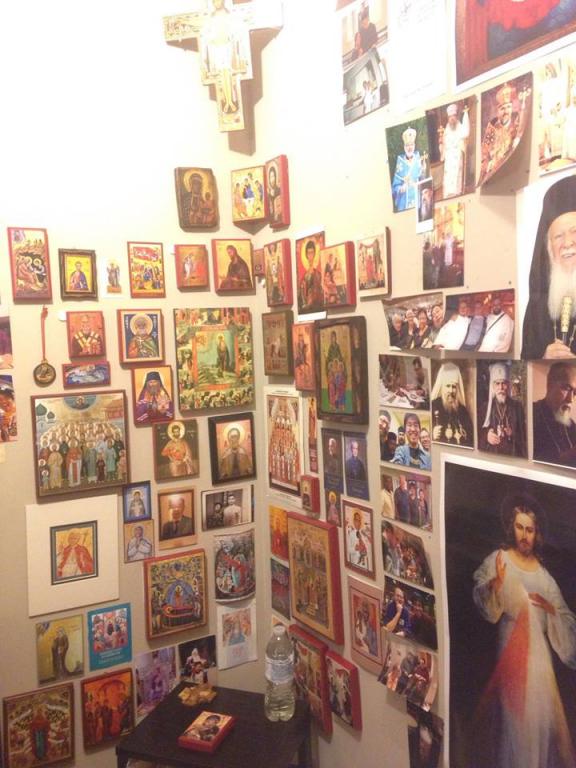
photo by me
In the divergence of my academic work and my popular reflection, the common integrated theme that is emerging in both projects is the concept of the postsecular. I have been very taken with the British social geographer Paul Cloke’s most recent articulation of the term, where he talks about the postsecular as a kind of bubbling up from beneath the surface of the secular. He made this statement in a lecture delivered at the American Association of Geographers earlier this year.
The actual research for Cloke’s claims came from a series of recent articles he and his research team had published about food banks in Britain. They recognize that food banks do not solve the structural problems of food insecurity, which can be chalked up to what is called neoliberal governance in which the state no longer provides for the welfare of its citizens but imagines that it is freeing them up in their creative pursuits by emphasizing their personal responsibility for their actions while providing a militarized police force to ensure stability in such a society, protecting it from criminals within and terrorists without. Structurally, food banks are not a solution, because what probably needs to happen is the dismantling of such a socially unjust order and its replacement with a system in which the welfare of those caught in hard times will not perish from hunger and homelessness. However, the fact is that there are people who are hungry and homeless right now, and food banks are a stopgap measure in the meantime for these mean times.
The postsecular, Cloke said, is very much like the food bank. They are pockets of challenge to a secular order, but they do not dismantle it. Sometimes people in postsecular spaces don’t even realize that there is an ideology to be challenged, or sometimes they misdiagnose the secular situation in which they find themselves. In this way, there is no postsecular agenda. It’s just a bubbling-up from below, some of it with anger, some of it out of desperation, and some of it because some people are decent human beings who can’t imagine a social order without personal love even though the systems by which they are circumscribed demand precisely that kind of secular compromise.
It occurred to me late last year that the icons that I venerate as a Byzantine Christian might for me at least be symptomatic of the postsecular. I came to the Kyivan Church via evangelicalism and Anglicanism, and in both of those worlds (which have much more significant overlap than those on the outside give them credit), there has been a search for what might be called an appreciation of supernatural presence in everyday life. Usually, the way that this quest is chalked up is a search for Christian art and aesthetics. For those of us who make our ways from such secular spiritualities into churches as teeming with the spiritual as the Byzantine ones, it can mean a significant paradigm shift. For example, part of the catechesis involves education in the ability to differentiate between religious art and iconography, the latter of which is not a representation, but in fact a window into heaven through which holy women and men gaze at us. In being seen by those who reflect the light of Christ on their faces, we are transformed.
Still, such gazing upon does nothing for ideological convictions, or the critique of ideology more wholesale in which my scholarly interests are invested. If I have learned anything in the Byzantine churches, it is that persons who share the same spirituality as me, especially in the veneration of icons as windows to heaven, can come to wildly different political conclusions about how the social order should be arranged. For every Orthodox and Eastern Catholic who is critical of Trump, there are those who call for seeing him as a person and giving him a second chance. For every person awakened to social injustice, there are those who still manage to believe that a neoliberal free market is an equal opportunity system for anyone who tries to work a little harder. For every woman and man who comes to be horrified at the perversions of misogynistic, homophobic, and transphobic behaviour against persons who are made in the image and likeness of God, there are plenty who reinforce these ideologies of domination and even justify it through their religious practices.
The practice of venerating icons as a Byzantine Christian, in other words, can be construed as postsecular in the sense that it is in being gazed upon that I can feel the supernatural bubbling up from the crusty surface of the secular that I had given into for so long. But that means nothing about politics. In an Aristotelian sense, such practices of prayer are, like education in ethics and the praxis of friendship, prepolitical. As John Panteleimon Manoussakis points out in an essay on friendship,
friendship is “historically and logically” prior to politics (and the “politics of friendship” as Jacques Derrida puts it) and often acts as a force of subversion to the established political order. Its prepolitical nature makes friendship more suitable for, or more understandable within, a Christian context, since the Church, and the bonds of communion amongst its members, ought to stand in a similar idiosyncratic position vis-à-vis the political order — “for our citizenship is in heaven” (Phil. 3:20). (p. 175).
To be prepolitical is not the same as being postpolitical. The postpolitical, which is worth opposing, is the imagination that we live in a world where politics has become unnecessary and that all that is needed is for bureaucracies with the correct ideology to implement policies that will enact a vision of social justice. Politics, in this sense, is part of the human vocation, as part of the agency of the person to engage in intense agonistic debate about the way that a social order should be arranged, governed, managed, and come into its own as a just society. The difference between the prepolitical and the postpolitical is that the postpolitical has given up on the political vocation, whereas the prepolitical is the preparation for it without having arrived at it yet.
The postsecular, I am saying from my personal experience, is prepolitical. It runs the risk of becoming postpolitical, but it is not even political yet. It is what we might call underdetermined. What I am saying about the veneration of icons in particular and Byzantine prayer much more broadly is that, for all the theologians who have tried to give voice to the church as itself a polis, it is simply not possible to assume that the practices of prayer will lead automatically to a certain political formation. It simply doesn’t. Prayer is prayer, and political formation is political formation. Certainly, prayer precedes politics and can even be the ground in which practices can be fostered that lead to good politics. But I am no longer sure that the two happen at the same time. One is prior to the other, which means that politics cannot do without this prayer that bubbles up from the surface of the secular and interrupts it, but it is also a progression from praying, the action that must be taken in the world from discerning the stuff that has been prayed over. The problem is that discernment doesn’t always happen at the stage of prayer. Sometimes, things are discerned wrongly. Many times, the threads are too loose and require time to come together for fuller reflection.
I reflect that this has been my process on my blog. Those who have walked this journey with me have told me that my writing here has been necessary above all for myself. But the truth is that it has all been preparation, an attempt to draw together the loose threads of the mystagogy into which I have been thrown in this Kyivan Church of ours. In this way, my prayerful practice is probably part of this postsecular phenomenon to which I am being drawn in my work. But in studying these preparatory elements, I wonder what politics such study advances.

Browse Our Archives
Select a Category Academia Anglican Communion anti-racism Aristotle Asia-Pacific Asian American Asian Canadian BlackLivesMatter Cantonese Catholic China Chinglican church politics Church-State Politics Civil Society Conservative Eastern Christianity Evangelical Evangelical Left Feminist/Womanist Theology Food Greek-Catholic Church of Kyiv Hong Kong Housekeeping Kyivan Church Latin Catholicism Law Liberal Liberation Theology New Calvinism Pentecostal/Charismatic Protestant Psychoanalysis Publics Religion Ethnicity Wired Secular Sovereignty TPCIU Uncategorized
Select a Month July 2019 June 2019 May 2019 April 2019 March 2019 February 2019 January 2019 December 2018 November 2018 October 2018 September 2018 August 2018 July 2018 June 2018 May 2018 March 2018 February 2018 January 2018 December 2017 November 2017 October 2017 September 2017 August 2017 July 2017 June 2017 April 2017 March 2017 February 2017 January 2017 December 2016 November 2016 October 2016 September 2016 August 2016 July 2016 January 2016 December 2015 November 2015 October 2015 August 2015 April 2015 March 2015 February 2015 December 2014 November 2014 September 2014 August 2014 July 2014 June 2014 May 2014 April 2014 March 2014 December 2013 November 2013 October 2013 September 2013 August 2013 July 2013 June 2013 May 2013 April 2013 March 2013 February 2013 January 2013 December 2012 October 2012 June 2012 May 2012 April 2012 February 2012 January 2012
Follow Us!
TAKE THE
Religious Wisdom Quiz
Which Christian denomination is led by the Pope?
Select your answer to see how you score.
Protestant Orthodox Anglican Catholic
Related posts from Eastern Catholic Person

I've found my way home: on the unraveling...

Patriyarkhat: 'Attending to the movements of my heart'

I'm flattered to be named an Asian American...

The secular does not stop when your drive...
TRENDING AT PATHEOS Catholic

The Parable Of The Sower And The Word...
One of Christ’s most famous parables is that of the sower who...

Rejecting Doom: Christian Hope And Human Action
Christianity is a religion of hope. We are to have hope and...

Why I Choose the Eucharist Over the Sermon
Choose the Eucharist, Not the Sermon What are we supposed to get...

5 Design Elements Found in Spiritually Rooted Homes
Putting Spirituality Into Home Decor Our homes are more than our living...

Credo: A Story of God Told with the...
About 10 years ago, I began to imagine a personal "Credo" that...

The Anatomy of Divine Revelation in Catholic Thought
The claim that God has made Himself known to human beings is...
view all Catholic blogs
Ad-Free & Subscriber Log-In Subscription Support
- About Us
- 2026 Calendar
- Videos
- Podcasts
- Library of World Religions
- Faith In Media Tracker
- Advertise With Us
- Write for Us
- Privacy Policy
- Terms of Service
- Do Not Sell My Data
- Contact Us
- Radiant Digital
- Manage Newsletter Subscriptions
- Unsubscribe From Notifications
- Sitemap
Copyright 2008-2026, Patheos. All rights reserved.
Subscription Support Ad-Free & Subscriber Log-In
Follow Patheos