
BuddhistCatholicContemplativeEvangelicalGeneral ChristianHinduJewishLatter-day SaintMuslimNew VisionsProgressive Christian
Beliefs
- Buddhist
- Catholic
- Contemplative
- Evangelical
- General Christian
- Hindu
- Jewish
- Latter-day Saint
- More Voices
- Muslim
- New Visions
- Pagan
- Progressive Christian
Topics
- Religion News
- Food and Religion
- Sports and Religion
- Religious Art
- Religious Music and Entertainment
- Religious Events
- History and Religion
- Style and Religion
- Politics and Religion
- Women in Religion
- Recreation Outdoors and Religion
- Business Finance and Religion
- Careers Workplace and Religion
- Education and Religion
- Family Parenting and Religion
- Health Fitness and Religion
- Home and Religion
- Relationships and Religion
- Technology and Religion
- Travel and Religion
Columnists
- Buddhist Columnists
- Business Finance and Religion Columnists
- Careers Workplace and Religion Columnists
- Catholic Columnists
- Contemplative Columnists
- Education and Religion Columnists
- Evangelists Columnists
- Family Parenting and Religion Columnists
- General Christian Columnists
- Health Fitness and Religion Columnists
- Hindu Columnists
- History and Religion Columnists
- Home and Religion Columnists
- Jewish Columnists
- More Voices Columnists
- Latter Day Columnists
- Muslim Columnists
- New Visions Columnists
- Nonreligious Columnists
- Pagan Columnists
- Politics and Religion Columnists
- Progressive Columnists
- Recreation Outdoors and Religion Columnists
- Relationships and Religion Columnists
- Religion News Columnists
- Religious Art Columnists
- Religious Events Columnists
- Religious Music and Entertainment Columnists
- Sports and Religion Columnists
- Style and Religion Columnists
- Technology and Religion Columnists
- Travel and Religion Columnists
- Women in Religion Columnists
Resource Library
- 2026 Calendar
- Library of World Religions
- The 100 Most Holy Places on Earth
- Patheos Answers
- Podcasts
- Videos
- Faith Leaders Database
- Anglican Episcopalian
- Bahai
- Baptist
- Buddhism
- Christianity
- Confucianism
- Eastern Orthodoxy
- Hinduism
- Holiness and Pentecostal
- ISKCON
- Islam
- Judaism
- Lutheran
- Methodist
- The Church of Jesus Christ of Latter-day Saints
- New Age
- Paganism
- Presbytarian and Reformed
- Protestantism
- Religion Behind the Scenes
- Roman Catholic
- Scientology
- Shia Islam
- Sikhism
- Sufism
- Sunni Islam
- Taoism
- Zen
- See all religions
Research Tools
 Ad-Free & Subscriber Log-In Subscription Support
Ad-Free & Subscriber Log-In Subscription Support
Follow Patheos 

- Trending:
- Forgiveness
- |
- Marriage
- |
- Consciousness
- |
- Death Penalty
- |
- Election
- |
- Halloween
 Eastern Catholic Person
- Home
- Catholic
- Friendship is a material thing: on not finishing my icon corner series
Friendship is a material thing: on not finishing my icon corner series
Last updated on: December 22, 2018 at 7:22 am by Justin Tse
Friendship is a material thing: on not finishing my icon corner series 2018-12-22T07:22:07-07:00 Justin Tse
Patheos Explore the world's faith through different perspectives on religion and spirituality! Patheos has the views of the prevalent religions and spiritualities of the world.
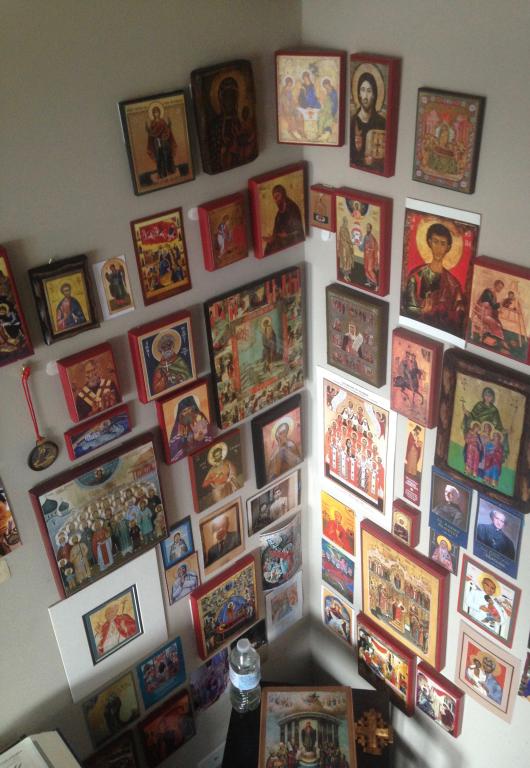
my icon corner – photo by me
As St Philip’s Fast draws to a close, I am beginning to accept that I will not finish my series on the icons in my beautiful corner. It’s just as well, as I have also been learning that I should not give away all the goods on my blog. If I ever transform any of these materials into something publishable in another venue, perhaps I’ll complete it then.
But publication savvy, I reflect, is not the only reason I won’t finish the series. It is because the purpose of blogging here, as far as I am concerned, is to provide a series of written reflections on my mystagogical journey, and writing through my icons has generated, I feel, a larger insight. It is on how an Orthodox theology of icons, which depends on the material order being so suffused with the supernatural that of course the materiality of the icon can serve as a window into heaven, has shaped a new understanding of friendship in my life in the Kyivan Church. The icons, after all, are not impersonal images representing figures who are inspirational in my life. In a very real way, they are my friends.
This thought, like friendship itself, is scary stuff. Those who imagine themselves wise in this contemporary order seem to me to prefer their friendships as purely intellectual endeavours. The idea is that one is able to speak heart to heart, but the experience is more head to head. We agree on some ideas, we might say, and so we can be friends. But we don’t have to do anything for each other. The fantasy is that we just need to be ideologically in sync.
Real friendship is messy. It requires patience, it takes time, and sometimes it even means you have to give someone money, food, and a place to stay. The mandate for friendship is not just empathy; you can’t just be empathic, for example, with a friend in a situation, say, of domestic violence or poverty. In our church’s daily readings in these weeks before Nativity, we learn from the Holy Apostle James of Jerusalem that this kind of fake compassion, where we let our poor sisters and brothers be heard and wish them well, is evil because what they actually need is to be sheltered, fed, and clothed. Faith without works, James reminds us, is dead. The same goes for empathy. It is as Holy John the Theologian puts it in his first letter: How does God’s love abide in anyone who has the world’s goods and sees a brother or sister in need and yet refuses help? Little children, let us love, not in word or speech, but in truth and action (1 John 3.17-18 NRSV).
This kind of friendship requires discernment. In these strange times, a posture of desperation is not always a sign of precarity. I have friends, for example, that I tell to knock off the desperate attitude. They are already clothed, fed, and sheltered. What is more, their material situation is not at all precarious and will not become so because, whatever has become of the public welfare system in this zombie neoliberal wasteland of a global order, their private safety nets are far more secure than they let on. On the same token, there are friends who appear to be put together who suffer such deprivations secretly. The art of friendship is to become the person who does not fail them when they reveal their secrets. Both situations have in fact presented themselves to me in the last two weeks. I cannot say more without violating the confidentiality of my sisters and brothers, but I will say that I am inspired by friends of mine whom I saw bend over backwards to help someone in need recently and have been pondering those acts of true friendship in my heart. I am grateful also for spiritual direction, which is a unique kind of companionship for the journey.
But what I can say is that I have friends who have been there for me, understanding what I need with the same kind of discernment my friends and I have undergone with others. I can speak about these more freely. I have someone in my life, for example, that I refer to as the ‘big brother of my everyday life.’ When I first moved out, he saw that for one reason or another, I had been woefully unequipped in the ability to build infrastructure in my home to organize it and get by as an independent adult. What I lacked, he discerned, was not the funds to purchase these items, so he took me to dollar stores, furniture outlets, hardware shops, and other such vendors to show me the ropes of life while making me buy them myself. I have another friend who has read over nearly every job application I have sent in academia. Like most academics at my level, I have sent out hundreds over the years, but what this person discerned early on is that my special problem was not so much that I didn’t have the goods, but wasn’t good at highlighting them. Each package became the rehearsal for the next one, sometimes painfully so, but like when I first moved out, the problem was that I did not seem to have the infrastructural organization to execute my career — so this friend helped me out. The same, I would say, goes for other practices, like my terrible game when I first started dating (I have had some glorious disasters), my very slow improvements in kitchen work, and my gradual progress out of modes of writing that were purely confessional, in both the doctrinal and the overly reflexive ways, into hopefully more generative expository styles.
Such discernment is only possible, however, not only when the other sees me, but when I open myself to another person’s gaze. Maybe this is the scariest part of friendship. Some will call it vulnerability or authenticity, but such therapeutic evangelical terms do not really approximate the truest fears of true friendships, where what is on the table are not my thoughts and fantasies, or even my feelings and desires, but my actual material circumstances: finances, health, domestic life, and basic social skills. I am good, I feel, at obfuscating these material realities, and nowhere is truer than on this blog, where as a brother once told me about his own blog, it is a bit of a tell-all insincerity. I am, of course, happy for my blog to be authentically insincere, but blogging is not friendship, and true friendships usually occur out of the sight of the public eye, exposing the real materiality of everyday life with their loving gazes and truthful words. For me, my friends know that I am not yet poor, even when I pretend to be. The problem, they know too well, is in organizing what I have, and what I am saying is that my truest friendships seem in reflection — though this too may turn out to be insincere when my friends who know even truer truths read this — to be marked by such materialist discernment.
Is this not, I reflect, the experience of standing before the icons in temples as liturgies occur, or indeed, opening myself to the gaze of the holy women and men who pray for me before the face of the One-Who-Is and gaze at me through open windows from heaven in my beautiful corner? They see everything, far beyond my thoughts and affections and into the very revealing practices of my everyday life. And yet, they love me. Indeed, when I invoke their prayers, they build in me a kind of spiritual infrastructure, ushering me back to the fundamentals of a supernatural economia. I realize now that as I wrote about my icons, it was in large part this theme to which I constantly returned, that the icons at this stage in my growth as a person are showing me what it means to be a true friend in the world by befriending me. This, I think, is the mystagogical insight I want to put on the record as Nativity draws near, that in this church, I am finally learning to be a person whose approach to others is formed by heavenly gazes, and that far from drawing me to heights of abstractness and ideological fantasy, I can feel roots being set in the material order where everyday life is but a working out of my salvation in fear and trembling.
In such a way is Christ born. With anticipation in this forefeast of the Nativity, let us even now glorify him.
Reflections on the icons in my beautiful corner composed the series I began writing for this year’s St Philip’s Fast in preparation for the Feast of the Nativity, beginning on the Old Calendar as I am in Chicago and switching back to the New Calendar when I return to Richmond in mid-December. They were attempts to account for my process of conversion in the Kyivan Church without discounting the Chinese Christianity of my Protestant past. They ended up being about friendship.
The nine posts concerned the San Damiano Cross, Rublev’s Trinity, the relation of the Black Madonna to the Oranta of Kyiv, the Sinai Pantocrator in relation to the Dormition, the ‘angels and archangels,’ the Prophet Jonah with Moses, Elijah, and John the Baptist, the Holy Apostles Peter and Paul, and the Holy Apostles Thomas and Jude.


Browse Our Archives
Select a Category Academia Anglican Communion anti-racism Aristotle Asia-Pacific Asian American Asian Canadian BlackLivesMatter Cantonese Catholic China Chinglican church politics Church-State Politics Civil Society Conservative Eastern Christianity Evangelical Evangelical Left Feminist/Womanist Theology Food Greek-Catholic Church of Kyiv Hong Kong Housekeeping Kyivan Church Latin Catholicism Law Liberal Liberation Theology New Calvinism Pentecostal/Charismatic Protestant Psychoanalysis Publics Religion Ethnicity Wired Secular Sovereignty TPCIU Uncategorized
Select a Month July 2019 June 2019 May 2019 April 2019 March 2019 February 2019 January 2019 December 2018 November 2018 October 2018 September 2018 August 2018 July 2018 June 2018 May 2018 March 2018 February 2018 January 2018 December 2017 November 2017 October 2017 September 2017 August 2017 July 2017 June 2017 April 2017 March 2017 February 2017 January 2017 December 2016 November 2016 October 2016 September 2016 August 2016 July 2016 January 2016 December 2015 November 2015 October 2015 August 2015 April 2015 March 2015 February 2015 December 2014 November 2014 September 2014 August 2014 July 2014 June 2014 May 2014 April 2014 March 2014 December 2013 November 2013 October 2013 September 2013 August 2013 July 2013 June 2013 May 2013 April 2013 March 2013 February 2013 January 2013 December 2012 October 2012 June 2012 May 2012 April 2012 February 2012 January 2012
Follow Us!
TAKE THE
Religious Wisdom Quiz
In 1 Peter, what does Peter say Sarah called Abraham?
Select your answer to see how you score.
Master Father Lord My beloved
Related posts from Eastern Catholic Person

I've found my way home: on the unraveling...

Patriyarkhat: 'Attending to the movements of my heart'

I'm flattered to be named an Asian American...

The secular does not stop when your drive...
TRENDING AT PATHEOS Catholic

Creation, Preservation, and Teleology in Catholic Theology
As I write this, it is very early Monday morning. Like millions...

The Parable Of The Sower And The Word...
One of Christ’s most famous parables is that of the sower who...

Rejecting Doom: Christian Hope And Human Action
Christianity is a religion of hope. We are to have hope and...

Why I Choose the Eucharist Over the Sermon
Choose the Eucharist, Not the Sermon What are we supposed to get...

5 Design Elements Found in Spiritually Rooted Homes
Putting Spirituality Into Home Decor Our homes are more than our living...

Credo: A Story of God Told with the...
About 10 years ago, I began to imagine a personal "Credo" that...
view all Catholic blogs
Ad-Free & Subscriber Log-In Subscription Support
- About Us
- 2026 Calendar
- Videos
- Podcasts
- Library of World Religions
- Faith In Media Tracker
- Advertise With Us
- Write for Us
- Privacy Policy
- Terms of Service
- Do Not Sell My Data
- Contact Us
- Radiant Digital
- Manage Newsletter Subscriptions
- Unsubscribe From Notifications
- Sitemap
Copyright 2008-2026, Patheos. All rights reserved.
Subscription Support Ad-Free & Subscriber Log-In
Follow Patheos