
BuddhistCatholicContemplativeEvangelicalGeneral ChristianHinduJewishLatter-day SaintMuslimNew VisionsProgressive Christian
Beliefs
- Buddhist
- Catholic
- Contemplative
- Evangelical
- General Christian
- Hindu
- Jewish
- Latter-day Saint
- More Voices
- Muslim
- New Visions
- Pagan
- Progressive Christian
Topics
- Religion News
- Food and Religion
- Sports and Religion
- Religious Art
- Religious Music and Entertainment
- Religious Events
- History and Religion
- Style and Religion
- Politics and Religion
- Women in Religion
- Recreation Outdoors and Religion
- Business Finance and Religion
- Careers Workplace and Religion
- Education and Religion
- Family Parenting and Religion
- Health Fitness and Religion
- Home and Religion
- Relationships and Religion
- Technology and Religion
- Travel and Religion
Columnists
- Buddhist Columnists
- Business Finance and Religion Columnists
- Careers Workplace and Religion Columnists
- Catholic Columnists
- Contemplative Columnists
- Education and Religion Columnists
- Evangelists Columnists
- Family Parenting and Religion Columnists
- General Christian Columnists
- Health Fitness and Religion Columnists
- Hindu Columnists
- History and Religion Columnists
- Home and Religion Columnists
- Jewish Columnists
- More Voices Columnists
- Latter Day Columnists
- Muslim Columnists
- New Visions Columnists
- Nonreligious Columnists
- Pagan Columnists
- Politics and Religion Columnists
- Progressive Columnists
- Recreation Outdoors and Religion Columnists
- Relationships and Religion Columnists
- Religion News Columnists
- Religious Art Columnists
- Religious Events Columnists
- Religious Music and Entertainment Columnists
- Sports and Religion Columnists
- Style and Religion Columnists
- Technology and Religion Columnists
- Travel and Religion Columnists
- Women in Religion Columnists
Resource Library
- 2026 Calendar
- Library of World Religions
- The 100 Most Holy Places on Earth
- Patheos Answers
- Podcasts
- Videos
- Faith Leaders Database
- Anglican Episcopalian
- Bahai
- Baptist
- Buddhism
- Christianity
- Confucianism
- Eastern Orthodoxy
- Hinduism
- Holiness and Pentecostal
- ISKCON
- Islam
- Judaism
- Lutheran
- Methodist
- The Church of Jesus Christ of Latter-day Saints
- New Age
- Paganism
- Presbytarian and Reformed
- Protestantism
- Religion Behind the Scenes
- Roman Catholic
- Scientology
- Shia Islam
- Sikhism
- Sufism
- Sunni Islam
- Taoism
- Zen
- See all religions
Research Tools
 Ad-Free & Subscriber Log-In Subscription Support
Ad-Free & Subscriber Log-In Subscription Support
Follow Patheos 

- Trending:
- Forgiveness
- |
- Marriage
- |
- Consciousness
- |
- Death Penalty
- |
- Election
- |
- Halloween
 Eastern Catholic Person
- Home
- Catholic
- ‘Glory to God in all things’: forthcoming mystagogical reflections on the postsecular
‘Glory to God in all things’: forthcoming mystagogical reflections on the postsecular
Last updated on: November 23, 2018 at 1:27 am by Justin Tse
‘Glory to God in all things’: forthcoming mystagogical reflections on the postsecular 2018-11-23T01:27:10-07:00 Justin Tse
Patheos Explore the world's faith through different perspectives on religion and spirituality! Patheos has the views of the prevalent religions and spiritualities of the world.
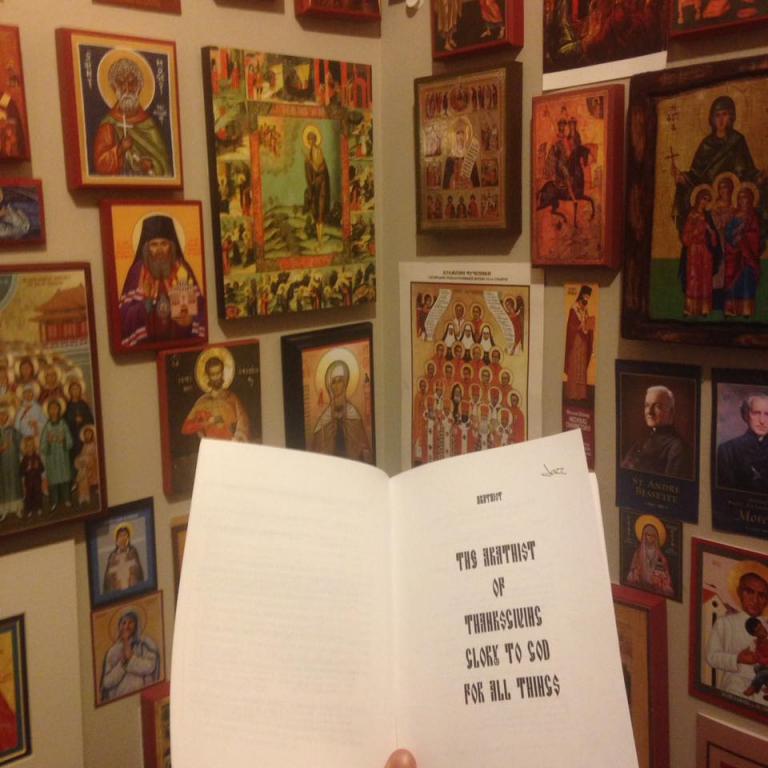
photo by me
Last night, on the eve of Thanksgiving, I prayed the Akathist of Thanksgiving, Glory to God in All Things. Written in exile by Metropolitan Tryphon in the difficult days of the Russian Church’s experience of the early Soviet Union, the series of hymns, often with incomplete stanzas, is a grateful meditation on everyday life, finding the grace-filled supernatural infusing all things in creation and working from those encounters with the world to the deeper mysteries of life in Christ. The name of the Akathist gives away the exilic context: ‘Glory to God for all things’ is a reference to the last words of the exiled Archbishop of Constantinople, the Holy Hierarch John Chrysostom, banished from the empire for his prophetic stance to imperial power and yet with his dying breath finding grace everywhere. It seemed right to pray for American Thanksgiving, a holiday that I hardly celebrate not because of my radical politics, but because I am Canadian, and we’ve already finished our celebrations in October. Finding an opportunity to revisit this hymn was more of an excuse; I first encountered it during a retreat at my temple in Richmond and have not really had an occasion to sing it again. I savoured it, and perhaps I will write more about it someday, but it is still too sweet and fresh, and I have to sit with it before I can say anything more.
If there has been one purpose for this blog, it has been to record my mystagogical journey as I’ve been received into the Kyivan Church. Of course, the period of formal mystagogy takes place immediately after the catechumenate, and the time to relive it is during the Pascha season through the experiences of the Holy Apostle Thomas, the Myrrhbearing Women, the Paralytic, the Samaritan Woman, and the Man Born Blind. For me, it was the summer months after the Feast of the Holy Apostles Peter and Paul in 2016 when I was chrismated, shortly before moving to Chicago and having to work out my faith in an everyday life lived in the secular academy.
But for me, the experience of mystagogy has continued well into a third year, and for the most part, I’ve recorded the major highlights on this blog, at least the parts that are publicly shareable. If anything, it has been a journey into a different way of doing theology. The news today, for example, of the death of the evangelical missionary John Allen Chau reminds me deeply of the circuits of evangelicalism that used to contextualize my life. Any way that one slices it, his actions in contacting that indigenous tribe that is independent of India are stupid, and the word martyr ought not to be used glibly about him. But as much as I want to get on board with the chorus decrying him as a colonizer who rightfully met his end, what he writes in his diary haunts me. God, I don’t want to die, he tells the Lord in one place, and then in another declares that it is all for his glory. Christianity Today suggests that the resolution of this tension lies in the fact that he was part of a missions agency, or even a network of them, and there are reports that the group International Christian Concern wants prosecution of those native peoples under the presumption that they are answerable to Indian law. For all those who say that Chau’s actions are the misadventures of an individual, the shadow of evangelicalism’s moneyed infrastructure looms large in the background here.
The gap in Chau’s diary reminds me of the tension in my theological past. There is what I feel in my heart, that which also courses through my body. There is also the requirement of the institution, that to which I must give intellectual assent. When I was an evangelical — even one within the Anglican Communion — I knew that the first is what was right, but I also understood the second to procure salvation for me. It was not until after my conversion and through a lot of spiritual direction that I entered into a process of being conscious of my own consciousness, to work from the feelings that I felt deeply toward the objective existence of the supernatural order that I knew to constitute the world.
I was just saying to some friends today that this journey toward Eastern Catholicism is my own. I am not sure that everyone has to come to the truth this way. In fact, I have become suspicious of my desire to convert all my friends to my church and have basically written the impulse off as unholy, though the ones who do come along are welcome to explore indeed. I told a few sisters and brothers today that I would much rather that my evangelical friends come to feel what they feel deeply instead of dismissing their feelings and trying to power through toward a resolution between their hearts and the institutional infrastructures to which they must give intellectual allegiance. At the end of the day, the conversion is to being an authentic human person, integrated with ourselves, in touch with the world as it is.
What I am saying is that there will be forthcoming mystagogical reflections of this nature coming soon. The more immediate ones I plan to lead up to the Feast of the Holy Apostle Philip, incidentally the patron saint of my biological father. That day, which for us on the Old Calendar commences on November 28, marks the opening of the Nativity Fast, during which I hope to blog until Theophany about the icons in my beautiful corner. These are musings on what I have called in the past the everyday supernatural, a term by which my student Eugenia Geisel seems particularly taken. I hope to work toward the much-debated concept of the postsecular as it plays out in my personal praxis through this process of writing.
Previous Post
November 20, 2018
On the Mercy Hospital shootings in Chicago

Browse Our Archives
Select a Category Academia Anglican Communion anti-racism Aristotle Asia-Pacific Asian American Asian Canadian BlackLivesMatter Cantonese Catholic China Chinglican church politics Church-State Politics Civil Society Conservative Eastern Christianity Evangelical Evangelical Left Feminist/Womanist Theology Food Greek-Catholic Church of Kyiv Hong Kong Housekeeping Kyivan Church Latin Catholicism Law Liberal Liberation Theology New Calvinism Pentecostal/Charismatic Protestant Psychoanalysis Publics Religion Ethnicity Wired Secular Sovereignty TPCIU Uncategorized
Select a Month July 2019 June 2019 May 2019 April 2019 March 2019 February 2019 January 2019 December 2018 November 2018 October 2018 September 2018 August 2018 July 2018 June 2018 May 2018 March 2018 February 2018 January 2018 December 2017 November 2017 October 2017 September 2017 August 2017 July 2017 June 2017 April 2017 March 2017 February 2017 January 2017 December 2016 November 2016 October 2016 September 2016 August 2016 July 2016 January 2016 December 2015 November 2015 October 2015 August 2015 April 2015 March 2015 February 2015 December 2014 November 2014 September 2014 August 2014 July 2014 June 2014 May 2014 April 2014 March 2014 December 2013 November 2013 October 2013 September 2013 August 2013 July 2013 June 2013 May 2013 April 2013 March 2013 February 2013 January 2013 December 2012 October 2012 June 2012 May 2012 April 2012 February 2012 January 2012
Follow Us!
TAKE THE
Religious Wisdom Quiz
How many days was Jesus in the tomb before His resurrection?
Select your answer to see how you score.
Three Forty Nine Seven
Related posts from Eastern Catholic Person

I've found my way home: on the unraveling...

Home is where your food is: a speech...

Patriyarkhat: 'Attending to the movements of my heart'

I'm flattered to be named an Asian American...
TRENDING AT PATHEOS Catholic

Creation, Preservation, and Teleology in Catholic Theology
As I write this, it is very early Monday morning. Like millions...

The Parable Of The Sower And The Word...
One of Christ’s most famous parables is that of the sower who...

Rejecting Doom: Christian Hope And Human Action
Christianity is a religion of hope. We are to have hope and...

Why I Choose the Eucharist Over the Sermon
Choose the Eucharist, Not the Sermon What are we supposed to get...

5 Design Elements Found in Spiritually Rooted Homes
Putting Spirituality Into Home Decor Our homes are more than our living...

Credo: A Story of God Told with the...
About 10 years ago, I began to imagine a personal "Credo" that...
view all Catholic blogs
Ad-Free & Subscriber Log-In Subscription Support
- About Us
- 2026 Calendar
- Videos
- Podcasts
- Library of World Religions
- Faith In Media Tracker
- Advertise With Us
- Write for Us
- Privacy Policy
- Terms of Service
- Do Not Sell My Data
- Contact Us
- Radiant Digital
- Manage Newsletter Subscriptions
- Unsubscribe From Notifications
- Sitemap
Copyright 2008-2026, Patheos. All rights reserved.
Subscription Support Ad-Free & Subscriber Log-In
Follow Patheos