
BuddhistCatholicContemplativeEvangelicalGeneral ChristianHinduJewishLatter-day SaintMuslimNew VisionsProgressive Christian
Beliefs
- Buddhist
- Catholic
- Contemplative
- Evangelical
- General Christian
- Hindu
- Jewish
- Latter-day Saint
- More Voices
- Muslim
- New Visions
- Pagan
- Progressive Christian
Topics
- Religion News
- Food and Religion
- Sports and Religion
- Religious Art
- Religious Music and Entertainment
- Religious Events
- History and Religion
- Style and Religion
- Politics and Religion
- Women in Religion
- Recreation Outdoors and Religion
- Business Finance and Religion
- Careers Workplace and Religion
- Education and Religion
- Family Parenting and Religion
- Health Fitness and Religion
- Home and Religion
- Relationships and Religion
- Technology and Religion
- Travel and Religion
Columnists
- Buddhist Columnists
- Business Finance and Religion Columnists
- Careers Workplace and Religion Columnists
- Catholic Columnists
- Contemplative Columnists
- Education and Religion Columnists
- Evangelists Columnists
- Family Parenting and Religion Columnists
- General Christian Columnists
- Health Fitness and Religion Columnists
- Hindu Columnists
- History and Religion Columnists
- Home and Religion Columnists
- Jewish Columnists
- More Voices Columnists
- Latter Day Columnists
- Muslim Columnists
- New Visions Columnists
- Nonreligious Columnists
- Pagan Columnists
- Politics and Religion Columnists
- Progressive Columnists
- Recreation Outdoors and Religion Columnists
- Relationships and Religion Columnists
- Religion News Columnists
- Religious Art Columnists
- Religious Events Columnists
- Religious Music and Entertainment Columnists
- Sports and Religion Columnists
- Style and Religion Columnists
- Technology and Religion Columnists
- Travel and Religion Columnists
- Women in Religion Columnists
Resource Library
- 2026 Calendar
- Library of World Religions
- The 100 Most Holy Places on Earth
- Patheos Answers
- Podcasts
- Videos
- Faith Leaders Database
- Anglican Episcopalian
- Bahai
- Baptist
- Buddhism
- Christianity
- Confucianism
- Eastern Orthodoxy
- Hinduism
- Holiness and Pentecostal
- ISKCON
- Islam
- Judaism
- Lutheran
- Methodist
- The Church of Jesus Christ of Latter-day Saints
- New Age
- Paganism
- Presbytarian and Reformed
- Protestantism
- Religion Behind the Scenes
- Roman Catholic
- Scientology
- Shia Islam
- Sikhism
- Sufism
- Sunni Islam
- Taoism
- Zen
- See all religions
Research Tools
 Ad-Free & Subscriber Log-In Subscription Support
Ad-Free & Subscriber Log-In Subscription Support
Follow Patheos 

- Trending:
- Forgiveness
- |
- Marriage
- |
- Consciousness
- |
- Death Penalty
- |
- Election
- |
- Halloween
 Eastern Catholic Person
- Home
- Catholic
- Reading Sobrino on Óscar Romero and the glory of God
Reading Sobrino on Óscar Romero and the glory of God
Last updated on: October 13, 2018 at 3:33 pm by Justin Tse
Reading Sobrino on Óscar Romero and the glory of God 2018-10-13T15:33:01-07:00 Justin Tse
Patheos Explore the world's faith through different perspectives on religion and spirituality! Patheos has the views of the prevalent religions and spiritualities of the world.
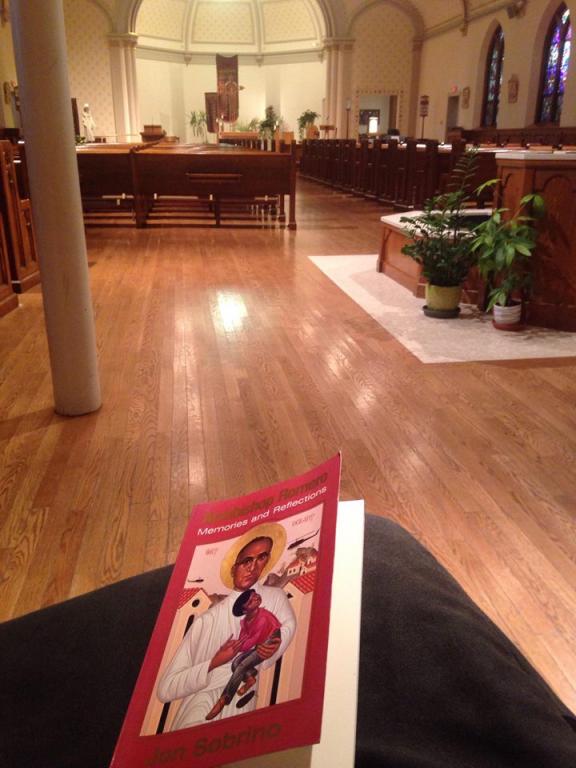
photo by me
I confess, and do not deny, that I have had difficulty reading the works of the theologian Jon Sobrino, and it is not for want of trying. I have tried to read Christology at the Crossroads on the advice of my spiritual father and just could not get into it. My spiritual father had once been posted to El Salvador as a young Canadian Jesuit, and he had known Sobrino’s friends, the ones who were later murdered as they bridged their teaching at the university with social justice for the community and became New-Martyrs themselves. My dear colleague Sam Tsang wrote an essay in my book Theological Reflections on the Hong Kong Umbrella Movement part on the Hong Kong theologian Kung Lap Yan and his usage of Sobrino’s Jesus the Liberator and Christ the Liberator in his understanding of theologies of liberation in Hong Kong, especially in relation to the Umbrella Movement. I edited the piece to fit Tsang’s Bruce Lee voice – you really should hear him talk, as the similarities are uncanny – but could not get into Sobrino himself. Here at Northwestern, I met the Protestant chaplain Tim Stevens early on in my time here. I learned that he had gone to El Salvador a number of times and was influenced by Sobrino. I appreciate what Stevens has done here at my school, but when I tried to get into Sobrino himself, I could not.
I suppose this is a little strange for someone who professes to be influenced by liberation theology, especially the work of its educational godfather Paulo Freire. But on this afternoon, this eve of the canonization of the New Hieromartyr Óscar Romero in our sister church, I went to the Latin parish closest to my home and office to pray and to do some spiritual reading. I read Jon Sobrino’s Archbishop Romero: Memories and Reflections. Reading with my heart, this is the passage that opened it. Sobrino describes the moment after the murder of Romero’s friend Rutilio Grande SJ, who had been working with the poor. He talks about a mass that Romero offered that combined all of the masses at the cathedral into a single mass that would gather up hundreds of people and have folks spill out the doors and onto the streets, with people from all social classes worshipping together. Reflecting on the planning of that single mass, Sobrino writes on Romero’s theological method and its process of conversion:
But even Archbishop Romero had had his doubts about the single Mass. He was convinced that something dramatic had to be done to stun the country and shake it from its apathy. But he had a theological scruple, which he formulated at our meeting with characteristic sincerity. “If the Eucharist gives glory to God,” he asked, “will not God have more glory in the usual number of Sunday Masses than in just one?”
I must confess that my heart sank to hear him. Here was a theology straight out of the dark ages. But in thinking it over afterwards, and on the basis of all his actions, I finally came to interpret Archbishop Romero’s words correctly. He was only showing his deep, genuine interest in the things of God. His theology was questionable. Beyond question, however, was his profound faith in God, and his surpassing concern for the glory of God in this world.
With the same frank attitude with which Archbishop Romero had propounded his own difficulty, others of us explained our theological reasoning to the contrary. A lengthy discussion ensued. Finally Father Jerez spoke up: “I think Monseñor is absolutely right to be concerned for the glory of God. But unless I am mistaken, the Fathers of the Church said, ‘Gloria Dei, vivens homo‘ — the glory of God is the living person.” Father Jerez’s intervention decided the issue for all practical purposes. Archbishop Romero seemed convinced, and relieved of his scruple. And he decided on the single Mass for that particular Sunday.
At that moment, I thought only that Archbishop Romero had made a lucid, courageous pastoral decision. But afterwards, I thought what it must have meant for him to accept such a novel formulation of what the actual “glory of God” is. At stake had been nothing less than his personal understanding of God — his faith in God. It was not a mere matter of a new theological formulation. It was a matter of a new understanding of God. And Archbishop Romero had accepted that new understanding. Tirelessly he would repeat that nothing was more important to God than the life of the poor. When he went to Puebla, he met Leonardo Boff there, and told him: “In my country, people are being horribly murdered. We must defend the minimum gift of God, which is also the maximum: life.” He himself reformulated Saint Irenaeus’s aphorism, the one Father Jerez had cited, as, “‘Gloria Dei, vivens pauper‘ — the glory of God is the living poor person.” Conversely, he railed against the idols — those false, but real, divinities that deal in death, the deities that call for victims because they live on their blood as the only means to their own survival. (Sobrino, Archbishop Romero, pp. 15-16).
As the canonization draws near, I reflect on this passage, turning it over and over again in my mind. To report the fruits of my contemplations this early would be premature, although certainly the reference to the glory of God may have something to do with my affinity, if not devotion, to Hans Urs von Balthasar. Milbank criticizes Balthasar for being apolitical in his aesthetic reflections, and I can see how a number of Balthasar’s disciples might be wanting in a theology of politics or even be drawn to a kind of conservatism. But Romero extends the Balthasarian reflection on the glory of the Lord, the beauty that ‘is the disinterested one, without which the ancient world refused to understand itself, a word which imperceptibly and yet unmistakably has bid farewell to our new world, a world of interests, leaving it to its own avarice and sadness’ (Balthasar, Seeing the Form, p. 18). Romero’s theology is medieval indeed: he begins with beauty and then locates it in the poor, and Sobrino, a theologian who should be pegged as a Marxist, notices it and dares to play with these formulations that can be construed as conservative, fortifying his commitment to liberation in the process.
There is something poignant about this afternoon reading. When I was a sophomore in high school, I was introduced to liberation theology in a class on Christology where we watched the film Romero, the one starring Raul Julia in the title role. I have an evangelical background. We do not do liberation theology as evangelicals, and I thought that my teacher was quite overly liberal (the word radical was not then in my vocabulary). But watching the film, I was drawn into Archbishop Romero’s world and came to understand the importance of theologies of liberation from a personal perspective. Today, Romero plays the same role in my life. I have struggled to read Sobrino because I read him with my head, attempting to annotate him with my hands. But Romero shows me the way of the heart, and through his icon, I could feel what Sobrino was talking about. The New-Hieromartyr Óscar has opened a door for me. I hope that I will finally be able to walk through it and share in his conversion.
Browse Our Archives
Select a Category Academia Anglican Communion anti-racism Aristotle Asia-Pacific Asian American Asian Canadian BlackLivesMatter Cantonese Catholic China Chinglican church politics Church-State Politics Civil Society Conservative Eastern Christianity Evangelical Evangelical Left Feminist/Womanist Theology Food Greek-Catholic Church of Kyiv Hong Kong Housekeeping Kyivan Church Latin Catholicism Law Liberal Liberation Theology New Calvinism Pentecostal/Charismatic Protestant Psychoanalysis Publics Religion Ethnicity Wired Secular Sovereignty TPCIU Uncategorized
Select a Month July 2019 June 2019 May 2019 April 2019 March 2019 February 2019 January 2019 December 2018 November 2018 October 2018 September 2018 August 2018 July 2018 June 2018 May 2018 March 2018 February 2018 January 2018 December 2017 November 2017 October 2017 September 2017 August 2017 July 2017 June 2017 April 2017 March 2017 February 2017 January 2017 December 2016 November 2016 October 2016 September 2016 August 2016 July 2016 January 2016 December 2015 November 2015 October 2015 August 2015 April 2015 March 2015 February 2015 December 2014 November 2014 September 2014 August 2014 July 2014 June 2014 May 2014 April 2014 March 2014 December 2013 November 2013 October 2013 September 2013 August 2013 July 2013 June 2013 May 2013 April 2013 March 2013 February 2013 January 2013 December 2012 October 2012 June 2012 May 2012 April 2012 February 2012 January 2012
Follow Us!
TAKE THE
Religious Wisdom Quiz
What was the name of the queen who visited Solomon?
Select your answer to see how you score.
Queen Esther Queen Vashti The Queen of Sheba Queen Jezebel
Related posts from Eastern Catholic Person

This time, I have a tradition: on solidarity...

Home is where your food is: a speech...

I'm flattered to be named an Asian American...
Christian atheism as orthodox liberation from the tragic...
TRENDING AT PATHEOS Catholic

Creation, Preservation, and Teleology in Catholic Theology
As I write this, it is very early Monday morning. Like millions...

The Parable Of The Sower And The Word...
One of Christ’s most famous parables is that of the sower who...

Rejecting Doom: Christian Hope And Human Action
Christianity is a religion of hope. We are to have hope and...

Why I Choose the Eucharist Over the Sermon
Choose the Eucharist, Not the Sermon What are we supposed to get...

5 Design Elements Found in Spiritually Rooted Homes
Putting Spirituality Into Home Decor Our homes are more than our living...

Credo: A Story of God Told with the...
About 10 years ago, I began to imagine a personal "Credo" that...
view all Catholic blogs
Ad-Free & Subscriber Log-In Subscription Support
- About Us
- 2026 Calendar
- Videos
- Podcasts
- Library of World Religions
- Faith In Media Tracker
- Advertise With Us
- Write for Us
- Privacy Policy
- Terms of Service
- Do Not Sell My Data
- Contact Us
- Radiant Digital
- Manage Newsletter Subscriptions
- Unsubscribe From Notifications
- Sitemap
Copyright 2008-2026, Patheos. All rights reserved.
Subscription Support Ad-Free & Subscriber Log-In
Follow Patheos