
BuddhistCatholicContemplativeEvangelicalGeneral ChristianHinduJewishLatter-day SaintMuslimNew VisionsProgressive Christian
Beliefs
- Buddhist
- Catholic
- Contemplative
- Evangelical
- General Christian
- Hindu
- Jewish
- Latter-day Saint
- More Voices
- Muslim
- New Visions
- Pagan
- Progressive Christian
Topics
- Religion News
- Food and Religion
- Sports and Religion
- Religious Art
- Religious Music and Entertainment
- Religious Events
- History and Religion
- Style and Religion
- Politics and Religion
- Women in Religion
- Recreation Outdoors and Religion
- Business Finance and Religion
- Careers Workplace and Religion
- Education and Religion
- Family Parenting and Religion
- Health Fitness and Religion
- Home and Religion
- Relationships and Religion
- Technology and Religion
- Travel and Religion
Columnists
- Buddhist Columnists
- Business Finance and Religion Columnists
- Careers Workplace and Religion Columnists
- Catholic Columnists
- Contemplative Columnists
- Education and Religion Columnists
- Evangelists Columnists
- Family Parenting and Religion Columnists
- General Christian Columnists
- Health Fitness and Religion Columnists
- Hindu Columnists
- History and Religion Columnists
- Home and Religion Columnists
- Jewish Columnists
- More Voices Columnists
- Latter Day Columnists
- Muslim Columnists
- New Visions Columnists
- Nonreligious Columnists
- Pagan Columnists
- Politics and Religion Columnists
- Progressive Columnists
- Recreation Outdoors and Religion Columnists
- Relationships and Religion Columnists
- Religion News Columnists
- Religious Art Columnists
- Religious Events Columnists
- Religious Music and Entertainment Columnists
- Sports and Religion Columnists
- Style and Religion Columnists
- Technology and Religion Columnists
- Travel and Religion Columnists
- Women in Religion Columnists
Resource Library
- 2026 Calendar
- Library of World Religions
- The 100 Most Holy Places on Earth
- Patheos Answers
- Podcasts
- Videos
- Faith Leaders Database
- Anglican Episcopalian
- Bahai
- Baptist
- Buddhism
- Christianity
- Confucianism
- Eastern Orthodoxy
- Hinduism
- Holiness and Pentecostal
- ISKCON
- Islam
- Judaism
- Lutheran
- Methodist
- The Church of Jesus Christ of Latter-day Saints
- New Age
- Paganism
- Presbytarian and Reformed
- Protestantism
- Religion Behind the Scenes
- Roman Catholic
- Scientology
- Shia Islam
- Sikhism
- Sufism
- Sunni Islam
- Taoism
- Zen
- See all religions
Research Tools
 Ad-Free & Subscriber Log-In Subscription Support
Ad-Free & Subscriber Log-In Subscription Support
Follow Patheos 

- Trending:
- Forgiveness
- |
- Marriage
- |
- Consciousness
- |
- Death Penalty
- |
- Election
- |
- Halloween
 Eastern Catholic Person
- Home
- Catholic
- Freud’s throne room
Freud’s throne room
Last updated on: September 23, 2018 at 8:46 pm by Justin Tse
Freud’s throne room 2018-09-23T20:46:30-07:00 Justin Tse
Patheos Explore the world's faith through different perspectives on religion and spirituality! Patheos has the views of the prevalent religions and spiritualities of the world.
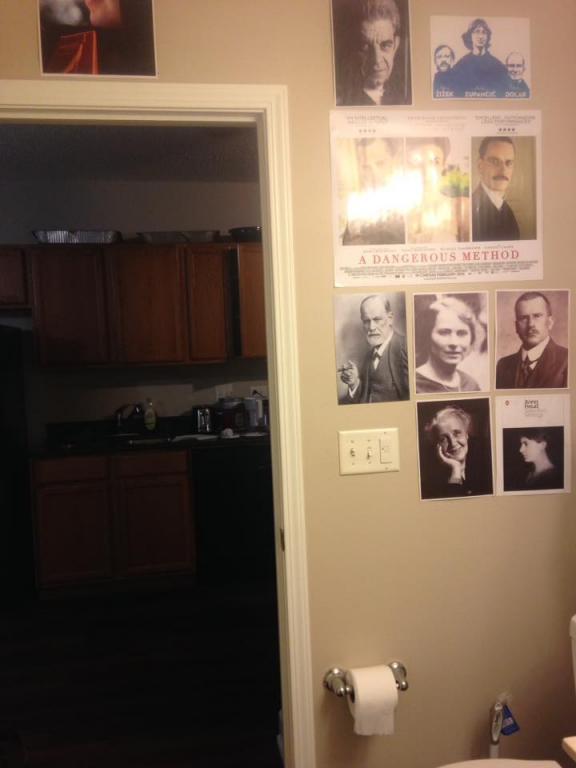
my bathroom in Evanston – photo by me
As I was going about my day on this fine Sunday Before the Exaltation of the Cross and Postfeast season of the Nativity of the Theotokos, my friend, colleague, and brother Eastern Catholic scholar Adam DeVille posted on my social media. It turns out that September 23 is the anniversary of the death of the great male theorist of the death-drive, the one we have dubbed St Sigmund of Vienna, known by the secular world simply by the name Freud. Of course, he is not the inventor of the death-drive. That falls to a psychoanalyst who is much greater than the man (and the rest of the men in the field, for that matter), Sabina Spielrein.
It is in fact my view that the women in psychoanalysis were probably better than their rigid male counterparts. In my home bathroom, I have put up a shrine to them. The places of prominence, if one observes carefully, fall to Spielrein, Melanie Klein, and Anna Freud. On top, their descendants from Ljubljana may include Slavoj Žižek, but the true great one of their trio is, in my view, Alenka Zupančič, twice the author of books that Žižek confesses to have wanted to write, Ethics of the Real and What Is Sex? Of course, Žižek didn’t write them. He was not capable of the work that Zupančič executed.
Freud was much the same. As a friend of mine who is a Greek-Catholic priest and a practicing psychoanalyst never ceases to remind me, Freud had much the same flaws as those of whom he accused others. If he is the godfather of patients with daddy and mommy issues, he himself had them the worst. With his male colleagues, everything had to be done in his own rigid way. When Alfred Adler and Carl Jung broke ranks with him even in the slightest matters, he unfriended them so publicly that the history of psychoanalysis would have been markedly different if he had been friendlier. The obverse goes for the women. Spielrein literally handed the death drive to him on a silver platter — one could even accuse the old man of plagiarism at some points — and his daughter Anna explicated ego and child sexuality in ways that he could not imagine.
What, then, is this cranky old man good for? If his most central ideas were developed by those around him, then who cares about him? Why even give him the facetious honorific St Sigmund of Vienna? These questions are all fair, and I will wager that if Freud had not literally been such a dick, psychoanalysis would be a much more respectable discipline. The shrine to the field would not be in my bathroom; it might even be in my closet, though the truth is that that space is currently occupied by my explorations of cinematic transference.
A perverse reading of Edith Wyschogrod’s classic Saints and Postmodernism might reveal an answer. Wyschogrod argues that in the current time in what the theorist Jean-François Lyotard calls highly advanced societies like ours, that the question of truth and its criteria in the public sphere is up for grabs demands that actual lives lived in real human bodies show of what the moral is actually made. Morality in this sense is not a set of rules to be followed. It describes a sense of relationality that is in actual accordance with the way that the world is, in ways that are actually integrated with that sense of reality. The truly moral is grounded. It is not abstract. It is the provenance of the body.
If Freud was as much subjected to mommy and daddy issues as the patients that he analyzed, then his bodily life demonstrates the truth of the transference phenomenon, the propensity for persons to transfer intimate situations in their past onto present encounters as if they were mirrors. In Dynamics of the Transference, Jung recounts the moment when he confesses to Freud that he thinks of transference as the ‘alpha and omega’ of the psychoanalytic project, and Freud famously responds: ‘Then you have grasped the main thing.’ It is important to break the mirror in an analytic situation – and I find that this is as true of scholarly work and ecclesial life as it is of the clinic – but there is a sense in which any time I think that I have fully broken out of the hall of mirrors and am finally free, that is the truest moment of danger. As Žižek points out as far back as The Sublime Object of Ideology, the moment when we think we are outside of ideology is the moment when we are the most fully in it. The most honest of those who give themselves to the seriousness of psychoanalysis as a mode of critical engagement with the world are able to confess that they will never be free of the transference, and that it is also not always bad, and that it is usually detected in hindsight and not in the moment.
On this Feast of St Sigmund of Vienna, we remember the old man’s flaws more than his contributions, then. We look back in hindsight and find that the one who showed us the way of analyzing transference was himself the most caught up in its processes. Rescuing us from our contrived puritanism, such reflections take us into the very bowels of our being. Freud’s throne in our hearts is the toilet, and the bathroom is his throneroom. Clean as we may try with as many flushes as we can afford, there is always more to digest when it comes to transference, and as Žižek reminds us in the work of the greatest of the psychoanalysts, Hegel, in his preface to The Sublime Object of Ideology, the truest reading of Hegelian synthesis is not progress, but the constant undoing of the constipation of the Idea, digesting it into the fecal matter that must be deposited into the watery space beneath the throne of our hearts.
For those of us in the apostolic churches, perhaps this disgusting image offers a fresh view of what happens in the space of confession, the Holy Mystery of Repentance. Some, including Pope Francis, have suggested that psychoanalysis is a secular form of confession, and they are not wrong. But if it is the case that – as others have demonstrated in the recent theological literature – that secularity is but a masking of theological phenomena still at work in the real world, then does not the clinical moment of the transference becoming analysis and not merely lived – when the analyst points out to the patient the mirrors that they bring to the encounter – mirror what happens in our confession before the holy icons, when we look at them and realize that they are not mirroring us but actually gazing through the windows of heaven upon the sins that we, not they, have committed? Is not the whisper of the spiritual father behind us overhearing our confession the voice of the other that disrupts the self-narration by which we have been tied into unconscious knots? And with this question I end: is not the exhortation to regular confession before Divine Liturgy not a statement of the supernatural truth that underlies the medical usage of regularity in the sense of how smoothly one’s bowels perform when enthroned upon the Iron Throne of each of our residences?
More information about the Kyivan Psychoanalysis Study Group can be found here.
Kyivan Psychoanalysis Study Group
Next Post

September 24, 2018 The chastity of the writing chamber
Browse Our Archives
Select a Category Academia Anglican Communion anti-racism Aristotle Asia-Pacific Asian American Asian Canadian BlackLivesMatter Cantonese Catholic China Chinglican church politics Church-State Politics Civil Society Conservative Eastern Christianity Evangelical Evangelical Left Feminist/Womanist Theology Food Greek-Catholic Church of Kyiv Hong Kong Housekeeping Kyivan Church Latin Catholicism Law Liberal Liberation Theology New Calvinism Pentecostal/Charismatic Protestant Psychoanalysis Publics Religion Ethnicity Wired Secular Sovereignty TPCIU Uncategorized
Select a Month July 2019 June 2019 May 2019 April 2019 March 2019 February 2019 January 2019 December 2018 November 2018 October 2018 September 2018 August 2018 July 2018 June 2018 May 2018 March 2018 February 2018 January 2018 December 2017 November 2017 October 2017 September 2017 August 2017 July 2017 June 2017 April 2017 March 2017 February 2017 January 2017 December 2016 November 2016 October 2016 September 2016 August 2016 July 2016 January 2016 December 2015 November 2015 October 2015 August 2015 April 2015 March 2015 February 2015 December 2014 November 2014 September 2014 August 2014 July 2014 June 2014 May 2014 April 2014 March 2014 December 2013 November 2013 October 2013 September 2013 August 2013 July 2013 June 2013 May 2013 April 2013 March 2013 February 2013 January 2013 December 2012 October 2012 June 2012 May 2012 April 2012 February 2012 January 2012
Follow Us!
TAKE THE
Religious Wisdom Quiz
Who was Jesus' earthly father?
Select your answer to see how you score.
Simeon Joachim Joseph Zechariah
Related posts from Eastern Catholic Person

I've found my way home: on the unraveling...
Tiananmen is my first childhood memory: reflections on...

I'm flattered to be named an Asian American...
I was born in the year of Chornobyl:...
TRENDING AT PATHEOS Catholic

Rejecting Doom: Christian Hope And Human Action
Christianity is a religion of hope. We are to have hope and...

It’s What Comes From Within Which Matters
One of the most difficult things for us to understand is why...

Why I Choose the Eucharist Over the Sermon
Choose the Eucharist, Not the Sermon What are we supposed to get...

5 Design Elements Found in Spiritually Rooted Homes
Putting Spirituality Into Home Decor Our homes are more than our living...

Credo: A Story of God Told with the...
About 10 years ago, I began to imagine a personal "Credo" that...

The Anatomy of Divine Revelation in Catholic Thought
The claim that God has made Himself known to human beings is...
view all Catholic blogs
Ad-Free & Subscriber Log-In Subscription Support
- About Us
- 2026 Calendar
- Videos
- Podcasts
- Library of World Religions
- Faith In Media Tracker
- Advertise With Us
- Write for Us
- Privacy Policy
- Terms of Service
- Do Not Sell My Data
- Contact Us
- Radiant Digital
- Manage Newsletter Subscriptions
- Unsubscribe From Notifications
- Sitemap
Copyright 2008-2026, Patheos. All rights reserved.
Subscription Support Ad-Free & Subscriber Log-In
Follow Patheos