
BuddhistCatholicContemplativeEvangelicalGeneral ChristianHinduJewishLatter-day SaintMuslimNew VisionsProgressive Christian
Beliefs
- Buddhist
- Catholic
- Contemplative
- Evangelical
- General Christian
- Hindu
- Jewish
- Latter-day Saint
- More Voices
- Muslim
- New Visions
- Pagan
- Progressive Christian
Topics
- Religion News
- Food and Religion
- Sports and Religion
- Religious Art
- Religious Music and Entertainment
- Religious Events
- History and Religion
- Style and Religion
- Politics and Religion
- Women in Religion
- Recreation Outdoors and Religion
- Business Finance and Religion
- Careers Workplace and Religion
- Education and Religion
- Family Parenting and Religion
- Health Fitness and Religion
- Home and Religion
- Relationships and Religion
- Technology and Religion
- Travel and Religion
Columnists
- Buddhist Columnists
- Business Finance and Religion Columnists
- Careers Workplace and Religion Columnists
- Catholic Columnists
- Contemplative Columnists
- Education and Religion Columnists
- Evangelists Columnists
- Family Parenting and Religion Columnists
- General Christian Columnists
- Health Fitness and Religion Columnists
- Hindu Columnists
- History and Religion Columnists
- Home and Religion Columnists
- Jewish Columnists
- More Voices Columnists
- Latter Day Columnists
- Muslim Columnists
- New Visions Columnists
- Nonreligious Columnists
- Pagan Columnists
- Politics and Religion Columnists
- Progressive Columnists
- Recreation Outdoors and Religion Columnists
- Relationships and Religion Columnists
- Religion News Columnists
- Religious Art Columnists
- Religious Events Columnists
- Religious Music and Entertainment Columnists
- Sports and Religion Columnists
- Style and Religion Columnists
- Technology and Religion Columnists
- Travel and Religion Columnists
- Women in Religion Columnists
Resource Library
- 2026 Calendar
- Library of World Religions
- The 100 Most Holy Places on Earth
- Patheos Answers
- Podcasts
- Videos
- Faith Leaders Database
- Anglican Episcopalian
- Bahai
- Baptist
- Buddhism
- Christianity
- Confucianism
- Eastern Orthodoxy
- Hinduism
- Holiness and Pentecostal
- ISKCON
- Islam
- Judaism
- Lutheran
- Methodist
- The Church of Jesus Christ of Latter-day Saints
- New Age
- Paganism
- Presbytarian and Reformed
- Protestantism
- Religion Behind the Scenes
- Roman Catholic
- Scientology
- Shia Islam
- Sikhism
- Sufism
- Sunni Islam
- Taoism
- Zen
- See all religions
Research Tools
 Ad-Free & Subscriber Log-In Subscription Support
Ad-Free & Subscriber Log-In Subscription Support
Follow Patheos 

- Trending:
- Forgiveness
- |
- Marriage
- |
- Consciousness
- |
- Death Penalty
- |
- Election
- |
- Halloween
 Eastern Catholic Person
- Home
- Catholic
- ‘I cannot run from his mercy’: reflections on the 2018 summer quarter
‘I cannot run from his mercy’: reflections on the 2018 summer quarter
Last updated on: September 22, 2018 at 8:00 am by Justin Tse
‘I cannot run from his mercy’: reflections on the 2018 summer quarter 2018-09-22T02:37:59-07:00 Justin Tse
Patheos Explore the world's faith through different perspectives on religion and spirituality! Patheos has the views of the prevalent religions and spiritualities of the world.
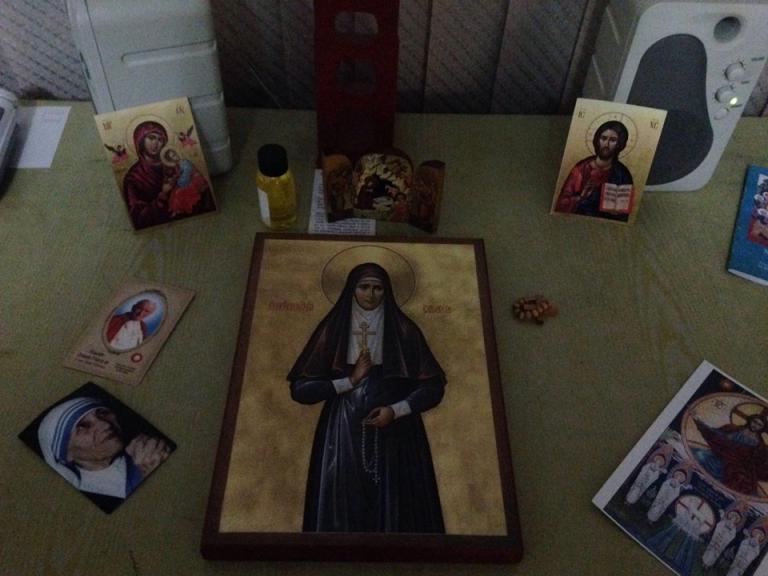
my makeshift icon corner in Richmond – photo by me
I depart from Richmond for Chicago today after a long and productive summer. I leave family and church behind, whom I will miss until my Winter Break beginning in December, but I also go to dear friends and a mission in Chicago that I have missed dearly as well.
I think this says something about the nature of my spiritual reflection over the summer, that it has been a good time to work on my heart so that I can actually do the labor to which I am called. I am, I finally accept, a Chinese Christian who has been made more fully so as a canonical lay person of the Greek-Catholic Church of Kyiv. As a result, everything I do is heart. It is how I was raised, and without it, I can do nothing. A colleague of mine told me that after having worked so hard at Northwestern, I should take some rest over the summer. I did, probably more than I should have, but I feel more than refreshed. I am alive.
I leave in our residence in Richmond the icon of the Holy New-Martyr Elizabeth the Merciful that Eugenia’s family gave me early on in the summer. It is a sign of the blessing that Eugenia and her family have been in our lives here as we continue to spend our lives here in the Pacific Northwest, at least part of the time, and more importantly, my distinct sense is that my growing sense of competence over the summer, a recovery from a long-term intellectual paralysis, can be attributed at least in some part to this icon having been in my office. Certainly, the latest reflections that I have begun on economia can somewhat be traced back to her presence in my life. Every day, I have opened the windows where she lies and have greeted her with a kiss; nightly, when I shut that same window, I venerate her again. Even though I said over the summer that I’d never be caught dead advocating for an outdated symphonia between imperium and sacerdotium except in the case of the Latin sex abuse crisis, no doubt she has still imparted to me her sense of quiet dignity, gracious compassion, and organizational capability. She is also a martyr saint. I seem to collect them. My patron saint is one of them too.
As I look over the makeshift icon corner that surrounds Holy Elizabeth, I am struck, after I get past the latinizations (it was not without a struggle that I became Greek Catholic, and they are evidence of my old flirtations with the Latin Church), at how much it reflects what I have been pondering as I have cantored at my home temple over the summer. Since my Cantonese friends’ chrismations on the Feast of Ss Peter and Paul, we have been using the Romanian melodies for ‘Lord, have mercy’ in our litanies, the one that cycles through five variations before repeating, as well as one from Univ Lavra, our monastery near Lviv. Lord, have mercy, my spiritual father once said, comprises about 83% of our liturgies. Here flanking this Orthodox new-martyr, as if by arrangement (it is not), are two new Latin saints, the Holy Bishop of Rome John Paul II and our Venerable Mother among the saints, Teresa of Calcutta. Both of them were known for their emphasis on the Lord’s mercy, and both of them definitely needed it too; suffice it to say that neither was perfect. In this, the universal witness of the apostolic churches is shown, that what it means to be Catholic at the end of the day is neither Latin nor Byzantine, but to locate oneself in the ocean of the Lord’s mercy.
Speaking of the ocean of mercy, I must share one anecdote that stands out to me over the summer. There was one night as I was perusing the stalls at the Richmond Night Market, a popular venue for street food and cheap goods, that I received some messages from my spiritual father. He wished to share with me some stories of pastoral wisdom that he had read about, and as my wifi flickered in and out, I managed to read them. The story that stood out the most was that of a conversion of someone who for one reason or another had rejected the Catholic faith. This person had written to his local bishop that he had renounced his faith, and the bishop speedily wrote back and said that if this person ever wished to reclaim it, they should write back. Years went by, and eventually this person somehow regained their faith and wrote to that bishop, who welcomed him with open arms.
I told my spiritual father that I liked the story. He asked me why, point blank. After all, I am a free person and am not obligated to like anything he sends me. I answered, slyly, that this narrative reminded me of the plot of Brideshead Revisited, a novel and television series that had more than one hand in bringing me into the Catholic fold. With a spoiler alert for those who have neither seen nor read it, I found that the testimony that my spiritual father shared with me was quite similar to the end of the story when Julia Flyte pushes her lover, the agnostic Charles Ryder, away. The context for this action is her watching her father, the unfaithful Lord Marchmain, convert to Catholicism on his deathbed. I cannot run from his mercy, she tells Charles. Inexplicably, in the epilogue, we learn that Charles also became Catholic. I too cannot run from the Lord’s mercy, I reflected as I wrote those words, as I could not forget the impact this scene had on my life even amidst the busy smells and sights of the night market.
Richmond has been a site of mercy for me over the summer, a place where I have gathered strength to return to Chicago, which for me is also a place in the merciful divine economy as I have experienced it. It is a mercy that my spiritual family stretches across these two places; it is merciful that the holy ones carry me on their shoulders in prayer as I move between them. Invoking the Lord’s mercy, we have managed to receive six people into the Greek-Catholic Church of Kyiv this year, by baptism, chrismation, and ascription. By his mercy, I realized that what I am doing on this blog has been nothing short of recording my own mystagogy, with practices that flow from the liturgy into the everyday work that I now understand requires more competence than ever. Through his mercy, I even go back to the Old Calendar, and the Virgin Theotokos of the Passion in my icon corner – that which the Redemptorists even in my own church call Our Lady of Perpetual Help – makes me realize that I am going back in sacred time to be the kleros at our mission on the Sunday Before the Exaltation of the Holy Cross. Again, I will celebrate the Universal Uplifting of the Holy and Life-Giving Cross of the Lord; in the Lord’s mercy, I will resolve to know nothing but Jesus Christ and him crucified.
It has been a good summer. I look forward to the labors of the next year as I fly off to do them, and I also await the time when I can come home, though the truth is that all of it is where I live because, as Julia Flyte reminds us at the end of Brideshead Revisited, I cannot run from his mercy.
Previous Post

September 21, 2018
Let It Sit
Next Post

September 23, 2018 Freud's throne room
Browse Our Archives
Select a Category Academia Anglican Communion anti-racism Aristotle Asia-Pacific Asian American Asian Canadian BlackLivesMatter Cantonese Catholic China Chinglican church politics Church-State Politics Civil Society Conservative Eastern Christianity Evangelical Evangelical Left Feminist/Womanist Theology Food Greek-Catholic Church of Kyiv Hong Kong Housekeeping Kyivan Church Latin Catholicism Law Liberal Liberation Theology New Calvinism Pentecostal/Charismatic Protestant Psychoanalysis Publics Religion Ethnicity Wired Secular Sovereignty TPCIU Uncategorized
Select a Month July 2019 June 2019 May 2019 April 2019 March 2019 February 2019 January 2019 December 2018 November 2018 October 2018 September 2018 August 2018 July 2018 June 2018 May 2018 March 2018 February 2018 January 2018 December 2017 November 2017 October 2017 September 2017 August 2017 July 2017 June 2017 April 2017 March 2017 February 2017 January 2017 December 2016 November 2016 October 2016 September 2016 August 2016 July 2016 January 2016 December 2015 November 2015 October 2015 August 2015 April 2015 March 2015 February 2015 December 2014 November 2014 September 2014 August 2014 July 2014 June 2014 May 2014 April 2014 March 2014 December 2013 November 2013 October 2013 September 2013 August 2013 July 2013 June 2013 May 2013 April 2013 March 2013 February 2013 January 2013 December 2012 October 2012 June 2012 May 2012 April 2012 February 2012 January 2012
Follow Us!
TAKE THE
Religious Wisdom Quiz
On which day did God create animals?
Select your answer to see how you score.
On the sixth day On the first day On the third day On the fourth day
Related posts from Eastern Catholic Person

I've found my way home: on the unraveling...

The Bay Area of the nineties is where...

This time, I have a tradition: on solidarity...

Patriyarkhat: 'Attending to the movements of my heart'
TRENDING AT PATHEOS Catholic

The Parable Of The Sower And The Word...
One of Christ’s most famous parables is that of the sower who...

Rejecting Doom: Christian Hope And Human Action
Christianity is a religion of hope. We are to have hope and...

Why I Choose the Eucharist Over the Sermon
Choose the Eucharist, Not the Sermon What are we supposed to get...

5 Design Elements Found in Spiritually Rooted Homes
Putting Spirituality Into Home Decor Our homes are more than our living...

Credo: A Story of God Told with the...
About 10 years ago, I began to imagine a personal "Credo" that...

The Anatomy of Divine Revelation in Catholic Thought
The claim that God has made Himself known to human beings is...
view all Catholic blogs
Ad-Free & Subscriber Log-In Subscription Support
- About Us
- 2026 Calendar
- Videos
- Podcasts
- Library of World Religions
- Faith In Media Tracker
- Advertise With Us
- Write for Us
- Privacy Policy
- Terms of Service
- Do Not Sell My Data
- Contact Us
- Radiant Digital
- Manage Newsletter Subscriptions
- Unsubscribe From Notifications
- Sitemap
Copyright 2008-2026, Patheos. All rights reserved.
Subscription Support Ad-Free & Subscriber Log-In
Follow Patheos