
BuddhistCatholicContemplativeEvangelicalGeneral ChristianHinduJewishLatter-day SaintMuslimNew VisionsProgressive Christian
Beliefs
- Buddhist
- Catholic
- Contemplative
- Evangelical
- General Christian
- Hindu
- Jewish
- Latter-day Saint
- More Voices
- Muslim
- New Visions
- Pagan
- Progressive Christian
Topics
- Religion News
- Food and Religion
- Sports and Religion
- Religious Art
- Religious Music and Entertainment
- Religious Events
- History and Religion
- Style and Religion
- Politics and Religion
- Women in Religion
- Recreation Outdoors and Religion
- Business Finance and Religion
- Careers Workplace and Religion
- Education and Religion
- Family Parenting and Religion
- Health Fitness and Religion
- Home and Religion
- Relationships and Religion
- Technology and Religion
- Travel and Religion
Columnists
- Buddhist Columnists
- Business Finance and Religion Columnists
- Careers Workplace and Religion Columnists
- Catholic Columnists
- Contemplative Columnists
- Education and Religion Columnists
- Evangelists Columnists
- Family Parenting and Religion Columnists
- General Christian Columnists
- Health Fitness and Religion Columnists
- Hindu Columnists
- History and Religion Columnists
- Home and Religion Columnists
- Jewish Columnists
- More Voices Columnists
- Latter Day Columnists
- Muslim Columnists
- New Visions Columnists
- Nonreligious Columnists
- Pagan Columnists
- Politics and Religion Columnists
- Progressive Columnists
- Recreation Outdoors and Religion Columnists
- Relationships and Religion Columnists
- Religion News Columnists
- Religious Art Columnists
- Religious Events Columnists
- Religious Music and Entertainment Columnists
- Sports and Religion Columnists
- Style and Religion Columnists
- Technology and Religion Columnists
- Travel and Religion Columnists
- Women in Religion Columnists
Resource Library
- 2026 Calendar
- Library of World Religions
- The 100 Most Holy Places on Earth
- Patheos Answers
- Podcasts
- Videos
- Faith Leaders Database
- Anglican Episcopalian
- Bahai
- Baptist
- Buddhism
- Christianity
- Confucianism
- Eastern Orthodoxy
- Hinduism
- Holiness and Pentecostal
- ISKCON
- Islam
- Judaism
- Lutheran
- Methodist
- The Church of Jesus Christ of Latter-day Saints
- New Age
- Paganism
- Presbytarian and Reformed
- Protestantism
- Religion Behind the Scenes
- Roman Catholic
- Scientology
- Shia Islam
- Sikhism
- Sufism
- Sunni Islam
- Taoism
- Zen
- See all religions
Research Tools
 Ad-Free & Subscriber Log-In Subscription Support
Ad-Free & Subscriber Log-In Subscription Support
Follow Patheos 

- Trending:
- Forgiveness
- |
- Marriage
- |
- Consciousness
- |
- Death Penalty
- |
- Election
- |
- Halloween
 Eastern Catholic Person
- Home
- Catholic
- The depression of men of letters
The depression of men of letters
Last updated on: September 20, 2018 at 10:00 am by Justin Tse
The depression of men of letters 2018-09-20T10:00:21-07:00 Justin Tse
Patheos Explore the world's faith through different perspectives on religion and spirituality! Patheos has the views of the prevalent religions and spiritualities of the world.

photo from Pixabay
When I was about seven years old, I sat with my grandfather as he drank his daily mug of tea. He was a great storyteller, and from him, I learned the basic form of what I do in my career studying Chinese Americans today. He told me the tales of the Four Great Novels, especially the travels of the Monkey, Sun Wukong, and his sidekicks in Journey to the West, but also enough of The Three Kingdoms for me not to be an idiot in terms of military strategy. We played Chinese chess together, and he was very good at it, often winning by stripping my pieces bare before checkmating me. He also had stories of his time as a landowner in Shanghai, and he spoke of the heartbreak that came with Japanese fascism and Chinese communism as his family was reduced to nothing. In this way, I learned the basic contours of modern Chinese history, along with its mythologies, from him as he drank his tea. I recall that the tea he drank is now my favourite kind too, the one that the white people know as lapsang souchong and that was supposed to be smoky like the cigarettes that he chain-smoked, except his was of a more refined kind. My mother-in-law has now given me a sample she acquired in China, and when I steeped it, all the memories of my grandfather, who reposed when I was eleven, came back to me.
As we sat at the table, my grandfather would pull out a small, metal pillbox. In it were two green pills, and he would take them as his tea cooled. I knew at that point that adults took medicines that they just swallowed, unlike the syrups that I drank when I got sick. I asked him one day what he took them for, and he said that it was to make him feel better. I wondered which part of his body was feeling so bad, and I named many of the typical symptoms I had as a kid. Was it a sore throat? An ear infection? A fever? He said no to all of them, and then reluctantly admitted that he often felt sad and that the pills made him feel better. It sounded ludicrous to me, and I thought my grandfather was pulling my leg again. It sounded like the medicines in his stories, the kind from the gods that worked like magic if you took them. Maybe grandpa felt sad, but that his magical medicines made him feel happy was too far-fetched for me to believe.
Now, of course, I know much better what clinical depression is because I have seen it among my colleagues, students, friends, and even close family. I know what medications are for, and though I am not on them, I am no longer persuaded that they are magical, but just that they work in the management of symptoms. I reflect on this now because as I prepare to go back to teach another year in Chicago, I am deeply aware that the academy is a place where we have to speak of mental health openly. Often, I have resisted because if I were to talk about it in explicit terms, my entire life story would have to be explicated, and misunderstanding my reticence, some people have perhaps even thought of me as insensitive, perhaps ableist, as I sometimes show my hand that I am not in favour of a purely pharmacological approach to mental challenges. But as I ponder my own family history, I feel compelled to write a few words on it in the hope that my thinking on this will be more clear, especially for me. I am driven especially to write this piece as I go back to teach Asian American studies because it is often the stereotype that ‘Asian families,’ whoever those are, are seen as inept when caring about mental health. I suppose the same could be said for some aspects of my family, but I do not think we were as unaware of it as some might think, and the proof is my grandfather’s green pills. I knew what anti-depressants were because my beloved grandfather was clinically depressed enough to get prescriptions for them.
Of the men in my family background to whom I am the most compared by those who know me, I would say the most that resemble me in description are the man who fathered my grandmother and then the one she married. Both fled from the communists because they were seen as landowners, but the truth is that they were men of letters. The unconscious does not lie. My grandmother, a woman whose competence is so renowned in the world of Methodist schools in Hong Kong that those who discover I am her grandchild often tip their hat in respect to me (not that I have anything to do with it), managed to find in a young man from Shanghai who didn’t speak a lick of Cantonese though he was a refugee living in Hong Kong the same qualities that had defined her own father from Guangzhou, the real home of urban Cantonese on the mainland. Both men were into calligraphy, both spent their hours working on their writing, both were excoriated for their incompetent organizational skills, both tried to make their way through a merchant world of commodities and failed miserably, both were said to have trouble living in the real world. My great-grandfather – my grandma’s father – had a store in Peru, which is why he was able to offer my grandmother cheese when she was growing up. But he was also generous to a fault and lent out so much of his money that he went bankrupt and had to move in with his children, especially after what was left was taken away by the communists and he had to flee to Hong Kong. When he died, all his debtors came and paid back the family, earning them a fortune. They did not want his ghost to haunt them for bankrupting him.
My grandfather was the same way. Raised in the modern world of urban Shanghai as a young aristocrat, he found himself ill-equipped for the ordinary working day in Hong Kong. He entered a corporate financial institution at an entry level because a family member was the head of the local branch. All he got from that job was the advice to look busy by chain-smoking cigarettes while not actually doing any work. For forty years, he sat at the same desk, never being promoted. He had trusted the wrong people, and they – even his own family members – had screwed him.
The thing that worries my family members the most about me is whenever I get into one of my moods, as they put it. When I am in the zone, I can concentrate, shut the world out, write like a maniac, and pretend that nothing else exists. Since I was a kid, they never liked that kind of thing because they were concerned that I did not live in the real world, that mine was a universe unto myself just like my grandfather and my great-grandfather. Attempting to prevent me from getting into those zones, they tried – and very successfully did – to give me a sense of routine structure in my life, to do chores and fill out paperwork, to be part of everyday human society. I appreciated this very much, and I still do, because it has made me into a functional human being. Indeed, one of the tried and true ways to get out of and to prevent depressive episodes is to have a strict routine, and in general, it works for me too.
However, to say that being in the zone was itself a symptom of depression was also a misdiagnosis, I’d argue. Here, I project a little onto my great-grandfather and my grandfather, and I’d suggest that that was not the cause of their depression either. My immediate family thinks of themselves as rescuing me from one of their moods – the ones that belonged to my ancestors – where they’d just sit and stare into space in blank desolation with no one being able to pull them out of their paralysis. I too in recent years have had those crippling spells, and before that, I would also have long sessions as an evangelical of what I called prayer where I stayed in my room, didn’t eat or sleep, and would just cry out to God in anguished praise. While I have never been clinically diagnosed – and I am feeling relatively fine enough to write this post, so I think I will be able to survive with my routine and good coffee for now – the thought has occurred to me that my ancestors passed on more than a love of letters to me. Maybe they gave me their depressive tendencies too. You are getting negative again, some of my family members occasionally say to me as a kind of warning. I am not sure that positive-thinking is the way out, though. It certainly has never worked for me because I hate lying to myself.
But depression in this sense, I would argue, is not just clinical. What motivates me and my ancestors before me is precisely that love of letters. To craft the word, we need space in solitude. The zone is a necessary place, a safe space, if you will, where the work that we must do is done. To those whose work is not in the measuring of prose and poetry, all of this can sound obscure and a little elitist, which I suppose is why the communists had it out for both of these men too. But bourgeois conventions are the real site of death for us, as the onset of depression for both of these men, and I realize for me too when I feel boxed in, is when we begin to feel guilty about making that space for ourselves to work. Our work, our productivity, our craft are all in that zone. Take it away from us, or at least call into question the reality of its existence, and our world falls apart. When I got married, I was told by some people inexperienced with my craft that I would not have access to that space again. It was very bad advice, and all I will say about that with some years behind me as I have struggled through the maze of academia is that I will never again take the advice of people who do not write for a living as applicable to my own life. They will never get it because writing is not what they do.
I think now of the advice we receive in the academy, that we need to be ruthless with our time, that we need to guard our time selfishly, that we need to make time to write. I used to resent it when I understood it in bourgeois terms, that my instructions were to hunker down and produce like a capitalist cog in the neoliberal academy, and truth be told, intellectual work is in large part conversational too, and I cannot do it without a sense of social life. But I understand now that the wisdom of the academy, despite all of its many problems and incompetencies and propensities to sell out to ideological fashionability, is to say that that zone that my great-grandfather and grandfather craved and were depressed over when they were denied access to it is the very space that I need to guard as an academic. I stand on their shoulders as a young scholar, jealously guarding what was taken away from them because the three of us, across our many generations, really think of what happens in that place as the real work of our lives – the crafting of letters, the revision of their arrangement, the measuring out of their prose, the setting of them to poetic music. Therein lies the real pain of our craft. It does not lie in the work itself. It is in having to fend off those who don’t understand this world from imposing themselves onto it with all their good intentions.
One may then protest that this space is still not the real world. I reject this premise. Deny this world, and we fall into depression, even clinically so in a diagnosed way, as my grandfather attested to with his green pills. In his final days, he resented the repression so much that he stopped taking his medications and famously went out in a manic spree and cut flowers from a neighbour’s front lawn just because he thought they were pretty and he wanted to take them home. This act freaked the whole family out, and they thought he was acting out of as a kind of mischievous inner child. I know better, though, because I think I understand his inner world, the one that was repeatedly told to him was not real with all of its stories and experiences and wisdom bursting, as we say in Asian American studies, with the telling. Cutting the flowers was his way of reclaiming the space; the colon cancer that shortly followed was him giving up on life. Now his picture hangs in my icon corner, for as he lay dying, he affirmed the faith when we asked him about it with a squeeze of his hand. I pray for him daily, and I wonder if he is with me because shortly after he died, I who had struggle with the art of whistling a tune was able to whistle like a pro. My grandfather is the whistler in the family, though, and I wonder if this was his last gift to me. In turn, I also ask him to pray for me.
For us, organization flows out of this sense of a world put right. Routines, paperwork, house chores, and institutional administration are possible for us, but they become the famous impossible tasks that are symptomatic of a depressive episode when the world in which our real work is done is negated. No one but ourselves can give us advice about how to manage this kind of world. For myself, I have sought therapies, liturgies, and spiritual direction to no avail, until the Lord provided a spiritual father who asked me to attend to my own feelings, to sit with them, to pray with them. I wrote about a week ago that I am coming out of a paralytic spell in my intellectual work, and the truth is that if anything was the greatest contribution to my paralysis, it was the inner voice that I had internalized telling me that my world of writing was not real. It is also all I do. My career, vocation, practice, work, and whatever you want to call it is based on that. Sam Rocha once said I was a geometer before I was a geographer, and he is more right than he will ever know. The work of words precedes the works of mapping; the crafting of prose takes precedence in my career before the putting of everything into its organizational place. I cannot hold myself to bourgeois expectations; the academy is not supposed to be a middle-class institution. It is at the same time elitist and working-class, where theology and Marx coincide, where the frantic labor of production takes place in a cocoon of peace.
This was a Chinese depression story. It is the story of how the ideological shifts of modern Chinese history ruined the worlds of writing that were the bread and butter of my ancestors’ craft, and it is the narrative of how I too almost fell prey to the same form of death. Writers are not a bourgeois people. We are not engaged in the sciences of buying and selling, of valuing and exchanging. We have a different sense of economia where words have meaning and maps tell the story of the real, and that is the world that must be jealously guarded. It is the world of which we must speak and write the truth. We cannot snap out of it, or else we will die a slow and painful death – in the literal sense, as the deceased bodies of my ancestors can attest. I, for one, am grateful to be alive despite all the busyness of this start of term, because I do the work my body knows to be real, and those works involve building a world with words that in and of itself the real world because the prose of my language gives literate shape to realities that are felt and must be voiced.

Next Post

September 21, 2018 Let It Sit
Browse Our Archives
Select a Category Academia Anglican Communion anti-racism Aristotle Asia-Pacific Asian American Asian Canadian BlackLivesMatter Cantonese Catholic China Chinglican church politics Church-State Politics Civil Society Conservative Eastern Christianity Evangelical Evangelical Left Feminist/Womanist Theology Food Greek-Catholic Church of Kyiv Hong Kong Housekeeping Kyivan Church Latin Catholicism Law Liberal Liberation Theology New Calvinism Pentecostal/Charismatic Protestant Psychoanalysis Publics Religion Ethnicity Wired Secular Sovereignty TPCIU Uncategorized
Select a Month July 2019 June 2019 May 2019 April 2019 March 2019 February 2019 January 2019 December 2018 November 2018 October 2018 September 2018 August 2018 July 2018 June 2018 May 2018 March 2018 February 2018 January 2018 December 2017 November 2017 October 2017 September 2017 August 2017 July 2017 June 2017 April 2017 March 2017 February 2017 January 2017 December 2016 November 2016 October 2016 September 2016 August 2016 July 2016 January 2016 December 2015 November 2015 October 2015 August 2015 April 2015 March 2015 February 2015 December 2014 November 2014 September 2014 August 2014 July 2014 June 2014 May 2014 April 2014 March 2014 December 2013 November 2013 October 2013 September 2013 August 2013 July 2013 June 2013 May 2013 April 2013 March 2013 February 2013 January 2013 December 2012 October 2012 June 2012 May 2012 April 2012 February 2012 January 2012
Follow Us!
TAKE THE
Religious Wisdom Quiz
What was the result of Jesus meeting the Gerasene demoniac?
Select your answer to see how you score.
Demons cast into pigs Bread multiplied A storm calmed A man healed of leprosy
Related posts from Eastern Catholic Person

This time, I have a tradition: on solidarity...
Betrayal is not redemptive: for Great and Holy...
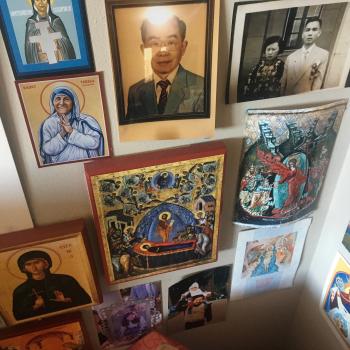
The death of a grandfather: on the raising...
The death of the father: for Forgiveness Sunday
TRENDING AT PATHEOS Catholic

Creation, Preservation, and Teleology in Catholic Theology
As I write this, it is very early Monday morning. Like millions...

The Parable Of The Sower And The Word...
One of Christ’s most famous parables is that of the sower who...

Rejecting Doom: Christian Hope And Human Action
Christianity is a religion of hope. We are to have hope and...

Why I Choose the Eucharist Over the Sermon
Choose the Eucharist, Not the Sermon What are we supposed to get...

5 Design Elements Found in Spiritually Rooted Homes
Putting Spirituality Into Home Decor Our homes are more than our living...

Credo: A Story of God Told with the...
About 10 years ago, I began to imagine a personal "Credo" that...
view all Catholic blogs
Ad-Free & Subscriber Log-In Subscription Support
- About Us
- 2026 Calendar
- Videos
- Podcasts
- Library of World Religions
- Faith In Media Tracker
- Advertise With Us
- Write for Us
- Privacy Policy
- Terms of Service
- Do Not Sell My Data
- Contact Us
- Radiant Digital
- Manage Newsletter Subscriptions
- Unsubscribe From Notifications
- Sitemap
Copyright 2008-2026, Patheos. All rights reserved.
Subscription Support Ad-Free & Subscriber Log-In
Follow Patheos