
BuddhistCatholicContemplativeEvangelicalGeneral ChristianHinduJewishLatter-day SaintMuslimNew VisionsProgressive Christian
Beliefs
- Buddhist
- Catholic
- Contemplative
- Evangelical
- General Christian
- Hindu
- Jewish
- Latter-day Saint
- More Voices
- Muslim
- New Visions
- Pagan
- Progressive Christian
Topics
- Religion News
- Food and Religion
- Sports and Religion
- Religious Art
- Religious Music and Entertainment
- Religious Events
- History and Religion
- Style and Religion
- Politics and Religion
- Women in Religion
- Recreation Outdoors and Religion
- Business Finance and Religion
- Careers Workplace and Religion
- Education and Religion
- Family Parenting and Religion
- Health Fitness and Religion
- Home and Religion
- Relationships and Religion
- Technology and Religion
- Travel and Religion
Columnists
- Buddhist Columnists
- Business Finance and Religion Columnists
- Careers Workplace and Religion Columnists
- Catholic Columnists
- Contemplative Columnists
- Education and Religion Columnists
- Evangelists Columnists
- Family Parenting and Religion Columnists
- General Christian Columnists
- Health Fitness and Religion Columnists
- Hindu Columnists
- History and Religion Columnists
- Home and Religion Columnists
- Jewish Columnists
- More Voices Columnists
- Latter Day Columnists
- Muslim Columnists
- New Visions Columnists
- Nonreligious Columnists
- Pagan Columnists
- Politics and Religion Columnists
- Progressive Columnists
- Recreation Outdoors and Religion Columnists
- Relationships and Religion Columnists
- Religion News Columnists
- Religious Art Columnists
- Religious Events Columnists
- Religious Music and Entertainment Columnists
- Sports and Religion Columnists
- Style and Religion Columnists
- Technology and Religion Columnists
- Travel and Religion Columnists
- Women in Religion Columnists
Resource Library
- 2026 Calendar
- Library of World Religions
- The 100 Most Holy Places on Earth
- Patheos Answers
- Podcasts
- Videos
- Faith Leaders Database
- Anglican Episcopalian
- Bahai
- Baptist
- Buddhism
- Christianity
- Confucianism
- Eastern Orthodoxy
- Hinduism
- Holiness and Pentecostal
- ISKCON
- Islam
- Judaism
- Lutheran
- Methodist
- The Church of Jesus Christ of Latter-day Saints
- New Age
- Paganism
- Presbytarian and Reformed
- Protestantism
- Religion Behind the Scenes
- Roman Catholic
- Scientology
- Shia Islam
- Sikhism
- Sufism
- Sunni Islam
- Taoism
- Zen
- See all religions
Research Tools
 Ad-Free & Subscriber Log-In Subscription Support
Ad-Free & Subscriber Log-In Subscription Support
Follow Patheos 

- Trending:
- Forgiveness
- |
- Marriage
- |
- Consciousness
- |
- Death Penalty
- |
- Election
- |
- Halloween
 Eastern Catholic Person
- Home
- Catholic
- Shu, awaremeyo: reflections on Paul-san’s reception and the baptism of his son
Shu, awaremeyo: reflections on Paul-san’s reception and the baptism of his son
Last updated on: September 15, 2018 at 11:22 am by Justin Tse
Shu, awaremeyo: reflections on Paul-san’s reception and the baptism of his son 2018-09-15T11:22:08-07:00 Justin Tse
Patheos Explore the world's faith through different perspectives on religion and spirituality! Patheos has the views of the prevalent religions and spiritualities of the world.
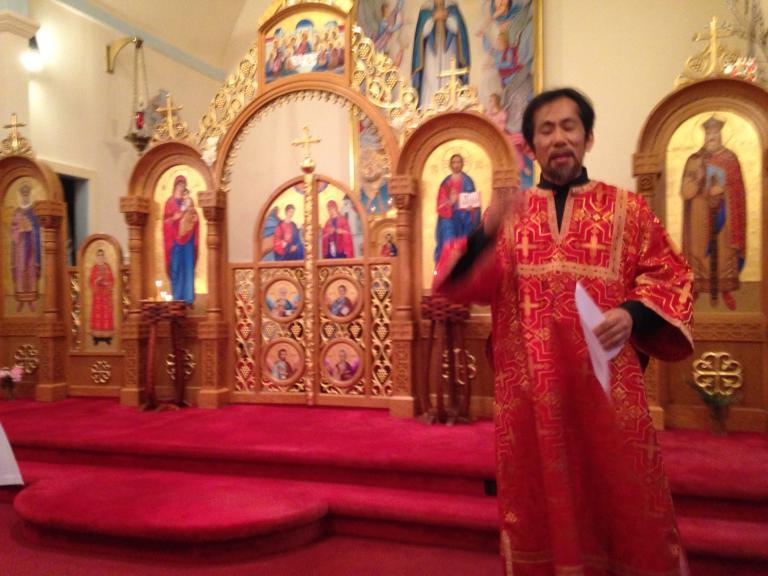
Paul-san – photo by me, used with his permission
In this time of the postfeast of the Universal Exaltation of the Holy and Life-Giving Cross, I would like to reflect on the reception of a brother of mine in the Lord whom I shall call Paul-san into our Eastern Catholic Church, together with the baptism of his youngest son. Paul-san and his family are from Hokkaido Prefecture in Japan, and they came to our temple in the middle of August. Paul-san was already a Catholic in the Latin Church; his son, however, had not yet been baptized. We received Paul-san by ascription, acknowledging that he was already in full communion with us but now has decided to live under our canons and discipline and share in the life of our church in a direct way. Then we baptized his son, chrismated him, and shared communion with him.
I had the great honour of serving as the cantor for both services, the reception by ascription and the baptism, and I had a fantastic kleros to work with. As is the custom of our Byzantine churches, we try to have the liturgy in the vernacular language of the places where we are situated. Paul-san and his family spoke Japanese. Because of this, we did the easiest possible adjustment to our liturgical practices that we could: we changed all the Lord, have mercy responses, which make up the bulk of all of our liturgies anyway, to Shu, awaremeyo. We also learned the Trisagion in Japanese, and Paul-san did the Apostol readings too.
Paul-san is also a theology professor in Japan, so we asked him to share about why he took the step that he did. He has, after all, always been in communion with us, so we were curious as to what becoming Eastern Catholic from the Latin Church meant for him. I think he also wanted us to relate to him, so he began in his reflections with the Japanese Empire – or rather, the Greater East Asian Co-Prosperity Sphere – in the early twentieth century. He said that that was a time in Japan when violence was celebrated, and Japan was basically at war throughout Asia.
But after the war, things changed. The ninth article of the new Japanese constitution, he pointed out, has two points:
(1) Aspiring sincerely to an international peace based on justice and order, the Japanese people forever renounce war as a sovereign right of the nation and the threat or use of force as means of settling international disputes.(2) In order to accomplish the aim of the preceding paragraph, land, sea, and air forces, as well as other war potential, will never be maintained. The right of belligerency of the state will not be recognized.
Realizing that war causes so much suffering, Japan renounced its imperial ends, he said. Of course, as others at the temple pointed out to me later on, Paul-san’s reflections demonstrated his radical political stance in a contemporary age of Japanese nationalist revival, and indeed, an age of neo-authoritarian romance throughout the world. I am sure Paul-san knows how radical he is in his context, and the beauty of it is that, even without him having to tell us, we understand the risk of his claims. After all, he was doing theology. Those of us who were there understood that the Japanese did not give up war just because they wanted to – this was a concession to an emerging liberal international order being headed by the United States and in contest with the Soviet Union. We also know something of international news, and we know that Japanese nationalism both then and now is not exactly peaceful. By putting together the information we know and what Paul-san was telling us, we know that Paul-san’s reflections are deeply Christian, that it is as a Christian that Paul-san himself says that war is evil and that it should be renounced by the nation.
These reflections by Paul-san are a gift to our church. My spiritual father pointed out recently at my Chinese friend Faith’s chrismation that just as her entry into the church was a fulfillment of the prayers of the Syriac missionaries like Alopen and the Jesuits who came much later, Paul-san’s reception and the involvement of his entire family in our church is the answer to the faithfulness of those that became known as the hidden Christians in Japan, the ones who went deeply into hiding after being persecuted by the shogunate. Certainly, with the popularization of Endō’s Silenceby Martin Scorsese, we are well aware of these stories of persecution and the pain that that experience wrought on the Body of Christ throughout the world. But now Paul-san and his family are in our church in an open way, and in that openness, they still maintain the spirituality of Christian critique toward the acts of imperial violence. Like Faith bringing her experience of the Chinese church of martyrs into this church of martyrs that is the Kyivan Church, Paul-san brings the spirituality of the Japanese church into our liturgical gathering, calling us to be critical of the violent acts of empire because it is inflicted on human bodies that are the very icons of Christ.
Are not these reflections so appropriate as we contemplate the True Cross that St Helena found in Jerusalem and that was exalted in Constantinople every year until its fall? It was in that sign – the sign of the holy cross – that Constantine conquered and established Christianity as the imperial religion. The cross, once the sign of imperial violence against those who opposed it, became the sign of empire itself. And yet, as we sit with the echo of the postfeast of the cross’s uplifting today, are not the empires that signed themselves with the sign of the cross broken? Even those nation-states that we criticize as imperialistic today are just playing at empire, with bourgeois figures as dictatorial leaders whose propaganda is only convincing if you consciously let down all your critical faculties and embrace a cynical approach to life. The cross has indeed conquered, for the empires that claimed it in conquest have been negated from within.
In this sense, the cross is the merciful negation given to us ordinary Christians who have to live in a world of national regimes playing at imperialist fantasy. Paul-san has offered his experience of the nation to our church as a sign of this subversion, that as Christians, we do renounce the evil one and spit on him because ours is the way of crucifixion, of dying with Christ that we may rise with him. With Paul-san and his family, we continue to sing, Shu, awaremeyo, because these supernatural insights can only be seen with the eyes of the Spirit by which we are received into the gathering of the holy ones who mystically represent the cherubim in liturgical action.
Browse Our Archives
Select a Category Academia Anglican Communion anti-racism Aristotle Asia-Pacific Asian American Asian Canadian BlackLivesMatter Cantonese Catholic China Chinglican church politics Church-State Politics Civil Society Conservative Eastern Christianity Evangelical Evangelical Left Feminist/Womanist Theology Food Greek-Catholic Church of Kyiv Hong Kong Housekeeping Kyivan Church Latin Catholicism Law Liberal Liberation Theology New Calvinism Pentecostal/Charismatic Protestant Psychoanalysis Publics Religion Ethnicity Wired Secular Sovereignty TPCIU Uncategorized
Select a Month July 2019 June 2019 May 2019 April 2019 March 2019 February 2019 January 2019 December 2018 November 2018 October 2018 September 2018 August 2018 July 2018 June 2018 May 2018 March 2018 February 2018 January 2018 December 2017 November 2017 October 2017 September 2017 August 2017 July 2017 June 2017 April 2017 March 2017 February 2017 January 2017 December 2016 November 2016 October 2016 September 2016 August 2016 July 2016 January 2016 December 2015 November 2015 October 2015 August 2015 April 2015 March 2015 February 2015 December 2014 November 2014 September 2014 August 2014 July 2014 June 2014 May 2014 April 2014 March 2014 December 2013 November 2013 October 2013 September 2013 August 2013 July 2013 June 2013 May 2013 April 2013 March 2013 February 2013 January 2013 December 2012 October 2012 June 2012 May 2012 April 2012 February 2012 January 2012
Follow Us!
TAKE THE
Religious Wisdom Quiz
Who was lowered through a roof to be healed by Jesus?
Select your answer to see how you score.
Jairus' daughter A blind man A leper A paralyzed man
Related posts from Eastern Catholic Person

I've found my way home: on the unraveling...

Patriyarkhat: 'Attending to the movements of my heart'

I'm flattered to be named an Asian American...

The secular does not stop when your drive...
TRENDING AT PATHEOS Catholic

Creation, Preservation, and Teleology in Catholic Theology
As I write this, it is very early Monday morning. Like millions...

The Parable Of The Sower And The Word...
One of Christ’s most famous parables is that of the sower who...

Rejecting Doom: Christian Hope And Human Action
Christianity is a religion of hope. We are to have hope and...

Why I Choose the Eucharist Over the Sermon
Choose the Eucharist, Not the Sermon What are we supposed to get...

5 Design Elements Found in Spiritually Rooted Homes
Putting Spirituality Into Home Decor Our homes are more than our living...

Credo: A Story of God Told with the...
About 10 years ago, I began to imagine a personal "Credo" that...
view all Catholic blogs
Ad-Free & Subscriber Log-In Subscription Support
- About Us
- 2026 Calendar
- Videos
- Podcasts
- Library of World Religions
- Faith In Media Tracker
- Advertise With Us
- Write for Us
- Privacy Policy
- Terms of Service
- Do Not Sell My Data
- Contact Us
- Radiant Digital
- Manage Newsletter Subscriptions
- Unsubscribe From Notifications
- Sitemap
Copyright 2008-2026, Patheos. All rights reserved.
Subscription Support Ad-Free & Subscriber Log-In
Follow Patheos