
BuddhistCatholicContemplativeEvangelicalGeneral ChristianHinduJewishLatter-day SaintMuslimNew VisionsProgressive Christian
Beliefs
- Buddhist
- Catholic
- Contemplative
- Evangelical
- General Christian
- Hindu
- Jewish
- Latter-day Saint
- More Voices
- Muslim
- New Visions
- Pagan
- Progressive Christian
Topics
- Religion News
- Food and Religion
- Sports and Religion
- Religious Art
- Religious Music and Entertainment
- Religious Events
- History and Religion
- Style and Religion
- Politics and Religion
- Women in Religion
- Recreation Outdoors and Religion
- Business Finance and Religion
- Careers Workplace and Religion
- Education and Religion
- Family Parenting and Religion
- Health Fitness and Religion
- Home and Religion
- Relationships and Religion
- Technology and Religion
- Travel and Religion
Columnists
- Buddhist Columnists
- Business Finance and Religion Columnists
- Careers Workplace and Religion Columnists
- Catholic Columnists
- Contemplative Columnists
- Education and Religion Columnists
- Evangelists Columnists
- Family Parenting and Religion Columnists
- General Christian Columnists
- Health Fitness and Religion Columnists
- Hindu Columnists
- History and Religion Columnists
- Home and Religion Columnists
- Jewish Columnists
- More Voices Columnists
- Latter Day Columnists
- Muslim Columnists
- New Visions Columnists
- Nonreligious Columnists
- Pagan Columnists
- Politics and Religion Columnists
- Progressive Columnists
- Recreation Outdoors and Religion Columnists
- Relationships and Religion Columnists
- Religion News Columnists
- Religious Art Columnists
- Religious Events Columnists
- Religious Music and Entertainment Columnists
- Sports and Religion Columnists
- Style and Religion Columnists
- Technology and Religion Columnists
- Travel and Religion Columnists
- Women in Religion Columnists
Resource Library
- 2026 Calendar
- Library of World Religions
- The 100 Most Holy Places on Earth
- Patheos Answers
- Podcasts
- Videos
- Faith Leaders Database
- Anglican Episcopalian
- Bahai
- Baptist
- Buddhism
- Christianity
- Confucianism
- Eastern Orthodoxy
- Hinduism
- Holiness and Pentecostal
- ISKCON
- Islam
- Judaism
- Lutheran
- Methodist
- The Church of Jesus Christ of Latter-day Saints
- New Age
- Paganism
- Presbytarian and Reformed
- Protestantism
- Religion Behind the Scenes
- Roman Catholic
- Scientology
- Shia Islam
- Sikhism
- Sufism
- Sunni Islam
- Taoism
- Zen
- See all religions
Research Tools
 Ad-Free & Subscriber Log-In Subscription Support
Ad-Free & Subscriber Log-In Subscription Support
Follow Patheos 

- Trending:
- Forgiveness
- |
- Marriage
- |
- Consciousness
- |
- Death Penalty
- |
- Election
- |
- Halloween
 Eastern Catholic Person
- Home
- Catholic
- ‘Call no man father’: daddy issues and the church
‘Call no man father’: daddy issues and the church
Last updated on: July 26, 2018 at 7:49 am by Justin Tse
‘Call no man father’: daddy issues and the church 2018-07-26T07:49:37-07:00 Justin Tse
Patheos Explore the world's faith through different perspectives on religion and spirituality! Patheos has the views of the prevalent religions and spiritualities of the world.
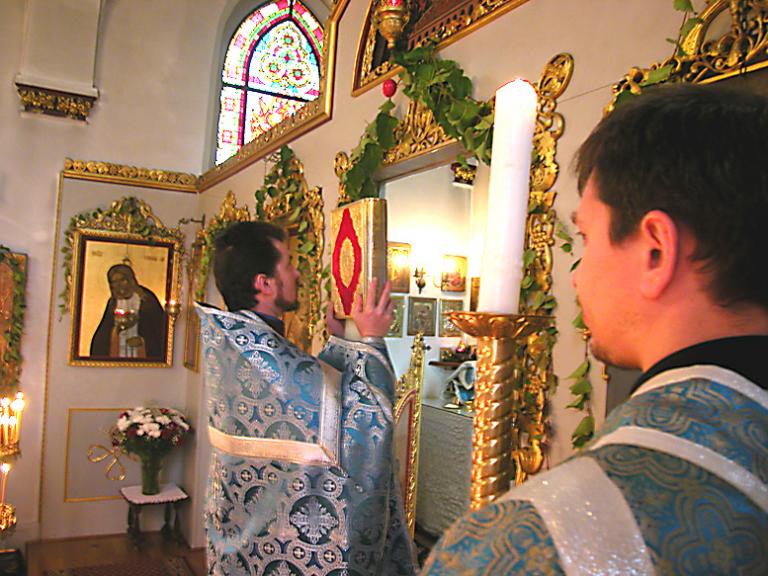
Little Entrance, Liturgy in orthodox church – Velopilger, Duesseldorf 21 September 2009, Public Domain, via Wikimedia Commons
It is occasionally offensive to me, when I am in a Big Mood state, to hear evangelicals reduce my conversion to Eastern Catholicism to some kind of insecure need for authority. The story goes that the world is a place of great uncertainty. Young people, like myself – or even older folks, like in Ed Stetzer’s explanation of Hank Hannegraaff’s reception into Greek Orthodoxy – are therefore craving some kind of certainty about the great life questions. Evangelicalism, with its looseness of structure, cannot provide people with such cravings with the security they desire. The explanation is that people like us therefore ‘get high’ with Catholicism or Orthodoxy (or both, in my case).
The problem with this explanation is that evangelicals use this trope about the crisis of authority to explain literally everything. I am not young enough to have forgotten that the New Calvinism of Mark Driscoll and John Piper was explained by young men looking for real answers to their life questions in a postmodern world, and I am not enough of a hermit to not know that they are also currently said to flock to Jordan Peterson for the same thing now. I am also not bad enough of a scholar to have not come across the Harold Ockenga speech that is said to have coined evangelicalism as a bastion of propositional truth in a nihilistic world, and I am familiar enough with Francis Schaeffer’s How Should We Then Live? to understand that the evangelical project exists to critique nihilism while providing explanations of The Truth in a world scarred by nothingness.
It’s not that there isn’t any evidence to support this claim relating conversion and authority. The Catholic and Orthodox worlds seem to have been thrown into confusion recently by evangelical converts whose basic impulse is described by the philosopher Charles Taylor as ‘the urge to Reform.’ Taylor’s explanation helpfully exposes, I think, the institutionalized tendency in evangelicalism that has its roots across Christian communions. His basic idea is that there are two ways to practice a religion. In the first and probably more ancient way, there were safety valves built into ecclesial praxis that let people get their inner crazy out: carnivals, a division between sacred and ordinary time, people in society operating at different ‘speeds’ of spiritual intensity coexisting together. With a modern mindset came a new development – for Taylor in the Latin Church, but also arguably in Orthodoxy as well (as he also indicates in a forum on his A Secular Age in the journal Modern Theology) – that he calls a Reform tendency. In this second mode, it is unacceptable for there to be a co-existence of spiritual speeds in Christianity. You were either all in or all out. Taylor sees this impulse operating from around the tenth to the sixteenth centuries, beginning with the papal revolutions in the Latin Church and evolving into the Protestant Reformation, the Catholic Counter-Reformation, and the setting up of Calvinist city-states. The idea is that the church became conceptualized as a religious institution that should bring about a kind of spiritual efficiency, engineering its members toward greater intensities of spiritual fullness. The irony, Taylor points out, is that this drive for simplification led to the evolution of the church toward a kind of bureaucratic modality that sowed the seeds for secularization. After all, if we can engineer spiritual experience ourselves, who really needs God?
The insight of psychoanalysis is that this institutionalization creates the networks through which the transference phenomenon happens. In a remarkable passage in Dynamics of the Transference, Freud writes:
The next question is, Why do these manifestations of transference-resistance appear only in psychoanalysis and not in other forms of treatment, in institutions, for example? The answer is that they do appear there also, but they need to be recognized for what they are. The outbreak of negative transference is a very common occurrence in institutions; as soon as he is seized by it the patient leaves, uncured or worse. The erotic transference has not such an inhibitory institutions, since there, as otherwise in life, it is decorously glossed over, instead of being exposed; nevertheless, it betrays itself unequivocally as resistance to the cure, not, indeed, by driving the patient out of the place – on the contrary, it binds him to the spot – but just as certainly by keeping him away from real life. Actually it is quite unimportant for his cure whether or not the patient can overcome this or that anxiety or inhibition in the institution; what is of importance, on the contrary, is whether or not he will be free from them in real life. (Dynamics, in Collected Papers, vol. 2, p. 332).
Freud is talking here about three sites: the psychoanalytic session, mental health institutions, and ‘real life.’ Transference, the phenomenon in which the experience of an intimate situation becomes transferred to situations in other institutions (e.g. the nurse is my mommy, the analyst is my daddy), can be seen most obviously in the intimacy between the psychoanalyst and the patient. But Freud points out that transference is actually an institutional phenomenon, that it happens in institutions that are bigger than the two people making up a psychoanalytic session, if only one has eyes to see it. In fact, it can be found in ‘real life’ as well outside of these institutions – or in other institutions – which is why the pathology has taken root in the first place.
The perversity of evangelicalism, and the urge to Reform more generally, is that it makes use of this transference phenomenon to shore up institutional legitimacy. By claiming that evangelicalism is supposed to give people in a hurting world answers for their uncertainty – and then lamenting its own institutional failures by chalking conversions to other branches of Christianity to the power of Catholicism and Orthodoxy to provide those explanations and bureaucratic structures more effectively than evangelicalism – the real message of evangelical reform is that the church should become your daddy or mommy, depending on which parent you had more issues with. Transfer all your issues to the church, it is saying, and you will find the certainty for which you crave.
With this Reform mentality, the main message of the church – or any other modern institution, for that matter – is, I want to be your daddy (which makes one wonder: what could possibly go wrong LOL?). There is no branch of Christianity or its secular institutional variants like schools, hospitals, prisons, social services, or even social justice revolutionaries that is really immune to this logic. As the breaking news scandal in the Latin Church about Cardinal McCarrick reminds us, I want to be your uncle is but a variation on the same theme. Whether in evangelicalism (such as in the G.R.A.C.E. reports), Roman Catholicism (as the longstanding sex abuse crisis has revealed), or Orthodoxy (with the whole thing about Ephraimite spiritual fathers voyeuristically asking about their people’s sex lives) – or even in the cover-up about sex abuse at Penn State or with the Olympic athletes – there is an uncomplicated connection between total adherence to authority figures in church (or church-like) institutions and a sex abuse crisis. In light of the handwringing about the John Jay Report that was supposed to have explained away the Latin Church’s pedophilia problem until the McCarrick fiasco recently blew it all open again, the real problem is that transference tends only to be tangentially about sex. Famously and not uncontroversially, the findings of the 2011 report suggested that pedophilia among Catholic priests coincided with liberalizing attitudes about sex and sexuality in the 1960s and 1970s, tapering off in an era of conservatism in the 1980s and seemingly vindicating the argument from George Weigel’s Courage to Be Catholic that what was needed in such a time of devastation was more Vatican centralization. But the McCarrick allegations, minus the minors he abused, mostly concern his adult prey, and the relationship that he seemed to develop with those who sought advancement in the church can better be described as a kind of pederasty, a kind of perverted teacher-student relationship where the full brunt of the erotic power of education is unleashed. Ivan Illich’s ‘Seamy Side of Charity‘ turns out to be salacious indeed. While Illich argued that the mission departments of the Catholic Church in the First World created economic dependencies in the Third, the revelation of the sex abuse scandals offer a sobering reminder that the words missionary and subordination describe sexual positions as well.
What I am saying is that daddy issues from the evangelical urge to Reform are not limited to Protestantism. If Taylor is right, they likely have their roots in the Latin Church, have probably seeped their way into Orthodoxy, and have been transferred to all kinds of secular institutions. The perversion here is that what is offered as the path to spiritual, psychological, and intellectual adulthood is actually the way to an extended adolescence at best and total infantilization at worst. If the practice of spirituality is nothing more than absolute obedience to institutional power, then one’s spiritual struggle becomes reduced only to the tension of conforming to the standards of the institution versus retaining one’s own individuality. There is no sense of struggling with the things that Christians across communions actually describe as marks of spiritual maturity with words like chastity, theology of the body, the dark night of the soul and ascent of Mount Carmel, hesychasm, and asceticism. Each of these terms denotes a kind of excruciating bodily and intellectual training toward integration over against the forces of disintegration, corruption, decay, and death, a fight so difficult that it is impossible with only human effort and can only be glimpsed through synergy with the Holy Spirit as the divine resurrectional energy. As a path to true adulthood, Christianity in any of its ritual forms cannot be conceived as an infantilizing institutional religion. Properly speaking, it is the revelation of the mysterion, a direct encounter with the G-d-who-is revealed as our brother, Jesus Christ, whose flesh and blood nourishes us and whose energies renew the face of creation.
It is a little funny that I had to become Eastern Catholic to fully appreciate the mystery of Christian praxis. I grew up evangelical Protestant, and we criticized everyone from Anglicans upward for their dead rituals and their practice of calling their pastors ‘Father.’ In criticizing the scribes and the Pharisees in the Gospel according to the Holy Evangelist Matthew, did not our Lord Jesus Christ command us not to call any man ‘father’ or ‘teacher’ because we only have one Father who is in heaven? Does not Holy John the Theologian say in his first epistle that we do not need to be taught special knowledge by anyone because we are directly taught in the Spirit? Did not the Protestant Reformation reveal to us that all believers are priests and that every person down to the ‘ploughman,’ in William Tyndale’s unforgettable words, should be able to read the Bible for themselves?
It was not until later in life that I discovered that there is a contradiction between the ideological doctrine and the institutional history of Protestantism. Whatever we might have been taught about the importance of having a personal relationship with Jesus Christ, the concerns of Protestants in practice tend to be about the efficiency of their institutions in delivering the goods of salvation, discipleship, and spiritual devotion. What one learns in ministry is not actually how to care for people, but how to compare different models of the church for their effectiveness in engineering evangelism. Recently, an advertisement came across my Facebook news feed that bore in it a brilliant Freudian slip. In excitement about a certain church planting network (which shall go unnamed) having its story shared on a prominent American radio show (which shall go unshared), the caption read: ‘The word is getting out about church planting!’ Growing up evangelical, I could have been fooled into thinking that we were really about the word of God, or the word that is Jesus Christ, or the word of the cross. But if this ad is any indicator – and from my experience from the nineties to the present, it is – then it turns out that evangelicalism is really only interested in the word of the institution.
And then, I remember attending the first mass on the First Sunday of Advent when the Latin Church promulgated their new Missal translation in 2011. It was in a large parish on the East Bay of the San Francisco Bay Area, where I was doing my research on Cantonese Protestants and took solace in Catholicism as a spirituality to drive my intellectual work. It occurred to me then that while I had been to many small masses in little chapels celebrated by my priest friends, and I had been to many Anglican Eucharists before that as I had by that point been received into the Anglican Communion, I had never been to a mass with lots of ordinary Catholics in a parish worth going to. It was a Novus Ordo guitar mass, one amplified by loud speakers and Hillsong anthems, and the people in front of me complained from beginning to end about the spirit of Vatican II going by the wayside with ‘and with your spirit’ and ‘us men’ in the Creed, not to mention a priest that they saw as authoritarian because he was from Africa.
But I remember that African priest as he came in on the back of the procession. He held high the book of the Gospels and set it down on the holy table. At the Alleluia, he came back out, took the Gospel book, and held it high above his head until he came to the ambo, where he read it. Both times, I burst into tears. Perhaps it was because I was an evangelical, even in Anglicanism, that I got the message offered by a proper practice of the liturgical rubrics. In that moment, the priest was relativizing his authority. You are not taught by me as a father, for you have one Father in heaven, his actions were saying, and this Father opened the heavens and says, This is my Son, in whom I am well pleased. Listen to him. The relationship with G-d himself is direct, through his Word itself. In that moment, the priest did not seem to me in persona Christi. It was the book. What I saw there, I could not unsee, and in that moment, I knew that I had to become Catholic.
I learned later in my Byzantine church that I was not crazy to have interpreted the liturgical action of raising the Gospel as relativizing the priest’s authority as a father figure. At least as we understand it, the book of the Gospels, like the hand of the priest who blesses us in the name of the Lord, is an icon of Christ. We kiss both the hands of our clergy and the book of the Gospels because in the moment of blessing and in the words of Christ proclaimed, the priest and the book are relativized, and Christ mysteriously appears in their stead. In the Holy Mystery of Repentance, we place our heads on the Gospel book, and the priest covers us with his epitrakhil to speak the words of absolution, in which Christ – not the priest – forgives us. In Sunday Matins, the Resurrection Gospel is read, and the book is brought out before the people for veneration, after which we receive a blessing from the priest: in both cases again, the book and the hand of the priest are icons of Christ, mysteriously appearing to us as if in material with new substance. In the Divine Liturgy, the Gospel is brought out to the people at the Third Antiphon, and at least in the Kyivan tradition, the people come out to kiss it as the deacon declares, Christ is among us. The Little Entrance then happens, the moment when the bishop usually arrived at the church and went through the royal doors, but theologically, it is not our father entering the altar, but Christ himself in the icon of the Gospel.
The mystery in this liturgical action is that what appears to be a hierarchical institution that gives its people an authority for which they hunger is actually the site of direct encounter with the G-d who relativizes the institutional authority. In the elevation of the Gospel and the proclamation of the Word, Christ is not over us or under us; he is among us, both in the present and in the eschaton. The priest whom we call ‘Father’ is but a conduit to the Father, his authority relativized by the icon of Christ in the Gospels and in his very hand. In this mystery, the mirrors created by the transference are smashed, as the One-Who-Is comes directly to meet us, and all we can do is to pray the prayer of the heart that the hesychasts of old taught us all along was the only act of Christian integration there is: to negate the passions of the mind by bringing the intellect into the stillness of the heart with the words, Lord Jesus Christ, Son of God, have mercy on me, a sinner.
Previous Post

July 25, 2018
The pop psychoanalysis posse and the popular culture of Ida
Next Post

July 27, 2018 On my extended adolescence in differentiating from evangelicalism
Browse Our Archives
Select a Category Academia Anglican Communion anti-racism Aristotle Asia-Pacific Asian American Asian Canadian BlackLivesMatter Cantonese Catholic China Chinglican church politics Church-State Politics Civil Society Conservative Eastern Christianity Evangelical Evangelical Left Feminist/Womanist Theology Food Greek-Catholic Church of Kyiv Hong Kong Housekeeping Kyivan Church Latin Catholicism Law Liberal Liberation Theology New Calvinism Pentecostal/Charismatic Protestant Psychoanalysis Publics Religion Ethnicity Wired Secular Sovereignty TPCIU Uncategorized
Select a Month July 2019 June 2019 May 2019 April 2019 March 2019 February 2019 January 2019 December 2018 November 2018 October 2018 September 2018 August 2018 July 2018 June 2018 May 2018 March 2018 February 2018 January 2018 December 2017 November 2017 October 2017 September 2017 August 2017 July 2017 June 2017 April 2017 March 2017 February 2017 January 2017 December 2016 November 2016 October 2016 September 2016 August 2016 July 2016 January 2016 December 2015 November 2015 October 2015 August 2015 April 2015 March 2015 February 2015 December 2014 November 2014 September 2014 August 2014 July 2014 June 2014 May 2014 April 2014 March 2014 December 2013 November 2013 October 2013 September 2013 August 2013 July 2013 June 2013 May 2013 April 2013 March 2013 February 2013 January 2013 December 2012 October 2012 June 2012 May 2012 April 2012 February 2012 January 2012
Follow Us!
TAKE THE
Religious Wisdom Quiz
What does "Apocalypse" mean in Greek?
Select your answer to see how you score.
Victory Judgment Destruction Revelation
Related posts from Eastern Catholic Person

I've found my way home: on the unraveling...

Tiananmen is my first childhood memory: reflections on...

I am no longer ashamed of being from...

Patriyarkhat: 'Attending to the movements of my heart'
TRENDING AT PATHEOS Catholic

Rejecting Doom: Christian Hope And Human Action
Christianity is a religion of hope. We are to have hope and...

It’s What Comes From Within Which Matters
One of the most difficult things for us to understand is why...

Why I Choose the Eucharist Over the Sermon
Choose the Eucharist, Not the Sermon What are we supposed to get...

5 Design Elements Found in Spiritually Rooted Homes
Putting Spirituality Into Home Decor Our homes are more than our living...

Credo: A Story of God Told with the...
About 10 years ago, I began to imagine a personal "Credo" that...

The Anatomy of Divine Revelation in Catholic Thought
The claim that God has made Himself known to human beings is...
view all Catholic blogs
Ad-Free & Subscriber Log-In Subscription Support
- About Us
- 2026 Calendar
- Videos
- Podcasts
- Library of World Religions
- Faith In Media Tracker
- Advertise With Us
- Write for Us
- Privacy Policy
- Terms of Service
- Do Not Sell My Data
- Contact Us
- Radiant Digital
- Manage Newsletter Subscriptions
- Unsubscribe From Notifications
- Sitemap
Copyright 2008-2026, Patheos. All rights reserved.
Subscription Support Ad-Free & Subscriber Log-In
Follow Patheos