
BuddhistCatholicContemplativeEvangelicalGeneral ChristianHinduJewishLatter-day SaintMuslimNew VisionsProgressive Christian
Beliefs
- Buddhist
- Catholic
- Contemplative
- Evangelical
- General Christian
- Hindu
- Jewish
- Latter-day Saint
- More Voices
- Muslim
- New Visions
- Pagan
- Progressive Christian
Topics
- Religion News
- Food and Religion
- Sports and Religion
- Religious Art
- Religious Music and Entertainment
- Religious Events
- History and Religion
- Style and Religion
- Politics and Religion
- Women in Religion
- Recreation Outdoors and Religion
- Business Finance and Religion
- Careers Workplace and Religion
- Education and Religion
- Family Parenting and Religion
- Health Fitness and Religion
- Home and Religion
- Relationships and Religion
- Technology and Religion
- Travel and Religion
Columnists
- Buddhist Columnists
- Business Finance and Religion Columnists
- Careers Workplace and Religion Columnists
- Catholic Columnists
- Contemplative Columnists
- Education and Religion Columnists
- Evangelists Columnists
- Family Parenting and Religion Columnists
- General Christian Columnists
- Health Fitness and Religion Columnists
- Hindu Columnists
- History and Religion Columnists
- Home and Religion Columnists
- Jewish Columnists
- More Voices Columnists
- Latter Day Columnists
- Muslim Columnists
- New Visions Columnists
- Nonreligious Columnists
- Pagan Columnists
- Politics and Religion Columnists
- Progressive Columnists
- Recreation Outdoors and Religion Columnists
- Relationships and Religion Columnists
- Religion News Columnists
- Religious Art Columnists
- Religious Events Columnists
- Religious Music and Entertainment Columnists
- Sports and Religion Columnists
- Style and Religion Columnists
- Technology and Religion Columnists
- Travel and Religion Columnists
- Women in Religion Columnists
Resource Library
- 2026 Calendar
- Library of World Religions
- The 100 Most Holy Places on Earth
- Patheos Answers
- Podcasts
- Videos
- Faith Leaders Database
- Anglican Episcopalian
- Bahai
- Baptist
- Buddhism
- Christianity
- Confucianism
- Eastern Orthodoxy
- Hinduism
- Holiness and Pentecostal
- ISKCON
- Islam
- Judaism
- Lutheran
- Methodist
- The Church of Jesus Christ of Latter-day Saints
- New Age
- Paganism
- Presbytarian and Reformed
- Protestantism
- Religion Behind the Scenes
- Roman Catholic
- Scientology
- Shia Islam
- Sikhism
- Sufism
- Sunni Islam
- Taoism
- Zen
- See all religions
Research Tools
 Ad-Free & Subscriber Log-In Subscription Support
Ad-Free & Subscriber Log-In Subscription Support
Follow Patheos 

- Trending:
- Forgiveness
- |
- Marriage
- |
- Consciousness
- |
- Death Penalty
- |
- Election
- |
- Halloween
 Eastern Catholic Person
- Home
- Catholic
- My mother taught me to clean: reflections for another birthday
My mother taught me to clean: reflections for another birthday
Last updated on: July 24, 2018 at 9:24 am by Justin Tse
My mother taught me to clean: reflections for another birthday 2018-07-24T09:24:59-07:00 Justin Tse
Patheos Explore the world's faith through different perspectives on religion and spirituality! Patheos has the views of the prevalent religions and spiritualities of the world.
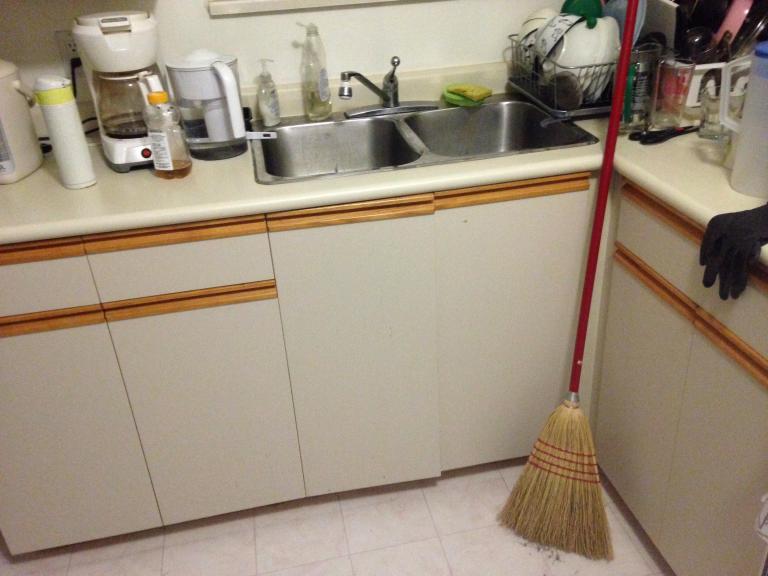
some of the fruits of my cleaning, not perfect, but on its way – photo by me
Yesterday, on the eve of my birthday, I offered some reflections on my mother to my wife. As most married men will know, this was a risky Freudian act. In the heart of hearts of many a couple, the Oedipal complex still remains true. All men want to marry their mothers, and all wives are horrified when they discover that they are on the receiving end of a kind of transference that has condemned them to a life sentence of being chained to a boy. Oedipus still thinks he’s smart about the riddles of humanity, and Jocasta will hang herself when she discovers his sordid truth.
But for one reason or another, my mother really liked the woman that I married, and still does. In fact, she has long been in the habit of making comments that my wife is exactly like her, even while my beloved and I were dating and especially at the wedding banquet. The truth, however, is that my wife is nothing like my mother, and she has spent much of our marriage demonstrating this non-equivalency, much to my delight. In hindsight, what my mom actually did in some ways was to prevent the transference between herself and my wife in my own mind. My wife and I are both grateful for this smashed mirror.
One way in which my wife is not like my mother is that she never makes me clean. Of course, she appreciates it when I do, and the truth is that, without enough internalized guilt for not doing it, neither of us do enough of it. I said to my wife last night that it had suddenly dawned on me why my parents’ house was so clean when I was a kid. After dinner, my chores included wiping down the table, using a cloth to wash the kitchen floors, sweeping the dining area, and taking out the garbage and recycling. When I had moved out shortly after I had gotten engaged, I stopped doing all of that. My after-dinner ritual, when I had the time – and I’d often let this slide too, justifying to myself that I had writing to do – was to wash the dishes, which is what my sister used to do. In fact, in my first blog biography when I was Chinglican at Table, I had just moved out, and the punchline was that I liked doing the dishes so that my ‘sweetheart’ wouldn’t have to do them. I told the world that I found soap suds sacramental and that I enjoyed the story of how St Bonaventure received his cardinal’s hat while he was doing the dishes.
My reflection, however, was that the chores that my mother made me do have not been done since I moved out. It then occurred to me that the reason my parents’ house was clean was because I made it clean (at least the kitchen and dining area) and that the places I’ve lived haven’t been as clean because I haven’t cleaned them the way I once did. This was a stunning realization for me because I do not have a reputation for cleanliness, or attention to detail, or administration and organization in general (ask my colleagues at Northwestern if you want corroboration). And yet it was once my job to see every crumb, every scrap, every random bit of material that could be wiped on the ground and on the table and make sure that it disappeared.
I reflected to my wife that perhaps I had such clarity in my writing and an inability to procrastinate in those days because of these daily rituals that my mother, in her wisdom, put me through. Indeed, Mom was probably doubly wise. Altruistically, she was justifying that she was making a man out of me, but I can’t help but think that she realized that it was like a magic trick: if I wipe the floors, then they will be magically clean. In fact, I know the second part is true for a fact because when I was a little kid, the floor and table work was her daily task, and as I was growing up, I learned that she’d been doing that since she herself was a child. I had simply inherited her chores, but since moving out, I’d neglected them.
Understandably, when I offered to do these things around the house on a daily basis in addition to the dishes, my wife was overjoyed. We tried it once last night. She was very happy with the progress I made. I think we may continue in this habit of having me clean more. There is much more to be done.
My thoughts on housecleaning were probably born from the intellectual work of the day. I have been recasting my academic work, much of which is already explicitly theological in its orientation, in psychoanalytic terms. As I did so yesterday, I had a background reflection on the moral gap between keeping the commandment to honor my parents (the only one with a promise attached to it, the Holy Apostle Paul points out – that one will live long in the promised land) and being committed to psychoanalysis as a method, with all of its critical orientation to the ego ideal, the internalized parent by which the self sets standards also known in popular Freudian parlance as the superego. One memory percolated to the surface. I recalled vividly a scene where I witnessed one progressive white evangelical pastor respond to an Asian student during the question-answer session of a talk on the Gospel of John that the Hebrew translation for ‘honor’ might be better translated weigh. I think the Asian guy had daddy issues and was transferring them to God the Father. The preacher replied that instead of honoring your parents by obeying them, you should weigh their words and criticize accordingly. I remember my body recoiling at this thought, interesting as it was intellectually. Intriguing as it sounded, it felt wrong.
I later reflected on my visceral reaction to the prospect of dishonoring my parents with evangelical justification. In addition to being offended by this preacher’s orientalism, I was suspicious on biblical grounds too. Is not our Lord’s response to his critics about their obsession with ritual cleanliness that they nullify the commandments by telling younger folks to tell their parents that anything they may have inherited is now corban and belongs to the Lord instead of being used to take care of their parents’ physical needs? Does not the Holy Apostle Paul say that a man who does not take care of his family in a material way, including his parents, is worse than a pagan? Certainly, I cannot really see a situation in which G-d is commanding that we fulfill all of our parents’ bourgeois fantasies. But the older I’ve gotten, the more I’ve found the impulse to dishonor one’s parents, whether in evangelicalism or in psychoanalysis, suspect, especially when such rebellion is born of an orientalist casting of Asian parents as somehow inherently despotic and therefore justifying the misinterpretation of the Bible for life in a purportedly liberal society. At the same time, I also think that a large part of intellectual maturity comes with abandoning one’s projections of one’s own parents as superego – and with it, the other ego ideals that one might have gathered in a media-saturated and institutionally totalizing world – and becoming one’s own person by taking responsibility for one’s own words and actions.
My intellectual reflections in turn probably have spiritual origins. Over the last few weeks, I’ve begun realizing that joining the Kyivan Church has meant for even more attentiveness to what family is in practice, even though I left the Protestant faith communities that taught me to think and act theologically. In the daily prayers for lay people in churches like mine, we begin by invoking the prayers of our holy mothers and fathers by which the Lord Jesus Christ has mercy on us. We ask the Lord to save our patriarchs, metropolitans, archbishops and bishops, presbyters and deacons, and all who serve in the church. We pray especially for our spiritual father. We ask for the earthly and spiritual good things for our parents and all our kindred according to the flesh, as well as for our neighbours and friends. We entreat salvation for those who have departed from us, both clergy in our church and our own family members, including our parents. Much of what prayer is in our my everyday life in this Kyivan Church is constituted by acts of honoring my parents, both spiritual and biological. The result has been quite special: I think more about them all during the day and find myself genuinely more affectionate to those who are supposed to be my ‘loved ones,’ because I begin the day by praying for them. I wonder if this is what Master Kong – the ancient sage popularly known as Confucius – meant when he suggests throughout his aphorisms that liturgical relationships have the power to restore personal bonds in an age of immorality and cultures of political betrayal.
Here, I think the artificial contradiction between psychoanalysis and the commandment to honor my parents is at least somewhat resolved. In making my reflections about my mother and housecleaning, I realize that I do not clean the house now because I’ve internalized her orders to do my chores. In offering my wife to make our house cleaner, the act feels free. In fact, I found myself on the ground wiping the floor and then realizing that I was having fun. In reflecting on how my mother broke the mirror with my wife by overdetermining my relationship to both of them with such ridiculousness, I think I may actually be psychically safe, if only just by a hair, of transferring my affections for my mom to my beloved wife.
It is curious that these thoughts are coming at a time when I am finally at last beginning to feel like I’ve begun to transcend my extended adolescence and really claim the mantle of adulthood, if only tenuously and with great trepidation at the risk of jinxing myself by talking about it. None of the traditional rites of passage seemed to do it for me: employment, moving out, paying rent, marriage, having finances to manage, getting degreed to the max by academia, becoming Eastern Catholic. Instead, it is only in reflecting on the concrete practice of everyday life as a part of the hard work of prayerful psychic integration that I am finally beginning to feel that I might be getting somewhere, though it is often two steps forward and three back.
My experience is corroborated by the feminist scholar Audre Lorde’s profound manifesto about parenting men who will not grow up to be so fragile that they cannot survive in a non-patriarchal world. The longstanding feminist insight, with which I must agree from my own attentiveness to my body, is that masculine violence is actually a symptom of male fragility. Without integration, there is disintegration. A man must be taught – and who better to learn from than his own mother? – to get in touch with his feelings for the sake of the world, then. Part of that personal integrity is to know that one cannot exist in the realm of individual fantasy. Actions beget real-world consequences: one cleans, and the house is clean, or one does not clean, and the state of the home enters its natural entropy. Words also have the power to hurt or to heal; I know this because in the foolishness of my youth I used to say things that made my mother cry, and while I wrote it off at the time as her being fragile and not being able to take a joke, the fragility was in fact my own in needing to be seen as funny, or independent, or interesting. The male human who learns these lessons about how the real world really works and puts in the work for the personal integration required to overcome his own fragility in the facing of that world is the true man, in Lorde’s eyes. The problem is that patriarchy enables the masculine species to linger in realms of fantasies disconnected from concrete realities, and instead of becoming men, most remain as the ‘man-child’: fragile, infantile, paralyzed in the perpetual fetal position, predisposed to irrational fits of anger that get more destructive the larger he is.
Upon reflection, my mother raised me to be a man, right down to the cleaning chores. It was not until later that I learned to be a man-child. The miseducation was subtle: I picked up from various places, mostly from men but also from women who enabled them, that it is not the role of a man to nurture the young, and then that it is not within the purview of a man to be oriented to detail, and then that it is not necessary for men to connect the dots between their own actions or lack thereof with their consequences. In recovering my mother’s chores on the eve of my birthday, I realize that I still have the muscle memory for attentiveness, close reading, nurturing, and personal integrity. I realize how indebted I am to her giving me life and raising me, and I start appreciating what it truly means to honor her. In picking these chores back up, I realize that I am not doing them to please her or to obey her voice inside my head. Instead, I appreciate her personal wisdom as a person who is different from me, much as I have been soaking in the wise deeds and words of the holy women who pray to G-d for me: the Most Holy Theotokos, the Holy Equal-to-the-Apostles Olha of Kyiv, the Holy Martyrs Sophia and her daughters Faith, Hope, and Love, our Venerable Mother Among the Saints Mary of Egypt, St Teresa of Calcutta, the Holy Fool-for-Christ Xenia of St Petersburg, and the Holy New-Martyr Elizabeth the Merciful. To be an adult in relation to one’s mother is to recognize that she is wise independent of me, and that it is in freedom that I practice the muscle memory which she offered me as a path to maturity.
It is a truism that a man should honor the woman who gave him birth on the day of his birthday. I did not even realize that this was my intention when I began these reflections. But hopefully with less cliché toward which my evangelical upbringing predisposes me, I am more than happy to offer my gratitude to her. Because of her, I know how to clean a house and make my wife happy. I suspect if I recover the habits I learned from her, I will finally leave my childishness behind and become the man she raised me to be.
I know better, however, than to make this my birthday resolution. Men talk big, women tell me, sometimes (actually, usually) about me too. Maybe I am beginning to learn my lesson in this sense too: it’s better to be tentative and to report on what I’ve actually done on the next birthday.
Previous Post
July 22, 2018
I had another cantoring nightmare last night
Next Post
July 25, 2018 The pop psychoanalysis posse and the popular culture of Ida
Browse Our Archives
Select a Category Academia Anglican Communion anti-racism Aristotle Asia-Pacific Asian American Asian Canadian BlackLivesMatter Cantonese Catholic China Chinglican church politics Church-State Politics Civil Society Conservative Eastern Christianity Evangelical Evangelical Left Feminist/Womanist Theology Food Greek-Catholic Church of Kyiv Hong Kong Housekeeping Kyivan Church Latin Catholicism Law Liberal Liberation Theology New Calvinism Pentecostal/Charismatic Protestant Psychoanalysis Publics Religion Ethnicity Wired Secular Sovereignty TPCIU Uncategorized
Select a Month July 2019 June 2019 May 2019 April 2019 March 2019 February 2019 January 2019 December 2018 November 2018 October 2018 September 2018 August 2018 July 2018 June 2018 May 2018 March 2018 February 2018 January 2018 December 2017 November 2017 October 2017 September 2017 August 2017 July 2017 June 2017 April 2017 March 2017 February 2017 January 2017 December 2016 November 2016 October 2016 September 2016 August 2016 July 2016 January 2016 December 2015 November 2015 October 2015 August 2015 April 2015 March 2015 February 2015 December 2014 November 2014 September 2014 August 2014 July 2014 June 2014 May 2014 April 2014 March 2014 December 2013 November 2013 October 2013 September 2013 August 2013 July 2013 June 2013 May 2013 April 2013 March 2013 February 2013 January 2013 December 2012 October 2012 June 2012 May 2012 April 2012 February 2012 January 2012
Follow Us!
TAKE THE
Religious Wisdom Quiz
In 1 Peter, what does Peter say Sarah called Abraham?
Select your answer to see how you score.
Master Father Lord My beloved
Related posts from Eastern Catholic Person

I've found my way home: on the unraveling...
Tiananmen is my first childhood memory: reflections on...

Patriyarkhat: 'Attending to the movements of my heart'

I'm flattered to be named an Asian American...
TRENDING AT PATHEOS Catholic

Creation, Preservation, and Teleology in Catholic Theology
As I write this, it is very early Monday morning. Like millions...

The Parable Of The Sower And The Word...
One of Christ’s most famous parables is that of the sower who...

Rejecting Doom: Christian Hope And Human Action
Christianity is a religion of hope. We are to have hope and...

Why I Choose the Eucharist Over the Sermon
Choose the Eucharist, Not the Sermon What are we supposed to get...

5 Design Elements Found in Spiritually Rooted Homes
Putting Spirituality Into Home Decor Our homes are more than our living...

Credo: A Story of God Told with the...
About 10 years ago, I began to imagine a personal "Credo" that...
view all Catholic blogs
Ad-Free & Subscriber Log-In Subscription Support
- About Us
- 2026 Calendar
- Videos
- Podcasts
- Library of World Religions
- Faith In Media Tracker
- Advertise With Us
- Write for Us
- Privacy Policy
- Terms of Service
- Do Not Sell My Data
- Contact Us
- Radiant Digital
- Manage Newsletter Subscriptions
- Unsubscribe From Notifications
- Sitemap
Copyright 2008-2026, Patheos. All rights reserved.
Subscription Support Ad-Free & Subscriber Log-In
Follow Patheos