
BuddhistCatholicContemplativeEvangelicalGeneral ChristianHinduJewishLatter-day SaintMuslimNew VisionsProgressive Christian
Beliefs
- Buddhist
- Catholic
- Contemplative
- Evangelical
- General Christian
- Hindu
- Jewish
- Latter-day Saint
- More Voices
- Muslim
- New Visions
- Pagan
- Progressive Christian
Topics
- Religion News
- Food and Religion
- Sports and Religion
- Religious Art
- Religious Music and Entertainment
- Religious Events
- History and Religion
- Style and Religion
- Politics and Religion
- Women in Religion
- Recreation Outdoors and Religion
- Business Finance and Religion
- Careers Workplace and Religion
- Education and Religion
- Family Parenting and Religion
- Health Fitness and Religion
- Home and Religion
- Relationships and Religion
- Technology and Religion
- Travel and Religion
Columnists
- Buddhist Columnists
- Business Finance and Religion Columnists
- Careers Workplace and Religion Columnists
- Catholic Columnists
- Contemplative Columnists
- Education and Religion Columnists
- Evangelists Columnists
- Family Parenting and Religion Columnists
- General Christian Columnists
- Health Fitness and Religion Columnists
- Hindu Columnists
- History and Religion Columnists
- Home and Religion Columnists
- Jewish Columnists
- More Voices Columnists
- Latter Day Columnists
- Muslim Columnists
- New Visions Columnists
- Nonreligious Columnists
- Pagan Columnists
- Politics and Religion Columnists
- Progressive Columnists
- Recreation Outdoors and Religion Columnists
- Relationships and Religion Columnists
- Religion News Columnists
- Religious Art Columnists
- Religious Events Columnists
- Religious Music and Entertainment Columnists
- Sports and Religion Columnists
- Style and Religion Columnists
- Technology and Religion Columnists
- Travel and Religion Columnists
- Women in Religion Columnists
Resource Library
- 2026 Calendar
- Library of World Religions
- The 100 Most Holy Places on Earth
- Patheos Answers
- Podcasts
- Videos
- Faith Leaders Database
- Anglican Episcopalian
- Bahai
- Baptist
- Buddhism
- Christianity
- Confucianism
- Eastern Orthodoxy
- Hinduism
- Holiness and Pentecostal
- ISKCON
- Islam
- Judaism
- Lutheran
- Methodist
- The Church of Jesus Christ of Latter-day Saints
- New Age
- Paganism
- Presbytarian and Reformed
- Protestantism
- Religion Behind the Scenes
- Roman Catholic
- Scientology
- Shia Islam
- Sikhism
- Sufism
- Sunni Islam
- Taoism
- Zen
- See all religions
Research Tools
 Ad-Free & Subscriber Log-In Subscription Support
Ad-Free & Subscriber Log-In Subscription Support
Follow Patheos 

- Trending:
- Forgiveness
- |
- Marriage
- |
- Consciousness
- |
- Death Penalty
- |
- Election
- |
- Halloween
 Eastern Catholic Person
- Home
- Catholic
- The Wound of History
The Wound of History
Last updated on: June 4, 2018 at 7:58 pm by Justin Tse
The Wound of History 2018-06-04T19:58:18-07:00 Justin Tse
Patheos Explore the world's faith through different perspectives on religion and spirituality! Patheos has the views of the prevalent religions and spiritualities of the world.
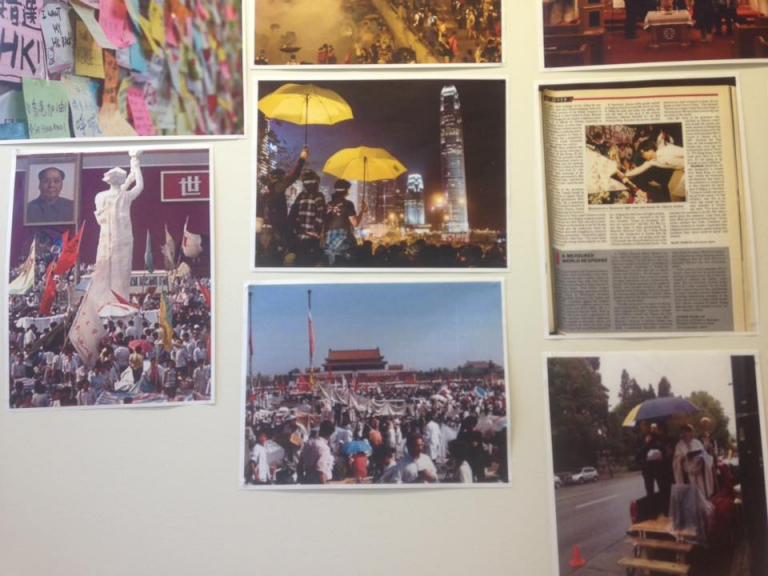
The wound of history at Tiananmen, along with scenes of the 2014 Umbrella Movement, in my academic office – photo by me
In my first childhood memory, I am standing by the fireplace. It’s made of brick, and it goes up to the ceiling and out the roof and becomes the chimney to our home. Next to it is a television set. On it is playing scenes of protest, then of fire, and then of a man standing before three tanks holding a metal lunch box. Over these clips, a song is playing. It is in Mandarin, and I am singing.
When I was an undergraduate, my parents told me that an uncle from church had heard me singing that song. I probably didn’t know what I was singing, but apparently I had done so with conviction. It had stirred him to his bones, so he made a cassette tape recording of it for me. I later found it. It was called ‘The Wound of History,’ lishi de shangkou 歷史的傷口.
‘The Wound of History’ plays at most commemorations of the massacre that the Chinese Communist Party – at first the engine of hope for capitalist democratization because of the political reforms spearheaded by Deng Xiaoping, Zhao Ziyang, and Hu Yaobang throughout the 1980s, then the hammer that shattered those fantasies – perpetrated against an estimate of ten thousand people on the streets of Beijing on the night before June 4, 1989. The square that the protesters – first students, then a million people, with workers and farmers coming to the big city from all corners of the country – supposedly stood on was named Tiananmen, the Gate of Heavenly Peace. It was here that students had decried the backward thinking they held to have held China back on May 4, 1919, here that (as the apocryphal tale goes, as nowhere is it put down that he actually said this) Chairman of the victorious Communist Party, Mao Zedong, had declared that ‘today, the Chinese people have stood up.’
Just a month before the events we now know as June 4, the young RAND Corporation political scientist Francis Fukuyama had celebrated the Beijing Spring as the marker of what he, channeling Hegel and Kojève, called the ‘end of history.’ For Fukuyama, 1989 signalled the fulfillment of the French Revolution. Of the trio of ideologies born in modernity – liberal capitalist democracy, socialist communism, and national fascism – the first had supposedly triumphed as the Berlin Wall fell in 1989, signalling the beginning of the end of the Soviet Union (fascism had supposedly been decimated in 1945, the operative word here being supposedly). Of the Beijing Spring, Fukuyama writes: ‘The student demonstrations in Beijing that broke out first in December 1986 and recurred recently on the occasion of Hu Yao-bang’s death were only the beginning of what will inevitably be mounting pressure for change in the political system as well’ (pp. 11-12). I am sure that Fukuyama ate his words when the People’s Liberation Army shot them instead. The political philosopher Giorgio Agamben probably puts it more rightly, if not more poetically, in The Coming Community: ‘Whatever singularity, which wants to appropriate belonging itself, its own being-in-language, and thus rejects all identity and every condition of belonging, is the principal enemy of the State. Wherever these singularities peacefully demonstrate their being in common there will be a Tiananmen, and, sooner or later, the tanks will appear’ (p. 86).
In other words, the end of history had just begun when it received its wound. Tiananmen is liberal capitalist democracy’s original sin. Americans may find this precept difficult to understand. The sociologist Richard Madsen says that the United States often sees China as its mirror, and vice versa is often true as well. Tiananmen was supposed to have signalled the inexorable march of capitalism to democracy, and the massacre shattered this fantasy, depriving Americans of the delight of a Disney ending. The ironies are even more pronounced when one considers that the Tiananmen protesters were hardly demanding the neoliberalism that Americans thought everybody wanted. Craig Calhoun points out that central to the Beijing Spring was a kind of ‘Chinese culture’ – a Chinese way of being public – that took its continuity in Chinese political philosophy as well as the May Fourth Movement in 1919 and the Cultural Revolution that Mao encouraged. Tiananmen was a movement of the masses – they were singing songs of Mao on the square! – spurred on by the incompleteness of the Party’s reform, kinks in the system that had led to widespread urban-rural inequality and the quick commodification of everyday life. The students demanded their supposedly radical government to follow through on its radicalism. Instead, they were crushed.
Slavoj Žižek says that there is ‘trouble in paradise‘ at the end of history, but the wound of Tiananmen suggests that – as Žižek himself hints in his first English-language book, The Sublime Object of Ideology – right at the cusp of the celebrations of 1989, it was already over. The triumph of liberal capitalist democracy does not promise a more radical democratic turn in the world. If anything, it signals that – as Žižek says over and over – ‘the marriage between capitalism and democracy is over.’ The turn toward market socialism in the People’s Republic of China did not signal the inexorable march toward democracy. It revealed instead the ugly face of capitalism everywhere.
The wound of history, about which I sang when I was a toddler standing in front of the television by the fireplace, captures this insight immaculately. The song opens with a denunciation of self-deception: ‘Blindfold your eyes, and you thought you didn’t see. Block your ears, and you thought you wouldn’t hear.’ But no matter one’s comprehension of Chinese political history, or ideological geographies, or global geopolitics, no one is truly deceived: ‘But the truth is in the heart, creating pain in the chest. How long do we have to wait, how much longer the silence?’ Without deception, there is genuine emotion: ‘If tears could wash the dust, if blood could be exchanged for freedom, may tomorrow remember the roar of today, may the world also behold the wound of history.’
Ideology blinds. Many ideologies obscure the wound of history. Apologists for the Chinese Communist Party argue that the students were aligned with American media to demand a neoliberal makeover of China, one where a Party that had lifted millions out of poverty would leave them to fend for themselves in an open market. The Party itself has made an aggressive attempt to shut down all conversation about Tiananmen, especially within its borders, censoring the news that it even happened. Evangelicals with missionary interests in China tend to sideline it in an effort not to tick off the Chinese government with whom they have to work. Even the younger generation of radical autonomy activists in Hong Kong denounce the Tiananmen commemorations, saying that they do not want to be associated with something that has to do with the Chinese patriotism of the older democracy activists like Martin Lee and Szeto Wah, whose aims since the 1970s were to bring democracy to China.
Ideology blinds those held in its phantasmic spell because it is fundamentally masturbatory, turning the self inward on itself. In each case, there is a degree of self-interest. The wound of history cannot be spoken of because of political economy, or because of political practicalities, or because of identity politics. I remember when I mentioned these objections to Tiananmen commemorations to my spiritual father, an Eastern Jesuit who was ordained the week of the Tiananmen massacre, and he said that such views are unacceptable for Christians, much less those of us who call ourselves Catholic – and especially those of us whose politics are shaped by the Byzantine liturgy. A Christian does not put these interests first; our Lord Jesus Christ demands that a death to ego and a resurrectional life that aligns us with the poor, the oppressed, and the wounded. Catholic social teaching posits a preferential option for the poor; what is at stake in the life of each Christian claiming the word Catholic is whether we live out this poor catholicity.
In this way, the wound of history is the wound of the world taken on by the crucified Lord. It is poetic that today, June 4, is the first day of the Apostles’ Fast on the Old Calendar. In Pentecost, King Cosmos has emerged from darkness by the power of the Holy Spirit bearing the truth of the apostles’ teaching in its very constitution. It is from the apostles that we received this word of solidarity with the wounded, calling us to behold the wound of history instead of wallowing in celebratory and masturbatory delusions that try to cover it up. Like the child that the Lord calls in his midst, I return to being that two-year-old before the television at the fireplace, singing songs of wounds I do not fully comprehend. I have spent much of my adult life and education trying to make sense of the effects of Tiananmen on the Chinese diaspora, and still, I feel like I am at the beginning. But imposter syndrome is no case for silence. History did not end in 1989. With the brutal wound of June 4, perhaps it was then that this new age of authoritarianism – now finally discussed so passionately in the age of Trump, Brexit, and Le Front National – actually began. Let us attend to this wound. Let the world also see the wound of history.
Previous Post
May 29, 2018
Repenting of the postmodern politics of the pure heart

Browse Our Archives
Select a Category Academia Anglican Communion anti-racism Aristotle Asia-Pacific Asian American Asian Canadian BlackLivesMatter Cantonese Catholic China Chinglican church politics Church-State Politics Civil Society Conservative Eastern Christianity Evangelical Evangelical Left Feminist/Womanist Theology Food Greek-Catholic Church of Kyiv Hong Kong Housekeeping Kyivan Church Latin Catholicism Law Liberal Liberation Theology New Calvinism Pentecostal/Charismatic Protestant Psychoanalysis Publics Religion Ethnicity Wired Secular Sovereignty TPCIU Uncategorized
Select a Month July 2019 June 2019 May 2019 April 2019 March 2019 February 2019 January 2019 December 2018 November 2018 October 2018 September 2018 August 2018 July 2018 June 2018 May 2018 March 2018 February 2018 January 2018 December 2017 November 2017 October 2017 September 2017 August 2017 July 2017 June 2017 April 2017 March 2017 February 2017 January 2017 December 2016 November 2016 October 2016 September 2016 August 2016 July 2016 January 2016 December 2015 November 2015 October 2015 August 2015 April 2015 March 2015 February 2015 December 2014 November 2014 September 2014 August 2014 July 2014 June 2014 May 2014 April 2014 March 2014 December 2013 November 2013 October 2013 September 2013 August 2013 July 2013 June 2013 May 2013 April 2013 March 2013 February 2013 January 2013 December 2012 October 2012 June 2012 May 2012 April 2012 February 2012 January 2012
Follow Us!
TAKE THE
Religious Wisdom Quiz
According to Colossians, what has been raised with Christ and should we set our hearts on?
Select your answer to see how you score.
The gospel message Things above, where Christ is seated Eternal life The kingdom of God
Related posts from Eastern Catholic Person

I've found my way home: on the unraveling...

This time, I have a tradition: on solidarity...
Tiananmen is my first childhood memory: reflections on...

Patriyarkhat: 'Attending to the movements of my heart'
TRENDING AT PATHEOS Catholic

Rejecting Doom: Christian Hope And Human Action
Christianity is a religion of hope. We are to have hope and...

It’s What Comes From Within Which Matters
One of the most difficult things for us to understand is why...

Why I Choose the Eucharist Over the Sermon
Choose the Eucharist, Not the Sermon What are we supposed to get...

5 Design Elements Found in Spiritually Rooted Homes
Putting Spirituality Into Home Decor Our homes are more than our living...

Credo: A Story of God Told with the...
About 10 years ago, I began to imagine a personal "Credo" that...

The Anatomy of Divine Revelation in Catholic Thought
The claim that God has made Himself known to human beings is...
view all Catholic blogs
Ad-Free & Subscriber Log-In Subscription Support
- About Us
- 2026 Calendar
- Videos
- Podcasts
- Library of World Religions
- Faith In Media Tracker
- Advertise With Us
- Write for Us
- Privacy Policy
- Terms of Service
- Do Not Sell My Data
- Contact Us
- Radiant Digital
- Manage Newsletter Subscriptions
- Unsubscribe From Notifications
- Sitemap
Copyright 2008-2026, Patheos. All rights reserved.
Subscription Support Ad-Free & Subscriber Log-In
Follow Patheos