
BuddhistCatholicContemplativeEvangelicalGeneral ChristianHinduJewishLatter-day SaintMuslimNew VisionsProgressive Christian
Beliefs
- Buddhist
- Catholic
- Contemplative
- Evangelical
- General Christian
- Hindu
- Jewish
- Latter-day Saint
- More Voices
- Muslim
- New Visions
- Pagan
- Progressive Christian
Topics
- Religion News
- Food and Religion
- Sports and Religion
- Religious Art
- Religious Music and Entertainment
- Religious Events
- History and Religion
- Style and Religion
- Politics and Religion
- Women in Religion
- Recreation Outdoors and Religion
- Business Finance and Religion
- Careers Workplace and Religion
- Education and Religion
- Family Parenting and Religion
- Health Fitness and Religion
- Home and Religion
- Relationships and Religion
- Technology and Religion
- Travel and Religion
Columnists
- Buddhist Columnists
- Business Finance and Religion Columnists
- Careers Workplace and Religion Columnists
- Catholic Columnists
- Contemplative Columnists
- Education and Religion Columnists
- Evangelists Columnists
- Family Parenting and Religion Columnists
- General Christian Columnists
- Health Fitness and Religion Columnists
- Hindu Columnists
- History and Religion Columnists
- Home and Religion Columnists
- Jewish Columnists
- More Voices Columnists
- Latter Day Columnists
- Muslim Columnists
- New Visions Columnists
- Nonreligious Columnists
- Pagan Columnists
- Politics and Religion Columnists
- Progressive Columnists
- Recreation Outdoors and Religion Columnists
- Relationships and Religion Columnists
- Religion News Columnists
- Religious Art Columnists
- Religious Events Columnists
- Religious Music and Entertainment Columnists
- Sports and Religion Columnists
- Style and Religion Columnists
- Technology and Religion Columnists
- Travel and Religion Columnists
- Women in Religion Columnists
Resource Library
- 2026 Calendar
- Library of World Religions
- The 100 Most Holy Places on Earth
- Patheos Answers
- Podcasts
- Videos
- Faith Leaders Database
- Anglican Episcopalian
- Bahai
- Baptist
- Buddhism
- Christianity
- Confucianism
- Eastern Orthodoxy
- Hinduism
- Holiness and Pentecostal
- ISKCON
- Islam
- Judaism
- Lutheran
- Methodist
- The Church of Jesus Christ of Latter-day Saints
- New Age
- Paganism
- Presbytarian and Reformed
- Protestantism
- Religion Behind the Scenes
- Roman Catholic
- Scientology
- Shia Islam
- Sikhism
- Sufism
- Sunni Islam
- Taoism
- Zen
- See all religions
Research Tools
 Ad-Free & Subscriber Log-In Subscription Support
Ad-Free & Subscriber Log-In Subscription Support
Follow Patheos 

- Trending:
- Forgiveness
- |
- Marriage
- |
- Consciousness
- |
- Death Penalty
- |
- Election
- |
- Halloween
 Eastern Catholic Person
- Home
- Catholic
- Lady Bird and the transfiguration of everyday life (Great Fast #8)
Lady Bird and the transfiguration of everyday life (Great Fast #8)
Last updated on: February 26, 2018 at 11:23 pm by Justin Tse
Lady Bird and the transfiguration of everyday life (Great Fast #8) 2018-02-26T23:23:21-07:00 Justin Tse
Patheos Explore the world's faith through different perspectives on religion and spirituality! Patheos has the views of the prevalent religions and spiritualities of the world.
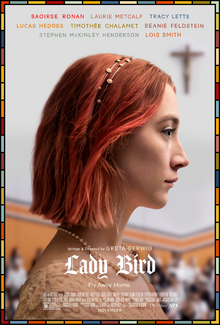
This is a poster for Lady Bird. The poster art copyright is believed to belong to the distributor of the item promoted, the publisher of the item promoted or the graphic artist. The image is used for identification in the context of critical commentary of the work, product or service for which it serves as poster art. It makes a significant contribution to the user’s understanding of the article, which could not practically be conveyed by words alone. The image is placed in the infobox at the top of the article discussing the work, to show the primary visual image associated with the work, and to help the user quickly identify the work, product or service and know they have found what they are looking for. Use for this purpose does not compete with the purposes of the original artwork, namely the creator providing graphic design services, and in turn the marketing of the promoted item. Use of the poster art in the article complies with fair use under United States copyright law as described above.
There are necessarily spoilers for what I am about to write. But it is fair for me to include spoilers since Lady Bird has been out for months. Please read then, whether or not you have seen Lady Bird.
Lady Bird came out last autumn, but I have only just seen it. Like Lady Bird, I have been trying to become a decent writer. Because of that, I have had to discipline my prose. Having grown up evangelical, my writing tends toward hyperbole. Therefore, I am not able to say definitively that Lady Bird is the best film that has ever been made, at least since I have watched it about an hour ago. But it is how I feel and what I think because I felt understood as I watched it. At the end, when Lady Bird – or rather, Christine – asks her mother on the phone if she remembers the first time she drove in Sacramento, I cried.
I did not grow up in Sacramento. I grew up in Fremont. Like Lady Bird, I tell people that I grew up in San Francisco because like the guy at the party in New York that she kisses and then vomits all over, nobody really knows where Fremont or Sacramento are. But everybody knows where ‘San Fran’ is. You know that someone is not from the Bay when they call it that. For us, it is just called ‘the City.’
I knew that I was going to cry, though, because my two recent partners in crime, Eugenia Geisel and Grace Yu, told me to see the film. Eugenia has a whole post about it on her blog for Ash Wednesday. But what Eugenia told me that got her was the scene with the nun where she says that she read Lady Bird’s college admissions essay and remarks that she truly loves Sacramento. Lady Bird replies that she doesn’t necessarily love Sacramento; she just pays attention. The nun remarks that love and paying attention might be the same thing.
In this way, Lady Bird is a film that understands me. The joke among some of my friends is that Fremont is a parking lot with a mayor. This, however, is not fair to Fremont, and I don’t mean that in the Diana Eck way where she celebrates all the multireligious diversity and the making of a new religious America. I too remember my first time after finally getting my drivers’ license – I failed once, like Lady Bird, and barely passed my second one – driving by myself around the city. There were, as Lady Bird tells her mom on the phone, the familiar shops and places that I’d been to. But now, I was behind the wheel. I didn’t have to have my mom drive me around town. I could go where I wanted: to the Borders Books and Music, to the music store, down the routes that I always preferred to take. I also remember when I turned 18. It is as if Lady Bird were part of my group of friends. We joked that we’d be able to buy cigarettes, porn, and the lottery when we turned 18. Lady Bird actually does it.
I don’t think I appreciated Fremont until I moved away. Unlike Lady Bird, my whole family packed up with me and moved to Vancouver – Richmond, to be exact – when I went to college. There is a reason I write the way I do about Richmond, and not about Fremont, and that is that my time in the car by myself in Fremont was just too short before I moved away for good. I have been back for visits and for field work during my doctoral research, but it is just not the same without my family there.
And yet, Fremont is where I learned to write. The fiction that I produced there was pretty bad, though some of it was published in a literary magazine that I founded at the Catholic school I attended in Hayward. But the first geography essay I ever wrote was on Allegro Music in Fremont. My English teacher at the Catholic school wanted us to write a ‘Place Essay.’ His class was really hard; it was the first time I had ever gotten B’s on my assignments. I chalk that up not to my own intelligence, but to the Christian school that precedes my time in Catholic school as giving wild extra credit scores that shot some of my grades up to 109%. Perhaps I overcompensated when I wrote about Allegro Music as a place where if you look and listen carefully enough, the place resounds like a symphony in the way it is organized and managed as a store. The teacher, a hard grader, gave me a 100% for that piece. It must have been good. It predicted my future vocation as a geographer.
But how I wrote about that place was that I had to pay attention. That teacher taught us James Joyce’s Dubliners shortly after that place essay assignment, and that is a text to which you have to pay attention. ‘Don’t you think there is a certain resemblance between the mystery of the Mass and what I am trying to do?’ Joyce writes to his brother, in a quote that Vintage printed on the back of the edition of Dubliners we used for class. ‘To give people some kind of intellectual pleasure or spiritual enjoyment by converting the bread of everyday life into something that has a permanent artistic life of its own.’ To this day, my scholarship is formed by this quote. I always tell people that I got my ethic of trying to write closely about everyday life from Michel de Certeau. It is true, after all, that Certeau was the theorist that featured prominently in my very first peer-reviewed academic publication, which I got out early in my PhD studies. But there is a reason that Certeau speaks to me. It’s because everything I needed to learn about writing closely about everyday life and transforming it through the art of prose, I learned in Catholic school.
Lady Bird goes to Catholic school, but she is not Catholic; she is there because her brother Miguel saw someone knifed in front of his school. That was the reason I had gone to Christian school, then Catholic school, as well. My parents decided to put me through private school until college, and it cost them dearly, especially toward the end when they managed to spend their entire savings while pastoring a small evangelical church in Fremont that wasn’t paying their health insurance. They too wondered how they were going to pay for college; that’s when we discovered that tuition in Canada for me as a Canadian citizen was a lot cheaper than any U.S. school. I did have a dream school in California that I had been planning to attend before I got the idea about Vancouver. It was Davis.
The thing that got me about Lady Bird is that it is set at a time when I got my first sense that what happens politically can shake you up at the level of everyday life. What is going on in the background of Lady Bird is the immediate memory of 9/11 in 2001 and the Iraq War in 2003. If Lady Bird were a real person, she would have been a year older than me. She was a senior when the Iraq War happened, and applying to New York schools makes her mom scared in part because of the ‘terrorism.’ I was a junior, so I had some time to think about what would happen if Congress implemented the draft for the Iraq War. For people who remember that time, it was a live discussion, especially on television. I decided to move to Canada to get away from it all. Of course, that would not have saved me if they had drafted me; when I was 18, I still had to register for the draft, and it says on the form that even if you are in another country, you still have to come back to fight if they call you.
When I got to Richmond, I thought I was free. I especially believed myself to have been liberated from Catholic school, and I threw myself hard into evangelicalism, so much that it disgusted all the people who knew me back at the Catholic school because I came back the next year and talked to them about becoming a ‘man of God‘ and purging my mind from lust. The people I had become close to by the end of my time in Catholic school were – and probably still are – very attractive women. One of them unfriended me on facebook after that conversation. Evangelicalism, it turns out, is creepy. In turn, I transfigured my lusts through the trope of the Manic Pixie Dream Girl. My favorite movies at the time spoke to the anomie of our generation: Garden State (with Pixie Dream Girl Natalie Portman) and Elizabethtown (with Pixie Dream Girl Kirsten Dunst). It is often said that the Manic Pixie Dream Girl exists only to give meaning to the life of a sad emo boy. Could it not be said, then, that Lady Bird is the view of life from the perspective of the Manic Pixie Dream Girl, one that is three-dimensional and disappointed in all the sad boys she falls in love with? Do we not see through her eyes the same way that Kirsten Dunst’s character in Elizabethtown revisions America for Orlando Bloom with an American accent? Is this not the Natalie Portman with the Shins projecting from her headphones in Garden State, just without the inexplicable need to be with the loser called Zach Braff whose dad is somehow also Bilbo Baggins? Is not all this creepy fantasizing why girls who would have been Lady Bird unfriended me?
By the end of the movie, Lady Bird walks into a church – probably an Episcopal one, by the looks of it – and is so moved by the singing that she calls her family. It took me a lot longer, and the Anglican liturgies I first attended were so poorly done that it reminded me of the gym masses in the Catholic schools with the rote responses, the liturgical dancers with the see-through tops, and the attempt at praise-and-worship where the cantor was always a quarter-tone flat.
But something eventually happened. I realized that the liturgy was literally a participation of the whole people of God in the proclamation of the Gospel. Unlike evangelicalism, it was not just a preacher preaching. It was all of us together making Christ present. Out of liturgy comes the practice of everyday life. Even the avowed Marxist revolutionary scholar Henri Lefebvre acknowledges this liturgical reality in the first volume of The Critique of Everyday Life: ‘O Church, O Holy Church, when I finally managed to escape from your control I asked myself where your power came from…Now I can see the fearful depths, the fearful reality of human alienation! O Holy Church, for centuries you have tapped and accumulated every illusion, every fiction, every vain hope, every frustration’ (p. 236).
In fact, it is as she steps out of the liturgy that Lady Bird makes that phone call to her mom and asks her if she remembers the first time she drove through Sacramento. It is a liturgy that she does not understand, even though she knows all the moves during mass: not only does she hold her friends’ hands during the Our Father and know what an unconsecrated communion wafer is, but the give-away is that when the priest says, The Lord be with you, she gestures with her hands, And also with you (this is indeed pre-2011 missal translation). And yet, there is a mysterious connection between Lady Bird’s non-Catholicism and her encounter with the liturgical drama that sweeps into a sacramental imagination that engulfs the city poetically named Sacramento. It is much like the end of Brideshead Revisited when Charles Ryder, the non-Catholic sucked into the Catholic drama of the Flyte family, genuflects when he enters a church to pray – not for good manners as he does with his friend Sebastian at the beginning of the novel (and BBC miniseries), but because he has become Catholic. It is inexplicable: like Lady Bird, Brideshead Revisited also takes us through a number of sexual occasions: Charles and Sebastian’s flirtation with homosexuality (perhaps like Danny), Charles transferring his feelings to Sebastian’s sister Julia and them becoming lovers (perhaps like Kyle), the overbearing Catholicism of Lady Marchmain (maybe like the nun, although the line about ‘six inches for the Holy Spirit’ during the dance is funny). Charles should have ended up devastated: the death of Lord Marchmain makes Julia commit to celibacy, literally depriving Ryder of sex. I cannot run from his mercy, she tells Ryder. And what does Ryder do? Inexplicably, he becomes Catholic.
I too became Catholic – Eastern Catholic, yes, but Catholic also in the sense of it transfiguring my everyday life. I still remember encountering a liturgy that I did not understand as a non-Catholic in a Catholic school that, just like Charles Ryder and Lady Bird’s encounter with Catholicism, had all kinds of crazy sexual stuff going on. I recall being trained to write closely and to read everyday life as a drama; I even got it, as it is also portrayed in Lady Bird, through musicals and Shakespeare’s Tempest. I find my intellectual fuel now in soaking in liturgy because it gives me the attentiveness that I need to write about place, the love I must have to write about persons. To contemplate everyday life and to write about it requires attentiveness, the ability to perceive the sacrament in Sacramento. In this way, Lady Bird reminded me of what I am doing. All I could do when it ended was to sit there and cry, then walk slowly to the train station and go home. I may need to watch it again before this Fast ends.

Next Post
February 27, 2018 i was a man of god dreaming of manic pixie dream girls (Great Fast #9)
Browse Our Archives
Select a Category Academia Anglican Communion anti-racism Aristotle Asia-Pacific Asian American Asian Canadian BlackLivesMatter Cantonese Catholic China Chinglican church politics Church-State Politics Civil Society Conservative Eastern Christianity Evangelical Evangelical Left Feminist/Womanist Theology Food Greek-Catholic Church of Kyiv Hong Kong Housekeeping Kyivan Church Latin Catholicism Law Liberal Liberation Theology New Calvinism Pentecostal/Charismatic Protestant Psychoanalysis Publics Religion Ethnicity Wired Secular Sovereignty TPCIU Uncategorized
Select a Month July 2019 June 2019 May 2019 April 2019 March 2019 February 2019 January 2019 December 2018 November 2018 October 2018 September 2018 August 2018 July 2018 June 2018 May 2018 March 2018 February 2018 January 2018 December 2017 November 2017 October 2017 September 2017 August 2017 July 2017 June 2017 April 2017 March 2017 February 2017 January 2017 December 2016 November 2016 October 2016 September 2016 August 2016 July 2016 January 2016 December 2015 November 2015 October 2015 August 2015 April 2015 March 2015 February 2015 December 2014 November 2014 September 2014 August 2014 July 2014 June 2014 May 2014 April 2014 March 2014 December 2013 November 2013 October 2013 September 2013 August 2013 July 2013 June 2013 May 2013 April 2013 March 2013 February 2013 January 2013 December 2012 October 2012 June 2012 May 2012 April 2012 February 2012 January 2012
Follow Us!
TAKE THE
Religious Wisdom Quiz
What Christian holiday celebrates the visit of the Magi to the baby Jesus?
Select your answer to see how you score.
Trinity Sunday Epiphany Advent Pentecost
Related posts from Eastern Catholic Person

I've found my way home: on the unraveling...

The Bay Area of the nineties is where...

I am no longer ashamed of being from...
The globalization of Notre-Dame de Paris: for Great...
TRENDING AT PATHEOS Catholic

Rejecting Doom: Christian Hope And Human Action
Christianity is a religion of hope. We are to have hope and...

It’s What Comes From Within Which Matters
One of the most difficult things for us to understand is why...

Why I Choose the Eucharist Over the Sermon
Choose the Eucharist, Not the Sermon What are we supposed to get...

5 Design Elements Found in Spiritually Rooted Homes
Putting Spirituality Into Home Decor Our homes are more than our living...

Credo: A Story of God Told with the...
About 10 years ago, I began to imagine a personal "Credo" that...

The Anatomy of Divine Revelation in Catholic Thought
The claim that God has made Himself known to human beings is...
view all Catholic blogs
Ad-Free & Subscriber Log-In Subscription Support
- About Us
- 2026 Calendar
- Videos
- Podcasts
- Library of World Religions
- Faith In Media Tracker
- Advertise With Us
- Write for Us
- Privacy Policy
- Terms of Service
- Do Not Sell My Data
- Contact Us
- Radiant Digital
- Manage Newsletter Subscriptions
- Unsubscribe From Notifications
- Sitemap
Copyright 2008-2026, Patheos. All rights reserved.
Subscription Support Ad-Free & Subscriber Log-In
Follow Patheos