
BuddhistCatholicContemplativeEvangelicalGeneral ChristianHinduJewishLatter-day SaintMuslimNew VisionsProgressive Christian
Beliefs
- Buddhist
- Catholic
- Contemplative
- Evangelical
- General Christian
- Hindu
- Jewish
- Latter-day Saint
- More Voices
- Muslim
- New Visions
- Pagan
- Progressive Christian
Topics
- Religion News
- Food and Religion
- Sports and Religion
- Religious Art
- Religious Music and Entertainment
- Religious Events
- History and Religion
- Style and Religion
- Politics and Religion
- Women in Religion
- Recreation Outdoors and Religion
- Business Finance and Religion
- Careers Workplace and Religion
- Education and Religion
- Family Parenting and Religion
- Health Fitness and Religion
- Home and Religion
- Relationships and Religion
- Technology and Religion
- Travel and Religion
Columnists
- Buddhist Columnists
- Business Finance and Religion Columnists
- Careers Workplace and Religion Columnists
- Catholic Columnists
- Contemplative Columnists
- Education and Religion Columnists
- Evangelists Columnists
- Family Parenting and Religion Columnists
- General Christian Columnists
- Health Fitness and Religion Columnists
- Hindu Columnists
- History and Religion Columnists
- Home and Religion Columnists
- Jewish Columnists
- More Voices Columnists
- Latter Day Columnists
- Muslim Columnists
- New Visions Columnists
- Nonreligious Columnists
- Pagan Columnists
- Politics and Religion Columnists
- Progressive Columnists
- Recreation Outdoors and Religion Columnists
- Relationships and Religion Columnists
- Religion News Columnists
- Religious Art Columnists
- Religious Events Columnists
- Religious Music and Entertainment Columnists
- Sports and Religion Columnists
- Style and Religion Columnists
- Technology and Religion Columnists
- Travel and Religion Columnists
- Women in Religion Columnists
Resource Library
- 2026 Calendar
- Library of World Religions
- The 100 Most Holy Places on Earth
- Patheos Answers
- Podcasts
- Videos
- Faith Leaders Database
- Anglican Episcopalian
- Bahai
- Baptist
- Buddhism
- Christianity
- Confucianism
- Eastern Orthodoxy
- Hinduism
- Holiness and Pentecostal
- ISKCON
- Islam
- Judaism
- Lutheran
- Methodist
- The Church of Jesus Christ of Latter-day Saints
- New Age
- Paganism
- Presbytarian and Reformed
- Protestantism
- Religion Behind the Scenes
- Roman Catholic
- Scientology
- Shia Islam
- Sikhism
- Sufism
- Sunni Islam
- Taoism
- Zen
- See all religions
Research Tools
 Ad-Free & Subscriber Log-In Subscription Support
Ad-Free & Subscriber Log-In Subscription Support
Follow Patheos 

- Trending:
- Forgiveness
- |
- Marriage
- |
- Consciousness
- |
- Death Penalty
- |
- Election
- |
- Halloween
 Eastern Catholic Person
- Home
- Catholic
- On learning about ‘church politics’ when I was seven (Great Fast #4)
On learning about ‘church politics’ when I was seven (Great Fast #4)
Last updated on: February 22, 2018 at 9:48 am by Justin Tse
On learning about ‘church politics’ when I was seven (Great Fast #4) 2018-02-22T09:48:00-07:00 Justin Tse
Patheos Explore the world's faith through different perspectives on religion and spirituality! Patheos has the views of the prevalent religions and spiritualities of the world.
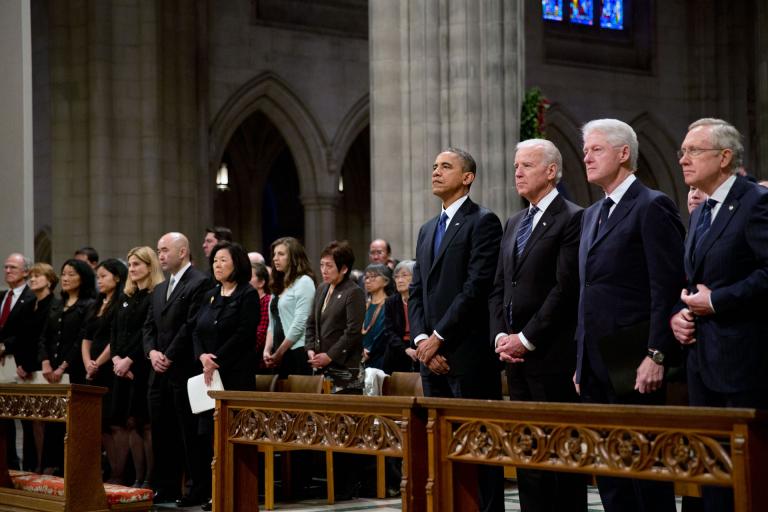
President Barack Obama, Vice President Joe Biden, former President Bill Clinton, and Senate Majority Leader Harry Reid, attend the funeral service for Hawaiian Senator Daniel Inouye at Washington National Cathedral in Washington, D.C., Dec. 21, 2012. Senator Inouye’s family stands at left. (Official White House Photo by Pete Souza) – CC BY 3.0 US (https://creativecommons.org/licenses/by/3.0/us/)
I am following the train of thought I’ve taken for these first few days of clean week: first on neoconservatism, then on ‘the kids are all Democrats,’ and then on the politics of the Kyivan Church. My spiritual father told me in my catechumenate, which I am reliving for the Great Fast, that ‘politics is very close to my soul.’ Therefore, I offer the following tentative thoughts on church politics for anyone who wants to psychoanalyze me further.
I was seven when I first learned the words ‘church politics.’ I had come down to the kitchen to see my mom and dad discussing something. When I asked them what it was, they both looked at each other, their eyes asking if they should tell me. They first said that I couldn’t know what they were talking about. I thought that that was odd, so I walked away slowly, just slow enough for them to reverse their decision. I came back. Then they told me that we were going to leave our church.
I began to cry and cry and cry and cry. It was uncontrollable, and frankly, irrational too. We had begun going to a new church just a few years ago so that my father could fulfill his pastoral internship requirements. I had made some friends there, mostly a few years older than me. Between Sunday school and Chinese school, they had taught me to play pogs, those circular discs that you stack on the playground and then slam to see which ones fulfill your bet. Some of them had computers, which my family did not have, and they played a game called Lemmings, which I really liked. They also had cool board games that I had never played, like Clue, which was exciting because any one of my friends could have killed Mr Boddy (it was never me). Also, the pastor’s daughter, a high school junior, looked like one of those girls that just floated out of the movies. We called her ‘big sister,’ a jiejie 姐姐, but I always thought of her as a ‘family big sister,’ a gahjie 家姐. The reason I cried so hard was because I wouldn’t get to see my ‘big sister’ at church on the weekends anymore. I liked her. Of course when my parents asked why I was bawling uncontrollably, I didn’t say that it was because of ‘big sister.’ Even a seven-year-old knows when a relationship is too complicated to explain.
My parents explained to me that we were leaving that church because of ‘church politics.’ Where there are people, there are politics, my mom said. I did not know what ‘politics’ were – I was seven – but it sure sounded bad. As I listened more, I learned that ‘big sister’s’ dad was not very nice to my dad. It turned out that that church’s pastor, as my father’s internship supervisor, was not pleased that my parents, who are people with Cantonese dignity, were not content to be his money-making minions. They wanted my mom, a graduate of a prestigious Hong Kong university with a Chinese literature major, to be the volunteer principal of their Chinese school. The school, however, was a for-profit enterprise. The money would go back to the pastor’s family. My parents wouldn’t see a penny, but that was the lot (so the reasoning went) for someone doing their internship at this church. My parents, naïve about the political consequences of being people of dignity, refused. The pastor then wrote a number of letters to my dad’s seminary professors about his bad performance. It was an untenable situation. Of course, my dad performed ridiculously well. When he left, he took a number of the people with him too, and he had been just an intern.
This, I learned, was called politics. As far as I understood it, politics is when bad people have super secret plans to use a situation to amass wealth and power for themselves. As far as Chinese Christian lingo (which aligns very well with politically conservative rhetoric) is concerned, politics is equated with the catch-all phrase having your own agenda. I did not know what an agenda was, and I was very confused soon afterward when we returned to the old church – the one we had originally left to come to this new church with this scheming internship supervisor – to learn that my dad had to prepare an agenda when he went to committee meetings with the ‘board of deacons’ (‘deacons’ in evangelical churches are the trustees; they are not ordained). It was not until much later that I also learned how to prepare an agenda for meetings. I felt very guilty about writing up agendas until I realized that it was not my agenda that I was preparing, but it was the schedule for the meeting to follow in which it was everybody’s agenda. In hindsight, then, I feel like having your own agenda is actually not so bad of a euphemism for shady politics at churches. It means that while everyone else is following the common agenda for the meeting, you’ve got your own schedule in your pocket, ready to be pulled out when it is convenient.
In short, politics were dirty. If you played them, you were unclean; this is what it meant to be dirtier than a politician. I didn’t know what a politician was, but I kept on hearing about this guy called Bill Clinton, who had been elected when I was in kindergarten. We were permanent residents from Canada – ‘resident aliens,’ I learned when I was four – but that didn’t stop me from voting in my school’s mock elections. We had secret ballots on which you could write the first name of your favored candidate: ‘B’ for Bush, ‘C’ for Clinton, ‘P’ for Perot. I went home and asked my parents whom I should vote for. They said that they’d probably vote for Bush because he looked like he had experience, unlike Clinton. They asked me if I had heard of a president called Reagan; they really liked him because that guy really looked like he had experience. As far as Clinton went, they said that they didn’t trust him. He didn’t have experience, and he didn’t look like the kind of guy who was trustworthy. Maybe he even had his own agenda. So I went back and entered ‘B’ in the mock election. Bush lost, in the mock election and in the general one too. And we were a Christian school.
Politics were bad because it usually involved people having their own agenda trying to seize power without any regard for the actual people it was affecting. Politics were what ‘big sister’s’ dad had played; that is why my dad finished his internship in pain and left the church, which left me in a lurch when it came to my pogs friends and seeing ‘big sister’ every weekend. Politics were also played in my dad’s deacon board; that’s why he frequently came home from them fuming about how yet another someone – usually some uncle on the board – had been advancing his own agenda again, usually in a way that screwed the pastoral staff (of which my dad was a part). There is a joke among pastor’s kids about one of our kind who was bullied and sought to cuss out his assailant. But pastor’s kids don’t know too many cuss words, so all that came out of the kid’s mouth was, You board member!
Politics are also what you play when you are spiritually immature, I surmised. Take Bill Clinton as an example again. My parents saw the fruit of his inexperience when he finally ‘did not have sexual relations with that woman.’ For them, it spoke to what happens when you are advancing your own agenda: you are probably immoral, and you will eventually get caught with your pants down. Of course, I did not know what ‘sexual relations’ were. I asked my parents what that was, and they said that it was when you ‘have sex.’ I always thought of ‘sex’ as either being a boy or a girl – or in fancypants terms, ‘male’ or ‘female.’ I did not know what it meant that Bill Clinton ‘had sex’ with that woman, but having a boy or a girl with Monica Lewinsky sounded weird, lewd, and strange all at the same time. For AWANA – the children’s program at church I was part of where we memorized Bible verses and played games while wearing scout uniforms – I had to write my representative in the House as an ‘act of patriotism.’ I decided to write to him about Bill Clinton being a bad example for having sex, whatever that meant. The Honorable Pete Stark was a Democrat. He wrote me back to say that the president’s private life was his own business.
In this sense, politics were secular – ‘of the world.’ They were what folks like Bill Clinton did. They were not what people in church should be doing. Playing politics in the church could be dangerous stuff. Our church was embroiled in a sex scandal the next year. My dad, the only guy who was clean because he wasn’t involved in the politics, handled it. I am not sure what it means to say that he was not involved at the same time that he handled it, but this formulation was possible in our way of thinking about politics as dirty, especially in the church, because they were secular, worldly, and certainly not of God.
And yet, I have been arguing precisely the opposite in these recent set of posts. I have said that my spiritual father says that politics is close to my soul, but what I have also implied is that as apolitical as others in the church might be, our engagement together in our common life together is still politics.
But this understanding of the political, while still a little dirty in the sense that getting involved in the rough and tumble never makes for clean hands, doesn’t seem to be all about people having their own agendas and amassing power, wealth, and sex through the church and in the world. So what is this other way of understanding politics? Is it still secular? Is it really appropriate for the church, especially in my new home in Eastern Catholicism? How did I come to this new way of thinking, and even before that, how did I get to the point where my spiritual father said that politics has become close to my soul?
I’ll continue to ask these questions during this Fast, probing my memory for hints about the missing parts of my journey. As far as ‘big sister’ was concerned, I saw her again once about a year after we left that church. It was at a gathering of people who were supporters of my dad when he was an intern. For some reason, ‘big sister’ showed up, even though her dad had been so unkind to my father. It was awkward at first, but we started playing board games. Poetically, I think we played SORRY. Some moments were quiet and peaceful; at other points, we roared with so much laughter that the adults had to come shut us up. Though we never saw each other again, I have reflected on this moment and come to a startling realization: the devastation of bad church politics can never fully eviscerate the conviviality of such ecclesial sibling love. Perhaps it is out of such life and love that cannot be repressed from which a good politics emerges.
Next Post

February 23, 2018 Billy, Bob, Dick, Mark, Tom, and me (Great Fast #5)
Browse Our Archives
Select a Category Academia Anglican Communion anti-racism Aristotle Asia-Pacific Asian American Asian Canadian BlackLivesMatter Cantonese Catholic China Chinglican church politics Church-State Politics Civil Society Conservative Eastern Christianity Evangelical Evangelical Left Feminist/Womanist Theology Food Greek-Catholic Church of Kyiv Hong Kong Housekeeping Kyivan Church Latin Catholicism Law Liberal Liberation Theology New Calvinism Pentecostal/Charismatic Protestant Psychoanalysis Publics Religion Ethnicity Wired Secular Sovereignty TPCIU Uncategorized
Select a Month July 2019 June 2019 May 2019 April 2019 March 2019 February 2019 January 2019 December 2018 November 2018 October 2018 September 2018 August 2018 July 2018 June 2018 May 2018 March 2018 February 2018 January 2018 December 2017 November 2017 October 2017 September 2017 August 2017 July 2017 June 2017 April 2017 March 2017 February 2017 January 2017 December 2016 November 2016 October 2016 September 2016 August 2016 July 2016 January 2016 December 2015 November 2015 October 2015 August 2015 April 2015 March 2015 February 2015 December 2014 November 2014 September 2014 August 2014 July 2014 June 2014 May 2014 April 2014 March 2014 December 2013 November 2013 October 2013 September 2013 August 2013 July 2013 June 2013 May 2013 April 2013 March 2013 February 2013 January 2013 December 2012 October 2012 June 2012 May 2012 April 2012 February 2012 January 2012
Follow Us!
TAKE THE
Religious Wisdom Quiz
What is the central prayer of Christian faith, taught by Jesus?
Select your answer to see how you score.
The Shema The Hail Mary The Jesus Prayer The Lord's Prayer
Related posts from Eastern Catholic Person

I've found my way home: on the unraveling...

I am no longer ashamed of being from...

Patriyarkhat: 'Attending to the movements of my heart'

I'm flattered to be named an Asian American...
TRENDING AT PATHEOS Catholic

Rejecting Doom: Christian Hope And Human Action
Christianity is a religion of hope. We are to have hope and...

It’s What Comes From Within Which Matters
One of the most difficult things for us to understand is why...

Why I Choose the Eucharist Over the Sermon
Choose the Eucharist, Not the Sermon What are we supposed to get...

5 Design Elements Found in Spiritually Rooted Homes
Putting Spirituality Into Home Decor Our homes are more than our living...

Credo: A Story of God Told with the...
About 10 years ago, I began to imagine a personal "Credo" that...

The Anatomy of Divine Revelation in Catholic Thought
The claim that God has made Himself known to human beings is...
view all Catholic blogs
Ad-Free & Subscriber Log-In Subscription Support
- About Us
- 2026 Calendar
- Videos
- Podcasts
- Library of World Religions
- Faith In Media Tracker
- Advertise With Us
- Write for Us
- Privacy Policy
- Terms of Service
- Do Not Sell My Data
- Contact Us
- Radiant Digital
- Manage Newsletter Subscriptions
- Unsubscribe From Notifications
- Sitemap
Copyright 2008-2026, Patheos. All rights reserved.
Subscription Support Ad-Free & Subscriber Log-In
Follow Patheos