
BuddhistCatholicContemplativeEvangelicalGeneral ChristianHinduJewishLatter-day SaintMuslimNew VisionsProgressive Christian
Beliefs
- Buddhist
- Catholic
- Contemplative
- Evangelical
- General Christian
- Hindu
- Jewish
- Latter-day Saint
- More Voices
- Muslim
- New Visions
- Pagan
- Progressive Christian
Topics
- Religion News
- Food and Religion
- Sports and Religion
- Religious Art
- Religious Music and Entertainment
- Religious Events
- History and Religion
- Style and Religion
- Politics and Religion
- Women in Religion
- Recreation Outdoors and Religion
- Business Finance and Religion
- Careers Workplace and Religion
- Education and Religion
- Family Parenting and Religion
- Health Fitness and Religion
- Home and Religion
- Relationships and Religion
- Technology and Religion
- Travel and Religion
Columnists
- Buddhist Columnists
- Business Finance and Religion Columnists
- Careers Workplace and Religion Columnists
- Catholic Columnists
- Contemplative Columnists
- Education and Religion Columnists
- Evangelists Columnists
- Family Parenting and Religion Columnists
- General Christian Columnists
- Health Fitness and Religion Columnists
- Hindu Columnists
- History and Religion Columnists
- Home and Religion Columnists
- Jewish Columnists
- More Voices Columnists
- Latter Day Columnists
- Muslim Columnists
- New Visions Columnists
- Nonreligious Columnists
- Pagan Columnists
- Politics and Religion Columnists
- Progressive Columnists
- Recreation Outdoors and Religion Columnists
- Relationships and Religion Columnists
- Religion News Columnists
- Religious Art Columnists
- Religious Events Columnists
- Religious Music and Entertainment Columnists
- Sports and Religion Columnists
- Style and Religion Columnists
- Technology and Religion Columnists
- Travel and Religion Columnists
- Women in Religion Columnists
Resource Library
- 2026 Calendar
- Library of World Religions
- The 100 Most Holy Places on Earth
- Patheos Answers
- Podcasts
- Videos
- Faith Leaders Database
- Anglican Episcopalian
- Bahai
- Baptist
- Buddhism
- Christianity
- Confucianism
- Eastern Orthodoxy
- Hinduism
- Holiness and Pentecostal
- ISKCON
- Islam
- Judaism
- Lutheran
- Methodist
- The Church of Jesus Christ of Latter-day Saints
- New Age
- Paganism
- Presbytarian and Reformed
- Protestantism
- Religion Behind the Scenes
- Roman Catholic
- Scientology
- Shia Islam
- Sikhism
- Sufism
- Sunni Islam
- Taoism
- Zen
- See all religions
Research Tools
 Ad-Free & Subscriber Log-In Subscription Support
Ad-Free & Subscriber Log-In Subscription Support
Follow Patheos 

- Trending:
- Forgiveness
- |
- Marriage
- |
- Consciousness
- |
- Death Penalty
- |
- Election
- |
- Halloween
 Eastern Catholic Person
- Home
- Catholic
- The Freud candle house blessing
The Freud candle house blessing
Last updated on: February 14, 2018 at 10:32 am by Justin Tse
The Freud candle house blessing 2018-02-14T10:32:11-07:00 Justin Tse
Patheos Explore the world's faith through different perspectives on religion and spirituality! Patheos has the views of the prevalent religions and spiritualities of the world.
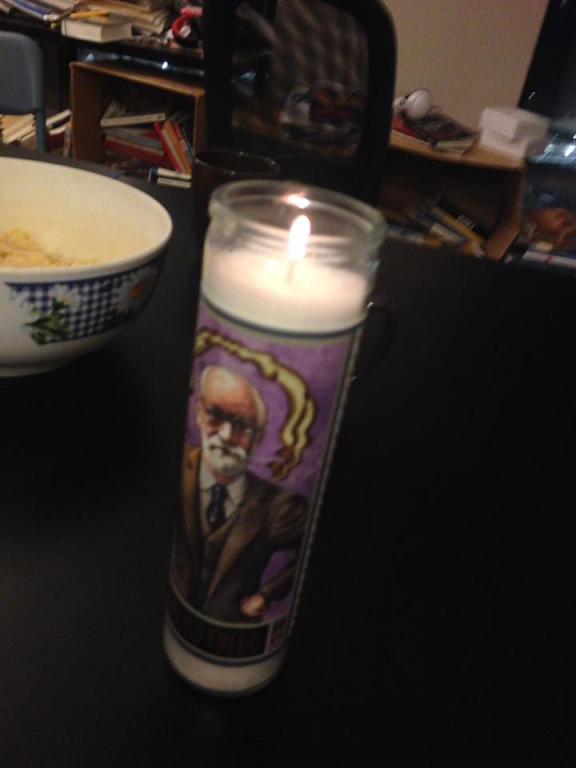
Freud candle – photo by me
A few Sundays ago, I invited the group that I facetiously call the Kyivan Psychoanalysis Study Group to my apartment for a house blessing. It was a few weeks after Theophany, and we have a tradition in the Kyivan Church that the holy water that we bless to make present in our lives the baptism of Christ should be spread to our homes as well. Christ is baptized in the Jordan by John, sanctifying all the waters of creation by laying claim to them with his body. In the blessing of the home, Christ proclaims his ownership of the the everyday space where I live as well.
It occurred to me after I invited everyone over that I would need to do some cooking. One member of the group messaged me asking whether we would be having dinner. Of course, said I impulsively, remembering the chicken congee I had made the night before. The next day, I went down to the store and bought some chicken thighs. An hour before everyone arrived, I began baking them.
People trickled in to the smell of baking chicken thighs. One member of the group said that I had this Ukrainian thing down pat. I hope he liked the thighs. Most people told me they were good, actually, but I found them a little too oily. If anything needed improvement, it was the rice that was too dry, as I recall our Asian American feminist blogger member saying. Her name is Grace Yu, and she is going to have a blog, and it’s ok that she said that, because she brought a bacon salad, and we like bacon. Another couple brought a homemade apple pie.
One of the unofficial leaders of our group is Fr Myron Panchuk. He has a PhD in depth psychology, and we bonded over pizza and our shared affinity for the Giant of Ljubljana, Slavoj Žižek. His assistant came with some of the materials for a house blessing: his epitrakhil (the thing a priest wears around the neck), a blessing cross, holy water, and a candle. Have a look at the candle, Fr Myron said. The brand on the tag was ‘Secular Saints,’ and it had an icon of St Sigmund of Vienna, with an attached prayer invoking his deliverance from dark phantasies of the night. It was a Freud candle. One of our members had found it in a store in Milwaukee and given it to Fr Myron as a gift. Now Fr Myron was returning the favour by using it in the blessing of my apartment.
I have been reflecting in this Preparation period for the Great Fast on this moment. I was not exactly sure why it stayed with me so much, other than the Freud candle joke being a little over the top. It could have been that when the singing started, I realized that we might have some of the best singers in the Kyivan Church in our group. It might have been the jovial, bourbon-infused conversation around the table afterward. Perhaps it was that afterward, we even skyped Eugenia Geisel in from Seattle.
But in the quietness of my heart, I think I know what was going on. Fr Myron points out in his dissertation that Freud was a Ukrainian Jew who faced racism as he worked in the hospital in Vienna. Having published widely in neuropathology, he opened a clinic. But what is often missed in the popular renditions of Freud is that his patients were a lot like him: they were Jewish, often from the eastern parts of the Austro-Hungarian Empire, who faced day-to-day antisemitism. It took some of Freud’s admirers like Adler and Jung to popularize psychoanalysis beyond this racialized community, but when they did, the racializing experience of modern colonization on the human psyche became a little muted. Of course, the theorist of colonization Frantz Fanon was himself a practicing psychiatrist in Algeria, where he became a revolutionary. But there is something to be said for how Fanon is often known as an anti-colonial psychoanalyst, as if you need the qualifier because psychoanalysis is supposed to be European and therefore white. It is not. It was born out of an experience of racism.
Fr Myron and I have talked at length about how historic and contemporary experiences of Ukrainian marginality, Jewish and otherwise (for this distinction, Ukrainians are often trolled, though the actual relations are very complex because they are not in a zero sum relationship), have led to all sorts of pathologies. Actually, I have had more than one conversation with more than one person about this. A Ukrainian in Richmond told me that there is a kind of shame for some family members who had been in the Ukrainian Insurgent Army, or UPA, as goes the Ukrainian acronym. Julian Hayda, who was the actual purchaser of the Freud candle, crafted the following statement when I asked him more about UPA:
No matter which side of the Second World War the conventional colonizers were on, UPA was on the other side. To the Soviets, their resistance to Russian hegemony was a threat. To the Nazis, Slavs were on the second-lowest rung of racial hierarchy, but their disenfranchisement made for easy exploitation. Many interwar insurgents, including UPA, initially collaborated with the Nazis against Polish and Soviet imperialists, for example. For some, it was a way of avoiding Nazi slave labor camps which other Slavs had been imprisoned in. They were referred to as “osterbeiters” or “Eastern laborers” in German. When the war ended, UPA soldiers and osterbeiters alike were not treated very well in the refugee camps. Some hoped the U.S. would provide shelter, while others were accused of real or perceived Nazi collaboration and ended up in Siberian labor camps. Some hid their identities as they fled from Europe. Some, like John Demjanjuk, were discovered living in America by German law enforcement decades later, and, in an effort to vindicate the Germans, were falsely prosecuted for war crimes.
It is not easy to live with that kind of family history, knowing that the trauma is not just something that was done to you, but something that you may have been complicit in too, that the historic experience of the European colonization of Ukrainian lands made your ancestors misread the powers that be and side with the worst of people. The danger of a colonized people being non-ideological is that you don’t know what ideologies are colonizing you. Antisemitism in this case is not just an act of horrendous colonization; it is also its symptom. It is difficult to live with this knowledge. It stymies your capacity for liberation, as you know deep down that you too were and probably still are an oppressor. It can even lead to suicide.
No wonder popular forms of psychoanalysis also pervade Chinese evangelical communities. The impression that the churches of my youth is that we are a bunch of Bible-thumping fundamentalists. Nothing could be further from the truth. Since the 1980s, the elites in these churches all found their way into some kind of counseling psychology study and work with the hope of helping Chinese people ‘heal.’ We too have our family traumas, memories of war, and experiences of colonization. Our symptom, then, is that we search for this, that, and the other pop psychology model to heal ourselves and grow our churches: the church growth movement, spiritual gifts checklists, enneagrams, Myers-Briggs, gay conversion therapy, family systems theory, contagious Christianity, cell group models, authentic sharing, basic life principles, kissing dating goodbye.
Ironically, the effect that all of this intellectual shopping has had on the Chinese evangelical communities I’ve experienced has been a kind of haphazard thought control. You don’t just talk to people at church; you have to dig deep into their feelings and mine them for whether they are on mission contributing to the growth of God’s kingdom. Talking about feelings, doing authentic life together, understanding each other’s personalities, and so on is supposed to liberate. But in practice, it just piles repression on top of repression. Oftentimes, there is no fellowship in such communities. It’s a panopticon with people who aren’t very good at surveillance because what they are really doing is trying to see themselves in you. Our group’s Asian American feminist blogger, Grace, tells me that her experience is slightly different. Then again, she also has an obsession with what ‘community’ is too, partly because of these dynamics in her history with evangelicalism, Chinese or otherwise. Maybe she’ll work it out differently from me. I have a lot to learn from her.
But what I experienced that night at the house blessing was a kind of spontaneous conviviality, and Grace said so too. We were not using psychoanalytical techniques on each other; we used a Freud candle as a joke in the house blessing. But jokes, as Freud would say, give the lie to something more serious going on. In our laughing and eating and talking mostly nonsense with no agenda, we took the lid off of a kind of neurotic repression and just let the words hang out. This was not the first time I had experienced this feeling in the Kyivan Church; in Richmond, our coffee hour is equally chaotic and convivial, and Chinese Protestants who experience it tell me that this is the kind of fellowship they had always longed for. But blessing the apartment with a Freud candle gave these feelings a kind of quasi-liturgical form. We are a church of beautiful chaos, a deacon in our eparchy likes to tell me, and as I think of it, I am not surprised that one of the major theologians in our church, Adam DeVille, has been writing extensively about Freud these days too.
Perhaps these reflections make for a theological agenda that is emerging in our church. I don’t know. What I do know is that as we blessed the apartment with the waters of creation, we were together in convivial joy. We saw a crack in the repressions of our complex colonized communities. But I do not pretend to know where that opening might lead, except that I’ll be pondering it a lot more during the Great Fast.
Previous Post

February 13, 2018
Tolstoy and my model minority mirror
Next Post
February 15, 2018 They call me Prof Yenta
Browse Our Archives
Select a Category Academia Anglican Communion anti-racism Aristotle Asia-Pacific Asian American Asian Canadian BlackLivesMatter Cantonese Catholic China Chinglican church politics Church-State Politics Civil Society Conservative Eastern Christianity Evangelical Evangelical Left Feminist/Womanist Theology Food Greek-Catholic Church of Kyiv Hong Kong Housekeeping Kyivan Church Latin Catholicism Law Liberal Liberation Theology New Calvinism Pentecostal/Charismatic Protestant Psychoanalysis Publics Religion Ethnicity Wired Secular Sovereignty TPCIU Uncategorized
Select a Month July 2019 June 2019 May 2019 April 2019 March 2019 February 2019 January 2019 December 2018 November 2018 October 2018 September 2018 August 2018 July 2018 June 2018 May 2018 March 2018 February 2018 January 2018 December 2017 November 2017 October 2017 September 2017 August 2017 July 2017 June 2017 April 2017 March 2017 February 2017 January 2017 December 2016 November 2016 October 2016 September 2016 August 2016 July 2016 January 2016 December 2015 November 2015 October 2015 August 2015 April 2015 March 2015 February 2015 December 2014 November 2014 September 2014 August 2014 July 2014 June 2014 May 2014 April 2014 March 2014 December 2013 November 2013 October 2013 September 2013 August 2013 July 2013 June 2013 May 2013 April 2013 March 2013 February 2013 January 2013 December 2012 October 2012 June 2012 May 2012 April 2012 February 2012 January 2012
Follow Us!
TAKE THE
Religious Wisdom Quiz
How many seals, trumpets, and bowls of judgment are there in Revelation?
Select your answer to see how you score.
Seven each Five each Ten each Twelve each
Related posts from Eastern Catholic Person

I've found my way home: on the unraveling...
Tiananmen is my first childhood memory: reflections on...

Patriyarkhat: 'Attending to the movements of my heart'

I'm flattered to be named an Asian American...
TRENDING AT PATHEOS Catholic

Rejecting Doom: Christian Hope And Human Action
Christianity is a religion of hope. We are to have hope and...

It’s What Comes From Within Which Matters
One of the most difficult things for us to understand is why...

Why I Choose the Eucharist Over the Sermon
Choose the Eucharist, Not the Sermon What are we supposed to get...

5 Design Elements Found in Spiritually Rooted Homes
Putting Spirituality Into Home Decor Our homes are more than our living...

Credo: A Story of God Told with the...
About 10 years ago, I began to imagine a personal "Credo" that...

The Anatomy of Divine Revelation in Catholic Thought
The claim that God has made Himself known to human beings is...
view all Catholic blogs
Ad-Free & Subscriber Log-In Subscription Support
- About Us
- 2026 Calendar
- Videos
- Podcasts
- Library of World Religions
- Faith In Media Tracker
- Advertise With Us
- Write for Us
- Privacy Policy
- Terms of Service
- Do Not Sell My Data
- Contact Us
- Radiant Digital
- Manage Newsletter Subscriptions
- Unsubscribe From Notifications
- Sitemap
Copyright 2008-2026, Patheos. All rights reserved.
Subscription Support Ad-Free & Subscriber Log-In
Follow Patheos