
BuddhistCatholicContemplativeEvangelicalGeneral ChristianHinduJewishLatter-day SaintMuslimNew VisionsProgressive Christian
Beliefs
- Buddhist
- Catholic
- Contemplative
- Evangelical
- General Christian
- Hindu
- Jewish
- Latter-day Saint
- More Voices
- Muslim
- New Visions
- Pagan
- Progressive Christian
Topics
- Religion News
- Food and Religion
- Sports and Religion
- Religious Art
- Religious Music and Entertainment
- Religious Events
- History and Religion
- Style and Religion
- Politics and Religion
- Women in Religion
- Recreation Outdoors and Religion
- Business Finance and Religion
- Careers Workplace and Religion
- Education and Religion
- Family Parenting and Religion
- Health Fitness and Religion
- Home and Religion
- Relationships and Religion
- Technology and Religion
- Travel and Religion
Columnists
- Buddhist Columnists
- Business Finance and Religion Columnists
- Careers Workplace and Religion Columnists
- Catholic Columnists
- Contemplative Columnists
- Education and Religion Columnists
- Evangelists Columnists
- Family Parenting and Religion Columnists
- General Christian Columnists
- Health Fitness and Religion Columnists
- Hindu Columnists
- History and Religion Columnists
- Home and Religion Columnists
- Jewish Columnists
- More Voices Columnists
- Latter Day Columnists
- Muslim Columnists
- New Visions Columnists
- Nonreligious Columnists
- Pagan Columnists
- Politics and Religion Columnists
- Progressive Columnists
- Recreation Outdoors and Religion Columnists
- Relationships and Religion Columnists
- Religion News Columnists
- Religious Art Columnists
- Religious Events Columnists
- Religious Music and Entertainment Columnists
- Sports and Religion Columnists
- Style and Religion Columnists
- Technology and Religion Columnists
- Travel and Religion Columnists
- Women in Religion Columnists
Resource Library
- 2026 Calendar
- Library of World Religions
- The 100 Most Holy Places on Earth
- Patheos Answers
- Podcasts
- Videos
- Faith Leaders Database
- Anglican Episcopalian
- Bahai
- Baptist
- Buddhism
- Christianity
- Confucianism
- Eastern Orthodoxy
- Hinduism
- Holiness and Pentecostal
- ISKCON
- Islam
- Judaism
- Lutheran
- Methodist
- The Church of Jesus Christ of Latter-day Saints
- New Age
- Paganism
- Presbytarian and Reformed
- Protestantism
- Religion Behind the Scenes
- Roman Catholic
- Scientology
- Shia Islam
- Sikhism
- Sufism
- Sunni Islam
- Taoism
- Zen
- See all religions
Research Tools
 Ad-Free & Subscriber Log-In Subscription Support
Ad-Free & Subscriber Log-In Subscription Support
Follow Patheos 

- Trending:
- Forgiveness
- |
- Marriage
- |
- Consciousness
- |
- Death Penalty
- |
- Election
- |
- Halloween
 Eastern Catholic Person
- Home
- Catholic
- Tolstoy and my model minority mirror
Tolstoy and my model minority mirror
Last updated on: February 13, 2018 at 7:18 am by Justin Tse
Tolstoy and my model minority mirror 2018-02-13T07:18:06-07:00 Justin Tse
Patheos Explore the world's faith through different perspectives on religion and spirituality! Patheos has the views of the prevalent religions and spiritualities of the world.
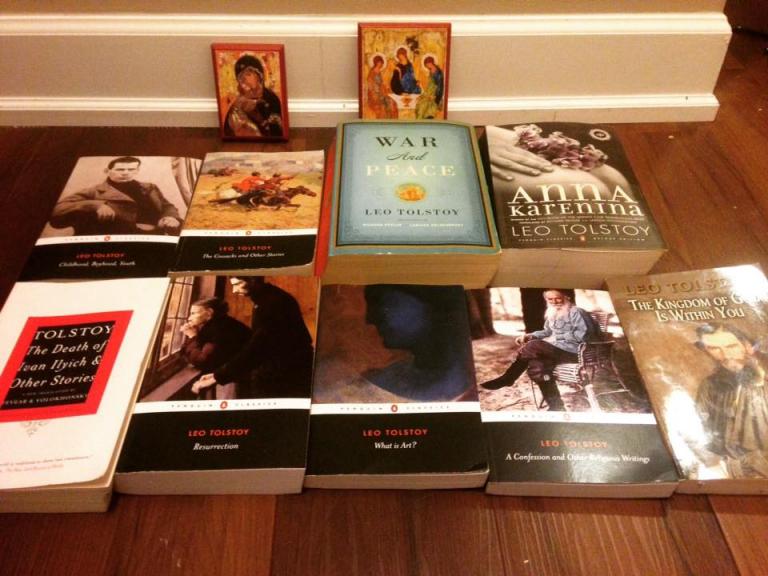
Tolstoy binge ready – photo by me
Yesterday I wrote about how I recently read Tolstoy’s ‘Kreutzer Sonata’ during this Preparation period for the Great Fast. My comments were in the context of discovering that I practiced a habit from evangelical Protestantism of seeing the world, texts I was reading, and other people as mirrors. I had written a short story titled ‘The Goldberg Variations’ without ever reading Tolstoy’s story. The piece I wrote is an unredeemable disaster; I read it a few weeks ago, and it was torture. The more I have grown in my scholarly journey and in my fledgling Eastern Catholic praxis, the more I feel that I am able to break the mirror. My sense is that Tolstoy is going to be helpful, so I hope to use this year’s Great Fast to read more of him.
I got back into Tolstoy when I began to blog on Patheos. My channel editor at the time, Sam Rocha, told me to read Tolstoy’s ‘Death of Ivan Ilyich.’ At that point, I had not read Tolstoy for many years. A lecture on Dostoevsky as the school year started for the first year of my PhD prompted me to re-read The Brothers Karamazov. But the truth is that I had not read Russian literature for many years, not since a seminar during my history undergrad scarred me with our haphazard attempt to use Russian novels by Turgenev, Dostoevsky, Nagrodskaya, and Bely as primary sources for the writing of history.
The other truth is that I had started reading Tolstoy in junior high. I had done so to impress a girl. I had overheard someone asking her to come over to hang out, and she had retorted that she’d only come if there were a bookshelf of classics. She also told me that she was reading War and Peace. I knew she was my type because she was Chinese and smart. Accordingly, I also read War and Peace.
I cannot say that I understood it. I remember getting a sense that Napoleon was invading Russia, which confused me because I thought he was a French guy. I was very bad at modern European history. But the characters of Prince Alexei, Natasha Rostova, and Pierre Bezukhov really stood out to me. I even got excited because my translation said that some pervert called Prince Anatole ‘makes love’ to Natasha. It was very exciting because my only reference point for Russian characters at the time were James Bond films, so I plugged in a few Bond girls into the character, not knowing that Audrey Hepburn plays Natasha in the movie adaptation. A few years later, I did the same thing for a bunch of Dostoevsky novels. I suppose this is what happens when one grows up in a suburban fantasyland.
The problem is that when I got to the lovemaking chapter in War and Peace (in fact, I may have flipped ahead, seeing that it was in the table of contents), all they ever did was kiss. At least that is what they did in the translation I read. That was pretty disappointing, and it wasn’t until the end when Pierre and Natasha are in bed that she grabs him and says, You’re mine, you’re mine, you’ll never get away! This scene occurs before that very boring essay Tolstoy put at the end of War and Peace about historiography. About a year later, I learned that Tolstoy had another book that was all about sex. It was called Anna Karenina, and my impression was that it would make up for all the disappointments of War and Peace. It did not. I sat there for hours and hours waiting for that Konstantin Levin guy to just ask a girl out already.
I would not say that Tolstoy did not get under my skin, even though I obviously had no idea what I was reading. Needless to say, the girl didn’t work out. Later on in grad school, I tried to convince another girl that I thought had been dating over the summer (it was one of those relationships where none of the dates were actually dates) that we could still go out because that’s like what Pierre and Natasha do in War and Peace. The ploy did not work.
All of this is to say that I have never really been a good reader of Tolstoy. I will venture to say that when I obeyed Sam and read ‘The Death of Ivan Ilyich,’ I was struck by how Ivan Ilyich’s bureaucratic life feels a little bit like how most people in my world talk about their occupations now. Lawyers, academics, journalists, and politicians say a lot even in public about having to suck up to people, attend meetings, make family life look respectable, and engage in small acts of collegial betrayal to get ahead. It was very powerful when it dawned on Ivan Ilyich that he had wasted his whole life, that the only time he was ever truly happy was when he was a child. In that moment, I thought of myself. I do not know if that is a good thing or not.
The friends who have had the unfortunate pleasure of reading my Sea Changes stories in full have mused with me about why I am such a bad reader of Tolstoy. One of these friends has read a lot of Tolstoy. She is also a former student of mine. Actually, she is Eugenia Geisel.
Eugenia tells me that what is weird about my approach to Tolstoy is that I was reading him as a kind of model minority, the smart Chinese boy who reads long books just because they are long. I agree, as this is the same reason a number of Asian Americans read Ayn Rand: you can kill someone by chucking The Fountainhead and Atlas Shrugged at them. The problem is that Tolstoy does not lend himself to a model minority reading. If ‘The Death of Ivan Ilyich’ is any indication, he’s against getting ahead at the risk of losing your own soul – or worse, as in ‘The Kreutzer Sonata,’ repressing your erotic inclinations until they explode and you stab somebody. It is a little funny that she picked up on the model minority bit so quickly. The truth is that I encountered the title ‘The Kreutzer Sonata’ in a Borders while looking for a copy of the Asian American historian Ronald Takaki’s tome Strangers from a Different Shore. The reason I hadn’t read that short story until recently was that I picked up the Takaki instead and gave it to my dad for his birthday. He read it on a plane and told me that he cried. I learned that Asian Americans have suffered a lot, he said.
The conclusion that my friends (especially Eugenia) and I reached together is that I need to read a lot more Tolstoy over this Great Fast – and not just his fiction, but his theology too. I had been afraid that it would come to this point for some time. I have learned that Tolstoy didn’t treat his wife Sonya very well. In fact, he ended up leaving her and dying on a train ten days later. Tolstoy’s practice of marriage – and his views about women more generally – struck me as atrocious. Whatever his influence on Gandhi and King might have been, I did not want to be learning from such a man.
But as my friends and I discovered, breaking the mirror has its advantages. It turns out when I don’t need Tolstoy to be my mirror – a status symbol as the model minority, the articulator of my erotic fantasies, the guide out of a life shackled by institutional bureaucracy – then I can read him as he is. Tolstoy is not me, and I am not him. What it means to engage him is to critique him, but to criticize, I have to have read him closely.
If my memory and recent readings serve me well, I suspect what I’ll find in Tolstoy is an account of the ‘everyday supernatural.’ I don’t know if it will match my reading of the world, but I don’t think I need it to. I am, however, curious about this man who could be considered at some level as part of the Russian elite attempting to give up as much power as he could, especially in trying to relate as a person to the peasants on his land. My sense is that what I have to do is to get inside his imagination, to see the world as he is describing it. In this way, I will not only be learning from his wisdom – I will be able to criticize him too.
The discipline over the Great Fast will be to not impose what I want him to say onto Tolstoy. This will be hard because it is already a longstanding habit of mine. But I suppose what this means is that all of the psychological drama that is seared into my mind from Tolstoy’s books – the erotic repression, the depressive paralysis, the disappointments in love, the guilt over elitism, the folk phenomenology – will be given new life for me. Maybe I’ll finally understand what Konstantin Levin was all about.
Previous Post

February 12, 2018
Writing myself to a sea-change
Next Post
February 14, 2018 The Freud candle house blessing
Browse Our Archives
Select a Category Academia Anglican Communion anti-racism Aristotle Asia-Pacific Asian American Asian Canadian BlackLivesMatter Cantonese Catholic China Chinglican church politics Church-State Politics Civil Society Conservative Eastern Christianity Evangelical Evangelical Left Feminist/Womanist Theology Food Greek-Catholic Church of Kyiv Hong Kong Housekeeping Kyivan Church Latin Catholicism Law Liberal Liberation Theology New Calvinism Pentecostal/Charismatic Protestant Psychoanalysis Publics Religion Ethnicity Wired Secular Sovereignty TPCIU Uncategorized
Select a Month July 2019 June 2019 May 2019 April 2019 March 2019 February 2019 January 2019 December 2018 November 2018 October 2018 September 2018 August 2018 July 2018 June 2018 May 2018 March 2018 February 2018 January 2018 December 2017 November 2017 October 2017 September 2017 August 2017 July 2017 June 2017 April 2017 March 2017 February 2017 January 2017 December 2016 November 2016 October 2016 September 2016 August 2016 July 2016 January 2016 December 2015 November 2015 October 2015 August 2015 April 2015 March 2015 February 2015 December 2014 November 2014 September 2014 August 2014 July 2014 June 2014 May 2014 April 2014 March 2014 December 2013 November 2013 October 2013 September 2013 August 2013 July 2013 June 2013 May 2013 April 2013 March 2013 February 2013 January 2013 December 2012 October 2012 June 2012 May 2012 April 2012 February 2012 January 2012
Follow Us!
TAKE THE
Religious Wisdom Quiz
What does "Sheol," often found in Psalms, mean?
Select your answer to see how you score.
Blessing The grave or abode of the dead Eternal light Above the mountain
Related posts from Eastern Catholic Person

I've found my way home: on the unraveling...

Patriyarkhat: 'Attending to the movements of my heart'

I'm flattered to be named an Asian American...

The secular does not stop when your drive...
TRENDING AT PATHEOS Catholic

Rejecting Doom: Christian Hope And Human Action
Christianity is a religion of hope. We are to have hope and...

It’s What Comes From Within Which Matters
One of the most difficult things for us to understand is why...

Why I Choose the Eucharist Over the Sermon
Choose the Eucharist, Not the Sermon What are we supposed to get...

5 Design Elements Found in Spiritually Rooted Homes
Putting Spirituality Into Home Decor Our homes are more than our living...

Credo: A Story of God Told with the...
About 10 years ago, I began to imagine a personal "Credo" that...

The Anatomy of Divine Revelation in Catholic Thought
The claim that God has made Himself known to human beings is...
view all Catholic blogs
Ad-Free & Subscriber Log-In Subscription Support
- About Us
- 2026 Calendar
- Videos
- Podcasts
- Library of World Religions
- Faith In Media Tracker
- Advertise With Us
- Write for Us
- Privacy Policy
- Terms of Service
- Do Not Sell My Data
- Contact Us
- Radiant Digital
- Manage Newsletter Subscriptions
- Unsubscribe From Notifications
- Sitemap
Copyright 2008-2026, Patheos. All rights reserved.
Subscription Support Ad-Free & Subscriber Log-In
Follow Patheos