
BuddhistCatholicContemplativeEvangelicalGeneral ChristianHinduJewishLatter-day SaintMuslimNew VisionsProgressive Christian
Beliefs
- Buddhist
- Catholic
- Contemplative
- Evangelical
- General Christian
- Hindu
- Jewish
- Latter-day Saint
- More Voices
- Muslim
- New Visions
- Pagan
- Progressive Christian
Topics
- Religion News
- Food and Religion
- Sports and Religion
- Religious Art
- Religious Music and Entertainment
- Religious Events
- History and Religion
- Style and Religion
- Politics and Religion
- Women in Religion
- Recreation Outdoors and Religion
- Business Finance and Religion
- Careers Workplace and Religion
- Education and Religion
- Family Parenting and Religion
- Health Fitness and Religion
- Home and Religion
- Relationships and Religion
- Technology and Religion
- Travel and Religion
Columnists
- Buddhist Columnists
- Business Finance and Religion Columnists
- Careers Workplace and Religion Columnists
- Catholic Columnists
- Contemplative Columnists
- Education and Religion Columnists
- Evangelists Columnists
- Family Parenting and Religion Columnists
- General Christian Columnists
- Health Fitness and Religion Columnists
- Hindu Columnists
- History and Religion Columnists
- Home and Religion Columnists
- Jewish Columnists
- More Voices Columnists
- Latter Day Columnists
- Muslim Columnists
- New Visions Columnists
- Nonreligious Columnists
- Pagan Columnists
- Politics and Religion Columnists
- Progressive Columnists
- Recreation Outdoors and Religion Columnists
- Relationships and Religion Columnists
- Religion News Columnists
- Religious Art Columnists
- Religious Events Columnists
- Religious Music and Entertainment Columnists
- Sports and Religion Columnists
- Style and Religion Columnists
- Technology and Religion Columnists
- Travel and Religion Columnists
- Women in Religion Columnists
Resource Library
- 2026 Calendar
- Library of World Religions
- The 100 Most Holy Places on Earth
- Patheos Answers
- Podcasts
- Videos
- Faith Leaders Database
- Anglican Episcopalian
- Bahai
- Baptist
- Buddhism
- Christianity
- Confucianism
- Eastern Orthodoxy
- Hinduism
- Holiness and Pentecostal
- ISKCON
- Islam
- Judaism
- Lutheran
- Methodist
- The Church of Jesus Christ of Latter-day Saints
- New Age
- Paganism
- Presbytarian and Reformed
- Protestantism
- Religion Behind the Scenes
- Roman Catholic
- Scientology
- Shia Islam
- Sikhism
- Sufism
- Sunni Islam
- Taoism
- Zen
- See all religions
Research Tools
 Ad-Free & Subscriber Log-In Subscription Support
Ad-Free & Subscriber Log-In Subscription Support
Follow Patheos 

- Trending:
- Forgiveness
- |
- Marriage
- |
- Consciousness
- |
- Death Penalty
- |
- Election
- |
- Halloween
 Eastern Catholic Person
- Home
- Catholic
- Theological agency in Asian American studies (My conversion to liberation theology #8)
Theological agency in Asian American studies (My conversion to liberation theology #8)
Last updated on: December 20, 2017 at 12:05 pm by Justin Tse
Theological agency in Asian American studies (My conversion to liberation theology #8) 2017-12-20T12:05:00-07:00 Justin Tse
Patheos Explore the world's faith through different perspectives on religion and spirituality! Patheos has the views of the prevalent religions and spiritualities of the world.
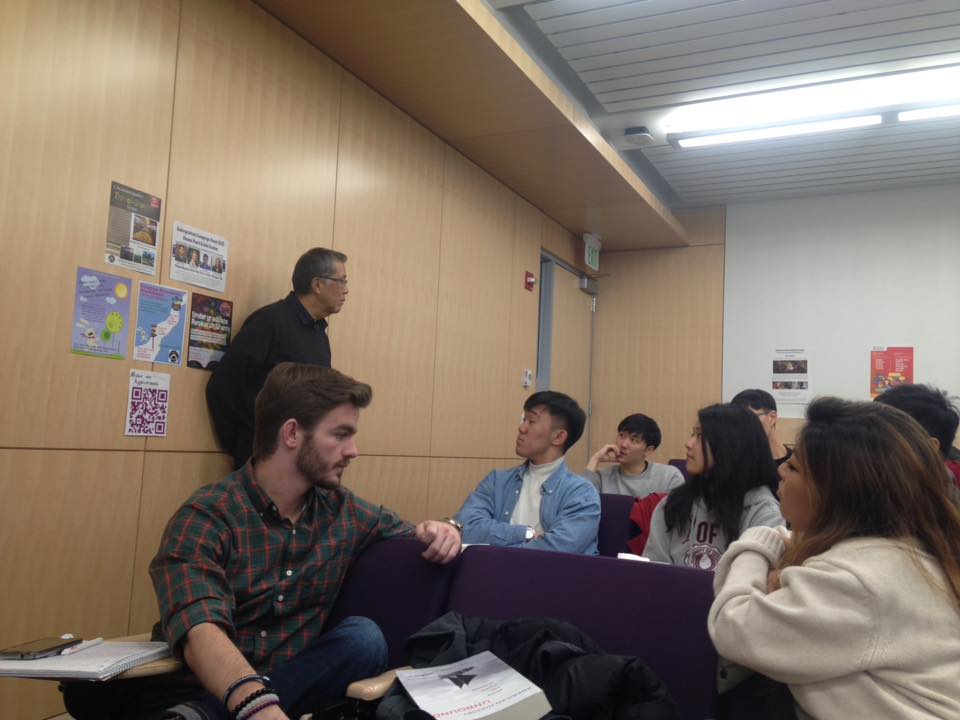
Gary Okihiro visits my class in Asian American history, 10 Nov 2017 – photo by me
This is the eighth in a series of posts testifying about my conversion to liberation theology. For previous posts, here are the first, second, third, fourth, fifth, sixth, and seventh.
By the time I was really wrestling through the possibility that I had converted to liberation theology through Eastern Catholic spiritual direction and liturgy, I was teaching Asian American studies at Northwestern University. The beautiful thing about being a secular academic, though, is that I think of myself as good at compartmentalization. I am actually very bad at it, but I like to deceive myself into thinking that I am not. Because of this, I still wanted to do my cute thing where I see the theology of harmonious communion everywhere. Radical Orthodoxy had, after all, been my bread and butter in my graduate studies; it should therefore be the foundation for my academic career.
I also style myself as a bit of a heretic in Asian American studies. This too is a bit of a false identity. The truth is that I have been critical about the work of Asian and Asian American liberation theology because I’ve often felt that it itself is too ideological, making loose connections to race and capital that don’t actually trace the actual material relations among different kinds of oppression. This is why the accusation that Asian American studies is all about identity politics rolls like water off my back. I agree with the critics that when any kind of academic study becomes all about identity, then you start making stuff up about the world and pretending that’s reality when in fact it is fantasy.
But in teaching this way, I am no heretic. When I was learning Asian American studies from the historian Henry Yu in graduate school, I remember remarking to him that I was excited about learning Asian American studies because it would be about identity and community. He replied that it wasn’t. When I furrowed my brow, he leaned in and said: It’s a politics.
It took me until I was finally teaching Asian American studies at Northwestern to fully flesh out what this means. I had, of course, been trained to understand that the term ‘Asian American’ was coined by the Asian American historian and activist Yuji Ichioka during the struggles of the Third World Liberation Front in 1968. For Ichioka – and for the students occupying college campuses in Berkeley and San Francisco – to be ‘Asian American’ was, in the words of the journalist Jeff Chang, to pick a fight. It was to say that despite a history of being mistreated as part of the racial category of ‘oriental,’ an ‘Asian American’ was a person, someone who could act in history to determine their own future.
I had trouble communicating this in the first few courses I taught, though. The students in my classes on ‘comparative minority conservatisms’ and Asian American history were nice enough to give me some pretty good ratings, and one of them even said that I changed her entire view of the discipline altogether (aw shucks). However, I felt like I really did not know how to communicate to them the difference between an identity and a politics. My students viewed my views as a bit of an oddity, as if I’d come around to reconciling the tension one day. Some of my colleagues were not as kind; I think they thought of me as straight-up on the Right and got off speaking terms with me.
Both groups that rejected my rejection of Asian American identity needed Asian American to be an identity because it was a kind of mobilizing ideology, an inspirational narrative to drum up support to dismantle white supremacy, assert Asian American agency, and align with other peoples of color and indigenous peoples. They thought that I was taking that away from them and therefore must be undermining their cause. I have been to confession about these people more than once, and sometimes, the priests have laughed compassionately in my face as I brought my workplace politics to the Lord. I think me telling that story may convince some of my opponents that I am really far off the social justice pale. Isn’t Catholicism, after all, a white man’s religion, and isn’t Eastern Catholicism a kind of obfuscation of my true allegiances?
One day, a faculty colleague who has been mentoring me walked into my office just as I was in the physical act of pulling out my hair. I screamed, What am I doing wrong? Why does everyone seem to think that ‘Asian American’ is an identity? Am I crazy?
She smiled. Then she proceeded to fill in the gap in my education. The main problem, she said, was that I had been trained properly in Asian American historiography. Not everyone is so fortunate, she continued. Most academics who go through the traditional disciplines of sociology, anthropology, English, history, and so on are trained to think of Asian American history as the history of Asians migrating to the United States (or to the ‘Americas,’ if they are more hemispherically generous). As a result, their grand narrative, often supported by some of the key textbooks on Asian American history (especially the late Ron Takaki’s Strangers from a Different Shore), is about ‘Asian Americans’ developing an identity, even a political one, tied to cultural practices born out of their experiences of race in America. Usually, this story has something to do with fitting into the main institutions of the United States, celebrating people moving into the legal, business, and medical worlds and even into public service and state office. Their assumptions about what Asian American history determines their politics.
The problem is that this is not Asian American history, at least not according to Gary Okihiro and his disciples, of which she informed me I was a part. I replied that I did not know that I was one of Okihiro’s intellectual descendants, having thought that all Asian Americanists had been trained like me, and she said that she could understand my naïveté, as I was trained in geography through religious studies (but really through theology, as my past affinity with Milbank shows), but that it was time to be realistic about the world.
The truth, she continued, is that most people don’t really understand Okihiro’s work anymore. What are especially baffling are his new books on ‘space-time’ like Island World and Pineapple Culture. His textbook American History Unbound: Asians and Pacific Islanders is just as strange, which is why she as an Okihiro disciple had had a hand in convincing me to use in my class, knowing that I was cryptically also one by virtue of my training. Okihiro’s problem, as he himself says in his books, is that he doesn’t want to do a conventional narrative of Asians coming to the Americas, but a counter-narrative, an account that disrupts the story and interrupts the way that an Asian American identity politics – an ideology, really – might be formed. The strategy for pulling that off is to move constantly to the margins instead of trying to parse the mainstream. Back in the day, he accomplished that by doing histories of Asian Americans ‘east of California,’ disrupting the centrality of Californian migration to Asian American history. By the time he got to Island World, he was moving to where he grew up in Hawai’i, using the Pacific Islands to talk about the American mainland. This is fleshed out even more in Pineapple Culture, where he traces how geographers (!) mapped the Pacific Islands and came up with all sorts of weird ideas about natives and ‘orientals’ for colonizing purposes. Third World Studies puts it all together: the whole point of the Third World Liberation Front had actually been to help communities of color in the United States see their solidarity with the margins of the ‘Third World,’ the people that W.E.B. DuBois had seen on the other side of the ‘problem of the color line’ in a global sense. No wonder nobody understood what Okihiro was doing: he was trying to map the mainstream – what he called the ‘social formation’ of institutions that colonize the lives of peoples of color, Pacific Islanders, and indigenous peoples – from the margins.
In so doing, Okihiro had to account for the agency of the colonized. Like de Certeau and Freire, Okihiro seems to be interested in the words that people use for their own way of being in the world. Much of the time, that has to do with their own spiritual mythologies, their sense of primal history. For example, Island World opens with Okihiro recounting all kinds of Hawaiian creation myths, with goddesses like Pele as actual agents in the world. Because of this, I spend the first half of my Asian American history class now recounting the primal histories of Asian Americans and Pacific Islanders, and then I move toward how modern Christian theology has assumed a kind of ideological position about sovereignty, which philosophers like Giorgio Agamben, theologians like Willie Jennings and William Cavanaugh, and theorists like Gil Anidjar have also theorized.
This helped me to see a line that runs through Asian American studies that is also about the liberation of what might be called theological agency, the ability of people to speak of gods and spirits in both the unconscious ways that de Certeau describes and in the ‘conscientized’ way for which Freire advocates. It turns out that Asian American history is about so much more than identity.
First, it’s about a range of peoples around the world who have been colonized by being misrecognized as orientals: indigenous peoples who were first called indios in the Americas, Pacific Islanders whose islands were explored and then settled, ‘Asians’ from Turkey to the outer edge of the Asia-Pacific who have been exoticized and considered to be from one singular culture – which as Edward Said shows in Orientalism is a ridiculous claim.
Second, it’s about those peoples’ agency, which means that each of them are going to have all kinds of ways of talking not only about how the world works, but also of how the gods and spirits are agents in the world, including in their reception of Christianity, which is not necessarily a European religion (how else does one account for Syriac missionaries in the fifth to seventh centuries?).
Third, if this agency is revealed through a process one might call liberation, then does it not follow that such speech about gods and spirits, including in a Christian sense, is liberation theology? Is this not precisely the point that Gustavo Gutiérrez is trying to make in We Drink From Our Own Wells, that what actually counts in theology is the people’s words and practices that reveal the presence of God that is always already there? Is this not Henri de Lubac’s central argument in Surnaturel where he excoriates the colonizing notion that the ‘supernatural’ is some extra addition onto a ‘purely natural order’ and begs us to see within Christian tradition a surnaturel in which all creation – the entire material order, such that there is no contradiction between being a ‘materialist’ and a true Christian whose life is ‘spiritual’ – has always already been constituted by the divine grace by which it was made?
Properly done, Asian American studies opens up global vistas in liberation theology, theorizing the material in a way that does not divorce it from the spiritual. In fact, in one of the greatest moments I’ve witnessed at Northwestern, Okihiro invited himself to speak to my class in Asian American history. He wanted to see how his book was being taught, and we seized on the opportunity to ask him lots of questions. One question that I asked him was precisely about this theological stuff. He replied that he had actually planned to become a theologian in college, as he had some affinity for death-of-God theology – a similar impulse that powers Žižek’s ‘Christian atheism’ now. Again, here, the spiritual is to be found in the material. If the Congregation of the Doctrine of the Faith has a problem with liberation theology’s materialism over all, that issue is certainly not to be found here.
But I suppose the question, then, is how these musings from radical academia might relate back to my ecclesial life. After all, one might imagine that Christians who are Orthodox would look kindly on these musings. That would be a mistake, I claim in the next post.
Previous Post
December 20, 2017
The real problem in the West-Coates spat is Coates's atheism

Browse Our Archives
Select a Category Academia Anglican Communion anti-racism Aristotle Asia-Pacific Asian American Asian Canadian BlackLivesMatter Cantonese Catholic China Chinglican church politics Church-State Politics Civil Society Conservative Eastern Christianity Evangelical Evangelical Left Feminist/Womanist Theology Food Greek-Catholic Church of Kyiv Hong Kong Housekeeping Kyivan Church Latin Catholicism Law Liberal Liberation Theology New Calvinism Pentecostal/Charismatic Protestant Psychoanalysis Publics Religion Ethnicity Wired Secular Sovereignty TPCIU Uncategorized
Select a Month July 2019 June 2019 May 2019 April 2019 March 2019 February 2019 January 2019 December 2018 November 2018 October 2018 September 2018 August 2018 July 2018 June 2018 May 2018 March 2018 February 2018 January 2018 December 2017 November 2017 October 2017 September 2017 August 2017 July 2017 June 2017 April 2017 March 2017 February 2017 January 2017 December 2016 November 2016 October 2016 September 2016 August 2016 July 2016 January 2016 December 2015 November 2015 October 2015 August 2015 April 2015 March 2015 February 2015 December 2014 November 2014 September 2014 August 2014 July 2014 June 2014 May 2014 April 2014 March 2014 December 2013 November 2013 October 2013 September 2013 August 2013 July 2013 June 2013 May 2013 April 2013 March 2013 February 2013 January 2013 December 2012 October 2012 June 2012 May 2012 April 2012 February 2012 January 2012
Follow Us!
TAKE THE
Religious Wisdom Quiz
What did fire from heaven consume to prove Elijah's God was real?
Select your answer to see how you score.
The temple A chariot Sacrifice on Mount Carmel A golden calf
Related posts from Eastern Catholic Person

The Bay Area of the nineties is where...

This time, I have a tradition: on solidarity...

Home is where your food is: a speech...

I am no longer ashamed of being from...
TRENDING AT PATHEOS Catholic

Creation, Preservation, and Teleology in Catholic Theology
As I write this, it is very early Monday morning. Like millions...

The Parable Of The Sower And The Word...
One of Christ’s most famous parables is that of the sower who...

Rejecting Doom: Christian Hope And Human Action
Christianity is a religion of hope. We are to have hope and...

Why I Choose the Eucharist Over the Sermon
Choose the Eucharist, Not the Sermon What are we supposed to get...

5 Design Elements Found in Spiritually Rooted Homes
Putting Spirituality Into Home Decor Our homes are more than our living...

Credo: A Story of God Told with the...
About 10 years ago, I began to imagine a personal "Credo" that...
view all Catholic blogs
Ad-Free & Subscriber Log-In Subscription Support
- About Us
- 2026 Calendar
- Videos
- Podcasts
- Library of World Religions
- Faith In Media Tracker
- Advertise With Us
- Write for Us
- Privacy Policy
- Terms of Service
- Do Not Sell My Data
- Contact Us
- Radiant Digital
- Manage Newsletter Subscriptions
- Unsubscribe From Notifications
- Sitemap
Copyright 2008-2026, Patheos. All rights reserved.
Subscription Support Ad-Free & Subscriber Log-In
Follow Patheos