
BuddhistCatholicContemplativeEvangelicalGeneral ChristianHinduJewishLatter-day SaintMuslimNew VisionsProgressive Christian
Beliefs
- Buddhist
- Catholic
- Contemplative
- Evangelical
- General Christian
- Hindu
- Jewish
- Latter-day Saint
- More Voices
- Muslim
- New Visions
- Pagan
- Progressive Christian
Topics
- Religion News
- Food and Religion
- Sports and Religion
- Religious Art
- Religious Music and Entertainment
- Religious Events
- History and Religion
- Style and Religion
- Politics and Religion
- Women in Religion
- Recreation Outdoors and Religion
- Business Finance and Religion
- Careers Workplace and Religion
- Education and Religion
- Family Parenting and Religion
- Health Fitness and Religion
- Home and Religion
- Relationships and Religion
- Technology and Religion
- Travel and Religion
Columnists
- Buddhist Columnists
- Business Finance and Religion Columnists
- Careers Workplace and Religion Columnists
- Catholic Columnists
- Contemplative Columnists
- Education and Religion Columnists
- Evangelists Columnists
- Family Parenting and Religion Columnists
- General Christian Columnists
- Health Fitness and Religion Columnists
- Hindu Columnists
- History and Religion Columnists
- Home and Religion Columnists
- Jewish Columnists
- More Voices Columnists
- Latter Day Columnists
- Muslim Columnists
- New Visions Columnists
- Nonreligious Columnists
- Pagan Columnists
- Politics and Religion Columnists
- Progressive Columnists
- Recreation Outdoors and Religion Columnists
- Relationships and Religion Columnists
- Religion News Columnists
- Religious Art Columnists
- Religious Events Columnists
- Religious Music and Entertainment Columnists
- Sports and Religion Columnists
- Style and Religion Columnists
- Technology and Religion Columnists
- Travel and Religion Columnists
- Women in Religion Columnists
Resource Library
- 2026 Calendar
- Library of World Religions
- The 100 Most Holy Places on Earth
- Patheos Answers
- Podcasts
- Videos
- Faith Leaders Database
- Anglican Episcopalian
- Bahai
- Baptist
- Buddhism
- Christianity
- Confucianism
- Eastern Orthodoxy
- Hinduism
- Holiness and Pentecostal
- ISKCON
- Islam
- Judaism
- Lutheran
- Methodist
- The Church of Jesus Christ of Latter-day Saints
- New Age
- Paganism
- Presbytarian and Reformed
- Protestantism
- Religion Behind the Scenes
- Roman Catholic
- Scientology
- Shia Islam
- Sikhism
- Sufism
- Sunni Islam
- Taoism
- Zen
- See all religions
Research Tools
 Ad-Free & Subscriber Log-In Subscription Support
Ad-Free & Subscriber Log-In Subscription Support
Follow Patheos 

- Trending:
- Forgiveness
- |
- Marriage
- |
- Consciousness
- |
- Death Penalty
- |
- Election
- |
- Halloween
 Eastern Catholic Person
- Home
- Catholic
- ‘Do you know why Hannah was so hurt?’: reflections on the Holy Ancestors
‘Do you know why Hannah was so hurt?’: reflections on the Holy Ancestors
Last updated on: September 9, 2017 at 2:46 pm by Justin Tse
‘Do you know why Hannah was so hurt?’: reflections on the Holy Ancestors 2017-09-09T14:46:04-07:00 Justin Tse
Patheos Explore the world's faith through different perspectives on religion and spirituality! Patheos has the views of the prevalent religions and spiritualities of the world.
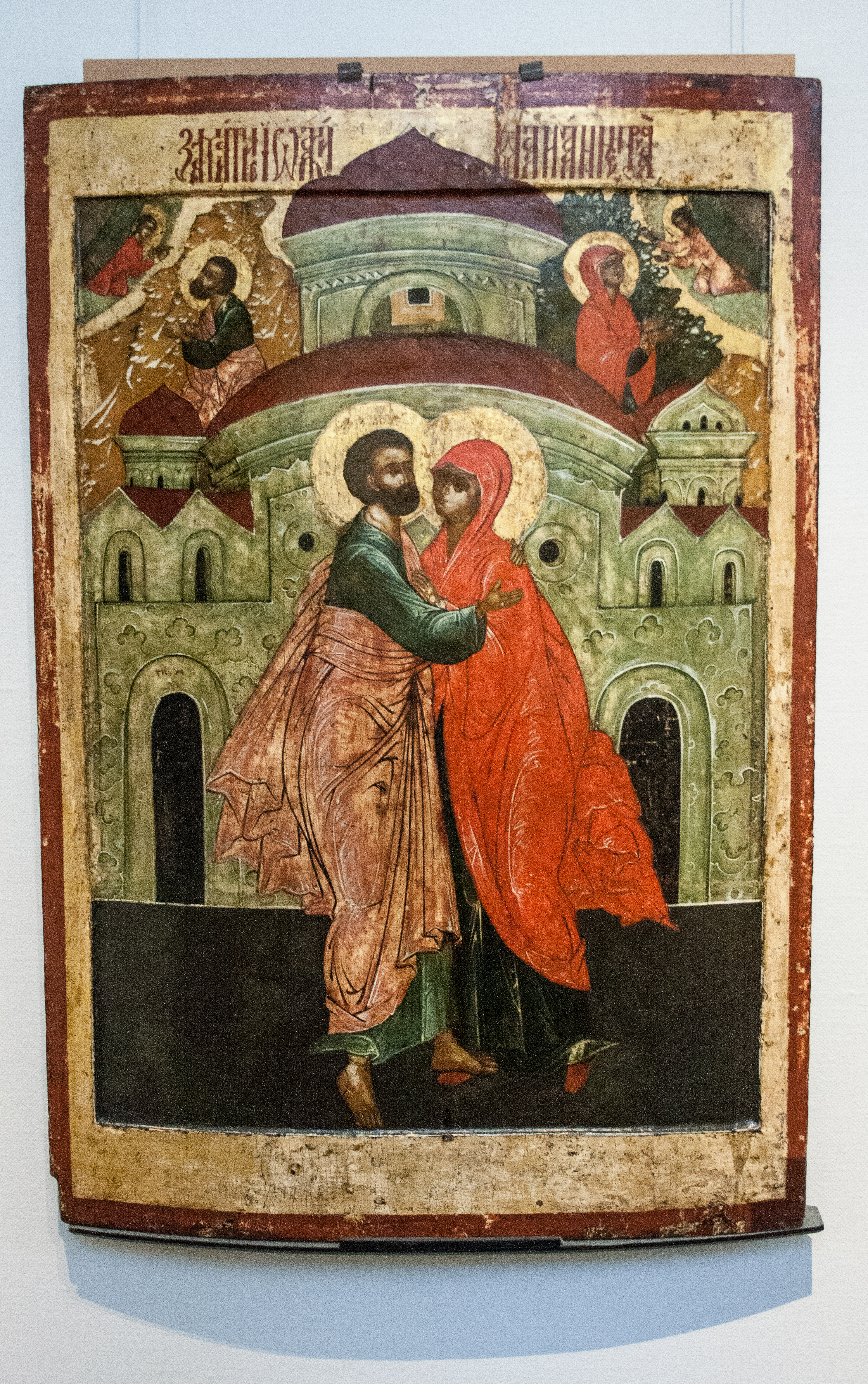
The embrace of Joachim and Anna, PD-Art, via Wikimedia Commons
The story of Hannah that opens the Prophecy of Samuel has been one of my favourites since I was a child. Unable to have children, Hannah is mocked by everyone around her. Her husband Elkanah, described as an all-around stand-up and devout guy, is actually kind of a jerk: he takes on a second wife Peninnah, who provokes Hannah to tears on account of her closed womb. Elkanah’s cruelty, by contrast, is magnified by its lack of intention: sure, he loves Hannah and gives her a double portion of his peace offering, but when Hannah cries, he makes things worse: Hannah, why do you weep? he tries to comfort his beloved. And why do you not eat? And why is your heart sad? Am I not more to you than ten sons? Sometimes, not saying anything is better than to have said it, especially when the one saying it is the man with two wives.
Hannah goes off in desperation to pray, but even before the opening of the tabernacle, there sits (he’s not standing because he’s too fat) Eli, whose sons are selling sacrificial meat on the black market and sleeping with the tabernacle servers. Eli observes Hannah moving her mouth but making no sound and concludes that she’s drunk. Like every good conservative appalled by such lapses in liturgical propriety, Eli reprimands her.
But Hannah won’t have it. She gets up and explains the situation to Eli, who melts back into the cuddly furball he is. For Hannah’s part, she gets pregnant and dedicates her son Samuel to the service of the tabernacle, making him a cute little ephod every year as he grew bigger. She sings a song in triumph:
My heart exults in YHWH;
my strength is exalted in YHWH.
My mouth derides my enemies,
because I rejoice in your salvation.There is none holy like YHWH;
there is none besides you;
there is no rock like our God.
Talk no more so very proudly,
let not arrogance come from your mouth;
for YHWH is a God of knowledge,
and by him actions are weighed.
The bows of the mighty are broken,
but the feeble bind on strength.
Those who were full have hired themselves out for bread,
but those who were hungry have ceased to hunger.
The barren has borne seven,
but she who has many children is forlorn.
YHWH kills and brings to life;
he brings down to Sheol and raises up.
YHWH makes poor and makes rich;
he brings low and he exalts.
He raises up the poor from the dust;
he lifts the needy from the ash heap
to make them sit with princes
and inherit a seat of honor.
For the pillars of the earth of YHWH’s,
and on them he has set the world.He will guard the feet of his faithful ones,
but the wicked shall be cut off in darkness,
for not by might shall a man prevail.
The adversaries of YHWH shall be broken to pieces;
against them he will thunder in heaven.
YHWH will judge the ends of the earth;
he will give strength to his king
and exalt the power of his anointed. (1 Samuel 2.1-10).
It seems that every Christian homiletical treatment notes the parallel between the Song of Hannah and the Song of Mary in the Gospel according to the Holy Evangelist Luke known as the Magnificat; in fact, when I was taking the introductory New Testament Foundations at Regent College for what I thought would become advanced studies in theology (that never happened, for a number of reasons), Professor Rikk Watts emphasized the parallels between the Samuel story and the infancy narratives in Luke – it turned out, I learned, that Watts was very interested where the Hebrew Scriptures were used in the New Testament and brought his interests to bear on even our introductory class. I thought this was cool because, as I grew up, the Bible book that my father came to love most through his seminary studies in Berkeley was the Gospel of Luke and its emphasis on the poor and the marginalized, as he learned while taking classes from his New Testament professor, Joel B. Green. More pertinent to my current church situation, the third ode of the canon for Matins (as well as for other services) is based on the Song of Hannah. The familiar story that I have heard since I was a child has a prominent place in the liturgical life of the Church, central as it is to the Gospel account that has shaped my youth through both my father’s studies and my own theological dabbling. My confirmation bias that the female characters in Scripture are much more important the men continues to be confirmed.
On this Feast of the Holy Ancestors Joachim and Anna – the echo of the Feast of the Nativity of the Theotokos – this story grabs my attention yet again. The story of Joachim and Anna are recorded in the Protoevangelium of James, a text that I avoided religiously when I learned about it as a Protestant because the Latins who told me about it said that I’d find the story of the Immaculate Conception of Mary there, and I was not going to read about something so far-fetched. Since becoming more open to Catholicism – and then straight-up taking the plunge into the Kyivan Church – I have skimmed it several times. However, much as I venerate the Theotokos as All-Holy, I still cannot find the part that says that Mary’s sin was taken away from her as a zygote. I then learned recently while skimming through my colleague Mark Shea’s writing that the Latin Church regards the Protoevangelium as a work of fiction.
But what struck me today as I re-read the Protoevangelium of James today on a whim (I just thought, hey, why not? as I drank my morning coffee) was how much this text, declaring itself to be written by the hand of Holy James of Jerusalem (hahaha), is a narrative reflection on the birth of Samuel. The story itself, of course, is apocryphal, but historical fiction never hurt anybody, especially not over morning coffee. The prayer of Anna, which really is Hannah without the h‘s, is a remarkable gloss on what Hannah might have said before the opening of the tabernacle – Joachim and Anna, like Hannah of old, were barren:
‘”Oh me, who gave birth to me? What womb caused me to grow? For I was born cursed in front of the children of Israel. I am reviled and they treat me with contempt and cast me out of the temple of the Lord my God.
‘”Oh me, what am I like? I am not like the birds of the sky, for the birds of the sky are fruitful before you, Lord.
‘”Oh me, what am I like? I am not like the domestic animals, for the domestic animals are fruitful before you, Lord.
‘”Oh me, what am I like? I am not like the wild animals of the earth, for the wild animals of the earth are fruitful before you, Lord.
‘”Oh me, what am I like? I am not like these waters, for these waters are fruitful before you, Lord.
‘”Oh me, what am I like? I am not like this earth, for the earth produces its fruit in season and blesses you, Lord.”‘ (Protoevangelium of James 3.2-8).
The contrast is that her husband Joachim is not a jerk like Elkanah; he goes on a fast for forty days, trying to hunger-strike God into giving them a child. What ends up happening is that an angel appears to Anna, tells her that she will be pregnant, and when Joachim comes home, they embrace (as is often displayed on their icon) – which is how every Sunday school tries to end with the story of Elkanah and Hannah, happily ever after despite the ongoing existence of the other wife whose ten children bear witness to how busy Elkanah must have been with her. Here, in the Protoevangelium of James, the story is much happier – Joachim and Anna are comforted by the birth of their daughter Mary, who is given like Samuel to the temple as a virgin. It’s so good that it must be fiction.
But fictional though the Protoevangelium may be, the reflections on Hannah are strikingly consistent with the Hebrew Scriptures. In the Protoevangelium, Anna is praying separately from Joachim; apart, they come to the same prophetic conclusion about their daughter. Mary’s life is described liturgically, with her own life as a virgin to lead before the Lord, and so is her cousin Elizabeth’s. This all reminds me of why I loved the story of Hannah so much as a child. My mother used to read it to me at bedtime, and she used to have me imagine myself as a future husband saying similar things as Elkanah would to Hannah. Do you know why Hannah was so hurt? she asked night in and night out. It’s because her husband just said things to her but didn’t mean them. You can’t just tell a woman you love her. You have to respect her and show your love in your actions. A woman knows when you are being true and when you are just lying.
Reading the Protoevangelium over my morning coffee, I hear my mother’s words again. Now I am married, and I know personally the danger against which my mother warned so many years ago. Yet in the contrast between Joachim and Elkanah, I find myself renewing my commitment to prayerfulness and words of love that actually mean something, and in the embrace of Joachim and Anna, I work out my salvation in fear and trembling.
Previous Post
September 8, 2017
And I, I did not even know it: on the Nativity of the Theotokos
Next Post
September 26, 2017 Online humiliation and the pedagogy of the Holy Cross
Browse Our Archives
Select a Category Academia Anglican Communion anti-racism Aristotle Asia-Pacific Asian American Asian Canadian BlackLivesMatter Cantonese Catholic China Chinglican church politics Church-State Politics Civil Society Conservative Eastern Christianity Evangelical Evangelical Left Feminist/Womanist Theology Food Greek-Catholic Church of Kyiv Hong Kong Housekeeping Kyivan Church Latin Catholicism Law Liberal Liberation Theology New Calvinism Pentecostal/Charismatic Protestant Psychoanalysis Publics Religion Ethnicity Wired Secular Sovereignty TPCIU Uncategorized
Select a Month July 2019 June 2019 May 2019 April 2019 March 2019 February 2019 January 2019 December 2018 November 2018 October 2018 September 2018 August 2018 July 2018 June 2018 May 2018 March 2018 February 2018 January 2018 December 2017 November 2017 October 2017 September 2017 August 2017 July 2017 June 2017 April 2017 March 2017 February 2017 January 2017 December 2016 November 2016 October 2016 September 2016 August 2016 July 2016 January 2016 December 2015 November 2015 October 2015 August 2015 April 2015 March 2015 February 2015 December 2014 November 2014 September 2014 August 2014 July 2014 June 2014 May 2014 April 2014 March 2014 December 2013 November 2013 October 2013 September 2013 August 2013 July 2013 June 2013 May 2013 April 2013 March 2013 February 2013 January 2013 December 2012 October 2012 June 2012 May 2012 April 2012 February 2012 January 2012
Follow Us!
TAKE THE
Religious Wisdom Quiz
What does Hebrews say God will never do?
Select your answer to see how you score.
Fail to keep his promise Deny his own Forget your work Leave you or forsake you
Related posts from Eastern Catholic Person

I've found my way home: on the unraveling...

Patriyarkhat: 'Attending to the movements of my heart'

I'm flattered to be named an Asian American...

The secular does not stop when your drive...
TRENDING AT PATHEOS Catholic

The Parable Of The Sower And The Word...
One of Christ’s most famous parables is that of the sower who...

Rejecting Doom: Christian Hope And Human Action
Christianity is a religion of hope. We are to have hope and...

Why I Choose the Eucharist Over the Sermon
Choose the Eucharist, Not the Sermon What are we supposed to get...

5 Design Elements Found in Spiritually Rooted Homes
Putting Spirituality Into Home Decor Our homes are more than our living...

Credo: A Story of God Told with the...
About 10 years ago, I began to imagine a personal "Credo" that...

The Anatomy of Divine Revelation in Catholic Thought
The claim that God has made Himself known to human beings is...
view all Catholic blogs
Ad-Free & Subscriber Log-In Subscription Support
- About Us
- 2026 Calendar
- Videos
- Podcasts
- Library of World Religions
- Faith In Media Tracker
- Advertise With Us
- Write for Us
- Privacy Policy
- Terms of Service
- Do Not Sell My Data
- Contact Us
- Radiant Digital
- Manage Newsletter Subscriptions
- Unsubscribe From Notifications
- Sitemap
Copyright 2008-2026, Patheos. All rights reserved.
Subscription Support Ad-Free & Subscriber Log-In
Follow Patheos