
BuddhistCatholicContemplativeEvangelicalGeneral ChristianHinduJewishLatter-day SaintMuslimNew VisionsProgressive Christian
Beliefs
- Buddhist
- Catholic
- Contemplative
- Evangelical
- General Christian
- Hindu
- Jewish
- Latter-day Saint
- More Voices
- Muslim
- New Visions
- Pagan
- Progressive Christian
Topics
- Religion News
- Food and Religion
- Sports and Religion
- Religious Art
- Religious Music and Entertainment
- Religious Events
- History and Religion
- Style and Religion
- Politics and Religion
- Women in Religion
- Recreation Outdoors and Religion
- Business Finance and Religion
- Careers Workplace and Religion
- Education and Religion
- Family Parenting and Religion
- Health Fitness and Religion
- Home and Religion
- Relationships and Religion
- Technology and Religion
- Travel and Religion
Columnists
- Buddhist Columnists
- Business Finance and Religion Columnists
- Careers Workplace and Religion Columnists
- Catholic Columnists
- Contemplative Columnists
- Education and Religion Columnists
- Evangelists Columnists
- Family Parenting and Religion Columnists
- General Christian Columnists
- Health Fitness and Religion Columnists
- Hindu Columnists
- History and Religion Columnists
- Home and Religion Columnists
- Jewish Columnists
- More Voices Columnists
- Latter Day Columnists
- Muslim Columnists
- New Visions Columnists
- Nonreligious Columnists
- Pagan Columnists
- Politics and Religion Columnists
- Progressive Columnists
- Recreation Outdoors and Religion Columnists
- Relationships and Religion Columnists
- Religion News Columnists
- Religious Art Columnists
- Religious Events Columnists
- Religious Music and Entertainment Columnists
- Sports and Religion Columnists
- Style and Religion Columnists
- Technology and Religion Columnists
- Travel and Religion Columnists
- Women in Religion Columnists
Resource Library
- 2026 Calendar
- Library of World Religions
- The 100 Most Holy Places on Earth
- Patheos Answers
- Podcasts
- Videos
- Faith Leaders Database
- Anglican Episcopalian
- Bahai
- Baptist
- Buddhism
- Christianity
- Confucianism
- Eastern Orthodoxy
- Hinduism
- Holiness and Pentecostal
- ISKCON
- Islam
- Judaism
- Lutheran
- Methodist
- The Church of Jesus Christ of Latter-day Saints
- New Age
- Paganism
- Presbytarian and Reformed
- Protestantism
- Religion Behind the Scenes
- Roman Catholic
- Scientology
- Shia Islam
- Sikhism
- Sufism
- Sunni Islam
- Taoism
- Zen
- See all religions
Research Tools
 Ad-Free & Subscriber Log-In Subscription Support
Ad-Free & Subscriber Log-In Subscription Support
Follow Patheos 

- Trending:
- Forgiveness
- |
- Marriage
- |
- Consciousness
- |
- Death Penalty
- |
- Election
- |
- Halloween
 Eastern Catholic Person
- Home
- Catholic
- Race and the passions: musings on the Feast of St Moses the Black, St Augustine of Hippo, and Blessed Gebremichael
Race and the passions: musings on the Feast of St Moses the Black, St Augustine of Hippo, and Blessed Gebremichael
Last updated on: August 29, 2017 at 1:24 am by Justin Tse
Race and the passions: musings on the Feast of St Moses the Black, St Augustine of Hippo, and Blessed Gebremichael 2017-08-29T01:24:38-07:00 Justin Tse
Patheos Explore the world's faith through different perspectives on religion and spirituality! Patheos has the views of the prevalent religions and spiritualities of the world.
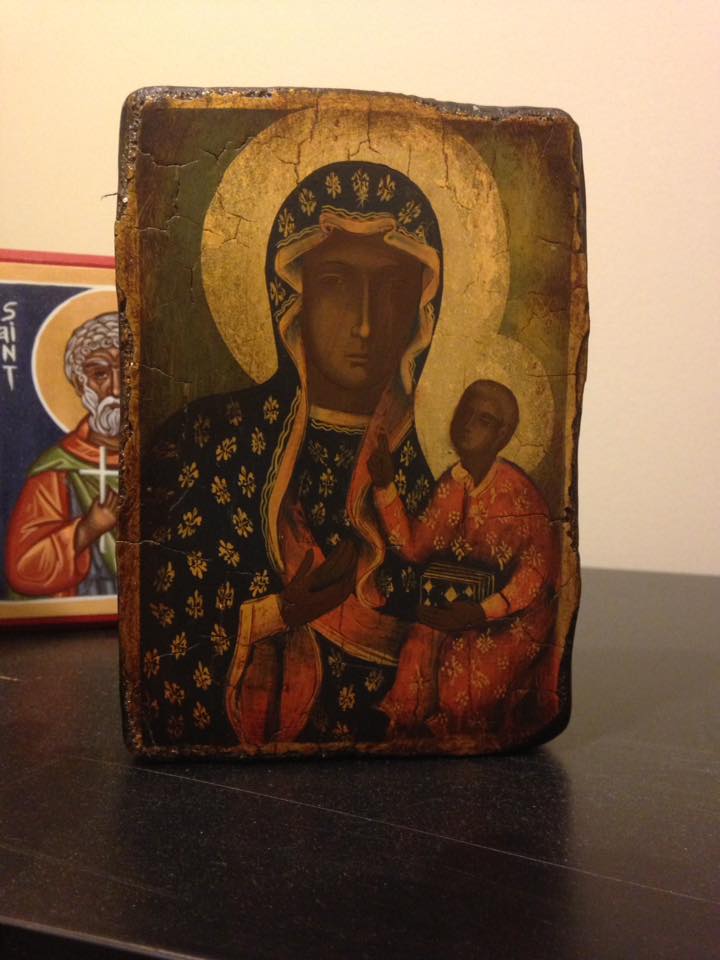
My icon of St Moses the Black, standing behind the Theotokos of Częstochowa – photo by me
Today on the Newer Calendar of the Kyivan Church, we commemorate three African saints: our Venerable Father Moses the Black, our Holy Father Augustine, Bishop of Hippo, and the Holy Martyr Gebremichael, Illuminator of Ethiopia.
It would be trite of me to turn this feast into an opportunity for me to reflect on my family’s solidarity with black people. It is, however, tempting. My father, after all, was probably the first Chinese American to be ordained in the Progressive National Baptist Convention, and this was done by the hand of the Rev Dr J. Alfred Smith, Sr., one of the greatest African American preachers who has ever lived and a friend to the Black Panthers, to boot. After moving to Vancouver, our family was received into the Anglican Communion through the Province of Rwanda; of course, this means that we became part of the infamous realignment in the Anglican Mission, which is now split from Rwanda and is now recognized by bishops in Kenya, Congo, and Tanzania. Since being received into the Kyivan Church, I find myself in communion with Ethiopian Catholics, who venerate Blessed Gebremichael and invite me to their services in Chicago; I will finally have time to take them up on the offer this year.
I could thus say that African and African American Christianities of all sorts of theologies, ideologies, and controversies are near and dear to my heart and central to my spiritual formation, and I would not be lying. I could even go as far as to say that this is a manifestation of the radical Asian American dream of sorts – to center at the heart of Asian American struggle for racial justice and the implosion of the model minority myth in a number of origin stories for the revolutions of people of color: the Asian American Movement’s alliance with the Black Student Union to form the Third World Liberation Front at San Francisco State, for example, or the bridges built after the disaster of the showdown between Korean and black communities in the Los Angeles Koreatown uprising in 1992, or even Vijay Prashad’s history of the longue durée of African-Asian trade and exchange pre-dating the dawn of European modernity. Asians and Africans, Asian Americans and African Americans: we must recognize our sisterhood and brotherhood by virtue of the very fact of living together and making our common home together on this earth.
But true as all this may be and relevant as it might be in the wake of the Charlottesville fiasco, this is not the word that the African saints commemorated today offer to those who celebrate their feast today. Two of them – Holy Moses the Black and Holy Augustine of Hippo – even pre-date the racial politics of modernity, and no matter how much commentary is spilled on the color of their skin, even in their hagiographies (dressed in white, for example, Holy Moses the Black declared that he was still black within on account of his sins), their witness has little to do with the politics of identity that we love to play.
Instead, if one were to contemplate their lives, one would find that at the heart of their witness lies the path of the purification of the intellect of its passions. Holy Moses the Black was a slave in fourth-century Ethiopia who joined a band of highway robbers and was renowned for his great strength; he later joined a monastery and struggled through the sins that continued to plague him through his mind, the memory of the violence for the sake of material accumulation to which he was prone. Holy Augustine of Hippo, widely regarded as a western saint with a Latin orientation, has this point in common with Holy Moses: the sins of his youth are also bodily – erotic and sexual, in his case – and in meditating on the purification of the memory, he offers much for mulling over in terms of intellectual chastity, the psychological ‘trinity,’ and the practice of humility for those who live in the city of God. Even Blessed Gebremichael came to Catholic faith by an intellectual path as he became convinced of the distinctiveness of the two natures of Christ; indeed, in the conversations between the Byzantine and Ethiopian Orthodox, it must be said that the deeper reality that has eroded our differences has been the mutual acceptance that there is something true about Christ’s two natures without him being two persons or two beings.
What I am struck by in my meditations today is this accent on the cleansing of the intellect, the exorcism of the mind. It reminds me of my own reception into the Kyivan Church, when my spiritual father accepted me into the catechumenate with the three baptismal exorcisms and then repeated a version of those prayers in the rite of chrismation: the emphasis is that I might be cleansed from my former delusions. Like Holy Moses the Black and Holy Augustine of Hippo, the struggles that I have encountered in the last year have truly been intellectual, as I come to a deeper understanding of how the passions have shaped my intellect and how trapped I am by them. There is, for example, the passion of wanting to close the gaps of my own identity by equating myself with this or that construct: Asian American, Chinese American, Hongkonger, even Eastern Catholic. There are the passions of imagined fetishes that have no correspondence to the materiality of everyday life. There are violent passions where what I think is righteous anger is simply vengeful fantasy.
Perhaps this is why identity politics often feels cheap: in crystallizing an identity for the sake of political mobilization, all that may be gotten is a false consciousness that leaves the passions intact. As the African saints celebrated today show me, the intellectual task is to untangle the intellect from the passions, to penetrate through to reality amidst a sea of delusion. Delusionary consciousness is itself real, of course; this is, after all, what race really is – the attribution of cultural characteristics to biological phenotype that is itself a scientific fiction, but has led to the destruction of so many bodies in modern history. In this way, as the great writer of the passions James Baldwin and the theologian of race J. Kameron Carter have both shown, the original perversion is that the white bodies exalted as the paragons of modern reason require a dark opposite to sustain its fiction. In this way, whiteness does not describe a skin color; it is a mentality, a psychosis, a fictional identity that keeps shifting and lumping different ethnic groups into its purview. This, I have often thought, is the genius of Black Lives Matter as a movement: it is a call to awaken from the delusions of racialization to realize that bodies are being targeted, tortured, and killed and that it is only by remaining drunk on the passions of whiteness that one can say that these bodies don’t matter. No wonder Baldwin tells his black nephew that he has to feel a little sorry for white people who imagine themselves free but are constrained by the fictions upon which their reality is built; his statement in his letter to his nephew ‘from a region of his mind’ – an intellectual statement par excellence – is that until they are free, none of us are. The problem is identification with a passion; the imperative is to non-identify with a delusion.
The Asian American historian Gary Okihiro writes in his book Third World Studies that if we are really going to get into the rigorous study of peoples of color and their inhabitation of this earth in the time of modernity, we would do well to consider the towering figure of the sociologist W.E.B. DuBois as a founding figure of the field. At the heart of DuBois’s investigations into ‘the problem of the color line’ in the twentieth century is what racial ideologies do to the consciousness of people who are not white, the psychological double consciousness of trying to live out one’s own everyday reality while constantly viewing oneself from the perspective of a world that is white. This is the real colonialism, what Ms Lauryn Hill calls the ‘war in the mind,’ the kind where I as a nonwhite person constantly wrestles with the very real gap between my everyday life and the demands of modern respectability. It turns out that with the fictions of white normativity have created a world where people are considered white and everyone else who is a person of color are actually more in the same boat than most think: in each of our own ways, the delusions of race are our lived reality, with very real psychological and material effects. I am not black – neither I nor my contemporaries nor my ancestors were colonized through the modern horrors of slavery and apartheid segregation – but I am Cantonese messed up by a model minority consciousness in which I am deluded into thinking I am some kind of ‘better’ nonwhite person when I often used as a go-between for ongoing forms of colonization. The war in the mind may be different from people across the racialized spectrum and positioning in the historic and contemporary global economy of race, but it is still a colonized consciousness we are talking about.
Holy Moses the Black, Holy Augustine of Hippo, and the Holy Martyr Gebremichael struggled to set their intellects free of delusional passions. But what can be learned from their lives is a paradox: this struggle took place in their bodies through askesis, the training of the body against passion. In his struggle against his own intellectual sins, Holy Moses the Black carried water to his brother monks throughout the night until he passed out. Holy Augustine wrote through his bodily struggles with chastity. Blessed Gebremichael was martyred in his body. The freedom of the mind starts with truly living life in the body.
But there is more. As these three African saints have gone before us, we have access to them through the communion of the Holy Spirit. Askesis is not self-torture; that would be an attempt to make myself holy by abusing my own body, the very thing that Pelagius, the Irish heretic opposed by Augustine, taught. Instead, the African saints show us in their lives that ascetic training is itself the prayer of the body, the invocation of the Spirit who is the one who gives the gift of holiness to those who ask in their bodies, for as the Holy Apostle Paul wrote, where the Spirit of the Lord is, there is freedom. Perhaps this quite closely encapsulates the reflections of those in the pan-Orthodox gathering, the Brotherhood of St Moses the Black, a collective dedicated to bringing together African American communities and Orthodox churches in the spirit of repentance that resonates with the spirituality of Holy Mary of Egypt.
Perhaps this is the dimension of deliverance that those of us persons of color who have struggled our whole lives with double consciousness opened to us in the Rite of Reception and the Order of Chrismation. Together with the holy ones we celebrate together, the prayer over us is that the Holy Spirit would deliver us from our former delusions. The journey of askesis is long after that, but together with those who have gone before me, perhaps even I will be granted the grace to throw off the shackles of my intellectual colonization and truly live freely.
Some might, of course, protest that this is so individualizing and that what must be dismantled is the fiction of race itself. But if I am not free, how could I participate in such a grand project of liberation? For my small role in racial justice, I invoke the prayers of Holy Moses the Black, Holy Augustine of Hippo, and the Holy Martyr Gebremichael that my mind might be clear and my bodily actions would be animated by the Spirit as I ascend the mountain of the Lord with my sisters and brothers on this earth.
Previous Post
August 22, 2017
SERIES: Reflections on the Most Holy Theotokos and her Dormition
Next Post
August 29, 2017 Some disorganized thoughts on Charlottesville
Browse Our Archives
Select a Category Academia Anglican Communion anti-racism Aristotle Asia-Pacific Asian American Asian Canadian BlackLivesMatter Cantonese Catholic China Chinglican church politics Church-State Politics Civil Society Conservative Eastern Christianity Evangelical Evangelical Left Feminist/Womanist Theology Food Greek-Catholic Church of Kyiv Hong Kong Housekeeping Kyivan Church Latin Catholicism Law Liberal Liberation Theology New Calvinism Pentecostal/Charismatic Protestant Psychoanalysis Publics Religion Ethnicity Wired Secular Sovereignty TPCIU Uncategorized
Select a Month July 2019 June 2019 May 2019 April 2019 March 2019 February 2019 January 2019 December 2018 November 2018 October 2018 September 2018 August 2018 July 2018 June 2018 May 2018 March 2018 February 2018 January 2018 December 2017 November 2017 October 2017 September 2017 August 2017 July 2017 June 2017 April 2017 March 2017 February 2017 January 2017 December 2016 November 2016 October 2016 September 2016 August 2016 July 2016 January 2016 December 2015 November 2015 October 2015 August 2015 April 2015 March 2015 February 2015 December 2014 November 2014 September 2014 August 2014 July 2014 June 2014 May 2014 April 2014 March 2014 December 2013 November 2013 October 2013 September 2013 August 2013 July 2013 June 2013 May 2013 April 2013 March 2013 February 2013 January 2013 December 2012 October 2012 June 2012 May 2012 April 2012 February 2012 January 2012
Follow Us!
TAKE THE
Religious Wisdom Quiz
A Samaritan stopped to help a wounded man after a priest and a Levite passed by. Where was the man traveling from and to?
Select your answer to see how you score.
From Bethany to Jerusalem From Jerusalem to Jericho From Galilee to Judea From Samaria to Nazareth
Related posts from Eastern Catholic Person

I've found my way home: on the unraveling...

The Bay Area of the nineties is where...

This time, I have a tradition: on solidarity...

Home is where your food is: a speech...
TRENDING AT PATHEOS Catholic

Creation, Preservation, and Teleology in Catholic Theology
As I write this, it is very early Monday morning. Like millions...

The Parable Of The Sower And The Word...
One of Christ’s most famous parables is that of the sower who...

Rejecting Doom: Christian Hope And Human Action
Christianity is a religion of hope. We are to have hope and...

Why I Choose the Eucharist Over the Sermon
Choose the Eucharist, Not the Sermon What are we supposed to get...

5 Design Elements Found in Spiritually Rooted Homes
Putting Spirituality Into Home Decor Our homes are more than our living...

Credo: A Story of God Told with the...
About 10 years ago, I began to imagine a personal "Credo" that...
view all Catholic blogs
Ad-Free & Subscriber Log-In Subscription Support
- About Us
- 2026 Calendar
- Videos
- Podcasts
- Library of World Religions
- Faith In Media Tracker
- Advertise With Us
- Write for Us
- Privacy Policy
- Terms of Service
- Do Not Sell My Data
- Contact Us
- Radiant Digital
- Manage Newsletter Subscriptions
- Unsubscribe From Notifications
- Sitemap
Copyright 2008-2026, Patheos. All rights reserved.
Subscription Support Ad-Free & Subscriber Log-In
Follow Patheos