
BuddhistCatholicContemplativeEvangelicalGeneral ChristianHinduJewishLatter-day SaintMuslimNew VisionsProgressive Christian
Beliefs
- Buddhist
- Catholic
- Contemplative
- Evangelical
- General Christian
- Hindu
- Jewish
- Latter-day Saint
- More Voices
- Muslim
- New Visions
- Pagan
- Progressive Christian
Topics
- Religion News
- Food and Religion
- Sports and Religion
- Religious Art
- Religious Music and Entertainment
- Religious Events
- History and Religion
- Style and Religion
- Politics and Religion
- Women in Religion
- Recreation Outdoors and Religion
- Business Finance and Religion
- Careers Workplace and Religion
- Education and Religion
- Family Parenting and Religion
- Health Fitness and Religion
- Home and Religion
- Relationships and Religion
- Technology and Religion
- Travel and Religion
Columnists
- Buddhist Columnists
- Business Finance and Religion Columnists
- Careers Workplace and Religion Columnists
- Catholic Columnists
- Contemplative Columnists
- Education and Religion Columnists
- Evangelists Columnists
- Family Parenting and Religion Columnists
- General Christian Columnists
- Health Fitness and Religion Columnists
- Hindu Columnists
- History and Religion Columnists
- Home and Religion Columnists
- Jewish Columnists
- More Voices Columnists
- Latter Day Columnists
- Muslim Columnists
- New Visions Columnists
- Nonreligious Columnists
- Pagan Columnists
- Politics and Religion Columnists
- Progressive Columnists
- Recreation Outdoors and Religion Columnists
- Relationships and Religion Columnists
- Religion News Columnists
- Religious Art Columnists
- Religious Events Columnists
- Religious Music and Entertainment Columnists
- Sports and Religion Columnists
- Style and Religion Columnists
- Technology and Religion Columnists
- Travel and Religion Columnists
- Women in Religion Columnists
Resource Library
- 2026 Calendar
- Library of World Religions
- The 100 Most Holy Places on Earth
- Patheos Answers
- Podcasts
- Videos
- Faith Leaders Database
- Anglican Episcopalian
- Bahai
- Baptist
- Buddhism
- Christianity
- Confucianism
- Eastern Orthodoxy
- Hinduism
- Holiness and Pentecostal
- ISKCON
- Islam
- Judaism
- Lutheran
- Methodist
- The Church of Jesus Christ of Latter-day Saints
- New Age
- Paganism
- Presbytarian and Reformed
- Protestantism
- Religion Behind the Scenes
- Roman Catholic
- Scientology
- Shia Islam
- Sikhism
- Sufism
- Sunni Islam
- Taoism
- Zen
- See all religions
Research Tools
 Ad-Free & Subscriber Log-In Subscription Support
Ad-Free & Subscriber Log-In Subscription Support
Follow Patheos 

- Trending:
- Forgiveness
- |
- Marriage
- |
- Consciousness
- |
- Death Penalty
- |
- Election
- |
- Halloween
 Eastern Catholic Person
- Home
- Catholic
- The theology of the Dormition (Dormition Fast #15/Dormition Feast)
The theology of the Dormition (Dormition Fast #15/Dormition Feast)
Last updated on: August 15, 2017 at 4:17 pm by Justin Tse
The theology of the Dormition (Dormition Fast #15/Dormition Feast) 2017-08-15T16:17:17-07:00 Justin Tse
Patheos Explore the world's faith through different perspectives on religion and spirituality! Patheos has the views of the prevalent religions and spiritualities of the world.
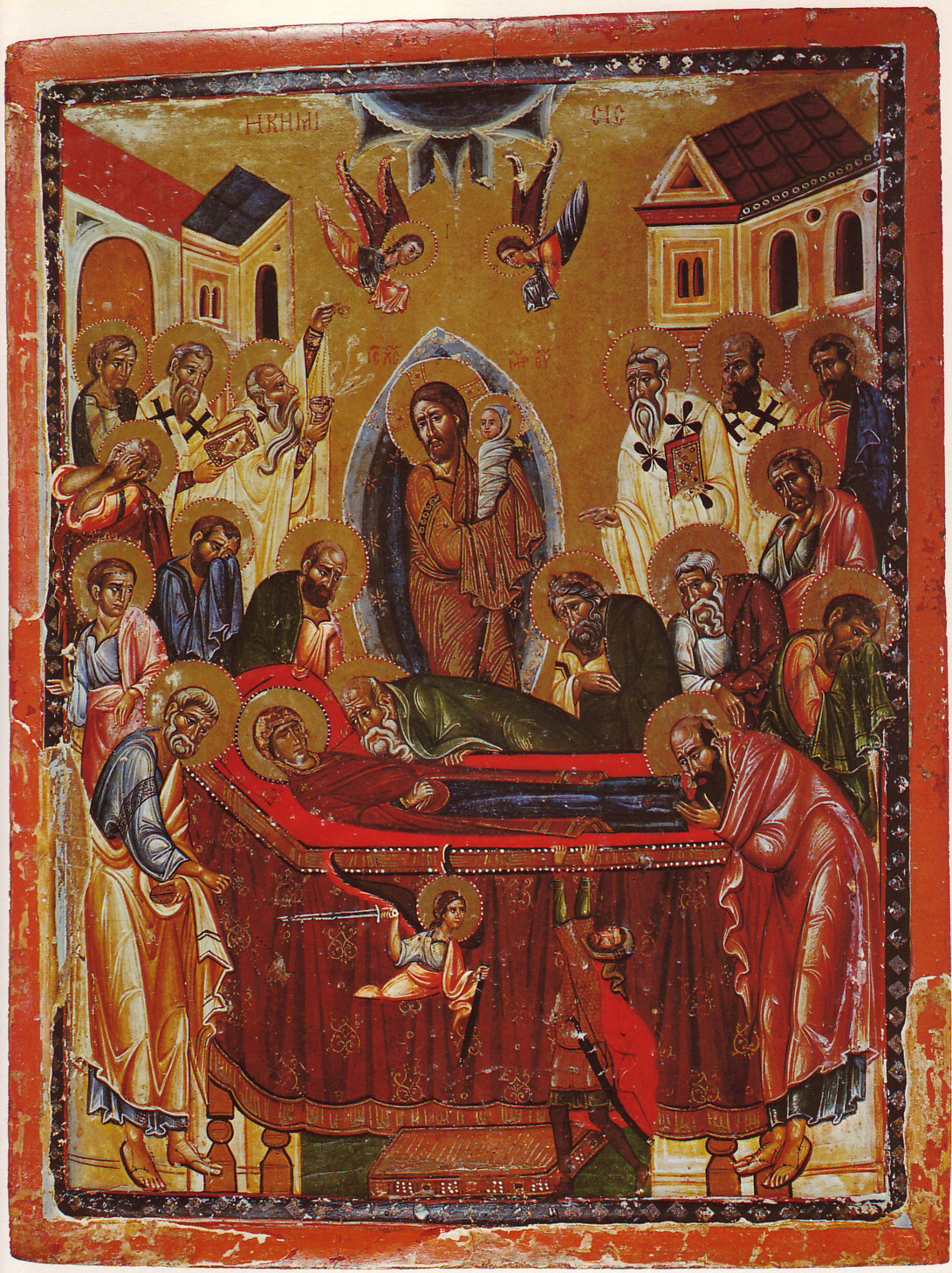
Outlaying of Mary’s corpse with mourning saints. Mixture of byzantine and occidental style. Venetian creator? Icon from the second half of the 13th century. 44.4 x 33.4 cm, Saint Catherine’s Monastery, Sinai (Egypt) / K. Weitzmann: “Die Ikone” – PD-Art, via Wikimedia Commons
I started this blog right before the Dormition Fast last year. Because of that, I announced that I wanted, among other things, to write about the Dormition of the Most Holy Theotokos. This was a new step for me; my previous forays in the blogosphere had been as a surreptitious Anglo-Catholic known as ‘Chinglican’ and as a commentator on contemporary religious happenings – and selectively so, at that. Still, I was encouraged by some of the Eastern Catholics I had met even prior to my chrismation. My Patheos colleague, the Byzantine Catholic writer Henry Karlson, said that I really should write about it. He told me that those who truly understand the theology will get a lot of insights out of it, especially because it’s essential to understand in order to have a sane grasp of what the Latins call the ‘Assumption.’ I think he assumed that as an Eastern Catholic, I’d be one to truly comprehend it.
The problem is that I felt more than I knew. I did have a relationship with the Theotokos even as a Protestant, and I had been chrismated, yes, in a temple that was named for the Dormition of the Theotokos. Though I had seen many icons prior to my encounter with Eastern Catholicism, her icon was the first one I had ever venerated, mostly because at my first visit to the temple, the Eastern Jesuit there invited all the people to venerate the icon on the tetrapod, kiss the blessing cross, and have some antidoron (blessed bread).
Still, I wanted to prove my Byzantine street creds to Karlson – foolishly, I now realize, as he never asked for them – so I tore through some research to look for what he could possibly mean by the Dormition. I learned some interesting things. I discovered, for example, that every icon of the Dormition has the Theotokos’s body lying asleep, while the Lord appears in the midst of his disciples to carry a baby Mary in swaddling clothes up to heaven. I appreciated my Patheos colleagues at Steel Magnificat who wrote about the man in the icon who gets his hands chopped off by ‘the Holy Angel None-of-Your-Business’ for trying to peek at whether the Ever-Virgin was really a virgin as far as her hymen goes, which is a topic that I thought only my other colleague Artur Rosman would have the stomach to tackle. I also learned that the main cathedral of the Kyivan Caves, the monastery that has inspired the spiritual lives of the churches descending from the baptism of the Holy Equals-to-the-Apostles Volodymyr and Olha, was named for the Dormition; so was the temple in which I was received into the Kyivan Church.
The last topic on the above list intrigued me the most because it had everything to do with my new ecclesial identity. The problem is that I could not find very much on what Karlson had called the ‘theology of the Dormition’ in relation to it, and what I ended up doing was writing on the only Dormition temple I knew about: my own. What was frustrating when it came to trying to find any kind of information about the Dormition Cathedral, whether online or in the Primary Chronicle or wherever else it was that I was looking for information about Kyivan Rus’, was that the stories only seem to talk about the temple being named for the Theotokos, nothing about her falling asleep. This was frustrating. Karlson had said to talk about the ‘theology of the Dormition,’ I wanted to write perhaps about the connection between my home temple and this central site in Kyivan spirituality, and all I could dig up was that it was named for the Theotokos, inexplicably for her Dormition. Of course, this most likely reveals that I am incompetent when it comes to doing research on Kyiv; competence and intelligence, I have often suggested on this blog, are not qualities with which I write anything.
But the theology of the Dormition, it turns out, was hiding there in plain sight, and I, I did not even know it. The stories of the building of the Dormition Cathedral can possibly be summarized as the fruit of the monastic vision of the founders of the Kyivan Caves, the Holy Monastics Antony and Theodosius. Despite many political struggles, a monastic community formed around these ascetic founders, and they envisioned building a temple in which the monastics could worship. The story goes that Holy Antony reposed before the project was completed, and even Holy Theodosius, who had brought to the community the Studious rule from Constantinople, was nearing the end of his earthly life. But both had visions that they needed to build a temple and dedicate it to the Most Holy Theotokos; some of the versions of the story have them bilocating to Constantinople while at prayer in Kyiv and recruiting builders with their resources, and others that do not contradict this version have it that the Most Holy Theotokos appeared to builders as a queen in the Church of Blachernae, the same one where she had appeared to throw her protecting mantle over the people from the Kyivan invaders. In any case, both the monastics and the builders somehow knew that it was the Theotokos herself who had called them to build a church in her name over the Kyivan Caves, and that temple is named for the Dormition – or even the Assumption, in some translations.
These stories told me nothing about the Dormition at first. I had expected, as per Karlson’s suggestion, to perhaps find something within the spirituality of the monastics of the Kyivan Caves that had something to do with falling asleep, maybe a line about dying before you die, as is so often said about the bodily training of askesis. Later on, when I discovered that my particular Catholic church’s monastery in Lviv, the Univ Lavra, was also named for the Dormition, I also expected to learn the same thing.
But there was nothing to learn about what I expected to learn because the ascetic theology of monastics, beautiful as it is, is not, properly speaking, the theology of the Dormition. To think that theology is purely conceptual and part of an theoretical realm where principles can be applied as from typologies betrays the fact that I grew up Protestant. The Dormition of the Most Holy Theotokos, though, is not abstract. In a point in history, she fell asleep in the Lord. Then, regardless of whichever apocryphal story one might believe about how she was translated into heaven, the next fact is that liturgical reflections on her falling asleep sprung up organically, articulating poetically how she was translated into heaven, stands in prayer for us before the living G-d, and protects us as her own children. And perhaps, as with the stories of the protecting mantle and the knowledge of monastics and builders alike that her temple at the Kyivan Caves should be named for her, she even shows up at critical points in her resurrected body.
In short, what makes the Theotokos’s palpable bodily presence in our everyday lives possible is the Dormition. As displayed in the icon of the Dormition, her falling asleep and being taken up into new life by the Lord is the foretaste of the resurrection after death, the sign of what we who share in the death and risen life of Christ our Pascha will become, the display as she who goes before us of where we hope to arrive as the pilgrim church.
And in light of that eschatological reality, what must we do? As the Orthodox blogger Matthew Franklin Cooper reminds us today, the Gospel for the Divine Liturgy for today tells us a both-and mystery. When the Lord answers the woman in the crowd who shouts to him, Blessed is the womb that bore you and the breasts that nursed you, he is not rebuking her when he answers that the truly blessed are those who hear the word of G-d and keep it. Instead, he is agreeing with her. To be sure, as Cooper re-translates the passage, and blessed are they that hear the word of God and keep it!
But what does it mean to hear the word of G-d and to keep it? Through the wisdom of our holy mothers and fathers in the church, we receive another Gospel pericope before the short conversation recounted above: the story of the other Mary, whose sister is Martha. Mary sits at the Lord’s feet to hear his teaching, while Martha is so frustrated with serving that she tells the Lord in exasperation to instruct her sister to help her. But the Lord replies, Martha, Martha, you are anxious and troubled about many things, but one thing is necessary. Mary has chosen the good portion, which will not be taken away from her.
Mirroring the fiat of the Theotokos, Mary the sister of Martha is not doing the word; the word is being done to her: fiat mihi secundum verbum tuum. This, the masters of hesychastic spirituality teach, is part of the mystery of being transfigured by the energies of the G-d whose essence cannot be grasped; supersessionists obsessed with their Christian identity politics have frequently complained about my usage of the formulation ‘G-d’ by instructing me time and time again that we are not Jewish, and I fully expect them to complain again about how reading the letters ‘G-d’ throws them off as some kind of falsely affected identitarian claim that I have no right to make. But there is no disagreement with our Jewish sisters and brothers here, and my usage has nothing to do with identity and everything to do with ontology: the beingness of the one who is pure Being cannot be grasped, but G-d reaches out to us through his incarnate energies, most fully in the Son who has exegeted him, to transform us as his icons into his likeness. Mary sits at the feet of her rabbi, and by the word of the G-d whose Being she cannot grasp but whose energy nevertheless creates in her a new being, she is being iconographically transformed.
Every year when the bishop comes to our temple named for the Dormition to celebrate our patronal feast with us, this is the Gospel passage that is set before him. Annually, we receive a reminder from him that even though he is among us, the busyness in food preparation and cleaning up the temple has to take a backseat to simply soaking in the liturgy and hearing the word of the G-d who transfigures us into his likeness, to be like Mary choosing the good portion and developing a relationship with Mary Theotokos who is our mother. It has taken time for the words of my earthly shepherd to sink into my heart, but now I know this finally to be the theology of the Dormition. It is nothing more and nothing less than sitting like Mary the sister of Martha with the Most Holy Theotokos in a bodily way, which is possible only because the body of the All-Holy and Ever-Virgin who fell asleep in the Lord has been taken up into new life. From the womb of she who bore the G-d whose name the people of Israel dare not pronounce and whose Being remains ungraspable comes the Word himself, our Teacher, our Rabbi, our Lord, the perfect icon of the one who is unseen whose Uncreated Light transfigures even us sinners.
Why would you name a church for the Dormition? Why would anyone call a temple the ‘death church’? Why would the stories about the Kyivan Caves speak so much about the presence of the Theotokos appearing to persons but not much about why the temples that are built are named for her falling asleep? The answer is mysterious, maybe even unsatisfying: the people of G-d are reflecting in their gathering on a mystery, which is that somehow, the maternal presence of the Most Holy Theotokos is even now bodily encountered. How is this even possible? It is a mystery, but the poetic language of our liturgy attempts to articulate it: she who has fallen asleep has been taken up into new life, for death could not hold her. She who is only human has been so infused with divine grace by the bodily presence of the Son she bore in her body that this new life is nothing short of the bodily resurrection promised to us. The Theotokos still encounters us in her body; in this way, we understand who we are ourselves as temples of the Holy Spirit, naming the temples in which we worship after the event that makes our encounter with her possible. Monastics and builders, clergy and laity, women and men, young and old: the centrality of the Dormition of the Most Holy Theotokos in the spirituality of the Kyivan Church is a call simply to be and to contemplate what we will become.
This, then, in the words of the psalmist, is the theology of the Dormition, the speech of my body about G-d through the falling asleep of his Mother into new bodily life: I have calmed and quieted my soul, like a weaned child with its mother; my soul is like the weaned child that is within me.
Previous Post
August 15, 2017
The assumption of the people (Dormition Fast #14)
Next Post
August 22, 2017 SERIES: Reflections on the Most Holy Theotokos and her Dormition
Browse Our Archives
Select a Category Academia Anglican Communion anti-racism Aristotle Asia-Pacific Asian American Asian Canadian BlackLivesMatter Cantonese Catholic China Chinglican church politics Church-State Politics Civil Society Conservative Eastern Christianity Evangelical Evangelical Left Feminist/Womanist Theology Food Greek-Catholic Church of Kyiv Hong Kong Housekeeping Kyivan Church Latin Catholicism Law Liberal Liberation Theology New Calvinism Pentecostal/Charismatic Protestant Psychoanalysis Publics Religion Ethnicity Wired Secular Sovereignty TPCIU Uncategorized
Select a Month July 2019 June 2019 May 2019 April 2019 March 2019 February 2019 January 2019 December 2018 November 2018 October 2018 September 2018 August 2018 July 2018 June 2018 May 2018 March 2018 February 2018 January 2018 December 2017 November 2017 October 2017 September 2017 August 2017 July 2017 June 2017 April 2017 March 2017 February 2017 January 2017 December 2016 November 2016 October 2016 September 2016 August 2016 July 2016 January 2016 December 2015 November 2015 October 2015 August 2015 April 2015 March 2015 February 2015 December 2014 November 2014 September 2014 August 2014 July 2014 June 2014 May 2014 April 2014 March 2014 December 2013 November 2013 October 2013 September 2013 August 2013 July 2013 June 2013 May 2013 April 2013 March 2013 February 2013 January 2013 December 2012 October 2012 June 2012 May 2012 April 2012 February 2012 January 2012
Follow Us!
TAKE THE
Religious Wisdom Quiz
What does "Rabbi" mean in Hebrew?
Select your answer to see how you score.
My Teacher Judge King Prophet
Related posts from Eastern Catholic Person

I've found my way home: on the unraveling...

Patriyarkhat: 'Attending to the movements of my heart'

I'm flattered to be named an Asian American...

The secular does not stop when your drive...
TRENDING AT PATHEOS Catholic

Rejecting Doom: Christian Hope And Human Action
Christianity is a religion of hope. We are to have hope and...

It’s What Comes From Within Which Matters
One of the most difficult things for us to understand is why...

Why I Choose the Eucharist Over the Sermon
Choose the Eucharist, Not the Sermon What are we supposed to get...

5 Design Elements Found in Spiritually Rooted Homes
Putting Spirituality Into Home Decor Our homes are more than our living...

Credo: A Story of God Told with the...
About 10 years ago, I began to imagine a personal "Credo" that...

The Anatomy of Divine Revelation in Catholic Thought
The claim that God has made Himself known to human beings is...
view all Catholic blogs
Ad-Free & Subscriber Log-In Subscription Support
- About Us
- 2026 Calendar
- Videos
- Podcasts
- Library of World Religions
- Faith In Media Tracker
- Advertise With Us
- Write for Us
- Privacy Policy
- Terms of Service
- Do Not Sell My Data
- Contact Us
- Radiant Digital
- Manage Newsletter Subscriptions
- Unsubscribe From Notifications
- Sitemap
Copyright 2008-2026, Patheos. All rights reserved.
Subscription Support Ad-Free & Subscriber Log-In
Follow Patheos