
BuddhistCatholicContemplativeEvangelicalGeneral ChristianHinduJewishLatter-day SaintMuslimNew VisionsProgressive Christian
Beliefs
- Buddhist
- Catholic
- Contemplative
- Evangelical
- General Christian
- Hindu
- Jewish
- Latter-day Saint
- More Voices
- Muslim
- New Visions
- Pagan
- Progressive Christian
Topics
- Religion News
- Food and Religion
- Sports and Religion
- Religious Art
- Religious Music and Entertainment
- Religious Events
- History and Religion
- Style and Religion
- Politics and Religion
- Women in Religion
- Recreation Outdoors and Religion
- Business Finance and Religion
- Careers Workplace and Religion
- Education and Religion
- Family Parenting and Religion
- Health Fitness and Religion
- Home and Religion
- Relationships and Religion
- Technology and Religion
- Travel and Religion
Columnists
- Buddhist Columnists
- Business Finance and Religion Columnists
- Careers Workplace and Religion Columnists
- Catholic Columnists
- Contemplative Columnists
- Education and Religion Columnists
- Evangelists Columnists
- Family Parenting and Religion Columnists
- General Christian Columnists
- Health Fitness and Religion Columnists
- Hindu Columnists
- History and Religion Columnists
- Home and Religion Columnists
- Jewish Columnists
- More Voices Columnists
- Latter Day Columnists
- Muslim Columnists
- New Visions Columnists
- Nonreligious Columnists
- Pagan Columnists
- Politics and Religion Columnists
- Progressive Columnists
- Recreation Outdoors and Religion Columnists
- Relationships and Religion Columnists
- Religion News Columnists
- Religious Art Columnists
- Religious Events Columnists
- Religious Music and Entertainment Columnists
- Sports and Religion Columnists
- Style and Religion Columnists
- Technology and Religion Columnists
- Travel and Religion Columnists
- Women in Religion Columnists
Resource Library
- 2026 Calendar
- Library of World Religions
- The 100 Most Holy Places on Earth
- Patheos Answers
- Podcasts
- Videos
- Faith Leaders Database
- Anglican Episcopalian
- Bahai
- Baptist
- Buddhism
- Christianity
- Confucianism
- Eastern Orthodoxy
- Hinduism
- Holiness and Pentecostal
- ISKCON
- Islam
- Judaism
- Lutheran
- Methodist
- The Church of Jesus Christ of Latter-day Saints
- New Age
- Paganism
- Presbytarian and Reformed
- Protestantism
- Religion Behind the Scenes
- Roman Catholic
- Scientology
- Shia Islam
- Sikhism
- Sufism
- Sunni Islam
- Taoism
- Zen
- See all religions
Research Tools
 Ad-Free & Subscriber Log-In Subscription Support
Ad-Free & Subscriber Log-In Subscription Support
Follow Patheos 

- Trending:
- Forgiveness
- |
- Marriage
- |
- Consciousness
- |
- Death Penalty
- |
- Election
- |
- Halloween
 Eastern Catholic Person
- Home
- Catholic
- The assumption of the people (Dormition Fast #14)
The assumption of the people (Dormition Fast #14)
Last updated on: August 15, 2017 at 12:20 pm by Justin Tse
The assumption of the people (Dormition Fast #14) 2017-08-15T12:20:43-07:00 Justin Tse
Patheos Explore the world's faith through different perspectives on religion and spirituality! Patheos has the views of the prevalent religions and spiritualities of the world.
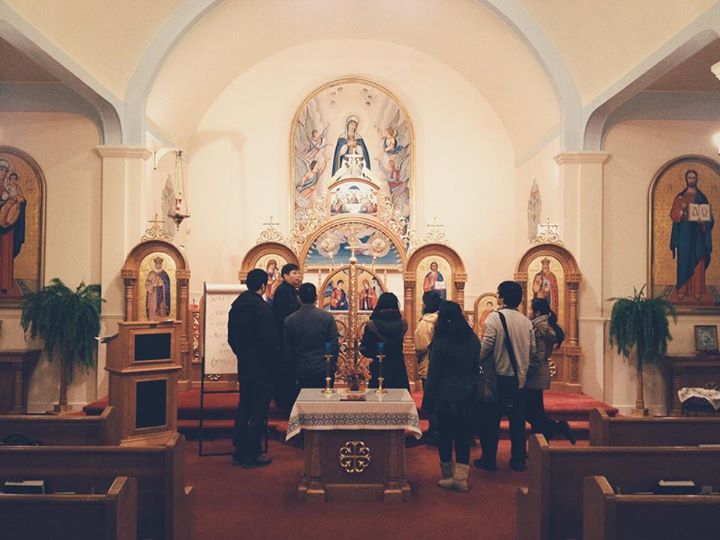
A bunch of bewildered Protestants contemplating the Umbrella Movement in an Eastern Catholic parish (see the reredos in the back?), 14 October 2016 – photo credit: Richard Wu
Recently, a priest of the Latin Church impressed on me the significance for the West of Pius XII defining the Dogma of the Assumption ex cathedra. He said that I had to keep in mind the time that Pius XII was writing: it was after the devastation of Europe in the Second World War. Cities had been bombed out, millions were dead, and fascist ideologies had been revealed not only to be bankrupt, but they also take down the world into the hell of nothingness that they are. By 1950, the world had not learned its lesson; it was the beginning of a Cold War between a stated Western European entrenchment into liberal democratic capitalism over against communism in Eastern Europe and Asia.
The Latin priest said that it was in the midst of all this meaningless devastation that Pius XII spoke. The Assumption of the Blessed Virgin into heaven, body and soul, was the one thing (he said) that the West could hold on to that was beautiful; in the midst of all this environmental destruction, there were flowers. As Pius XII opens his Apostolic Constitution Munificentissimus Deus, where he does the defining:
The most bountiful God, who is almighty, the plan of whose providence rests upon wisdom and love, tempers, in the secret purpose of his own mind, the sorrows of peoples and of individual men by means of joys that he interposes in their lives from time to time, in such a way that, under different conditions and in different ways, all things may work together unto good for those who love him. (MD, 1).
He continues by lamenting that ‘just like the present age, our pontificate is weighed down by ever so many cares, anxieties, and troubles, by reason of very severe calamities that have taken place and by reason of the fact that many have strayed away from truth and virtue’ (MD, 2). And yet he notices that ‘while the Catholic faith is being professed publicly and vigorously, piety toward the Virgin Mother of God is flourishing and daily growing more fervent, and that almost everywhere on earth it is showing indications of a better and holier life.’ Flowers indeed, in the bombed out garden.
In many ways, the most objectionable parts of the document for those of us in the Eastern churches come only at the end, when Pius XII declares that ‘if anyone, which God forbid, should dare willfully to deny or to call into doubt that which we have defined, let him know that he has fallen away completely from the divine and Catholic Faith’ (MD, 45). He continues: ‘It is forbidden to any man to change this, our declaration, pronouncement, and definition or, by rash attempt, to oppose and counter it. If any man should presume to make such an attempt, let him know that he will incur the wrath of Almighty God and of the Blessed Apostles Peter and Paul’ (MD, 47). As Bishop Kallistos Ware suggests, the objections of the Orthodox about the Assumption have really more to do with such ex cathedra pronouncements, much as the Bishop of Rome took pains earlier in the document to note that he had even surveyed the bishops in 1946 – in the wake of the immediate destruction of the Second World War – to ask, ‘Do you, venerable brethren, in your outstanding wisdom and prudence, judge that the bodily Assumption of the Blessed Virgin can be proposed and defined as a dogma of faith? Do you, with your clergy and people, desire it?’ (MD, 11). Their ‘almost unanimous affirmative response’ (MD, 12), he suggests, is part of a much pattern of the Latin faithful having petitioned the See of Rome to declare the Assumption to be dogma over the centuries.
Citing the First Vatican Council’s infamous document Pastor Aeternus on papal infallibility in ex cathedra pronouncements, Pius XII affirms that ‘the Holy Spirit was not promised to the successors of Peter in such a way that, by his revelation, they might manifest new doctrine, but so that, by his assistance, they might guard as sacred and might faithfully propose the revelation delivered through the apostles, or the deposit of faith’ (MD, 12). Not willing to speak unilaterally (while he is, of course, speaking unilaterally), he surveys the tradition as well, finding temples dedicated to the Theotokos, as well as theological formulations from Latin scholars. But one of his more interesting findings lies in his affirmation that the dogma of the Assumption can be found in both Western and Eastern liturgical traditions, the work of the people making Christ present in their midst handed down from generation to generation:
And, in the Byzantine liturgy, not only is the Virgin Mary’s bodily Assumption connected time and time again with the dignity of the Mother of God, but also with the other privileges, and in particular with the virginal motherhood granted her by a singular decree of God’s Providence. “God, the King of the universe, has granted you favors that surpass nature. As he kept you a virgin in childbirth, thus he has kept your body incorrupt in the tomb and has glorified it by his divine act of transferring it from the tomb.” (MD, 18).
A few paragraphs down, he cites our Byzantine fathers among the saints, Holy John of Damascus and Holy Germanus of Constantinople, on the Dormition:
Thus St. John Damascene, an outstanding herald of this traditional truth, spoke out with powerful eloquence when he compared the bodily Assumption of the loving Mother of God with her other prerogatives and privileges. “It was fitting that she, who had kept her virginity intact in childbirth, should keep her own body free from all corruption even after death. It was fitting that she, who had carried the Creator as a child at her breast, should dwell in the divine tabernacles. It was fitting that the spouse, whom the Father had taken to himself, should live in the divine mansions. It was fitting that she, who had seen her Son upon the cross and who had thereby received into her heart the sword of sorrow which she had escaped in the act of giving birth to him, should look upon him as he sits with the Father. It was fitting that God’s Mother should possess what belongs to her Son, and that she should be honored by every creature as the Mother and as the handmaid of God.”
These words of St. John Damascene agree perfectly with what others have taught on this same subject. Statements no less clear and accurate are to be found in sermons delivered by Fathers of an earlier time or of the same period, particularly on the occasion of this feast. And so, to cite some other examples, St. Germanus of Constantinople considered the fact that the body of Mary, the virgin Mother of God, was incorrupt and had been taken up into heaven to be in keeping, not only with her divine motherhood, but also with the special holiness of her virginal body. “You are she who, as it is written, appears in beauty, and your virginal body is all holy, all chaste, entirely the dwelling place of God, so that it is henceforth completely exempt from dissolution into dust. Though still human, it is changed into the heavenly life of incorruptibility, truly living and glorious, undamaged and sharing in perfect life.” And another very ancient writer asserts: “As the most glorious Mother of Christ, our Savior and God and the giver of life and immortality, has been endowed with life by him, she has received an eternal incorruptibility of the body together with him who has raised her up from the tomb and has taken her up to himself in a way known only to him.” (MD, 21-22).
The point, in other words, is that just because the Bishop of Rome exercised his ex cathedra powers to proclaim the Dogma of the Assumption doesn’t mean there’s not something to it; as a friend tells me, just because you’re paranoid doesn’t mean they’re not out to get you. Calling the Feast of the Dormition ‘perhaps the most popular feast in the hearts of the Orthodox,’ the Greek Orthodox theologian John Panteleimon Manoussakis suggests that Pius XII may be onto something when he says that the Assumption is linked to the other dogma proclaimed by his predecessor Pius IX on the Immaculate Conception (MD, 4):
How to explain what Christians have celebrated since at least the fifth century, that is, that Mary, even though she dies, is not dead; that her body does not see corruption but , together with her soul, experiences already the eschatological blessedness? How to explain all this without recourse to the exceptional and singular grace that the Virgin Mary received as the Mother of God? In the feast of the Dormition – perhaps the most popular feast in the hearts of the Orthodox – we find the key to how the Orthodox could accept doctrinally what they already confess liturgically, namely, the sinless nature of the Mother of God. (Manoussakis, For the Unity of All, p. 6).
Similar to Pius XII’s survey of liturgical traditions and recounting of the thousands of petitions that have come through the Vatican to declare the Assumption a dogma, Manoussakis is saying that these radical declarations about the Most Holy Theotokos, which might be described as ‘poetic,’ come from the liturgical work of the people. It is the people who are first conscious that the ark of the covenant in heaven that Holy John the Theologian saw in the Apocalypse on Patmos is none other than the Theotokos in her body (Rev. 11.19); their bishops’ role is to reflect later on upon the people’s practice of reception of the tradition through their liturgy.
Certainly, some of the Orthodox now have new reservations about the Assumption. The blogger who calls himself The Heavy Anglo-Orthodox, Matthew Franklin Cooper, wrote today, for example, of the dangers of taking the Assumption too far and saying that the Theotokos didn’t even have to go through death:
They speak wrongly, and unworthily, of the Theotokos who say that she was transported to Heaven without first falling asleep. To be sure, she was taken to Heaven, living in body and spirit. But by making the Ever-Virgin Mary something ontologically more-than-human, they lessen her humanity and they lessen (every bit as much as the predestinarians) the honour which is rightly due to her, that she freely chose to hear the word of God and keep it. By ‘forgetting the body’ of the Ever-Virgin Theotokos in the wrong way (and thus daring to do what Christ did not, in correcting or contradicting the woman from the crowd), they actually do her a grave injustice. It then becomes all-too-easy to forget that she was Jewish; that she was a woman of Nazareth; that she was working-class; that she was a subject of the Roman Empire and their Herodean client kings; that her father and mother Saints Joachim and Anna remembered the Hasmonean Kingdom with fondness and no doubt prayed for its restoration. In short, in forgetting the Dormition it becomes easier to forget the Theotokos as she was: an obedient daughter, a loving mother, a humble woman magnified by her love.
But certainly, such danger is also not in keeping with what Pius XII defines: throughout Munificentissimus Deus, he quotes from a variety of teachers from the tradition who speak about how the death of the Theotokos still could not hold her down and that, in a foreshadowing of our own bodily resurrection, her body was translated to heaven. In the tradition of both East and West, there is no forgetting of the Dormition; without death, resurrection would make no sense, and Pius XII’s ultimate pastoral objective would have been fruitless: ‘Finally it is our hope that belief in Mary’s bodily Assumption into heaven will make our belief in our own resurrection stronger and render it more effective’ (MD, 42).
Under the protecting mantle of the Most Holy Theotokos – who is able to protect us bodily because she is bodily in heaven – Christians from East and West might indeed find a way to make a common home amidst devastations today that are equally as horrific as when Pius XII wrote, what with the emergence of new far-right nationalisms, the destruction of the planet’s ecology leading to climate change, and a descent into both political chaos and authoritarianism around the world. In fact, Archbishop Elias Zoghby of blessed memory wrote in answer to those who posited that the Marian dogmas were still an impediment to Orthodox unity with the Bishop of Rome that it would be offensive to Mary Theotokos herself to see her children divided over her. Archbishop Elias, of course, wrote as the enfant terrible of the Second Vatican Council, recounting many of the Latin abuses in his canonical Melkite territory and describing uniatism as the straw that broke the proverbial camel’s back of de facto double communion between Rome and the Orthodox even after schism; he, in short, has no interest in latinization. For Archbishop Elias, the Theotokos is not a concept. She is a person. She relates to us as a bodily presence.
And yet, I am glad for the actual name of my home temple in Richmond, the Dormition of the Holy Mother of God; most of my friends don’t know this, though, as we have taken the liberty of calling it ‘the Eastern Catholic Church in Richmond’ to avoid having to explain to superstitious Chinese people why we are the death church. The plaque that records our temple’s consecration by Patriarch Josyf (Slipyj) of blessed memory says that we are supposed to be named for the Assumption of the Blessed Virgin, which makes sense because there is already a parish in Kelowna named for the Dormition. The reredos in the front of the temple is a dead giveaway; instead of the Oranta, we have a huge display of the Blessed Virgin ascending into heaven on wings of angels, put there from the time I was told that we didn’t even have an iconostas and the altar was pushed back against the wall like a traditional Latin church. Some time along the way, the iconostas went up, and eventually, somebody realized that the name was a problem and changed it; the true feat is that I have heard no controversy about it, as this is the kind of thing that stereotypical Ukrainians would throw a fit about (cf. How many Ukrainian Catholics does it take to change a light bulb? YOU CAN’T CHANGE THAT LIGHT BULB! MY GRANDFATHER DONATED THAT LIGHT BULB TO THE CHURCH!).
This, though, is an immensely helpful corrective. If we were to go by the reredos that is still there (along with the stations of the cross and the pews, cue nervous uniate laugh), we might say that at a popular and subjective level, we perhaps are in true danger of forgetting that there is no ‘assumption,’ ‘translation,’ ‘metastasis,’ or whatever of the body of the Theotokos without her Dormition. But in the tension of our very name, we just might enter into a better understanding of what it is when we feel the presence of the Theotokos near us, as a body even, such that we cry out, Most Holy Theotokos, save us! And in the non-usage of our name and our affirmation that we are not only the Eastern Catholic Church, but also in Chinese the 東正天主教會 – the Orthodox Catholic Church – we say that we are Orthodox in communion with Rome, affirming that what is seen as a deal-breaker with the Latin Church is not one at all, for our people have always been part of the liturgical tradition that sings the kondak hymn in the second tone: The tomb and death could not hold the Mother of God, unceasing in her intercession and unfailing hope of patronage, for, as the Mother of Life, she was transferred to life by Him Who had dwelt in her ever-virgin womb.
Previous Post
August 15, 2017
The presence of the Wise Older Women (Dormition Fast #13)
Next Post
August 15, 2017 The theology of the Dormition (Dormition Fast #15/Dormition Feast)
Browse Our Archives
Select a Category Academia Anglican Communion anti-racism Aristotle Asia-Pacific Asian American Asian Canadian BlackLivesMatter Cantonese Catholic China Chinglican church politics Church-State Politics Civil Society Conservative Eastern Christianity Evangelical Evangelical Left Feminist/Womanist Theology Food Greek-Catholic Church of Kyiv Hong Kong Housekeeping Kyivan Church Latin Catholicism Law Liberal Liberation Theology New Calvinism Pentecostal/Charismatic Protestant Psychoanalysis Publics Religion Ethnicity Wired Secular Sovereignty TPCIU Uncategorized
Select a Month July 2019 June 2019 May 2019 April 2019 March 2019 February 2019 January 2019 December 2018 November 2018 October 2018 September 2018 August 2018 July 2018 June 2018 May 2018 March 2018 February 2018 January 2018 December 2017 November 2017 October 2017 September 2017 August 2017 July 2017 June 2017 April 2017 March 2017 February 2017 January 2017 December 2016 November 2016 October 2016 September 2016 August 2016 July 2016 January 2016 December 2015 November 2015 October 2015 August 2015 April 2015 March 2015 February 2015 December 2014 November 2014 September 2014 August 2014 July 2014 June 2014 May 2014 April 2014 March 2014 December 2013 November 2013 October 2013 September 2013 August 2013 July 2013 June 2013 May 2013 April 2013 March 2013 February 2013 January 2013 December 2012 October 2012 June 2012 May 2012 April 2012 February 2012 January 2012
Follow Us!
TAKE THE
Religious Wisdom Quiz
In what city was Jesus born?
Select your answer to see how you score.
Nazareth Jerusalem Rome Bethlehem
Related posts from Eastern Catholic Person

I've found my way home: on the unraveling...

Patriyarkhat: 'Attending to the movements of my heart'

I'm flattered to be named an Asian American...

The secular does not stop when your drive...
TRENDING AT PATHEOS Catholic

Rejecting Doom: Christian Hope And Human Action
Christianity is a religion of hope. We are to have hope and...

It’s What Comes From Within Which Matters
One of the most difficult things for us to understand is why...

Why I Choose the Eucharist Over the Sermon
Choose the Eucharist, Not the Sermon What are we supposed to get...

5 Design Elements Found in Spiritually Rooted Homes
Putting Spirituality Into Home Decor Our homes are more than our living...

Credo: A Story of God Told with the...
About 10 years ago, I began to imagine a personal "Credo" that...

The Anatomy of Divine Revelation in Catholic Thought
The claim that God has made Himself known to human beings is...
view all Catholic blogs
Ad-Free & Subscriber Log-In Subscription Support
- About Us
- 2026 Calendar
- Videos
- Podcasts
- Library of World Religions
- Faith In Media Tracker
- Advertise With Us
- Write for Us
- Privacy Policy
- Terms of Service
- Do Not Sell My Data
- Contact Us
- Radiant Digital
- Manage Newsletter Subscriptions
- Unsubscribe From Notifications
- Sitemap
Copyright 2008-2026, Patheos. All rights reserved.
Subscription Support Ad-Free & Subscriber Log-In
Follow Patheos