
BuddhistCatholicContemplativeEvangelicalGeneral ChristianHinduJewishLatter-day SaintMuslimNew VisionsProgressive Christian
Beliefs
- Buddhist
- Catholic
- Contemplative
- Evangelical
- General Christian
- Hindu
- Jewish
- Latter-day Saint
- More Voices
- Muslim
- New Visions
- Pagan
- Progressive Christian
Topics
- Religion News
- Food and Religion
- Sports and Religion
- Religious Art
- Religious Music and Entertainment
- Religious Events
- History and Religion
- Style and Religion
- Politics and Religion
- Women in Religion
- Recreation Outdoors and Religion
- Business Finance and Religion
- Careers Workplace and Religion
- Education and Religion
- Family Parenting and Religion
- Health Fitness and Religion
- Home and Religion
- Relationships and Religion
- Technology and Religion
- Travel and Religion
Columnists
- Buddhist Columnists
- Business Finance and Religion Columnists
- Careers Workplace and Religion Columnists
- Catholic Columnists
- Contemplative Columnists
- Education and Religion Columnists
- Evangelists Columnists
- Family Parenting and Religion Columnists
- General Christian Columnists
- Health Fitness and Religion Columnists
- Hindu Columnists
- History and Religion Columnists
- Home and Religion Columnists
- Jewish Columnists
- More Voices Columnists
- Latter Day Columnists
- Muslim Columnists
- New Visions Columnists
- Nonreligious Columnists
- Pagan Columnists
- Politics and Religion Columnists
- Progressive Columnists
- Recreation Outdoors and Religion Columnists
- Relationships and Religion Columnists
- Religion News Columnists
- Religious Art Columnists
- Religious Events Columnists
- Religious Music and Entertainment Columnists
- Sports and Religion Columnists
- Style and Religion Columnists
- Technology and Religion Columnists
- Travel and Religion Columnists
- Women in Religion Columnists
Resource Library
- 2026 Calendar
- Library of World Religions
- The 100 Most Holy Places on Earth
- Patheos Answers
- Podcasts
- Videos
- Faith Leaders Database
- Anglican Episcopalian
- Bahai
- Baptist
- Buddhism
- Christianity
- Confucianism
- Eastern Orthodoxy
- Hinduism
- Holiness and Pentecostal
- ISKCON
- Islam
- Judaism
- Lutheran
- Methodist
- The Church of Jesus Christ of Latter-day Saints
- New Age
- Paganism
- Presbytarian and Reformed
- Protestantism
- Religion Behind the Scenes
- Roman Catholic
- Scientology
- Shia Islam
- Sikhism
- Sufism
- Sunni Islam
- Taoism
- Zen
- See all religions
Research Tools
 Ad-Free & Subscriber Log-In Subscription Support
Ad-Free & Subscriber Log-In Subscription Support
Follow Patheos 

- Trending:
- Forgiveness
- |
- Marriage
- |
- Consciousness
- |
- Death Penalty
- |
- Election
- |
- Halloween
 Eastern Catholic Person
- Home
- Catholic
- The private consensus is unraveling (Dormition Fast #10)
The private consensus is unraveling (Dormition Fast #10)
Last updated on: August 11, 2017 at 7:32 pm by Justin Tse
The private consensus is unraveling (Dormition Fast #10) 2017-08-11T19:32:33-07:00 Justin Tse
Patheos Explore the world's faith through different perspectives on religion and spirituality! Patheos has the views of the prevalent religions and spiritualities of the world.
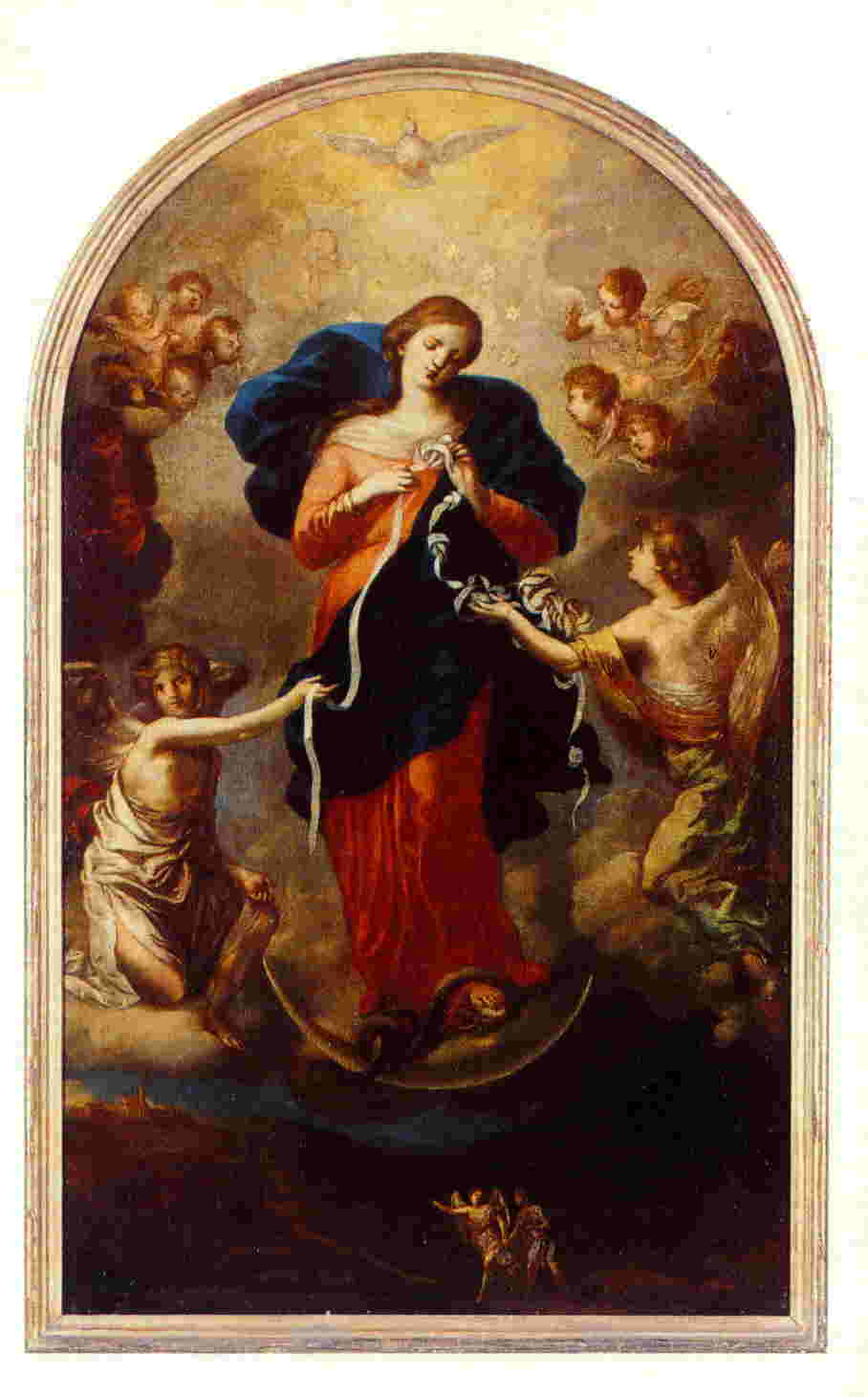
Maria Untier of Knots – PD-Art, via Wikimedia Commons
In 2013, in the year of the election of Jorge Mario Cardinal Bergoglio SJ as Pope Francis of Rome, at the tail end of the Latin Church’s Year of Faith, the See of Rome welcomed into its central square, the one named for the Holy Apostle Peter, the statue of the Lady who had appeared to three shepherd children at Fatima and predicted the ideological horrors of the twentieth century.
At this event, Francis offered a speech describing the faith of the Theotokos. Though he made three points that outlined Mary as 1) untying ‘the knot of sin,’ 2) giving ‘human flesh to Jesus’ (reflecting the longstanding teaching of the church on the Theotokos) and 3) preceding us on ‘pilgrimage’ (echoing his predecessor John Paul II’s Redemptoris Mater), perhaps the first point is the most important in understanding his theology:
The first aspect of her faith is this: Mary’s faith unties the knot of sin (cf. Lumen Gentium, 56). What does that mean? The Fathers of the Second Vatican Council took up a phrase of Saint Irenaeus, who states that “the knot of Eve’s disobedience was untied by the obedience of Mary; what the virgin Eve bound by her unbelief, the Virgin Mary loosened by her faith” (Adversus Haereses, III, 22, 4).
The “knot” of disobedience, the “knot” of unbelief. When children disobey their parents, we can say that a little “knot” is created. This happens if the child acts with an awareness of what he or she is doing, especially if there is a lie involved. At that moment, they break trust with their parents. You know how frequently this happens! Then the relationship with their parents needs to be purified of this fault; the child has to ask forgiveness so that harmony and trust can be restored. Something of the same sort happens in our relationship with God. When we do not listen to him, when we do not follow his will, we do concrete things that demonstrate our lack of trust in him – for that is what sin is – and a kind of knot is created deep within us. These knots take away our peace and serenity. They are dangerous, since many knots can form a tangle which gets more and more painful and difficult to undo.
But we know one thing: nothing is impossible for God’s mercy! Even the most tangled knots are loosened by his grace. And Mary, whose “yes” opened the door for God to undo the knot of the ancient disobedience, is the Mother who patiently and lovingly brings us to God, so that he can untangle the knots of our soul by his fatherly mercy. We all have some of these knots and we can ask in our heart of hearts: What are the knots in my life? “Father, my knots cannot be undone!” It is a mistake to say anything of the sort! All the knots of our heart, every knot of our conscience, can be undone. Do I ask Mary to help me trust in God’s mercy, to undo those knots, to change? She, as a woman of faith, will surely tell you: “Get up, go to the Lord: he understands you”. And she leads us by the hand as a Mother, our Mother, to the embrace of our Father, the Father of mercies.
Certainly, the formulation of the Theotokos untying the knot of sin also goes back to the earliest days of the church fathers; Holy Irenaeus of Lyons posits that Mary is a type of New Eve, the one who reverses the ancient human mother’s sin through the divine person born of her womb. But as the world got to know the newly elected Pope Francis, word also got out that he had been instrumental as the Latin Archbishop of Buenos Aires in introducing the devotion to Our Lady Untier of Knots to Catholics in Argentina after picking up her prayer card during his studies in Europe in the 1980s. Apart from the famous church in Austria named in her honour in the wake of Chernobyl, Our Lady Untier of Knots has since become a popular devotional figure and patroness of churches across Latin America; when Cardinal Bergoglio offered a chalice as a gift from his archdiocese to Benedict XVI, it was engraved with her figure.
It was tempting in 2013 to see Francis himself as a bit of an untier of knots. Widely hailed as a humble pope who carried his own bag and lived in the Casa Santa Marta instead of the papal apartments, Francis became a sort of rallying cry for the reformation of capital-R ‘Religion’ altogether, beginning with that tangled Vatican curia that had served up the sex abuse crisis of our lifetime and that was so leaky at the time that even the butler of the previous pontificate was embroiled in scandal. In many ways, Francis has delivered and continues to deliver, ripping to shreds the conventions of curial respectability and personally taking the reins of the Vatican’s unwieldy helm.
But if the person of Francis wasn’t enough to signal the untying of knots, then the times certainly were. On the very last day of the Year of Faith, Francis issued the Apostolic Exhortation Evangelii Gaudium, which had such colorful subheadings that the progressive American presidential candidate Senator Bernie Sanders later quoted it to say that even the pope is supportive of his brand of democratic socialism: No to an economy of exclusion! No to the new idolatry of money! No to a financial system that rules rather than serves! No to the inequality which spawns violence! Francis himself referenced the ‘current financial crisis’ (EG 55), the one so fresh from the heels of the 2008 financial meltdown after which it was remarkable how precious little any of the technocratic liberal elites of global capitalism changed their modus operandi or held accountable the persons driving the institutions that had caused the collapse, calling such establishments ‘too big to fail.’ By saying no to such inertia, Francis could so easily be read as joining in the waves of protests that had been sweeping the world in the wake of 2008, from the Arab Spring to Occupy Wall Street’s many spinoffs to Black Lives Matter – and those were just the beginning. By the end of 2013 and into 2014 came even more occupy protests celebrated by the Left (like Caracas and Ayotzinapa) as well as those rejected by the Left (Maidan, the Sunflower Movement, the Umbrella Movement), but whatever one’s assessments of any of these protests, the feeling in the air was that something was being undone, a Gordian knot of global capitalism, racism, political authoritarianism, and violent securitzation finally perhaps being untied.
I too, a Protestant, was inspired. Even within the microcosmic bubble of Asian American evangelical Protestantism, I could also feel this wave of liberation in the air. A week before the launch of a Hong Kong satellite plant of the evangelical megachurch Saddleback Church, its founding pastor Rick Warren, fancying himself a humorist, hoisted a photo of a Cultural Revolution-era Red Guard onto his public Facebook page, joking that it reflected the attitude of his staff as they go to work everyday. When both Asian Americans and Hong Kong people voiced their concerns that this was not exactly the way to make friends and win influence in Asia and Asian America, Warren fired back that it was only the Pharisees who did not get the Lord Jesus’ humor. The backlash was severe: several Asian American evangelical bloggers, myself included (with one post even citing Benedict XVI), excoriated Warren for orientalizing our people, as if we were only the butt of jokes within evangelicalism and not actual people existing within evangelical Protestantism. As the press picked up the story, all hell broke loose, especially when Warren apologized by saying ‘if‘ we were offended, he was sorry (would you ever apologize to your wife that way?). When a church leadership conference meeting at Saddleback three weeks later featured a skit imitating the characters from Karate Kid, Asian American evangelical leaders decided that they had had enough. An ‘open letter to the evangelical church‘ was circulated, more press picked up the story, and it seemed like for the first time, Asian American evangelicals would be taken seriously in our own right, not taken to be exotic toys for white missionaries any longer.
And then, after all that noise and hope that the knots of white normativity and Asian subservience in evangelical Protestantism had been untied, nothing. I later found out what had happened: the action items of the open letter had specified that all Asian Americans wanted was a seat at the white evangelical table, nothing more, nothing less. A few organizations had gotten in touch, a special issue of Christianity Today was planned and published, and that satisfied some of the main organizers of the letter so much that they didn’t feel the need to say anything more. Problem solved, case closed, next item on the agenda.
It really was my own fault that I didn’t read carefully the open letter I had signed (hence my reluctance to sign open letters now), but I also felt that this was a missed opportunity. Here had been the chance to bust open not only the racial dynamics of evangelical Protestantism, but also the even thornier problem behind race. As a number of scholars of evangelicals (Bob Wuthnow, Randall Balmer, Christian Smith, Michael Emerson, among others) and journalists (like Deborah Jian Lee) have shown, why nothing really ever changes in evangelical Protestantism is because of the unspoken religious norm that evangelical organizations are private, have their own vested interests, and rely on donations to keep operating. With such a modus operandi, there is hardly any notion of a commons: the world exists for the private agenda, not the common good. This ‘private consensus’ (the consensus that everything boils down to the private interest) was what in fact perpetuated the race problem in evangelicalism: evangelical organizations didn’t really have to care about people of color as long as they were well-funded for their stated Gospel-propagating purposes. This, I had thought, was the radical entry point for the open letter: it had the potential of showing that the Gospel is about the commons, the us who are included in the evangel, which includes people of color. In hindsight, I now realize that I didn’t get any of this from the text of the open letter; such talk of commons was too much a part of the zeitgeist of the occupy protests around the world, and I didn’t realize that the open letter itself played right into the hand of evangelical norms of private interests when it said point-blank that all they wanted was a seat at a table that was already in place.
Frustrated with the outcome of the open letter, I reached for the first phrase to describe what could have been. If the evangelical norm was a consensus that everything in its world was private, then what had been aborted was similar to the speech I had just heard (at the time) Pope Francis give about Mary Untier of Knots: it was unraveling. Almost in ecstasy, and thrilled that I was a Protestant borrowing from the pope without telling anyone what was really going on, I wrote the words, the private consensus is unraveling. Before long, I had a post situating the open letter in the context of American religion’s turn toward an obsession with the private sphere. Soon afterward, I had a hashtag #TPCIU, and conveniently enough, a series of evangelical megachurch scandals began to unfold, especially at the controversial Mars Hill Church in Seattle, where young men had been encouraged to marry young and purchase property in a bid to become responsible land owners. #TPCIU became shorthand for how everything that evangelicals thought was private would eventually become public (especially in the case of Mars Hill Church’s organizational structure and financial improprieties, and that was on top of the open misogyny), that public discussions they started should stay public instead of being re-rerouted into the private sphere (as per what had happened in the case of the open letter), and that evangelicalism itself was being re-organized into caring for the commons. Soon, I was writing about church scandals through #TPCIU; I even posted on Artur Rosman’s blog about the comparison between Protestant and Catholic ones.
Writing far too quickly made me overreach argumentatively, tying my intellectual life into knots as I confused the descriptive and the prescriptive. With some overly enthusiastic advice, I tried to turn #TPCIU into a book; because of other wise counselors who advised restraint, I aborted the project. Those who restrained me from my folly informed me that my finest writing at the time was when I descriptively sorted what was public from what was private; my worst (they did not mince words) was when I predicted that what I was calling the ‘private consensus’ – the consensus that everything was private – was unraveling. It was not, and I should have known it from my experience with the open letter, but I had to make it true – my writing, my reputation, my hashtag were all at stake. Before long, I myself had been tied into knots: I couldn’t write, I told the Jesuit who became my spiritual father, because it was like every time I’d sit down to a screen and start typing, it was like there was a train of words coming the other way to run me over.
I have since learned that my microcosmic experience within Asian American evangelical Protestantism is not unusual, as far as our times are concerned. The next year, I was involved in solidarity with the Hong Kong Umbrella Movement – yet another example of the private consensus unraveling, this time in Hong Kong with the collusion of the Special Administrative Region’s government, the Beijing central government, property tycoons, media outlets, and organized crime – and in the aftermath of the movement has simply come more anger and depression, with a lot of petty bickering among activists, pro-democracy politicians, and even pastors and theologians while the People’s Republic of China (PRC) has increased its security state’s powers, including in Hong Kong. The same goes for Maidan: the victory over ousting Victor Yanukovych soon turned into horror at the invasion of Crimea and the interminable war in Donbass, with politicians who are themselves ‘oligarchs’ continuing to maintain their financial and political power as if nothing had changed. Ditto the endorsement of Bernie Sanders for Hillary Clinton, the channeling of the urban energies of Black Lives Matter into protests in schools, the shock-and-awe Election Year of 2016 and the reality show presidency of Donald Trump: what looks like the private consensus unraveling eventually results in the knot being tied back tighter. As for the Bishop of Rome’s attempt to care for our common earthly home, Francis – my inspiration for #TPCIU – signed an agreement with the Moscow Patriarchate that relegated our church to ‘ecclesial communities’ while portraying the war in Ukraine as ‘hostility’ and ‘a conflict’ and is trying to force through the establishment of diplomatic relations with the PRC despite the warnings of Cardinal Zen that the issue of episcopal appointments in China is a much thornier problem than meets the eye. While such actions were perhaps intended to establish a commons in the midst of bringing an end to the ‘piecemeal third world war,’ the strategy might also be described as the old tactic of ostpolitik, pacifying some ‘eastern’ aggressors in order to focus on what he considers the trouble zones of real war. It seems that when the world is owned by private parties, the knot of the private consensus is a reality to be confronted, not a fiction to be debunked.
Is the private consensus really unraveling? From my microcosmic misreading of the Asian American open letter to the evangelical churches to the spectacular failure of the various occupy movements around the world, the answer would seem to be no. My own insistence otherwise led to a lengthy writer’s block. Even the Bishop of Rome who was my inspiration seems to have to navigate these vested private interests in order to establish the commons he wants to see in the world. It seems that in my enthusiasm for Mary Untier of Knots, I had indeed overreached argumentatively.
And yet, just as it was I who misread the Asian American open letter, I also have long been misreading the Bishop of Rome. How is the private consensus to be unraveled? Is it really through open letters and occupy protests? Is it truly through pacifying the other through the strategies of ostpolitik? Is it by looking through ecclesial structures to the church that presides in charity over the other churches? Is it by writing till my writers’ block goes away?
In trying to figure out what the knot of the private consensus really is, the Bishop of Rome – whose true primacy lies in not so much in his office, but in his church historically presiding in charity over the churches – calls the Catholic churches from all the liturgical traditions to consider more deeply the person of the Theotokos in the light of Holy Irenaeus of Lyons’s dictum: the knot of Eve’s disobedience was untied by the obedience of Mary; what the virgin Eve bound by her unbelief, the Virgin Mary loosened by her faith. The tangled cord of what the evangelical geographer David Ley calls ‘privatistic iniquity’ is loosed by the verbal reversal of the Theotokos’s bearing of G-d into the commons. The result, Francis says, is that disobedient children ‘ask forgiveness so that harmony and trust can be restored,’ as ‘the Mother who patiently and lovingly brings us to God, so that he can untangle the knots of our soul by his fatherly mercy.’ Mary is the untier of knots because it is she who leads us to the Holy Mystery of Repentance: ‘She, as a woman of faith, will surely tell you: “Get up, go to the Lord: he understands you”. And she leads us by the hand as a Mother, our Mother, to the embrace of our Father, the Father of mercies.’
Here we learn what the true role of the Bishop of Rome among the Catholic churches is. Is it as a politician? No, his strategy of ostpolitik would reinforce the private consensus. Is it as prognosticator? No, his statement about the knots of the world being untied would only seem to have resulted in the cords being drawn together tighter. No, rather, Francis is a priest, the one who is himself a sinner but who hears the confession of the world, the one who himself has vested interests but is so close to the Theotokos that he knows that she will untie even the knots he makes. By confessing our sins – by admitting, as the Protestant theologian Dietrich Bonhoeffer suggests, that we have ingested in the fruit of the tree of knowledge of good and evil and seek to remake the world into our private image – the knots of the private consensus in which every person in our contemporary society is complicit begin to come loose. Through repentance, healing comes to the earth. The missing link to the open letters and the occupy movements lies in the confession of the sins of those who protest social injustice; it is one thing to call out oppression, but it is quite another to acknowledge that we who demand the establishment of a commons are complicit through our own visions of what the world could be in its fragmentation from the beginning. It is no secret, then, that in going frequently to confession, I too have found the capacity to write again.
Toward the end of Francis’s call to care for the common earth, he contemplates the Theotokos as ‘Queen of all creation’:
Mary, the Mother who cared for Jesus, now cares with maternal affection and pain for this wounded world. Just as her pierced heart mourned the death of Jesus, so now she grieves for the sufferings of the crucified poor and for the creatures of this world laid waste by human power. Completely transfigured, she now lives with Jesus, and all creatures sing of her fairness. She is the Woman, “clothed in the sun, with the moon under her feet, and on her head a crown of twelve stars” (Rev 12:1). Carried up into heaven, she is the Mother and Queen of all creation. In her glorified body, together with the Risen Christ, part of creation has reached the fullness of its beauty. She treasures the entire life of Jesus in her heart (cf. Lk 2:19,51), and now understands the meaning of all things. Hence, we can ask her to enable us to look at this world with eyes of wisdom.
The Theotokos, in other words, beholds the fragments of the commons that the private consensus has shattered. Herself wounded by the swords of empire, she calls the people of the earth beyond ourselves to wisdom. Her gaze elicits the confession of our vested interests; in so doing, the knots we make are untied, and in an eschatological sense, contrary to all appearances, the private consensus is unraveling, and here, finally, we glimpse a new commons, glistening with the grace of the same supernatural infusion that made Mary the Godbearer in the first place.
open letter to the evangelical church
Previous Post
August 10, 2017
The primal catholicity of the Immovable Wall (Dormition Fast #9)
Next Post
August 12, 2017 The children of the New Eve have lost their innocence (Dormition Fast #11)
Browse Our Archives
Select a Category Academia Anglican Communion anti-racism Aristotle Asia-Pacific Asian American Asian Canadian BlackLivesMatter Cantonese Catholic China Chinglican church politics Church-State Politics Civil Society Conservative Eastern Christianity Evangelical Evangelical Left Feminist/Womanist Theology Food Greek-Catholic Church of Kyiv Hong Kong Housekeeping Kyivan Church Latin Catholicism Law Liberal Liberation Theology New Calvinism Pentecostal/Charismatic Protestant Psychoanalysis Publics Religion Ethnicity Wired Secular Sovereignty TPCIU Uncategorized
Select a Month July 2019 June 2019 May 2019 April 2019 March 2019 February 2019 January 2019 December 2018 November 2018 October 2018 September 2018 August 2018 July 2018 June 2018 May 2018 March 2018 February 2018 January 2018 December 2017 November 2017 October 2017 September 2017 August 2017 July 2017 June 2017 April 2017 March 2017 February 2017 January 2017 December 2016 November 2016 October 2016 September 2016 August 2016 July 2016 January 2016 December 2015 November 2015 October 2015 August 2015 April 2015 March 2015 February 2015 December 2014 November 2014 September 2014 August 2014 July 2014 June 2014 May 2014 April 2014 March 2014 December 2013 November 2013 October 2013 September 2013 August 2013 July 2013 June 2013 May 2013 April 2013 March 2013 February 2013 January 2013 December 2012 October 2012 June 2012 May 2012 April 2012 February 2012 January 2012
Follow Us!
TAKE THE
Religious Wisdom Quiz
Who was the villain plotting to destroy the Jews in Esther?
Select your answer to see how you score.
Ben-Hadad Sanballat Tobiah Haman
Related posts from Eastern Catholic Person

I've found my way home: on the unraveling...

Home is where your food is: a speech...

Patriyarkhat: 'Attending to the movements of my heart'

I'm flattered to be named an Asian American...
TRENDING AT PATHEOS Catholic

Rejecting Doom: Christian Hope And Human Action
Christianity is a religion of hope. We are to have hope and...

It’s What Comes From Within Which Matters
One of the most difficult things for us to understand is why...

Why I Choose the Eucharist Over the Sermon
Choose the Eucharist, Not the Sermon What are we supposed to get...

5 Design Elements Found in Spiritually Rooted Homes
Putting Spirituality Into Home Decor Our homes are more than our living...

Credo: A Story of God Told with the...
About 10 years ago, I began to imagine a personal "Credo" that...

The Anatomy of Divine Revelation in Catholic Thought
The claim that God has made Himself known to human beings is...
view all Catholic blogs
Ad-Free & Subscriber Log-In Subscription Support
- About Us
- 2026 Calendar
- Videos
- Podcasts
- Library of World Religions
- Faith In Media Tracker
- Advertise With Us
- Write for Us
- Privacy Policy
- Terms of Service
- Do Not Sell My Data
- Contact Us
- Radiant Digital
- Manage Newsletter Subscriptions
- Unsubscribe From Notifications
- Sitemap
Copyright 2008-2026, Patheos. All rights reserved.
Subscription Support Ad-Free & Subscriber Log-In
Follow Patheos