
BuddhistCatholicContemplativeEvangelicalGeneral ChristianHinduJewishLatter-day SaintMuslimNew VisionsProgressive Christian
Beliefs
- Buddhist
- Catholic
- Contemplative
- Evangelical
- General Christian
- Hindu
- Jewish
- Latter-day Saint
- More Voices
- Muslim
- New Visions
- Pagan
- Progressive Christian
Topics
- Religion News
- Food and Religion
- Sports and Religion
- Religious Art
- Religious Music and Entertainment
- Religious Events
- History and Religion
- Style and Religion
- Politics and Religion
- Women in Religion
- Recreation Outdoors and Religion
- Business Finance and Religion
- Careers Workplace and Religion
- Education and Religion
- Family Parenting and Religion
- Health Fitness and Religion
- Home and Religion
- Relationships and Religion
- Technology and Religion
- Travel and Religion
Columnists
- Buddhist Columnists
- Business Finance and Religion Columnists
- Careers Workplace and Religion Columnists
- Catholic Columnists
- Contemplative Columnists
- Education and Religion Columnists
- Evangelists Columnists
- Family Parenting and Religion Columnists
- General Christian Columnists
- Health Fitness and Religion Columnists
- Hindu Columnists
- History and Religion Columnists
- Home and Religion Columnists
- Jewish Columnists
- More Voices Columnists
- Latter Day Columnists
- Muslim Columnists
- New Visions Columnists
- Nonreligious Columnists
- Pagan Columnists
- Politics and Religion Columnists
- Progressive Columnists
- Recreation Outdoors and Religion Columnists
- Relationships and Religion Columnists
- Religion News Columnists
- Religious Art Columnists
- Religious Events Columnists
- Religious Music and Entertainment Columnists
- Sports and Religion Columnists
- Style and Religion Columnists
- Technology and Religion Columnists
- Travel and Religion Columnists
- Women in Religion Columnists
Resource Library
- 2026 Calendar
- Library of World Religions
- The 100 Most Holy Places on Earth
- Patheos Answers
- Podcasts
- Videos
- Faith Leaders Database
- Anglican Episcopalian
- Bahai
- Baptist
- Buddhism
- Christianity
- Confucianism
- Eastern Orthodoxy
- Hinduism
- Holiness and Pentecostal
- ISKCON
- Islam
- Judaism
- Lutheran
- Methodist
- The Church of Jesus Christ of Latter-day Saints
- New Age
- Paganism
- Presbytarian and Reformed
- Protestantism
- Religion Behind the Scenes
- Roman Catholic
- Scientology
- Shia Islam
- Sikhism
- Sufism
- Sunni Islam
- Taoism
- Zen
- See all religions
Research Tools
 Ad-Free & Subscriber Log-In Subscription Support
Ad-Free & Subscriber Log-In Subscription Support
Follow Patheos 

- Trending:
- Forgiveness
- |
- Marriage
- |
- Consciousness
- |
- Death Penalty
- |
- Election
- |
- Halloween
 Eastern Catholic Person
- Home
- Catholic
- The primal catholicity of the Immovable Wall (Dormition Fast #9)
The primal catholicity of the Immovable Wall (Dormition Fast #9)
Last updated on: August 10, 2017 at 4:53 pm by Justin Tse
The primal catholicity of the Immovable Wall (Dormition Fast #9) 2017-08-10T16:53:34-07:00 Justin Tse
Patheos Explore the world's faith through different perspectives on religion and spirituality! Patheos has the views of the prevalent religions and spiritualities of the world.
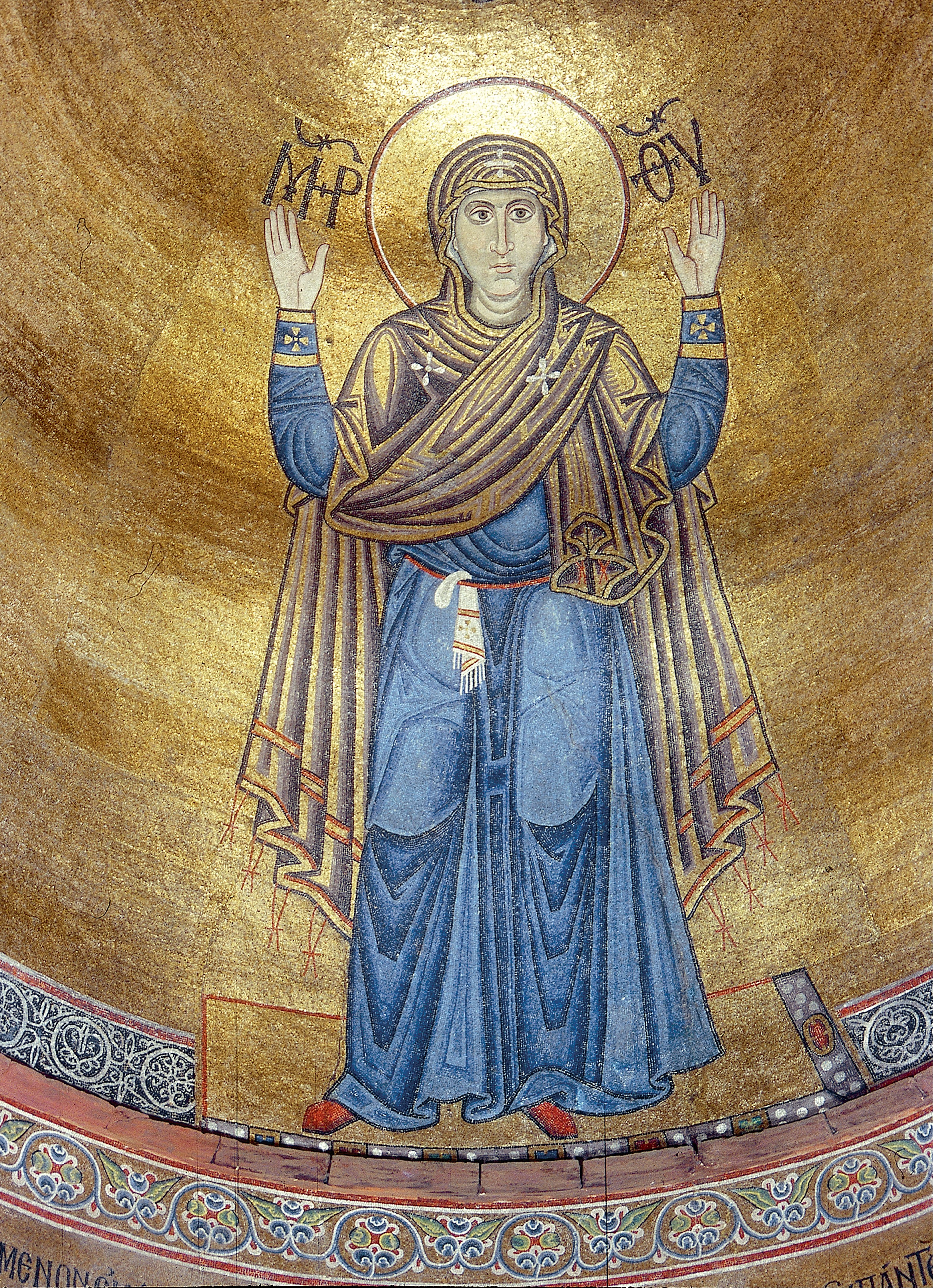
The Virgin Orans, St Sophia’s Cathedral – PD-US, via Wikimedia Commons and Google Cultural Institute
Of all the scary things that an Eastern Catholic can say to someone in the Latin Church, that we are not supposed to pray the rosary ranks pretty high up there. The other one is that we are not under the Pope of Rome – we are in communion with him – but in saying that, there is still something of an acknowledgement of the bishop of the church that presides in charity over the churches, and when it comes down to it, most Latins can explain that one away by saying that we are just playing word games. But with not praying the rosary, it’s pure negation: we do not do it.
But of course Eastern Catholics pray the rosary, one might say, and this would be empirically true. Anyone who has spent any time in Eastern Catholic circles knows that there are not only plenty of Eastern Catholics who pray the rosary regularly, but there are also rosary drives, rosary crusades, rosary hours, and people clutching their rosaries as they kneel (kneel!) at the pews (pews!) in the parish (parish!). Alongside the Jesus Prayer and the Byzantine home prayers, the rosary is a recommended private devotion in Christ Our Pascha, the Kyivan Church’s catechism, and there are plenty of Eastern Catholic resources for praying it with the odd tropar thrown in. For every cleric and theologian who has read the Instruction for Applying the Liturgical Prescriptions of the Code of Canons of Eastern Churches, in which the Latin Church itself calls for all ‘foreign’ liturgical elements to be eliminated from the historic Christian traditions in communion with Rome, there is someone who is complaining to their bishop that their priest is taking the rosary that they grew up with away from them. Some of the Orthodox might even be tempted to sympathize: there are plenty of stories of even those not in communion with Rome incorporating the rosary into their private devotional practice.
If the rosary had not been explained to me as a mantra when I was in Catholic high school, then I would perhaps more fully grasp the significance of dispensing with the rosary as a more visceral gut-punch. The rosary is the weapon, the Latin saint extraordinaire Padre Pio once said, and we all know who the enemy is: Satan and his minions. With evil lurking at the door, is it not an imperative to stop playing these word games and ecclesial identity politics and just pray the rosary to beat back the darkness? Is this not what the Lady said to the three children of Fatima when she told them of the geopolitical future of the twentieth century, of the fires of hell to be suffered by unbelieving soul and of the deceit of atheism that would plague the world beginning (as she said) with Russia? And for that matter, is there not a connection to the rosary in the appearance of the Theotokos to those in my own church at Hrushiv in Ukraine as she warned against the evils of communism in the early twentieth century and comforts her people later on in the wake of the Chernobyl meltdown?
In this depiction of the world, evil is a force out there; we are inside a fortress, protected by the walls of the church; the Theotokos whose womb bore the divine person now bears us. Herein lies, we are told, the significance of the rosary: meeting with our Lady in the garden of roses, we man the battlements, maintain the walls, stay on guard against the enemy.
Satan, demons, the enemy: evil has taken many guises over the centuries. In the story of the rosary being given to Holy Father Dominic, the enemies of Christ are the Albigensians, the heretics who like the gnostics of old denied the incarnation and the imperative to live life enfleshed. By the time Our Lady of the Rosary was taking root in the Latin Church, the enemy was physical: the Ottoman Turks at the gates of Europe in the Mediterranean. In the time of the modern Marian apparitions, atheism is the enemy, from the liberal secularism of France after the Revolution contested by the appearance of the Immaculate Conception at Lourdes to the perniciousness of Bolshevism described by the Lady at Fatima. Evil is nigh, the enemies of Christendom are laying siege: if Eastern Catholics for our ecclesial identity politics remove the rosary from Catholic practice, what defence have the faithful left against the devil? Thought in the face of evil is thrown into confusion; the cloud that envelopes this question is that of fear: evil is scary, the rosary is security, taking it away is to be left with insecurity.
But if it is indeed the Theotokos whose presence is being invoked to protect against evil, then insisting on the rosary as the only way to invoke her protection is to confuse the person with the method. Certainly, within the large population of the Latin Church, the rosary has become so incorporated even into corporate practice that it is a staple part of everyday life. But the invocations to the Theotokos in the Byzantine churches, for example, pre-date the rosary by quite a bit. In our common tradition with the Latin Church, we have been singing ‘Beneath your compassion’ – sub tuum praesidium – since the second century. Since the sixth century, the Akathist has been sung in Constantinople celebrating the unwedded bride who guards the city. Holy women and men in our church beheld the Theotokos taking off her mantle and spreading it out over the city in protection against invasion from the north. When those same invaders from Kyiv were themselves converted, they built into their central ecclesial edifice St Sophia’s Cathedral a mosaic icon of the Theotokos with her arms upraised in prayer, the Oranta, and said of her that she is the Immovable Wall: as long as she is praying with hands upraised, the city will not be taken. It is not so much that the rosary is being subtracted from our practice; much as we constantly point out to our Latin sisters and brothers that we most certainly did not delete the Filioque from the Creed, we are also simply saying that we have already long had invocations for the protection of the Most Holy Theotokos from evil well before the rosary. It is not in the tradition of our church; we have our own traditions.
Of course, this still does not address the deeper question of evil, against which both Latins and Byzantines invoke the Theotokos in our own respective liturgical ways for protection. What is this evil? What is this that we both fear?
Simply put, the evil is death – threats to human life, the risk of annihilation, the crumbling of the walls for the horde to enter and slaughter, the darkness that chokes out the light. From the sacking of the holy cities to the heresies that deny lives lived in the flesh to the ideological revisionism of the various technocratic atheisms, the primal cry for the protection of the Theotokos is our panicked scream in the evil face of death, often made more horrible by ideologies that justify the taking of life. The city must be conquered, but why, if not to serve some narrative? Life in the flesh is denied for that of the spirit, but why, if not to serve some ideal? The superstitions of the people must be substituted for the rational technocracies of liberalism and communism, but why, if not to serve some power? People who are not able to compete on the market do not deserve to live, but why, if not to line the coffers of the one percent?
At this primal level, the protection of the Theotokos becomes much clearer. Of course the Theotokos will be invoked by Latin rosaries and Byzantine akathists in these nervous times of threats to human life ranging from the mutual provocations between the Trump Administration and North Korea, the ever-morphing configurations of Daesh, and the mutations of a global market economy that eats its young and discards its old. But evil, as the philosopher Hannah Arendt demonstrated in her study of the trial of the Nazi bureaucrat Adolf Eichmann, is banal. What made Eichmann sign off on orders of genocide, Arendt suggested, was not that he was an evil schemer plotting world domination in his lair (much as this description might come closer to Hitler); it was that he was unthinking, unwilling to use his intellect as a human person with agency to question the ideological frame of his world. Ideology, the story that encases the reality of the world such that it is reality instead of just a story, more often than not demands that some higher cause is the truth for which to live; in such realities, the messiness of everyday life and the integrity of bodies are tolerated until they become obstacles, at which point they are expendable.
It is that ideological reality, that evil, that the Theotokos challenges. In the person of the Theotokos, she who is but human – but an expendable colonized Jewish peasant woman mysteriously pregnant out of wedlock – is infused with divine grace, a foretaste of such infusion of all creation: water, bread, wine, honey, fruit, flowers, our own bodies as icons shining with Uncreated Light. At this primal level, the Theotokos is profoundly anti-ideological; the supernatural fusion of nature and grace reveals that any narrative that justifies the taking of life is a lie, for divine truth is life itself. In the non-expendability of the Theotokos, we too are revealed to be non-expendable. Such is the protection of the Theotokos’s mantle; her bare life, caught up in the risen life of Christ, shows that our bare lives are existentially valuable. The most primal of truths, it turns out, is not the death drive; it is the resurrection in the face of death, the light shining in the darkness which the darkness cannot seize.
Life, light, love: these truths that are more primal than death are also messier than the darkness. Life grows organically, light shatters the darkness, love exceeds the boundaries of hate. In the life of the churches that comprise the Catholic oikoumēnē, our ecstatic realization that the Theotokos, herself only human, is so immaculately infused with the divine life that she is the fulfillment of all that we hope to be has developed over time into the devotions that make sense only within our own liturgical traditions, the handing down from generation to generation of the work of a people gathered in worship. That the rosary does not belong in the Byzantine tradition does not detract from our catholicity; it magnifies it, as the messiness of life in a communion of churches that are so dissimilar to each other still reveals in our different ways the deeper universality here: the Theotokos’s life is also the deepest primal truth of our existence – we are creatures of the Creator who infuses our existence with his own life. It is not the rosary that is universal, however many people mistakenly think that only the Latin Church is Catholic; the universality lies in the person, not the object. The Theotokos herself is Catholic, the Immovable Wall, the bearer in her body of the G-d who is life. In her life is the grace that refuses to justify death; under her protection, ideology is vanquished, and the banality of evil, the privation of life, is conquered by life itself, and this primal truth is so real that all the churches, in our separate liturgical ways, have proven our catholicity by recognizing her.
Previous Post
August 9, 2017
My D-I-Y Rosary (Dormition Fast #8)
Next Post
August 11, 2017 The private consensus is unraveling (Dormition Fast #10)
Browse Our Archives
Select a Category Academia Anglican Communion anti-racism Aristotle Asia-Pacific Asian American Asian Canadian BlackLivesMatter Cantonese Catholic China Chinglican church politics Church-State Politics Civil Society Conservative Eastern Christianity Evangelical Evangelical Left Feminist/Womanist Theology Food Greek-Catholic Church of Kyiv Hong Kong Housekeeping Kyivan Church Latin Catholicism Law Liberal Liberation Theology New Calvinism Pentecostal/Charismatic Protestant Psychoanalysis Publics Religion Ethnicity Wired Secular Sovereignty TPCIU Uncategorized
Select a Month July 2019 June 2019 May 2019 April 2019 March 2019 February 2019 January 2019 December 2018 November 2018 October 2018 September 2018 August 2018 July 2018 June 2018 May 2018 March 2018 February 2018 January 2018 December 2017 November 2017 October 2017 September 2017 August 2017 July 2017 June 2017 April 2017 March 2017 February 2017 January 2017 December 2016 November 2016 October 2016 September 2016 August 2016 July 2016 January 2016 December 2015 November 2015 October 2015 August 2015 April 2015 March 2015 February 2015 December 2014 November 2014 September 2014 August 2014 July 2014 June 2014 May 2014 April 2014 March 2014 December 2013 November 2013 October 2013 September 2013 August 2013 July 2013 June 2013 May 2013 April 2013 March 2013 February 2013 January 2013 December 2012 October 2012 June 2012 May 2012 April 2012 February 2012 January 2012
Follow Us!
TAKE THE
Religious Wisdom Quiz
How many minor prophets are in the Old Testament?
Select your answer to see how you score.
14 10 16 12
Related posts from Eastern Catholic Person

I've found my way home: on the unraveling...

Patriyarkhat: 'Attending to the movements of my heart'

I'm flattered to be named an Asian American...

The secular does not stop when your drive...
TRENDING AT PATHEOS Catholic

Rejecting Doom: Christian Hope And Human Action
Christianity is a religion of hope. We are to have hope and...

It’s What Comes From Within Which Matters
One of the most difficult things for us to understand is why...

Why I Choose the Eucharist Over the Sermon
Choose the Eucharist, Not the Sermon What are we supposed to get...

5 Design Elements Found in Spiritually Rooted Homes
Putting Spirituality Into Home Decor Our homes are more than our living...

Credo: A Story of God Told with the...
About 10 years ago, I began to imagine a personal "Credo" that...

The Anatomy of Divine Revelation in Catholic Thought
The claim that God has made Himself known to human beings is...
view all Catholic blogs
Ad-Free & Subscriber Log-In Subscription Support
- About Us
- 2026 Calendar
- Videos
- Podcasts
- Library of World Religions
- Faith In Media Tracker
- Advertise With Us
- Write for Us
- Privacy Policy
- Terms of Service
- Do Not Sell My Data
- Contact Us
- Radiant Digital
- Manage Newsletter Subscriptions
- Unsubscribe From Notifications
- Sitemap
Copyright 2008-2026, Patheos. All rights reserved.
Subscription Support Ad-Free & Subscriber Log-In
Follow Patheos