
BuddhistCatholicContemplativeEvangelicalGeneral ChristianHinduJewishLatter-day SaintMuslimNew VisionsProgressive Christian
Beliefs
- Buddhist
- Catholic
- Contemplative
- Evangelical
- General Christian
- Hindu
- Jewish
- Latter-day Saint
- More Voices
- Muslim
- New Visions
- Pagan
- Progressive Christian
Topics
- Religion News
- Food and Religion
- Sports and Religion
- Religious Art
- Religious Music and Entertainment
- Religious Events
- History and Religion
- Style and Religion
- Politics and Religion
- Women in Religion
- Recreation Outdoors and Religion
- Business Finance and Religion
- Careers Workplace and Religion
- Education and Religion
- Family Parenting and Religion
- Health Fitness and Religion
- Home and Religion
- Relationships and Religion
- Technology and Religion
- Travel and Religion
Columnists
- Buddhist Columnists
- Business Finance and Religion Columnists
- Careers Workplace and Religion Columnists
- Catholic Columnists
- Contemplative Columnists
- Education and Religion Columnists
- Evangelists Columnists
- Family Parenting and Religion Columnists
- General Christian Columnists
- Health Fitness and Religion Columnists
- Hindu Columnists
- History and Religion Columnists
- Home and Religion Columnists
- Jewish Columnists
- More Voices Columnists
- Latter Day Columnists
- Muslim Columnists
- New Visions Columnists
- Nonreligious Columnists
- Pagan Columnists
- Politics and Religion Columnists
- Progressive Columnists
- Recreation Outdoors and Religion Columnists
- Relationships and Religion Columnists
- Religion News Columnists
- Religious Art Columnists
- Religious Events Columnists
- Religious Music and Entertainment Columnists
- Sports and Religion Columnists
- Style and Religion Columnists
- Technology and Religion Columnists
- Travel and Religion Columnists
- Women in Religion Columnists
Resource Library
- 2026 Calendar
- Library of World Religions
- The 100 Most Holy Places on Earth
- Patheos Answers
- Podcasts
- Videos
- Faith Leaders Database
- Anglican Episcopalian
- Bahai
- Baptist
- Buddhism
- Christianity
- Confucianism
- Eastern Orthodoxy
- Hinduism
- Holiness and Pentecostal
- ISKCON
- Islam
- Judaism
- Lutheran
- Methodist
- The Church of Jesus Christ of Latter-day Saints
- New Age
- Paganism
- Presbytarian and Reformed
- Protestantism
- Religion Behind the Scenes
- Roman Catholic
- Scientology
- Shia Islam
- Sikhism
- Sufism
- Sunni Islam
- Taoism
- Zen
- See all religions
Research Tools
 Ad-Free & Subscriber Log-In Subscription Support
Ad-Free & Subscriber Log-In Subscription Support
Follow Patheos 

- Trending:
- Forgiveness
- |
- Marriage
- |
- Consciousness
- |
- Death Penalty
- |
- Election
- |
- Halloween
 Eastern Catholic Person
- Home
- Catholic
- My D-I-Y Rosary (Dormition Fast #8)
My D-I-Y Rosary (Dormition Fast #8)
Last updated on: August 9, 2017 at 7:43 pm by Justin Tse
My D-I-Y Rosary (Dormition Fast #8) 2017-08-09T19:43:34-07:00 Justin Tse
Patheos Explore the world's faith through different perspectives on religion and spirituality! Patheos has the views of the prevalent religions and spiritualities of the world.
![Carlow, County Carlow, Ireland Bottom feature of the left stained glass window in the north transept of Carlow Cathedral, showing how the rosary was given to St Dominic in an apparition by the Blessed Virgin Mary in the year 1214. Created by Franz Mayer & Co. in the 19th century - by Andreas F. Borchert, 3 September 2009 (800px-Carlow_Cathedral_St_Dominic_Receives_the_Rosary_from_the_Virgin_Mary_2009_09_03.jpg) (CC BY-SA 3.0 [https://creativecommons.org/licenses/by-sa/3.0/de/deed.en]), via Wikimedia Commons](https://wp-media.patheos.com/blogs/sites/721/2017/08/800px-Carlow_Cathedral_St_Dominic_Receives_the_Rosary_from_the_Virgin_Mary_2009_09_03.jpg)
Carlow, County Carlow, Ireland
Bottom feature of the left stained glass window in the north transept of Carlow Cathedral, showing how the rosary was given to St Dominic in an apparition by the Blessed Virgin Mary in the year 1214. Created by Franz Mayer & Co. in the 19th century – by Andreas F. Borchert, 3 September 2009 (800px-Carlow_Cathedral_St_Dominic_Receives_the_Rosary_from_the_Virgin_Mary_2009_09_03.jpg) (CC BY-SA 3.0 [https://creativecommons.org/licenses/by-sa/3.0/de/deed.en]), via Wikimedia Commons
The first time I prayed the rosary was in a class on Christian spirituality at the Catholic high school in my senior year. The teacher, a young newlywed who had stolen a seminarian from the Latin priesthood, had us make our own rosaries with multicolored beads in class. I was thankful for the clear instructions that she gave for how to do it, as I had never seen a rosary before; I was Protestant. Most of my friends were Catholic (of the Latin persuasion); some could make the thing from scratch and did so much quicker than I could.
We went down to the chapel and, as we knelt, we said the rosary. I wasn’t against Catholicism anymore; I had held out as a Protestant throughout Catholic school and felt by my senior year that I could relax a little. Adding to the relaxation, the teacher had advertised the rosary to us as something of a mantra, a meditative technique to channel one’s focus into prayer, including meditation on select mysteries from Christ’s life. This made some sense to me, as other teachers at the Catholic school had led guided meditations to focus our attention where we were instructed to take deep breaths and sit still, feeling our weight descend into the chair.
The point of meditation, they told us, was when we reach the threshold before sleep; sometimes, one might even fall into it. But there were special meditations for us who managed to stay over the balance: we’d be guided in our mind to imagine ourselves on a beach, in the forest, or just in our bodies with the chakras lighting up in different neon colors. I used to resist this New Agey borderline occultish stuff (as it was described by the fundamentalist books in my pastor dad’s library) by praying to Jesus extemporaneously and silently like a good evangelical, but eventually they felt so good that I just gave in, especially the ones about the beach. By senior year, I was dancing on the precipice of sleep like a boss.
The rosary, we were told, was something like that: a technique for getting to that point of sleep to facilitate this kind of imaginative meditation. The problem, as I learned, was that if you want to use it that way, you have to know it by heart; most of my classmates did, and I didn’t. This was a little embarrassing, as I was known throughout the school as the Protestant kid who knew the Bible so well that I could best my Catholic theology teachers in most debates. I did not know these prayers. I only knew the ‘Lord’s Prayer,’ which they called the Our Father (it took a while for it to register that that was what Catholics call the Lord’s Prayer). I barely knew the Creed by heart; I had found it in our Chinese evangelical church’s hymnbook one time and thought it might be a nice thing to learn someday, but it never occurred to me that it would come in handy for such a time as this (oops). I had never heard of this Glory be prayer, although I gathered that it had something to do with the Trinity and forever. I was at a complete loss with the Hail Mary and the Hail Holy Queen, and I had no idea what this Fatima Prayer was (the only Fatima I knew about at that point was the crazy campy villain from the unofficial James Bond cult classic Never Say Never Again, Fatima Blush). I mumbled through some parts I thought I knew and checked out for other parts to save myself the embarrassment.
I kept the rosary as a keepsake for a long time in a box of miscellaneous items. By the time I was in graduate school, the stresses of life were so overwhelming that I wanted to return to those oases of meditation through which I had been guided in high school. I tried guiding myself into the threshold before sleep, at which point I could go to my mental beach, and then realizing that they were not altogether dissimilar to St Ignatius of Loyola’s techniques of imagining oneself in biblical scenes, especially in the Gospels (somehow, along the way, I had managed to learn about the Jesuits). As a good evangelical, I resigned myself to those scenes; the beach could wait. The trouble is that, without my teachers from the high school guiding me, I felt a bit adrift whenever I’d get into these meditations because I didn’t want to lose track of time. Eventually, I got it into my head that maybe this is what rosary beads are for; after all, this is what the newlywed spirituality teacher had said. I went through my boxes to find that rosary that I had made in Catholic high school. But as a Protestant, I resisted for the longest time praying without the Hail Mary; I used instead the ‘Jesus Prayer,’ Lord Jesus Christ, Son of God, have mercy on me, a sinner.
At this point, my practice of the rosary became a bit D-I-Y – do-it-yourself. It was a bit, after all, like cheating on Protestantism, and I did not want to find a teacher to further enable me. Instead, I tracked down rosary instructions online, which are sometimes a bit tedious and confusing, although EWTN is not bad for this, all things considered. I wasn’t terribly sure if I should be praying for the pope’s intentions as the Bishop of Rome wasn’t my pope, so I skipped those, however many promises of heaven there were attached to them (I was justified by faith alone already). The Hail Holy Queen and the Memorare felt even grosser than the Hail Mary, so I definitely ignored those. Oddly enough, the Fatima Prayer looked fairly reasonable, but seeing that they were revealed by some Marian apparition that I wasn’t sure of, I decided not to look up the story and spoil it. As it happened, then, I did the Creed, the Our Father, three Jesus Prayers, a Glory Be (which by now I had learned because of Anglicanism), and then ten Jesus Prayers on the decade, bookended by an Our Father on one end and the Glory Be and Fatima Prayer on the other. Given my rejection of the Hail Holy Queen, papal intentions, and Memorare, I had no idea how to end the thing, so it was always a little awkward when I finished. I also found it hard to remember all of these things and contemplate the mysteries, but I figured I’d get better as I practiced. I did not.
The mental multitasking was the real problem. The whole point of meditation, as far as I understood it at this point, was to get to the threshold before sleep and then focus on a scene, and what the repetitions on the beads were supposed to do was to bring me into this state. It was not working, partly because I didn’t know the prayers well enough, but the other problem was that I was used to the mysteries themselves as texts, not as scenes, and familiar as I was with the words of the Gospels, I couldn’t quite picture them in my mind. I found myself drifting into constructing theological reflections on these scenes, which then pushed the prayers out, or I’d say the prayers and forget to meditate. I found that saying the prayers out loud made things easier (I was used to praying silently as a Protestant), but it was still hard to do all these things at once.
I needed a guide – a spiritual director, really – and I had no one to guide me. To be sure, I did have Protestant spiritual directors, even ones who called themselves such, but the advice they kept giving related to the texts of Scripture and mulling over the words, but I wanted to be guided into these more scenic meditations. I also started praying the Liturgy of the Hours, which I had learned at the home of a Latin priest where I had gone for a retreat, and in an effort to have a guide for that, I downloaded an app for the Divine Office, complete with audio recordings; I also listened to the daily mass readings, trying to let my mind be guided. But as much as I could put up with these readings, I couldn’t stand the rosary recordings – they were even cornier than what I was listening to, and praying with them would meant that I’d have to introduce the Marian prayers into my practice, which was something I was definitely not interested in doing, although I had been convinced by this point at an intellectual level that talking to Mary is an orthodox Christian thing to do. In fact, I came to understand that year through reading Pope St John Paul II’s Theology of the Body (of all things!) that if God is not the God of the dead but of the living, then the saints are before the face of God interceding for us. The problem is that as much as I understood in my mind the point of talking to Mary, I could not bring the residual anti-Catholic in me to do it in practice.
One night, however, I did. It was a desperate night, one in which my meditation was flailing quite badly and the relaxation that I sought was becoming more stressful by the second. In desperation, I reached out mentally to the first verbal hook I could find in the text of the Gospel for the Joyful Mysteries, the meditations on Christ’s infancy narratives. The Holy Evangelist Luke writes several times: And Mary pondered all these things in her heart. I responded: Mary, what are you thinking about? I felt a presence, as if she turned from the scene and looked at me. A Hail Mary came out of me. That freaked me out.
The discomfort of that moment sent me to several theological sources. I knew something about some high Anglicans having a Marian devotion – in fact, there was a conservative ‘realignment’ Anglican bishop in Canada (which meant to me at the time that he was one of the good guys) who was very public about his personal relationship with Mary – and I wondered seriously if I could have one too as an Anglican. Searching through Google, I came across the Anglican-Roman Catholic International Commission’s (ARCIC) joint statement on Mary. It is a very interesting document; the conclusion basically states that the development of Marian dogma and devotion went on separate paths for Anglicans and Roman Catholics such that Anglicans began sounding like nervous Protestants about Mary while Roman Catholics went all out on the Immaculate Conception and the Assumption, but it should remember that both the tacit and all-out approaches to Mary are rooted in a single apostolic and conciliar tradition that affirms Mary as Theotokos. In this way, the basic understanding is that Anglicans need not be overly nervous about Roman Catholic dogmas, as long as the Latins don’t require the Anglican Communion to have to abide by the exact formulations of when Mary was without sin and how she got assumed into heaven. Not only do the two communions have much in common about the Theotokos, then, but they also can learn from each other about Mary as they walk together.
I quite liked the ARCIC document, but it wasn’t what won me over. What did the trick, surprisingly, was the Holy Pope John Paul II’s Redemptoris mater. I came to this document very skeptically, especially because I saw that it was written for the Year of Mary and therefore must be papal propaganda. But as John Paul II unfolded his teaching about Mary, he seemed to nod at the Protestants and wink at the Orthodox; he was speaking of a common tradition of regarding Mary as only a human person, the one in whom divine grace had worked to perfectly infuse human nature. In this way, each person who is a Christian can look to Mary as the Christian, the kind of supernatural person that we wanted to become both as individual Christians and as the church, the people of God. This, John Paul II argues, is the direction of the pilgrimage of the people of God, and Mary is the further ahead in this pilgrim journey, the ‘model of the pilgrimage’ (para 30).
So this is what happened to me when the Theotokos looked at me in prayer, I thought. She who is the furthest ahead in the supernatural fusion of nature and grace had turned her gaze to me. What do I say in return, but to call her blessed among women and blessed is the fruit of her who had borne the Saviour and Deliverer of our souls? Begrudgingly, I tacked on the second part about her prayer now and in the hour of our death, morbid as it sounded; I wish I had known that the Orthodox version didn’t have this clause. I began using the Hail Mary in my rosary prayers, and to add some spice with the more meditation on the Annunciation, I also began praying the Angelus regularly at noon. Eventually, I started chanting it in Latin so that my Protestant landlady upstairs wouldn’t overhear. My favourite line of the Angelus, of course, was and still is: fiat mihi secundum verbuum tuum.
I told very few people at the time that I had begun to pray the rosary; when I did tell them, I usually lied and said that I was still substituting the Jesus Prayer so that I wouldn’t get weird Protestant questions about Mary. But I took the rosary with me on field work, and when the string broke in my backpack, I ordered a new free one from Family Rosary. I was determined to get better at the mental multitasking, especially now that I could try to see these scenes with the eyes of the Theotokos. But it was still a bit busy, and with the addition of the Divine Office and the Angelus, prayer began crowding out my whole day – and I had a day job as a secular academic geographer.
What I probably still needed was a guide, especially with build-up of all this prayerful noise; what I did not want to do was to ask, because it would have been embarrassing to let on that I knew much less about the Catholicism that I professed to love in public than I actually did. In hindsight, I really could have (and should have) asked the Dominicans; I was, after all, asking them lots of other questions and even seeking one or two out for spiritual direction, and I should have realized that they were the people who popularized the rosary in the first place – the legend is that the Theotokos gave Holy Dominic the rosary to help him combat the gnostic heresy of the Albigensians. All this is to say that I’m sure there is a way to pray the Rosary right and the Dominicans might have been helpful; what this probably means is that I was doing it wrong and have never learned to do it right.
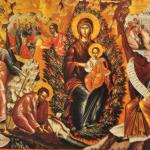
I think one of the big problems in the spiritual life is that it is seductive to think of busyness in prayer as a sign that one is making spiritual progress. In fact, during this time, I started reading John Paul II’s apostolic letter for the Jubilee Year encouraging the lay faithful to use the major hours of the Divine Office, as well as his Rosarium Virginis Mariæ, where he suggests praying the rosary in front of an icon. To that end, I tried attending the Liturgy of the Hours with the Dominicans – and I loved it, and I tried looking into the face of the Virgin Mary in her icons while praying the rosary, which helped, except that now I was praying the prayers, looking at an icon, and imagining scenes from the Gospels. I was praying a lot, but I could not get the noise out, and I was not asking anyone what was wrong. A D-I-Y prayer life was a noisy one indeed; it was quite the opposite of the meditative restfulness for which I had been seeking when this journey started.
At the high point of my mentally noisy prayer, I sought spiritual direction from the Eastern Jesuit I had met from the Umbrella Movement solidarity events. Gently, he suggested that I stop praying the rosary. He said that he couldn’t understand why I as a Protestant had developed such an overgrown devotion to the Theotokos, but if it wasn’t helping, it wouldn’t hurt to stop it. The Angelus went next, with his suggestion that while it was acceptable, there might be something to trying out Eastern Catholicism on its own terms, and not on Latin ones. I was not committed to becoming Eastern Catholic at that moment, but I did want to stop the noise. So I stopped. And the noise began to die down. And there was even some quiet sometimes.
This fulfilled my greatest worries. At least without a guide, I wouldn’t have to explain why I needed to crowd out my day with prayers to the Theotokos, but with a spiritual director, my prayers would have to become sane, and perhaps I would lose my devotion to the Theotokos altogether. I’d miss her, it’d be a lot of hard work wasted, and what did this mean about my relationship with the Latin Church, which I loved and still love?
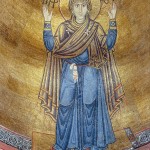
Then at a Moleben service – a supplication service – during the Great Fast, my spiritual father told a story. As Constantinople was besieged by – as he put it – Ukrainian pirates (the raiders of Rus’), there was a Vespers service where the people saw the Theotokos descend from the dome into their midst and walk with tears to the ambo. After joining them in prayer, she took off her mantle and spread it over the people, and then she went back up into the dome. With that, the city was saved, and the irony of it – as he pointed out – is that it’s the Ukrainians who are now far more devoted to the Protecting Mantle of the Theotokos, the Pokrova, than the Greeks.
As he told that story, I felt the gaze again of the Theotokos on my heart. She was covering me with her love, and I was but a child, and all I was doing was breathing. Under the mantle of the Mother of God, my heart is still. With her who has gone the furthest ahead in the pilgrim journey of the people of God, I wait for the Lord, my soul waits, and in his word I hope; my soul waits for the Lord more than those who watch for the morning, more than those who watch for the morning (Psalm 130.5 NRSV). Through the prayers of my spiritual father, I have calmed and quieted my soul, like a weaned child with its mother; my soul is like the weaned child that is within me (Ps 131. 2). There is no Byzantine judgment of the rosary here; the fact is I never learned to pray it right. There is only me following my Mother, asking her what she is pondering in her heart as I approach the threshold of sleep.
Next Post
August 10, 2017 The primal catholicity of the Immovable Wall (Dormition Fast #9)
Browse Our Archives
Select a Category Academia Anglican Communion anti-racism Aristotle Asia-Pacific Asian American Asian Canadian BlackLivesMatter Cantonese Catholic China Chinglican church politics Church-State Politics Civil Society Conservative Eastern Christianity Evangelical Evangelical Left Feminist/Womanist Theology Food Greek-Catholic Church of Kyiv Hong Kong Housekeeping Kyivan Church Latin Catholicism Law Liberal Liberation Theology New Calvinism Pentecostal/Charismatic Protestant Psychoanalysis Publics Religion Ethnicity Wired Secular Sovereignty TPCIU Uncategorized
Select a Month July 2019 June 2019 May 2019 April 2019 March 2019 February 2019 January 2019 December 2018 November 2018 October 2018 September 2018 August 2018 July 2018 June 2018 May 2018 March 2018 February 2018 January 2018 December 2017 November 2017 October 2017 September 2017 August 2017 July 2017 June 2017 April 2017 March 2017 February 2017 January 2017 December 2016 November 2016 October 2016 September 2016 August 2016 July 2016 January 2016 December 2015 November 2015 October 2015 August 2015 April 2015 March 2015 February 2015 December 2014 November 2014 September 2014 August 2014 July 2014 June 2014 May 2014 April 2014 March 2014 December 2013 November 2013 October 2013 September 2013 August 2013 July 2013 June 2013 May 2013 April 2013 March 2013 February 2013 January 2013 December 2012 October 2012 June 2012 May 2012 April 2012 February 2012 January 2012
Follow Us!
TAKE THE
Religious Wisdom Quiz
Who said, "Speak, Lord, for your servant is listening"?
Select your answer to see how you score.
Solomon Eli David Samuel
Related posts from Eastern Catholic Person

I've found my way home: on the unraveling...

Patriyarkhat: 'Attending to the movements of my heart'

I'm flattered to be named an Asian American...

The secular does not stop when your drive...
TRENDING AT PATHEOS Catholic

Rejecting Doom: Christian Hope And Human Action
Christianity is a religion of hope. We are to have hope and...

It’s What Comes From Within Which Matters
One of the most difficult things for us to understand is why...

Why I Choose the Eucharist Over the Sermon
Choose the Eucharist, Not the Sermon What are we supposed to get...

5 Design Elements Found in Spiritually Rooted Homes
Putting Spirituality Into Home Decor Our homes are more than our living...

Credo: A Story of God Told with the...
About 10 years ago, I began to imagine a personal "Credo" that...

The Anatomy of Divine Revelation in Catholic Thought
The claim that God has made Himself known to human beings is...
view all Catholic blogs
Ad-Free & Subscriber Log-In Subscription Support
- About Us
- 2026 Calendar
- Videos
- Podcasts
- Library of World Religions
- Faith In Media Tracker
- Advertise With Us
- Write for Us
- Privacy Policy
- Terms of Service
- Do Not Sell My Data
- Contact Us
- Radiant Digital
- Manage Newsletter Subscriptions
- Unsubscribe From Notifications
- Sitemap
Copyright 2008-2026, Patheos. All rights reserved.
Subscription Support Ad-Free & Subscriber Log-In
Follow Patheos