
BuddhistCatholicContemplativeEvangelicalGeneral ChristianHinduJewishLatter-day SaintMuslimNew VisionsProgressive Christian
Beliefs
- Buddhist
- Catholic
- Contemplative
- Evangelical
- General Christian
- Hindu
- Jewish
- Latter-day Saint
- More Voices
- Muslim
- New Visions
- Pagan
- Progressive Christian
Topics
- Religion News
- Food and Religion
- Sports and Religion
- Religious Art
- Religious Music and Entertainment
- Religious Events
- History and Religion
- Style and Religion
- Politics and Religion
- Women in Religion
- Recreation Outdoors and Religion
- Business Finance and Religion
- Careers Workplace and Religion
- Education and Religion
- Family Parenting and Religion
- Health Fitness and Religion
- Home and Religion
- Relationships and Religion
- Technology and Religion
- Travel and Religion
Columnists
- Buddhist Columnists
- Business Finance and Religion Columnists
- Careers Workplace and Religion Columnists
- Catholic Columnists
- Contemplative Columnists
- Education and Religion Columnists
- Evangelists Columnists
- Family Parenting and Religion Columnists
- General Christian Columnists
- Health Fitness and Religion Columnists
- Hindu Columnists
- History and Religion Columnists
- Home and Religion Columnists
- Jewish Columnists
- More Voices Columnists
- Latter Day Columnists
- Muslim Columnists
- New Visions Columnists
- Nonreligious Columnists
- Pagan Columnists
- Politics and Religion Columnists
- Progressive Columnists
- Recreation Outdoors and Religion Columnists
- Relationships and Religion Columnists
- Religion News Columnists
- Religious Art Columnists
- Religious Events Columnists
- Religious Music and Entertainment Columnists
- Sports and Religion Columnists
- Style and Religion Columnists
- Technology and Religion Columnists
- Travel and Religion Columnists
- Women in Religion Columnists
Resource Library
- 2026 Calendar
- Library of World Religions
- The 100 Most Holy Places on Earth
- Patheos Answers
- Podcasts
- Videos
- Faith Leaders Database
- Anglican Episcopalian
- Bahai
- Baptist
- Buddhism
- Christianity
- Confucianism
- Eastern Orthodoxy
- Hinduism
- Holiness and Pentecostal
- ISKCON
- Islam
- Judaism
- Lutheran
- Methodist
- The Church of Jesus Christ of Latter-day Saints
- New Age
- Paganism
- Presbytarian and Reformed
- Protestantism
- Religion Behind the Scenes
- Roman Catholic
- Scientology
- Shia Islam
- Sikhism
- Sufism
- Sunni Islam
- Taoism
- Zen
- See all religions
Research Tools
 Ad-Free & Subscriber Log-In Subscription Support
Ad-Free & Subscriber Log-In Subscription Support
Follow Patheos 

- Trending:
- Forgiveness
- |
- Marriage
- |
- Consciousness
- |
- Death Penalty
- |
- Election
- |
- Halloween
 Eastern Catholic Person
- Home
- Catholic
- ‘More Catholic than the Catholics’: a tale of transfiguration (Dormition Fast #6)
‘More Catholic than the Catholics’: a tale of transfiguration (Dormition Fast #6)
Last updated on: August 8, 2017 at 6:12 pm by Justin Tse
‘More Catholic than the Catholics’: a tale of transfiguration (Dormition Fast #6) 2017-08-08T18:12:00-07:00 Justin Tse
Patheos Explore the world's faith through different perspectives on religion and spirituality! Patheos has the views of the prevalent religions and spiritualities of the world.
![Black Madonna of Częstochowa in crown - by Robert Drózd (NMP-Czestochowska-w-koronie.jpg) [CC BY-SA 3.0 (https://creativecommons.org/licenses/by-sa/3.0/deed.en)], via Wikimedia Commons](https://wp-media.patheos.com/blogs/sites/721/2016/07/NMP-Czestochowska-w-koronie.jpg)
Black Madonna of Częstochowa in crown – by Robert Drózd (NMP-Czestochowska-w-koronie.jpg) [CC BY-SA 3.0 (https://creativecommons.org/licenses/by-sa/3.0/deed.en)], via Wikimedia Commons
By the time I was a postdoctoral fellow at the University of Washington, I thought I knew so much about Mary: councils, customs, cultures, and even cults. I suppose today is the right day to tell the story of how much of this knowledge became a much more intense form of Catholic love, as we celebrated the Feast of the Transfiguration two days ago. The Dominican Order was also instrumental in this journey, so I am enjoying this happy coincidence of being able to post about them on their patronal feast day.
Apparently, there was even a rumor that had been spreading about me in the kitchen since I arrived that stemmed from how I taught the course on American Religion for the Comparative Religion Program. Because I had made use of the work of William Cavanaugh and Henri de Lubac in explaining the eucharistic politics of Catholic political theology in the late Middle Ages and early modern period, the Catholic students in my class, who had been advised to take the course by the Polish Dominicans in the first place at the Newman, decided that I had got it, that I was pretty much on their side, that they had no need to defend themselves against any creeping secularism of religious studies. The story is that they had tried to describe me to their friends in the Newman kitchens: he’s more Catholic than the Catholics, but he’s not Catholic! The response had been: Then why isn’t he Catholic?!
Part of the truth, as I told one of these kitchen rumorers (who is now a Dominican novice himself), is that I had worked it out in my own head that it was in the interest of Catholics for me not to become Catholic; as I explained, didn’t Catholics want a mole on the Protestant side when it came to ecumenism? The truer truth was discerned by this young future Dominican in his reply: but don’t you want the sacraments? What can be said is that I was attracted to them – I had a habit of showing up a daily mass, especially to catch the Bible readings (which is the real interest for Protestants) – but I couldn’t say that I needed them. I pointed out, for example, that Protestants also had celebrations of sacraments, to varying degrees of validity in Catholic eyes, and I was content with those. I had also developed somewhat of a personal relationship with the Virgin Mary as a Protestant, so I didn’t really feel the need to become Catholic to get that sorted out; I already had everything I needed.
When the Umbrella Movement in Hong Kong happened, I offered my friends at this Newman Center a lecture on Catholicism in Hong Kong. I pointed out that the Catholic Church had an ambivalent relationship with the occupy movement, with some very publicly supporting it while others shied from definitive comment, and that this was a perfect opportunity for my Catholic friends and students to learn something important about Catholicism a world away. Strangely enough, the Dominicans at the Newman received the idea enthusiastically, the results of which I posted to Soundcloud shortly thereafter.
The makeup of the audience was interesting. One of the Polish Dominicans – the one who later came up to concelebrate my chrismation into the Kyivan Church – was there, as well as some of my students from that American Religion class (who later also were in the infamous trans-Pacific Christianities course), including this blog’s resident Latin Catholic contributor Eugenia Geisel (she later told me that she had been part of the kitchen crew). There was also an older white guy that nobody seemed to know; he seemed to be rich and conservative and knowledgeable about things around the world, intimidatingly so.
I began, as I begin every lecture, by telling members of my audience to say hello to each other and to ask each other what they knew about the Umbrella Movement; this is the best way to get preconceived notions right out onto the table in an effort to address them right away before the lecture begins. Most of the answers revolved around the ‘I don’t know much about Hong Kong, but it’s inspiring’ category, but Rich White Guy went on an extended monologue. He said that the Umbrella Movement troubled him because it smacked of the kind of CIA-infested protests around the world aimed at regime change, especially if you look at their funding from, say, the National Endowment for Democracy, an American granting agency accused of being neoconservative that funds some of these things (I must say, though, that I am not quite sure how a movement with so much contestation about its leadership can be ‘funded’). He then made the comparison – as I learned that many others who dislike the Umbrella Movement have since done – to what happened in Maidan Square in Ukraine earlier, as well as to numerous color revolutions around the world which happen to get their name from the Orange one, which also happened in Ukraine, also mostly on the Maidan. He said that the protesters in both Ukraine and Hong Kong had obviously been duped by the American deep state and that this would be a pretext for strengthening the police state against them, which was not in anyone’s interest given the progress that China (in the case of Hong Kong) had made toward capitalism in the last few decades. Isn’t it obvious, he concluded, that capitalism would make democracy an eventual reality?
There was a bit of an awkward pause after he said that. I didn’t know very much about Maidan at that time; my doctoral research had been on religion and Hong Kong people, and the most that I had gotten to know about the Ukrainian protests was from the buzz that mostly circulated around the Catholic blogosphere at the time, especially with Artur Rosman’s infamous post ‘God Hates Flags.’ I only knew was that they were abstractly important, that there were Orthodox clergy who were on the streets, and that they wanted democracy in some vague way. Little did I know that I’d come to care much more about them soon.
I am told that the lecture went well – it is, I repeat, on Soundcloud, so the Internet can deliver its own judgment as more suffer through its poor sound quality – but perhaps the most productive part of the event happened in the parking lot outside the Newman after Rich White Guy left. The Polish Dominican pulled me aside and began his own rant. This guy thinks that American intervention was what caused the Maidan, he complained. Doesn’t he know that the Ukrainians actually were asking for more American intervention? They wish there was more intervention; it means there wasn’t enough of it, and now look what happened – they lose Crimea too! I pretended to know what he was talking about, adding a quip about MH17 when it was convenient to show that I wasn’t completely stupid (MH17, after all, is about Asia, and I know stuff about Asia, supposedly).
And then the Polish Dominican began to tell me how much he resonated with my lecture. I had made the argument that Hong Kong Catholicism needs to be understood as in ‘passive collaboration’ with the government, neither openly endorsing nor opposing its policies, while often tacitly (as well as not-so-tacitly) on the side of democratic reform. The Polish Dominican really liked this concept of ‘passive collaboration,’ especially its coining and subsequent practice by Joseph Cardinal Zen Ze-kiun – allowing Catholics to join the undemocratic Election Committee on first-come-first-serve basis while advancing democratic causes that undermined the government. Zen reminded my Polish Dominican friend of the great Stefan Cardinal Wyszyński in Poland, and with that, he began to tell a story of what he saw as Wyszyński’s ‘passive collaboration.’ During the celebration of the Millennium of Christianity in Poland in 1966, Wyszyński had humiliated the communist authorities after they ‘arrested’ the icon of the Black Madonna: he sent its frame to tour around Poland, where it was greeted with just as much veneration as the actual icon herself. The Polish Dominican pointed out that this was indeed collaboration – Wyszyński seemed to publicly accept the icon’s arrest – but his passiveness also guaranteed that the communist’s strategy would backfire on themselves. I later learned that Zen is an admirer of Wyszński; when I told those who had attended that lecture as an addendum, no one seemed surprised.
I loved this story, but there was one slight problem: I had never seen the Black Madonna before. I was more Catholic than the Catholics, but I thought myself to be quite fine sacramentally because all I knew, I knew in terms of books and politics. In fact, I had a lot of difficulty in searching for this story online because I did not know to specify in my Google search that it was the Black Madonna; I did learn, however, that a search for ‘Poland Mary frame’ doesn’t get you very far, and adding ‘Wyszyński’ into the mix hardly helps. I was a little bit too embarrassed to ask the Dominican for help, so it took months of futile Internet surfing to finally come across the whiff of a story that had something to do with the story I had heard in the Newman parking lot. In time, I think I also gave up on protecting my knowledgeable reputation and contacted the Dominican, and probably somewhere between the scent I was getting from my own searching and his replies, I learned of an entity called ‘the Black Madonna.’
So I did another Google search for ‘Black Madonna.’ And there she was, looking at me.
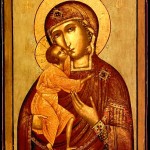
She was beautiful, so much that it hurt. I noticed immediately the scars on her face that look like tears; I also found that in the way she looked at me, she was piercing into my heart while pointing to her Son. The more eye contact I made with her, the more she saw into me, and the more she pointed me to Christ.
She was so beautiful that I had to make sure it was her. There had to be, I reasoned, many Black Madonnas, not just this one on Google Image, and indeed I found that there were. But I soon learned that the one from Częstochowa was the one most commonly referred to as the Black Madonna. It was from there that I began to learn about the Solidarity Movement, as well as her place in the history of Polish nationalism (she was, after all, crowned in Lviv because the Poles had routed the Swedes at Częstochowa); interlocutor as I was for Artur Rosman’s blog, somehow I had missed this. I did not, however, learn anything until much later about how the Kyivan Church refers to her as the Theotokos of Belz, as she had made her way to Częstochowa via Galicia; truth be told, I had no idea that I’d ever start caring about Ukraine in any way at the time. I did, however, message Eugenia, who promptly replied to me with a selfie of herself and the icon of the Black Madonna in the very room in which she was working. I told Eugenia that I might have fallen in love with the Black Madonna, and Eugenia responded quite nonchalantly that she has that effect on people.
I began to feel that my position of being more Catholic than the Catholics without being Catholic was suddenly not as desirable as I had previously felt. At the time, I was truly at a loss as to how to articulate what had happened; now that I am starting to have a bit of a better working knowledge of icons and the literal ecstasy – the being drawn to stand outside of one’s self (the ek-stasis, as Christos Yannaras puts it) – that the icon’s gaze often provokes, I realize that I was no match for the eyes of the Theotokos. Hungrily, I began to read everything I could about her, and when I came across the Holy Pope John Paul II’s speech at his act of consecration to the Theotokos of Czętochowa, I so resonated with his confession that ‘so many times I had whispered Totus tuus in prayer before this image’ that I too brought her up on my iPad screen and whispered those Latin words too. Mother, you are so beautiful, I added. Make me Catholic. I don’t know how that will possible, but make it so. Four months later, I was a catechumen in the Kyivan Church.
At this year’s celebration of the Transfiguration at our temple in Richmond, my spiritual father pointed out that the word for ‘Transfiguration’ in Greek is metamorphosis. An expert in butterflies, he pointed out, would be able to look at a caterpillar and say that this one is supposed to be this kind of butterfly, and this other one would become that other kind. In this way, the butterfly is the true form, but it requires the changing of the form of the caterpillar into its true form. The metamorphosis of Christ on the Mountain is where we see the true face of G-d on earth, as the Holy Apostle Peter says.
In the case of my encounter with the Theotokos of Belz-Częstochowa, one could plausibly say that as I beheld the eyes of the Black Madonna, my knowledge was transfigured by her metamorphosized gaze, shining as she does with the Uncreated Light of Christ, the same with which he shone on the Holy Mountain. But this, I think, is not the real point: Google searches do not transfigurations make. What might be better to say instead is that the gaze of the icon offers metamorphosis to the viewer; in being transfixed by one shining with Christ’s light, I am brought to ecstasy, to standing outside myself, to my own transfiguration. I may have been more Catholic than the Catholics, but in being seen by the Most Holy Theotokos, the Mother whose bearing of Christ in her body typifies the Church making Christ bodily present in our midst through the holy mysteries, my ecstatic response of falling in love with her made me Catholic.
Note: An earlier version of this post described the National Endowment for Democracy as a ‘neoconservative foundation.’ I wrote much too quickly, as is the bane of every blogger’s existence. The description has been amended.
Browse Our Archives
Select a Category Academia Anglican Communion anti-racism Aristotle Asia-Pacific Asian American Asian Canadian BlackLivesMatter Cantonese Catholic China Chinglican church politics Church-State Politics Civil Society Conservative Eastern Christianity Evangelical Evangelical Left Feminist/Womanist Theology Food Greek-Catholic Church of Kyiv Hong Kong Housekeeping Kyivan Church Latin Catholicism Law Liberal Liberation Theology New Calvinism Pentecostal/Charismatic Protestant Psychoanalysis Publics Religion Ethnicity Wired Secular Sovereignty TPCIU Uncategorized
Select a Month July 2019 June 2019 May 2019 April 2019 March 2019 February 2019 January 2019 December 2018 November 2018 October 2018 September 2018 August 2018 July 2018 June 2018 May 2018 March 2018 February 2018 January 2018 December 2017 November 2017 October 2017 September 2017 August 2017 July 2017 June 2017 April 2017 March 2017 February 2017 January 2017 December 2016 November 2016 October 2016 September 2016 August 2016 July 2016 January 2016 December 2015 November 2015 October 2015 August 2015 April 2015 March 2015 February 2015 December 2014 November 2014 September 2014 August 2014 July 2014 June 2014 May 2014 April 2014 March 2014 December 2013 November 2013 October 2013 September 2013 August 2013 July 2013 June 2013 May 2013 April 2013 March 2013 February 2013 January 2013 December 2012 October 2012 June 2012 May 2012 April 2012 February 2012 January 2012
Follow Us!
TAKE THE
Religious Wisdom Quiz
Who suggested throwing Moses into the Nile as a baby?
Select your answer to see how you score.
Miriam Pharaoh's daughter A Hebrew midwife Pharaoh
Related posts from Eastern Catholic Person

I've found my way home: on the unraveling...

The Bay Area of the nineties is where...

This time, I have a tradition: on solidarity...
The enthronement of Metropolitan Borys before the New-Martyrs
TRENDING AT PATHEOS Catholic

Rejecting Doom: Christian Hope And Human Action
Christianity is a religion of hope. We are to have hope and...

It’s What Comes From Within Which Matters
One of the most difficult things for us to understand is why...

Why I Choose the Eucharist Over the Sermon
Choose the Eucharist, Not the Sermon What are we supposed to get...

5 Design Elements Found in Spiritually Rooted Homes
Putting Spirituality Into Home Decor Our homes are more than our living...

Credo: A Story of God Told with the...
About 10 years ago, I began to imagine a personal "Credo" that...

The Anatomy of Divine Revelation in Catholic Thought
The claim that God has made Himself known to human beings is...
view all Catholic blogs
Ad-Free & Subscriber Log-In Subscription Support
- About Us
- 2026 Calendar
- Videos
- Podcasts
- Library of World Religions
- Faith In Media Tracker
- Advertise With Us
- Write for Us
- Privacy Policy
- Terms of Service
- Do Not Sell My Data
- Contact Us
- Radiant Digital
- Manage Newsletter Subscriptions
- Unsubscribe From Notifications
- Sitemap
Copyright 2008-2026, Patheos. All rights reserved.
Subscription Support Ad-Free & Subscriber Log-In
Follow Patheos