
BuddhistCatholicContemplativeEvangelicalGeneral ChristianHinduJewishLatter-day SaintMuslimNew VisionsProgressive Christian
Beliefs
- Buddhist
- Catholic
- Contemplative
- Evangelical
- General Christian
- Hindu
- Jewish
- Latter-day Saint
- More Voices
- Muslim
- New Visions
- Pagan
- Progressive Christian
Topics
- Religion News
- Food and Religion
- Sports and Religion
- Religious Art
- Religious Music and Entertainment
- Religious Events
- History and Religion
- Style and Religion
- Politics and Religion
- Women in Religion
- Recreation Outdoors and Religion
- Business Finance and Religion
- Careers Workplace and Religion
- Education and Religion
- Family Parenting and Religion
- Health Fitness and Religion
- Home and Religion
- Relationships and Religion
- Technology and Religion
- Travel and Religion
Columnists
- Buddhist Columnists
- Business Finance and Religion Columnists
- Careers Workplace and Religion Columnists
- Catholic Columnists
- Contemplative Columnists
- Education and Religion Columnists
- Evangelists Columnists
- Family Parenting and Religion Columnists
- General Christian Columnists
- Health Fitness and Religion Columnists
- Hindu Columnists
- History and Religion Columnists
- Home and Religion Columnists
- Jewish Columnists
- More Voices Columnists
- Latter Day Columnists
- Muslim Columnists
- New Visions Columnists
- Nonreligious Columnists
- Pagan Columnists
- Politics and Religion Columnists
- Progressive Columnists
- Recreation Outdoors and Religion Columnists
- Relationships and Religion Columnists
- Religion News Columnists
- Religious Art Columnists
- Religious Events Columnists
- Religious Music and Entertainment Columnists
- Sports and Religion Columnists
- Style and Religion Columnists
- Technology and Religion Columnists
- Travel and Religion Columnists
- Women in Religion Columnists
Resource Library
- 2026 Calendar
- Library of World Religions
- The 100 Most Holy Places on Earth
- Patheos Answers
- Podcasts
- Videos
- Faith Leaders Database
- Anglican Episcopalian
- Bahai
- Baptist
- Buddhism
- Christianity
- Confucianism
- Eastern Orthodoxy
- Hinduism
- Holiness and Pentecostal
- ISKCON
- Islam
- Judaism
- Lutheran
- Methodist
- The Church of Jesus Christ of Latter-day Saints
- New Age
- Paganism
- Presbytarian and Reformed
- Protestantism
- Religion Behind the Scenes
- Roman Catholic
- Scientology
- Shia Islam
- Sikhism
- Sufism
- Sunni Islam
- Taoism
- Zen
- See all religions
Research Tools
 Ad-Free & Subscriber Log-In Subscription Support
Ad-Free & Subscriber Log-In Subscription Support
Follow Patheos 

- Trending:
- Forgiveness
- |
- Marriage
- |
- Consciousness
- |
- Death Penalty
- |
- Election
- |
- Halloween
 Eastern Catholic Person
- Home
- Catholic
- ‘Like a weaned child with its mother’: on the ideological nonchalance of doxology (Dormition Fast #5)
‘Like a weaned child with its mother’: on the ideological nonchalance of doxology (Dormition Fast #5)
Last updated on: August 6, 2017 at 9:36 am by Justin Tse
‘Like a weaned child with its mother’: on the ideological nonchalance of doxology (Dormition Fast #5) 2017-08-06T09:36:31-07:00 Justin Tse
Patheos Explore the world's faith through different perspectives on religion and spirituality! Patheos has the views of the prevalent religions and spiritualities of the world.
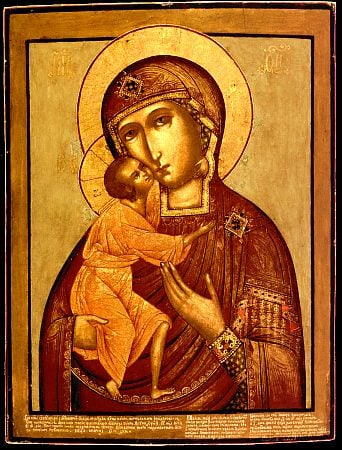
Our Lady of St Theodore (10th century), 18th Century copy of the holy protectress of Kostroma, following the same Byzantine “Tender Mercy” type – PD-Art, via Wikimedia Commons
I told a rather prominent Anglican ecumenist recently that when I was an Anglican in my former days, I thought I had found the silver bullet to resolving the thorny problem of women’s ordination that lay in the way of the Anglican Communion and the Latin Church. A saint who is commonly acknowledged between the two churches is Dame Julian of Norwich, who famously spoke about Christ as our Mother from whose breast we are nourished and under whose maternal care we are comforted with the words, all shall be well, all shall be well, all manner of things shall be well. If the Latin argument against women’s ordination rests on Christ and the apostles having been men, then certainly Dame Julian’s way of speaking of the Divine Feminine would open up the path for saying that women can also represent the apostleship of the Godhead. The Anglican ecumenist smiled and told me that it was a pretty cute argument, and then pointed out that Anglicans had always found the argument that the masculine representativeness of Christ and the apostleship to be rather flimsy, which meant that they were not even interested in dignifying it as a point of discussion between the churches.
I am neither Anglican nor Latin, so I have much less of a dog in this fight between the Anglican Communion and the Latin Church; we Kyivans do not interfere in the internal affairs of our sister church, much less churches with which we are not in communion. If there were to be any real discussion in my church (which, to my knowledge, there is not), it would have to be with the Orthodox, who would probably be at once quite a bit less polite about these things than the Anglicans and at another rather unclear about the question of whether women’s ordination is good (some theologians and bishops have made hints at this), at what level (diaconate? presbyterate? episcopate?), and whether the toleration of such questions means that one has fallen into the ‘pan-heresy of ecumenism’ (never mind that ecumenism is not really a heresy – but I should not say that so loudly: I am, after all, what they would call a ‘uniate’). Certainly, those in the Byzantine churches might answer that our titles for a priest’s wife include presbytera (a female elder), khouria (same thing), and dobrodika (a female teacher), but while there is subjective dignity for the ones who take this on fully as a vocation, there is also (objectively speaking) nothing less feminist than saying that a woman can share in her husband’s vocation; gee, thanks for nothing, one might hear in reply (ditto for arguments that women can be cantors, readers, board members, and on and on). But quite unlike the Protestant communities where it seems like one’s very intentions about such matters are articles by which the whole church will stand or fall, whatever I’d have to say about women’s ordination – much as I think that certain women monastics, for example, would be much more competent and pastorally sensitive than certain patriarchs – doesn’t really matter in my church or its practice of ecumenism: I am neither a monastic, nor a member of the clergy, nor even a theologian – I am a person whose day job is as an academic geographer in a secular university, and at church, most of what I do involves throwing the choir off with my bad singing.
But perhaps the deeper reason it doesn’t matter what I think about women’s ordination is because if, as the Anglican ecumenist was pointing out I was doing, I am saying such self-proclaimed genius things about Dame Julian to arrive at an applicable conclusion through which I can admire my own genius, then maybe I am better off letting my words be few. Like the vast majority of people who are able to turn any conversation about the church into a heated debate about women’s ordination and sexuality issues, I had read what I wanted to read out of Dame Julian’s words and completely missed the point of her showings, much like how some people read my blog and come to the conclusion that they disagree with me about women’s ordination because of what my church thinks about it – the truth is, I am not even sure my church really knows what it thinks about the question. But I can only speak for me, and my instincts to jump to conclusions while reading Dame Julian show me to be little more than a fool, and one should think twice before giving weight to any fool’s theology, much less ecclesiological prescription.
Dame Julian, after all, says nothing about women’s ordination; why would she? Her real point – and a much deeper one, at that – is that all shall be well, and such grace is so unfathomable that the G-d who lavishes such love upon the creatures of earth cannot be described. This is on the one hand a negative theology, a refusal to speak of that which cannot be spoken. But it is also similar to something one wise Byzantine liturgist said to me about the oft-repeated refrain Most Holy Theotokos, save us: this theological formulation may be technically incorrect as only Jesus saves as one in the Holy Trinity, but in the economy of salvation, the Theotokos plays such an integral role that one should dare to be wrong to emphasize this radical point. Indeed, this is quite close to Dame Julian’s point: she does have a showing of Mary earlier than her assertion that Christ is Mother, and in that showing, the Mother of God is our Mother, but she is so close to the Lord who makes all things well that it might the Lord’s maternal care should be emphasized as well. It is like what Stephen Colbert once said to Fr Thomas Rosica: when he as a Latin Catholic heard a female Anglican priest say the eucharistic prayer, it sounded different and brought deeper insight into his experience of the Eucharist.
In other words, the teaching of the apostolic churches may currently emphasize that the human person’s bodily experience of the world is fundamentally gendered, but the visionaries and mystics of our shared tradition also suggest that there is both a limit and a rashness to speaking of gender, including in a theological sense: of that which we cannot speak, we must not, and yet of the lavish experience of divine love that we encounter in the supernatural enframing of the world, we must also dare to speak radically, imprecisely, even rashly and erotically. Orthodoxy, as the theologian Rowan Williams points out through his exegesis of the Orthodox controversy that has come to define Orthodoxy (Arianism), is not about the kind of conservatism that protects God from human speech: this is, as he points out, what the heretic Arius tried to do by saying that ‘there was a time when the Son was not,’ in essence protecting the Father from the earthly suffering of the Son. Arius, Williams memorably contends, was a conservative. Williams demonstrates that in order to retain an orthodox commitment to the Son as coequal in divinity to the Father, theologians like Athanasius of Alexandria had to be more creative than the heretics, more willing to take risks in theological speech out of love for the Son in whose divine life they knew themselves to participating. Never mind that Williams is Anglican; he is doing exegesis, not identity politics. In a similar way, the council fathers of the Third Ecumenical Council dared to call Mary, a human being, the Mother of God, the Theotokos who literally bore G-d in her body and was thus an integral player in the economia of the Trinity’s salvation of the world.
We may, in other words, speak all we want of archetypes and experiences and bodies that are fundamentally gendered. But the impulse to use gender as a box to prescribe roles to be followed is hardly a creatively orthodox impulse; gender, after all, was made for the person, not the person for gender, and what is fundamental in Christian orthodoxy is the dignity of the acting person, the icon who shines with the light of Christ. In this way, there is even a limit in saying that the Theotokos is an archetypal representative for all women, despite our Lord’s address to her in John’s Gospel as ‘woman’; Most Holy Theotokos, save us is directed to her, a person, our Mother, not some vague abstract category of impersonal Woman. So too, when Dame Julian says that Christ is our Mother, the emphasis is on Christ, the person.
But with such personal doxological pronouncements, I do not know or even care whether the implications of such an argument are for or against whatever ideological controversy is the ecclesial fashion of the day. I am relatively unconcerned about whether the doxologies that come out of my very being due to my participation in the economia of salvation open the door to some slippery slope or shut the windows to the world outside. It does not matter to me what churches outside of mine think of the question, as it is not for me to interfere in the internal affairs of churches whose autonomy I am compelled to respect if I wish for them to respect mine; in fact, close friends of mine are ordained women pastors in Protestant communities, and I am quite supportive of their vocation among their people and don’t really see it as an obstacle to walking together in hope against hope of future unity. It also comforts me to know that my church would not take seriously anything I’d have to say about the matter either; we are, after all, not Protestant, and the ‘urge to Reform,’ as the Catholic philosopher Charles Taylor puts it, has never really been part of our culture. I do not, as the psalmist says, occupy myself with things too great and too marvelous for me, but I have calmed and quieted my soul, like a weaned child with its mother; my soul is like the weaned child that is within me (Ps 131.1-2 NRSV).
About such doxological nonchalance, there is a story, one that I do not know whether is apocryphal or true and the details of which I am also relatively unconcerned. Lodged into my memory is the tale of a cleric of some Byzantine tradition (I do not know whether canonical or not) who attended the lecture of a prominent Protestant theologian who was lecturing on the unknowability of God at an ecumenical gathering; the problem is that I do not remember where I read it. But as far as I remember it, every now and again during the lecture, the Byzantine made some visible and audible passive aggressive movements, and the theologian, visibly unnerved by the cleric, began to respond passive aggressively himself, at times mocking the conservatism of the more traditional churches for not being open to his scholarship. Finally, the cleric had enough. He rose and said – and I paraphrase in hopes that someone who knows the actual quote will find it for me: What you are describing is not God, for God can be known as the mother who cradles us like a troubled child until we fall asleep.
This is not ideology. This is not dogma. This is not rationalistic precision. This is doxology. Most Holy Theotokos, as we are compelled to say incorrectly, save us.
Previous Post
August 6, 2017
On my fundamentalist feminist theology (Dormition Fast #4)
Browse Our Archives
Select a Category Academia Anglican Communion anti-racism Aristotle Asia-Pacific Asian American Asian Canadian BlackLivesMatter Cantonese Catholic China Chinglican church politics Church-State Politics Civil Society Conservative Eastern Christianity Evangelical Evangelical Left Feminist/Womanist Theology Food Greek-Catholic Church of Kyiv Hong Kong Housekeeping Kyivan Church Latin Catholicism Law Liberal Liberation Theology New Calvinism Pentecostal/Charismatic Protestant Psychoanalysis Publics Religion Ethnicity Wired Secular Sovereignty TPCIU Uncategorized
Select a Month July 2019 June 2019 May 2019 April 2019 March 2019 February 2019 January 2019 December 2018 November 2018 October 2018 September 2018 August 2018 July 2018 June 2018 May 2018 March 2018 February 2018 January 2018 December 2017 November 2017 October 2017 September 2017 August 2017 July 2017 June 2017 April 2017 March 2017 February 2017 January 2017 December 2016 November 2016 October 2016 September 2016 August 2016 July 2016 January 2016 December 2015 November 2015 October 2015 August 2015 April 2015 March 2015 February 2015 December 2014 November 2014 September 2014 August 2014 July 2014 June 2014 May 2014 April 2014 March 2014 December 2013 November 2013 October 2013 September 2013 August 2013 July 2013 June 2013 May 2013 April 2013 March 2013 February 2013 January 2013 December 2012 October 2012 June 2012 May 2012 April 2012 February 2012 January 2012
Follow Us!
TAKE THE
Religious Wisdom Quiz
What does Hebrews say is sharper than any double-edged sword?
Select your answer to see how you score.
Faith The tongue A righteous man's prayer The word of God
Related posts from Eastern Catholic Person

I've found my way home: on the unraveling...

Patriyarkhat: 'Attending to the movements of my heart'

I'm flattered to be named an Asian American...

The secular does not stop when your drive...
TRENDING AT PATHEOS Catholic

Creation, Preservation, and Teleology in Catholic Theology
As I write this, it is very early Monday morning. Like millions...

The Parable Of The Sower And The Word...
One of Christ’s most famous parables is that of the sower who...

Rejecting Doom: Christian Hope And Human Action
Christianity is a religion of hope. We are to have hope and...

Why I Choose the Eucharist Over the Sermon
Choose the Eucharist, Not the Sermon What are we supposed to get...

5 Design Elements Found in Spiritually Rooted Homes
Putting Spirituality Into Home Decor Our homes are more than our living...

Credo: A Story of God Told with the...
About 10 years ago, I began to imagine a personal "Credo" that...
view all Catholic blogs
Ad-Free & Subscriber Log-In Subscription Support
- About Us
- 2026 Calendar
- Videos
- Podcasts
- Library of World Religions
- Faith In Media Tracker
- Advertise With Us
- Write for Us
- Privacy Policy
- Terms of Service
- Do Not Sell My Data
- Contact Us
- Radiant Digital
- Manage Newsletter Subscriptions
- Unsubscribe From Notifications
- Sitemap
Copyright 2008-2026, Patheos. All rights reserved.
Subscription Support Ad-Free & Subscriber Log-In
Follow Patheos