
BuddhistCatholicContemplativeEvangelicalGeneral ChristianHinduJewishLatter-day SaintMuslimNew VisionsProgressive Christian
Beliefs
- Buddhist
- Catholic
- Contemplative
- Evangelical
- General Christian
- Hindu
- Jewish
- Latter-day Saint
- More Voices
- Muslim
- New Visions
- Pagan
- Progressive Christian
Topics
- Religion News
- Food and Religion
- Sports and Religion
- Religious Art
- Religious Music and Entertainment
- Religious Events
- History and Religion
- Style and Religion
- Politics and Religion
- Women in Religion
- Recreation Outdoors and Religion
- Business Finance and Religion
- Careers Workplace and Religion
- Education and Religion
- Family Parenting and Religion
- Health Fitness and Religion
- Home and Religion
- Relationships and Religion
- Technology and Religion
- Travel and Religion
Columnists
- Buddhist Columnists
- Business Finance and Religion Columnists
- Careers Workplace and Religion Columnists
- Catholic Columnists
- Contemplative Columnists
- Education and Religion Columnists
- Evangelists Columnists
- Family Parenting and Religion Columnists
- General Christian Columnists
- Health Fitness and Religion Columnists
- Hindu Columnists
- History and Religion Columnists
- Home and Religion Columnists
- Jewish Columnists
- More Voices Columnists
- Latter Day Columnists
- Muslim Columnists
- New Visions Columnists
- Nonreligious Columnists
- Pagan Columnists
- Politics and Religion Columnists
- Progressive Columnists
- Recreation Outdoors and Religion Columnists
- Relationships and Religion Columnists
- Religion News Columnists
- Religious Art Columnists
- Religious Events Columnists
- Religious Music and Entertainment Columnists
- Sports and Religion Columnists
- Style and Religion Columnists
- Technology and Religion Columnists
- Travel and Religion Columnists
- Women in Religion Columnists
Resource Library
- 2026 Calendar
- Library of World Religions
- The 100 Most Holy Places on Earth
- Patheos Answers
- Podcasts
- Videos
- Faith Leaders Database
- Anglican Episcopalian
- Bahai
- Baptist
- Buddhism
- Christianity
- Confucianism
- Eastern Orthodoxy
- Hinduism
- Holiness and Pentecostal
- ISKCON
- Islam
- Judaism
- Lutheran
- Methodist
- The Church of Jesus Christ of Latter-day Saints
- New Age
- Paganism
- Presbytarian and Reformed
- Protestantism
- Religion Behind the Scenes
- Roman Catholic
- Scientology
- Shia Islam
- Sikhism
- Sufism
- Sunni Islam
- Taoism
- Zen
- See all religions
Research Tools
 Ad-Free & Subscriber Log-In Subscription Support
Ad-Free & Subscriber Log-In Subscription Support
Follow Patheos 

- Trending:
- Forgiveness
- |
- Marriage
- |
- Consciousness
- |
- Death Penalty
- |
- Election
- |
- Halloween
 Eastern Catholic Person
- Home
- Catholic
- ‘It’s how love works, man’
‘It’s how love works, man’
Last updated on: June 29, 2017 at 1:08 pm by Justin Tse
‘It’s how love works, man’ 2017-06-29T13:08:09-07:00 Justin Tse
Patheos Explore the world's faith through different perspectives on religion and spirituality! Patheos has the views of the prevalent religions and spiritualities of the world.
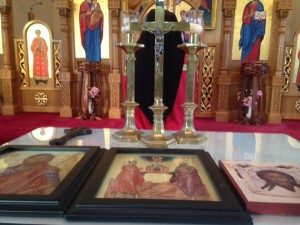
The icon of Ss Peter and Paul on the tetrapod at the Eastern Catholic Church in Richmond, where after the Akathist to Ss Peter and Paul we prayed on bended knees – photo by me
The day after my chrismation – on the proper feast day of Ss Peter and Paul – I was driving, and I had a sudden feeling that I needed to be a better husband. It wasn’t in reference to anything big; marriage, after all, is about the small things. But it was also the first sudden resolve of holiness I had after my chrismation, so I think it was a pretty big deal.
I noticed that the gas was running dangerously low, so I stopped at the nearest gas station. The gas stations in Richmond, British Columbia – quite unlike the rest of the province – are required to be full service. It was thus that the attendant approached my car and asked for my points card.
I replied that my wife had it. He shrugged, and we got the pump going.
Then he came back to my window. ‘I have a question for you,’ he said. I looked up, not sure what I was going to hear. Then he asked: ‘Do you ever fight with your wife?’
Sometimes, I said. I was thinking that that would be the correct answer.
Then he laughed. ‘We all do! My wife, she lives in India, even here, she controls me! Your wife control you too, yeah?’
It’s how love works, man, I replied.
‘YES!’ he shouted. The gas was done filling up, so we had a good laugh. Shortly afterward, I picked up my wife from work and told her about what had happened. We also had a good laugh.
I don’t want to presume too much on the Holy Spirit to say that this was definitively a divine encounter, but it sure does feel suspicious.
This is, after all, what it means to be Catholic. Catholicism is not an identity; that is far too static of a way to put it. To be Catholic is enter into the depths of love, to encounter my fellow person at the level of communion, to premise universality with personal charity. In this sense, the Latin Church is Catholic, but so is the Kyivan Church; we are Catholic because the love works itself out as a practice of universality in our prayer and worship. It is not an identity; it is fire.
All that I mean to say when I became Catholic, then, is that I entered into something that made me experience what it means to fall in love at a much deeper level. In such a Catholicism, the traditions and the ecclesial autonomy are simply there to ensure an ever-deepening practice of love; as Cyril Korolevsky put it in his critique of ‘uniatism,’ the problem with trying to latinize traditions that aren’t Latin is that the point of latinization has never really been to develop a hybrid universality. It’s rather saying that only the Latin tradition is universal, and all the other ones are inferior – and what’s worse, this attitude usually doesn’t come from the Latin Church, but by Greek Catholics with chips on their shoulders. This is not Catholic love, because Catholic love would be to say that both the Latin and Kyivan Churches are Catholic just as they already are, and in this do we share full communion at a much deeper, primal, ontological level despite the outward appearance of difference.
Let me now, then, on this Feast of Ss Peter and Paul, holy chief apostles by whose martyrdom of love the place of the church of the God-saved city of the First-Rome was cemented, express this love in full appreciation of the church that I am not canonically part of, but am in full communion with. For me, this Latin hymn expresses everything that I feel about what it means to be in full communion with the Latin Church while retaining my autonomous Byzantine practice within the Kyivan Church, seeing both churches as Catholic, both in full communion with each other, both practicing the acts of love that spill out into service to the world:
Ubi caritas et amor, Deus ibi est.
Congregavit nos in unum Christi amor.
Exsultemus, et in ipso jucundemur.
Timeamus, et amemus Deum vivum.
Et ex corde diligamus nos sincero.Ubi caritas et amor, Deus ibi est.
Simul ergo sum in unum congregamur;
Ne nos mente dividamur, caveamus.
Cessent iurgia maligna, cessent lites.
Et in medio nostri sit Christus Deus.Ubi caritas et amor, Deus ibi est.
Simul quoque cum beatis videamus,
Glorianter vultum tuum, Christe Deus:
Gaudium quod est immensum, atque probum,
Saecula per infinita saeculorum.Amen.
Previous Post
June 28, 2017
Some not-very-profound musings on my chrismation anniversary
Next Post

June 30, 2017 Two pieces on the Trump Era
Browse Our Archives
Select a Category Academia Anglican Communion anti-racism Aristotle Asia-Pacific Asian American Asian Canadian BlackLivesMatter Cantonese Catholic China Chinglican church politics Church-State Politics Civil Society Conservative Eastern Christianity Evangelical Evangelical Left Feminist/Womanist Theology Food Greek-Catholic Church of Kyiv Hong Kong Housekeeping Kyivan Church Latin Catholicism Law Liberal Liberation Theology New Calvinism Pentecostal/Charismatic Protestant Psychoanalysis Publics Religion Ethnicity Wired Secular Sovereignty TPCIU Uncategorized
Select a Month July 2019 June 2019 May 2019 April 2019 March 2019 February 2019 January 2019 December 2018 November 2018 October 2018 September 2018 August 2018 July 2018 June 2018 May 2018 March 2018 February 2018 January 2018 December 2017 November 2017 October 2017 September 2017 August 2017 July 2017 June 2017 April 2017 March 2017 February 2017 January 2017 December 2016 November 2016 October 2016 September 2016 August 2016 July 2016 January 2016 December 2015 November 2015 October 2015 August 2015 April 2015 March 2015 February 2015 December 2014 November 2014 September 2014 August 2014 July 2014 June 2014 May 2014 April 2014 March 2014 December 2013 November 2013 October 2013 September 2013 August 2013 July 2013 June 2013 May 2013 April 2013 March 2013 February 2013 January 2013 December 2012 October 2012 June 2012 May 2012 April 2012 February 2012 January 2012
Follow Us!
TAKE THE
Religious Wisdom Quiz
Who built two gold calves, leading Israel into idolatry after the split?
Select your answer to see how you score.
Rehoboam Josiah Jeroboam Solomon
Related posts from Eastern Catholic Person

I've found my way home: on the unraveling...

Patriyarkhat: 'Attending to the movements of my heart'

I'm flattered to be named an Asian American...

The secular does not stop when your drive...
TRENDING AT PATHEOS Catholic

Rejecting Doom: Christian Hope And Human Action
Christianity is a religion of hope. We are to have hope and...

It’s What Comes From Within Which Matters
One of the most difficult things for us to understand is why...

Why I Choose the Eucharist Over the Sermon
Choose the Eucharist, Not the Sermon What are we supposed to get...

5 Design Elements Found in Spiritually Rooted Homes
Putting Spirituality Into Home Decor Our homes are more than our living...

Credo: A Story of God Told with the...
About 10 years ago, I began to imagine a personal "Credo" that...

The Anatomy of Divine Revelation in Catholic Thought
The claim that God has made Himself known to human beings is...
view all Catholic blogs
Ad-Free & Subscriber Log-In Subscription Support
- About Us
- 2026 Calendar
- Videos
- Podcasts
- Library of World Religions
- Faith In Media Tracker
- Advertise With Us
- Write for Us
- Privacy Policy
- Terms of Service
- Do Not Sell My Data
- Contact Us
- Radiant Digital
- Manage Newsletter Subscriptions
- Unsubscribe From Notifications
- Sitemap
Copyright 2008-2026, Patheos. All rights reserved.
Subscription Support Ad-Free & Subscriber Log-In
Follow Patheos