
BuddhistCatholicContemplativeEvangelicalGeneral ChristianHinduJewishLatter-day SaintMuslimNew VisionsProgressive Christian
Beliefs
- Buddhist
- Catholic
- Contemplative
- Evangelical
- General Christian
- Hindu
- Jewish
- Latter-day Saint
- More Voices
- Muslim
- New Visions
- Pagan
- Progressive Christian
Topics
- Religion News
- Food and Religion
- Sports and Religion
- Religious Art
- Religious Music and Entertainment
- Religious Events
- History and Religion
- Style and Religion
- Politics and Religion
- Women in Religion
- Recreation Outdoors and Religion
- Business Finance and Religion
- Careers Workplace and Religion
- Education and Religion
- Family Parenting and Religion
- Health Fitness and Religion
- Home and Religion
- Relationships and Religion
- Technology and Religion
- Travel and Religion
Columnists
- Buddhist Columnists
- Business Finance and Religion Columnists
- Careers Workplace and Religion Columnists
- Catholic Columnists
- Contemplative Columnists
- Education and Religion Columnists
- Evangelists Columnists
- Family Parenting and Religion Columnists
- General Christian Columnists
- Health Fitness and Religion Columnists
- Hindu Columnists
- History and Religion Columnists
- Home and Religion Columnists
- Jewish Columnists
- More Voices Columnists
- Latter Day Columnists
- Muslim Columnists
- New Visions Columnists
- Nonreligious Columnists
- Pagan Columnists
- Politics and Religion Columnists
- Progressive Columnists
- Recreation Outdoors and Religion Columnists
- Relationships and Religion Columnists
- Religion News Columnists
- Religious Art Columnists
- Religious Events Columnists
- Religious Music and Entertainment Columnists
- Sports and Religion Columnists
- Style and Religion Columnists
- Technology and Religion Columnists
- Travel and Religion Columnists
- Women in Religion Columnists
Resource Library
- 2026 Calendar
- Library of World Religions
- The 100 Most Holy Places on Earth
- Patheos Answers
- Podcasts
- Videos
- Faith Leaders Database
- Anglican Episcopalian
- Bahai
- Baptist
- Buddhism
- Christianity
- Confucianism
- Eastern Orthodoxy
- Hinduism
- Holiness and Pentecostal
- ISKCON
- Islam
- Judaism
- Lutheran
- Methodist
- The Church of Jesus Christ of Latter-day Saints
- New Age
- Paganism
- Presbytarian and Reformed
- Protestantism
- Religion Behind the Scenes
- Roman Catholic
- Scientology
- Shia Islam
- Sikhism
- Sufism
- Sunni Islam
- Taoism
- Zen
- See all religions
Research Tools
 Ad-Free & Subscriber Log-In Subscription Support
Ad-Free & Subscriber Log-In Subscription Support
Follow Patheos 

- Trending:
- Forgiveness
- |
- Marriage
- |
- Consciousness
- |
- Death Penalty
- |
- Election
- |
- Halloween
 Eastern Catholic Person
- Home
- Catholic
- Full communion in the fire of the Spirit: Kyivan, Latin, Anglican, Irish, Pascha
Full communion in the fire of the Spirit: Kyivan, Latin, Anglican, Irish, Pascha
Last updated on: April 17, 2017 at 9:43 pm by Justin Tse
Full communion in the fire of the Spirit: Kyivan, Latin, Anglican, Irish, Pascha 2017-04-17T21:43:20-07:00 Justin Tse
Patheos Explore the world's faith through different perspectives on religion and spirituality! Patheos has the views of the prevalent religions and spiritualities of the world.
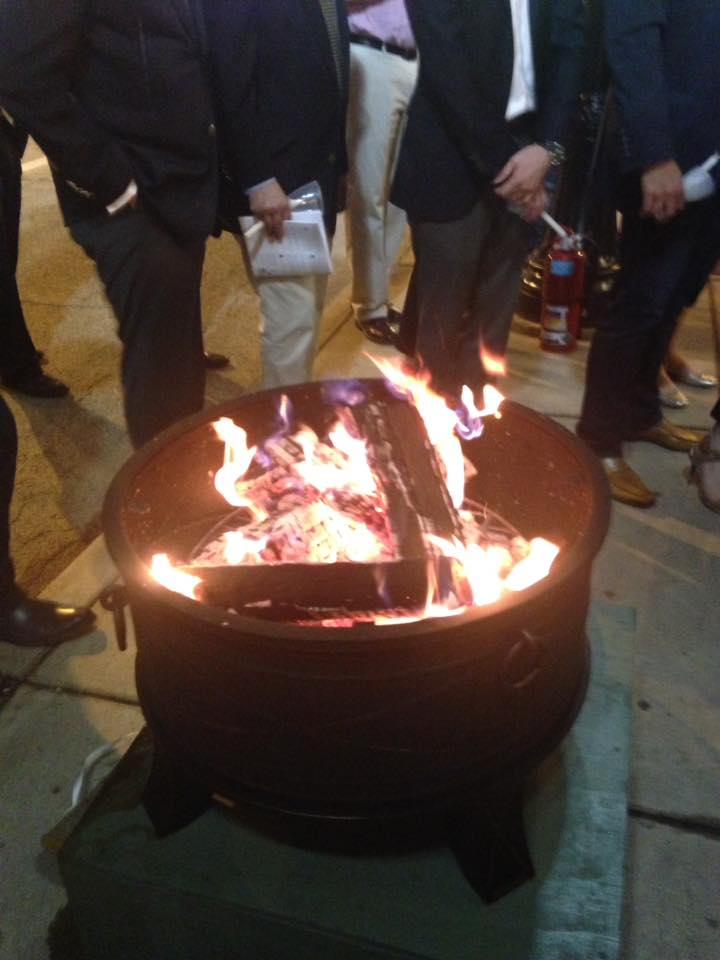
Easter fire at Old St Pat’s, 2017 – photo by me
I’ve made no secret that I attended the Easter Vigil at a Latin parish in Chicago instead of going to a Byzantine temple for Pascha. There were many reasons for this, and I also realize that I could have gone to Pascha afterward anyway, but I was far too tired from the conferences from my secular professional life – indeed, I slept for twelve hours afterward. That said, I feel that I have been carried on the prayers on the Kyivan Church as my impulse is still to sing the Paschal tropar in a Galician tone as well as the exapostilarion, the irmos, and parts of the canon. Pascha encompasses my entire Christian existence as my body is formed in Christ through the Greek-Catholic Church of Kyiv.
The real reason I went to Old St Pat’s in lieu of an Orthodox Pascha was because my friend was getting chrismated. There is a special bond among us Chinese evangelicals who come into the apostolic churches, and together with some of her friends (most of whom were still evangelical), we celebrated her entry into the Catholic Church and then had a vigorous debate over late night Chinese food in Chinatown about what this entry meant about her relationship with evangelical Protestants now.
Many of the practices of the Latin Church are not natural for someone whose body is being formed in the Kyivan Church. For one, Latins don’t ‘reverence’ (sign of the cross, right to left, with a bow) whenever they feel inwardly moved, but as I was moved at several point in the service, this is exactly what I did, and I think together with me being woefully underdressed for the service (I had gotten back from the conference and was in the mood for relaxation), that garnered more than one awkward stare. The eighth article of the Union of Brest, by which our church came into communion with Rome in 1598, actually articulates more of the differences between Easter and Pascha:
Likewise that we should not be compelled to have the blessing of fire, the use of wooden clappers, and similar ceremonies before Easter, for we have not had such ceremonies in our Church until now, but that we should maintain our ceremonies according to the rubrics and the Typicon of our Church.
I therefore understand the service that I attended on Pascha to be fundamentally different from my own tradition, yet in a church with which I am in full communion. The same goes for my friend and all those who were received together with her by baptism and chrismation into the Latin Church that night; they joined my sister church, a fundamentally different autonomous church from mine, and yet because of our full communion, I fully celebrate that my sister became Catholic and now shares in the drama of our conjoined ecclesial houses. Full communion means that I was completely aware of two simultaneous realities: that I was celebrating Pascha in an ecclesial house that is not my own, but this ecclesial house – quite unlike the Protestants with whom I have been drawing distinctions throughout the Great Fast – is so deeply linked with mine that it can be said still that we are one family at the same table.
The first sense I got, then, was that our joined ecclesial houses had gotten larger. As the catechumens were dunked and then the catechumens and candidates held candles while being chrismated, I felt viscerally that not only my friend, but also these people I did not know personally were now part of my family.
But the second sense was much more interesting. One of the interesting things about this particular parish, Old St Pat’s, is that there seems to be some attempt to claim a kind of Celtic spirituality as an old Irish Catholic parish named after St Patrick, Enlightener of the Irish. Modern British colonization be damned, however (except to say that it ruins everything I want to say!), the feeling that I got from the various attempts to subtly and not-so-subtly reclaim this heritage – Celtic crosses, an emphasis on the fire of love, the praying of the Breastplate of St Patrick – reminded me of the Anglicanism from which I came, an Anglicanism steeped not so much in the English Reformation but predating it all from Bede’s Ecclesiastical History to the fourteenth-century mystics like Richard Rolle, Julian of Norwich, Margery Kempe, Walter Hilton, and the mysterious author of The Cloud of Unknowing.
Now of course, to be very clear, I recognize that such a take will be as offensive to my Irish readers as my Ukrainian sisters and brothers would take umbrage to a writer lumping them in as Russian. I must clarify that what I have in mind here is a decolonized, fully Catholic sense of the ecclesia Anglicanorum that I failed to develop on my blog when I was an Anglican and that is much too complex to discuss here, except to say that I feel this objection in my gut and will perhaps have something to say about it some other time. I promise to use James Joyce to explain this when I get around to it, as well as to discuss how Irish Catholics and Protestants have both been formative to my spiritual life.
To do even more hand-waving, what I mean by ‘Anglican’ is thus not the same thing as when Catholics refer to ‘Anglicanism’ as a kind of liberal loosey-gooseyness that they are afraid is infecting the Vatican. When I blogged for Logos Anglican, I argued from the earliest sources to the present that the Anglican charism is a ‘public mysticism,’ a democratization of the Sarum Rite’s private priestly prayer: Almighty God, unto whom all hearts are open, all desires known, and from whom no secrets are hid, cleanse the thoughts of our hearts by the inspiration of Thy Holy Spirit, that we may perfectly love Thee, and worthily magnify Thy holy Name, through Christ our Lord, amen. What I did not get to fully develop while writing both there and as Chinglican was the implication of such a spirituality: it means that through the fire of the Holy Spirit, Anglicans pursue a way of perfection that can only be characterized by exorcism; it is no exaggeration to say, for example, that when Holy Augustine of Canterbury arrives in the British Isles sent by the Holy Pope Gregory the Great, he and his successors achieve an exorcism of the spirits of tribal warfare from the island by converting the tribal chieftains – is this not what Holy Patrick also did for the Irish? It was in this light also that when I first heard the current Archbishop of Canterbury Justin Welby open his first press conference with the Franciscan prayer Come, Holy Spirit, fill the hearts of your faithful and kindle in them the fire of your love, I nearly fell off my chair as I recognized that emphasis on fiery exorcism as the hallmark of the Anglican charism.
At a purely experiential level – meaning that it is very unlikely that this is how Old St Pat’s liturgists meant for me to take it – the Easter Vigil’s emphasis on fire and exorcism, paired with the Breastplate of St Patrick, evoked in me a pathway to G-d that I thought I had abandoned when I joined the Kyivan Church: the white-hot fire of exorcizing purification from the demons of tribalism that lead to incessant warfare. To be sure, when I was pursuing my catechumenate, I had been told not to abandon this charismatic Anglican sensibility, to come into an even fuller appreciation of the Book of Common Prayer and its Sarum Rite origins by participating in the Fellowship of St Alban and St Sergius, to perhaps attend the occasional Choral Evensong, to seek out the Personal Ordinariate where possible (indeed, the bishop is an alumnus of my high school in Hayward), to never speak ill of my Anglican sisters and brothers, as frustrated as I was with Communion politics. But the fact was that in my overreaction, I had not so much consciously abandoned these sensibilities as I had simply forgotten about them in my zeal to become fully Kyivan: I had forgotten my devotion to Julian of Norwich, I had forgotten about Holy Patrick Enlightener of the Irish, I had forgotten Holy Bede the Venerable and the story of Cædmon who was given the songs of heaven and earth, I had forgotten about the fiery exorcism of the spirits of war that make for true Catholic peace in what is common between Anglican and Irish charismatic practices.
As I felt the house of G-d expand through the baptisms and chrismations, I also felt a sense that this neglect of my Anglican past and my spiritual formation by Irish Catholics and Protestants had been quite unnecessary. There is no need for me to prove my Kyivan bona fides by abandoning the Anglican charism; if anything, I should be bringing that fiery charismatic approach to the divine with me to enrich my church’s practice of wisdom. Yes, of course, there is a tradition of fire in our church, even that of the holy fire descending onto Jerusalem – but the Anglican practice of fiery purification is my past, and the Holy Spirit came to purge me of my overreaction to my own ecclesial baggage.
Pascha with the Latins had a quite unexpected side effect, then, even though I have missed having Pascha in my own church this year. The gift that was my friend’s chrismation is that I felt taken deeper into the mystery of full communion between ecclesial houses that could not be more different in liturgical and charismatic sensibility, Latin and Kyivan. What’s more, in this mystery of full communion, the Holy Spirit came in fire to purify me even more of my propensity to an ecclesial identity politics, urging me as I was instructed during my catechumenate to never fully abandon the Anglican charism and the formation I received from my Irish teachers, which is as much mine in Christ as all things are mine, and I am Christ’s. Indeed, the beauty of these traditions must be kept integral, but this must be held in tension with the reality of the risen life of Christ, which is that in Christ there is neither Latin nor Kyivan nor Anglican nor Irish, but all are one in full communion in the Holy Spirit who comes to kindle in his faithful the fire of G-d’s love.
There is perhaps much more to be developed here, and the truth is that raw experience requires more reflection that I can muster in just a few days. But this was my Pascha, and through it, I affirm the truth that my church sings in the exapostilarion: In the flesh You fell asleep as a mortal man, O King and Lord. You rose on the third day raising Adam from corruption and destroying Death, O Pascha of incorruption, the salvation of the world!
Previous Post
April 16, 2017
Christ is risen from the dead, trampling death by death #Pascha2017
Next Post
April 19, 2017 A response to the hit piece on Hank Hanegraaf's Greek Orthodox temple
Browse Our Archives
Select a Category Academia Anglican Communion anti-racism Aristotle Asia-Pacific Asian American Asian Canadian BlackLivesMatter Cantonese Catholic China Chinglican church politics Church-State Politics Civil Society Conservative Eastern Christianity Evangelical Evangelical Left Feminist/Womanist Theology Food Greek-Catholic Church of Kyiv Hong Kong Housekeeping Kyivan Church Latin Catholicism Law Liberal Liberation Theology New Calvinism Pentecostal/Charismatic Protestant Psychoanalysis Publics Religion Ethnicity Wired Secular Sovereignty TPCIU Uncategorized
Select a Month July 2019 June 2019 May 2019 April 2019 March 2019 February 2019 January 2019 December 2018 November 2018 October 2018 September 2018 August 2018 July 2018 June 2018 May 2018 March 2018 February 2018 January 2018 December 2017 November 2017 October 2017 September 2017 August 2017 July 2017 June 2017 April 2017 March 2017 February 2017 January 2017 December 2016 November 2016 October 2016 September 2016 August 2016 July 2016 January 2016 December 2015 November 2015 October 2015 August 2015 April 2015 March 2015 February 2015 December 2014 November 2014 September 2014 August 2014 July 2014 June 2014 May 2014 April 2014 March 2014 December 2013 November 2013 October 2013 September 2013 August 2013 July 2013 June 2013 May 2013 April 2013 March 2013 February 2013 January 2013 December 2012 October 2012 June 2012 May 2012 April 2012 February 2012 January 2012
Follow Us!
TAKE THE
Religious Wisdom Quiz
Which prophet was commanded to buy a field during a siege?
Select your answer to see how you score.
Jeremiah Obadiah Habakkuk Isaiah
Related posts from Eastern Catholic Person

I've found my way home: on the unraveling...

Patriyarkhat: 'Attending to the movements of my heart'

I'm flattered to be named an Asian American...

The secular does not stop when your drive...
TRENDING AT PATHEOS Catholic

Creation, Preservation, and Teleology in Catholic Theology
As I write this, it is very early Monday morning. Like millions...

The Parable Of The Sower And The Word...
One of Christ’s most famous parables is that of the sower who...

Rejecting Doom: Christian Hope And Human Action
Christianity is a religion of hope. We are to have hope and...

Why I Choose the Eucharist Over the Sermon
Choose the Eucharist, Not the Sermon What are we supposed to get...

5 Design Elements Found in Spiritually Rooted Homes
Putting Spirituality Into Home Decor Our homes are more than our living...

Credo: A Story of God Told with the...
About 10 years ago, I began to imagine a personal "Credo" that...
view all Catholic blogs
Ad-Free & Subscriber Log-In Subscription Support
- About Us
- 2026 Calendar
- Videos
- Podcasts
- Library of World Religions
- Faith In Media Tracker
- Advertise With Us
- Write for Us
- Privacy Policy
- Terms of Service
- Do Not Sell My Data
- Contact Us
- Radiant Digital
- Manage Newsletter Subscriptions
- Unsubscribe From Notifications
- Sitemap
Copyright 2008-2026, Patheos. All rights reserved.
Subscription Support Ad-Free & Subscriber Log-In
Follow Patheos