
BuddhistCatholicContemplativeEvangelicalGeneral ChristianHinduJewishLatter-day SaintMuslimNew VisionsProgressive Christian
Beliefs
- Buddhist
- Catholic
- Contemplative
- Evangelical
- General Christian
- Hindu
- Jewish
- Latter-day Saint
- More Voices
- Muslim
- New Visions
- Pagan
- Progressive Christian
Topics
- Religion News
- Food and Religion
- Sports and Religion
- Religious Art
- Religious Music and Entertainment
- Religious Events
- History and Religion
- Style and Religion
- Politics and Religion
- Women in Religion
- Recreation Outdoors and Religion
- Business Finance and Religion
- Careers Workplace and Religion
- Education and Religion
- Family Parenting and Religion
- Health Fitness and Religion
- Home and Religion
- Relationships and Religion
- Technology and Religion
- Travel and Religion
Columnists
- Buddhist Columnists
- Business Finance and Religion Columnists
- Careers Workplace and Religion Columnists
- Catholic Columnists
- Contemplative Columnists
- Education and Religion Columnists
- Evangelists Columnists
- Family Parenting and Religion Columnists
- General Christian Columnists
- Health Fitness and Religion Columnists
- Hindu Columnists
- History and Religion Columnists
- Home and Religion Columnists
- Jewish Columnists
- More Voices Columnists
- Latter Day Columnists
- Muslim Columnists
- New Visions Columnists
- Nonreligious Columnists
- Pagan Columnists
- Politics and Religion Columnists
- Progressive Columnists
- Recreation Outdoors and Religion Columnists
- Relationships and Religion Columnists
- Religion News Columnists
- Religious Art Columnists
- Religious Events Columnists
- Religious Music and Entertainment Columnists
- Sports and Religion Columnists
- Style and Religion Columnists
- Technology and Religion Columnists
- Travel and Religion Columnists
- Women in Religion Columnists
Resource Library
- 2026 Calendar
- Library of World Religions
- The 100 Most Holy Places on Earth
- Patheos Answers
- Podcasts
- Videos
- Faith Leaders Database
- Anglican Episcopalian
- Bahai
- Baptist
- Buddhism
- Christianity
- Confucianism
- Eastern Orthodoxy
- Hinduism
- Holiness and Pentecostal
- ISKCON
- Islam
- Judaism
- Lutheran
- Methodist
- The Church of Jesus Christ of Latter-day Saints
- New Age
- Paganism
- Presbytarian and Reformed
- Protestantism
- Religion Behind the Scenes
- Roman Catholic
- Scientology
- Shia Islam
- Sikhism
- Sufism
- Sunni Islam
- Taoism
- Zen
- See all religions
Research Tools
 Ad-Free & Subscriber Log-In Subscription Support
Ad-Free & Subscriber Log-In Subscription Support
Follow Patheos 

- Trending:
- Forgiveness
- |
- Marriage
- |
- Consciousness
- |
- Death Penalty
- |
- Election
- |
- Halloween
 Eastern Catholic Person
- Home
- Catholic
- Into the depths: reflections on a catechumenate relived
Into the depths: reflections on a catechumenate relived
Last updated on: April 15, 2017 at 10:35 am by Justin Tse
Into the depths: reflections on a catechumenate relived 2017-04-15T10:35:49-07:00 Justin Tse
Patheos Explore the world's faith through different perspectives on religion and spirituality! Patheos has the views of the prevalent religions and spiritualities of the world.
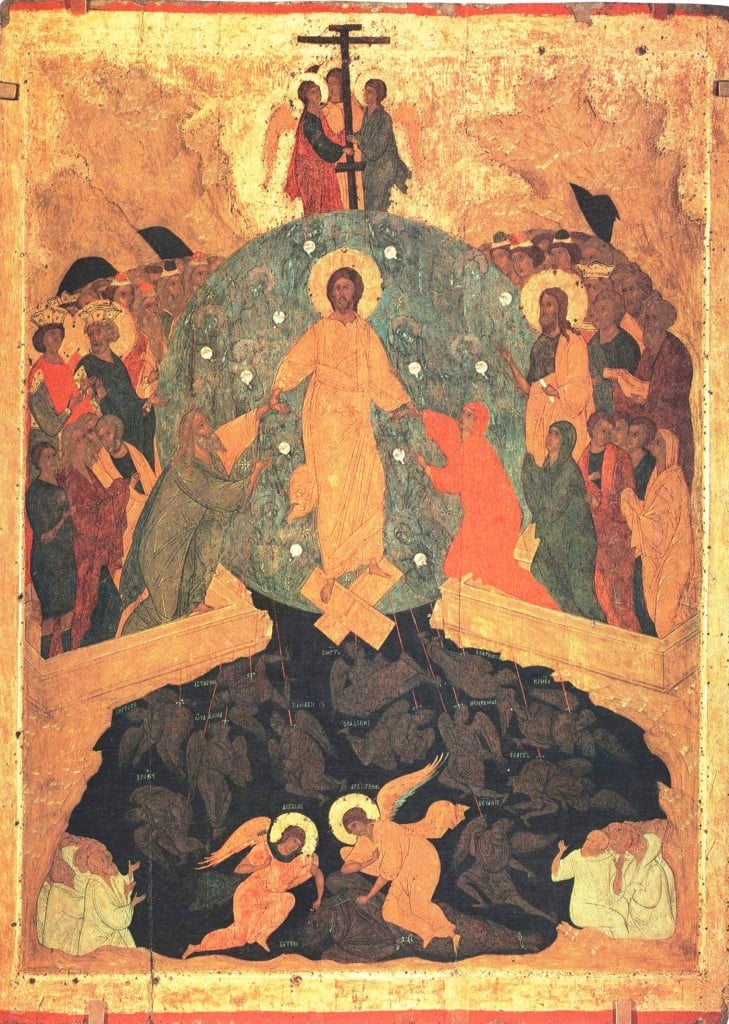
Descent into Hell, icon from the Ferapontov Monastery, PD-Art, via Wikimedia Commons
Great and Holy Saturday is upon us. The Great Fast has been over for a week. Even Great and Holy Week is almost over. The Lord is in the tomb. It is the time that the world is suspended by the death of God, the hiatus, the pause.
I have been reliving my catechumenate over the weeks of the Great Fast; this is, after all, what the Great Fast is for. There would be nothing special about what I have to say, except to say that every person’s reliving of a catechumenate will look different.
But my reliving of my catechumenate this year came upon me suddenly. Without much reflection on the time, I wrote some thoughts about Protestants in Vancouver and what I called their recourse to ideological ‘blackmail,’ and this launched me into a series of haphazard reflections on my awkwardness about writing about Protestants, especially because I was informed soon afterward that my comments were taken as an intervention into Protestantism. I insisted that as an Eastern Catholic, I could not possibly be intervening in the Protestant ecclesial houses; this was taken as disingenuous, and this threw me into a bit of a crisis into how it might be possible for me to write about Protestants, because this is what I still do in my professional academic life.
Because I used to be a Protestant, this series of events afforded me a tumultuous beginning to my process of reliving my catechumenate this year – even to the consideration of where I needed perhaps to be better catechized. I began writing in a frenzy, often switching between exuberant tones and thunderous critique, and my friend one day pulled me aside and informed me that he felt that my writing was becoming restless.
The crisis that ensued from this rebuke led to a new set of reflections, this time on hesychasm and what my friend and I called ‘intellectual chastity.’ I began reflecting on how hesychasm is about the body and on the work of the Holy Spirit in hesychastic practice in breaking down walls erected through the practice of the politics of identity. In the process, I confessed that I was a terrible hesychast and that I often confused the idleness of sloth with the practice of hesychastic stillness.
These were intellectual reflections – literally, reflections on the state of my intellect – and without getting into much detail, new attacks ensued. As I wrote about why I blogged in the context of my academic practice (I also have an incomplete series on why I blog) and even defended the academy, I was accused of being an intellectual for intellectuals without translating for the masses. The funny thing was that I was especially accused of this when I posted on Facebook about Protestant politics, especially the hubbub around Princeton Theological Seminary and Tim Keller.
For these people, to be an intellectual seemed to be to engage in the work of translation, of taking difficult thoughts and translating them for popular consumption. But over the course of the Great Fast, I became increasingly convinced that the praxis of being a public intellectual is to struggle publicly to be a hesychast, to have my intellect (my nous) taken into the depths of my heart to achieve a kind of stillness through which the Lord might speak to me and I could thus grasp the Holy Spirit.
This meant that I was not in fact trying to articulate the difference between me being a Protestant in the past and me being Eastern Catholic now, even though the difference between our ecclesial houses is real and should be talked about so that we can truly walk together aware of the historic gaps between our churches. But this was not a matter of identity politics. It was instead a matter of learning that theology – speaking of G-d – is not a matter of word games and discourses of identification. Hesychasm is a state beyond words, the encounter of the intellect with the truly deep, the truly profound, the truly primal.
To strive to be a hesychastic public intellectual – which means to fail publicly at it – meant that I struggled to write about the ascent of the divine ladder. My thoughts were also drawn to the service that had literally converted my body in a primal way – the Great Canon of St Andrew of Crete – and I wrote about the bodily act of performing prostrations, the impossibility of being completed by a spiritual father, and how the ‘erotic of holiness’ to be found in Holy Mary of Egypt were formative in the earliest parts of my catechumenate. As I reread the Gospels during Great Week, I also found myself beholding the face of Christ through the texts as icons. I also read with interest my friend and editor Sam Rocha skewering The Benedict Option for precisely a betrayal of such an intellectual life and its author’s absence of wit; Sam’s posts, I found, became catechetical texts for me.
My friend tells me that by probing these primal depths, I am finally starting to do theology – to speak of G-d – as Catholic. To be Catholic is to live in Christ as part of the communion of saints; this communion happens not at the level of political identification, but in the sharing of all things in the depths of existence. To be Catholic is to recognize that the sudden response of the Coptic New-Martyrs is the martyrdom that I share in the depths of being Byzantine; to be Catholic is to affirm that hesychasm is not a Byzantine thing, but a depth that is – as Holy Gregory Palamas wanted it to be – for everyone. Indeed, to be Catholic is to be able to say that even though this year I was at a conference and couldn’t attend the Byzantine services but instead attended Latin ones, and that I will be having Pascha with the Latins because a dear friend of mine is being chrismated tonight at the Easter Vigil, I am still being formed in the Kyivan Church.
This is because the whole point of autonomy for us Kyivans is not simply a matter of identity. As articulated in our catechism Christ Our Pascha, the self-understanding of what it means to be church for us in the Greek-Catholic Church of Kyiv is that we are a Pascha people. Liquidated by the cronies of the Soviet Union in 1946, our church literally rose from the dead in 1988 as our people came out of the underground in the millions, with the memory of many martyrs who had died for the union despite being vilified historically for selling out to Roman imperialism.
Of course, we are not unaware of the contested history of political machinations behind the union, and as the spiritual children of Metropolitan Andrei Sheptytsky and readers of Cyril Korolevsky, Archbishop Elias Zoghby, Serge Kelleher, and John Madey, we are not uncritical of the legacies of ‘uniatism’ in our practice, the propensity to prefer the traditions of the Latin church over our Byzantine heritage – a preference that the Vatican has instructed us to excise so that the fullness of our Byzantine consciousness will keep the Church fully catholic. The radical realization of our new reflection of our church is perhaps that the practice of uniatism as stated in such terms is that it is not only insufficiently Catholic; it is a perversion and betrayal of Catholicism, the trading in of one identity politics for another without any consciousness of the primal depths of communion. Catholicity is not to be found in the supremacy of one or some of the sister churches over all the others; it is to be found in our sisterhood itself. That is the point of our autonomy – that it is only in being conscious of ourselves as a self-governing church that we become conscious that our self-governance is not a law unto ourselves, but the very condition by which we can talk about our church sharing all things in common with our sister churches and walking in the hope against hope of such communion with churches not yet in the fullness of communion with us. This is only possible with a self-understanding of our church as founded by Christ Our Pascha, the Lord who gives himself to us so that we might live.
What I desire to learn more from this catechumenate relived is therefore not more information about Catholicism or Orthodoxy or Protestantism or Christianity. Instead, I want to practice speaking of G-d with such Catholic depth, to unlearn my previous practice of theological word-games so that I might be still and know that G-d is God. For Hans Urs von Balthasar, this is indeed the mystery of Holy Saturday, the death of God through which we who are joined to him descend into Hades with him, a mysterious participation that forces us to rework the ‘logic of theology’ so that the clearest expression of the sovereignty of this God is in his self-emptying.
As we enter into the feast days of Pascha, we also enter into a time of mystagogy, of being drawn deeper into the mysteries of communion, as the received catechumens become fully part of the Church, receiving the most holy Body and Blood as my friend who is joining the Latin Church tonight will. Perhaps in the days to come, then, I will be writing about reliving my mystagogy as well.
Lord Jesus Christ, Son of G-d, have mercy on me, a sinner.
Previous Post
April 15, 2017
Hiatus
Next Post
April 15, 2017 Arise, O G-d, and judge the earth! #HolySaturday
Browse Our Archives
Select a Category Academia Anglican Communion anti-racism Aristotle Asia-Pacific Asian American Asian Canadian BlackLivesMatter Cantonese Catholic China Chinglican church politics Church-State Politics Civil Society Conservative Eastern Christianity Evangelical Evangelical Left Feminist/Womanist Theology Food Greek-Catholic Church of Kyiv Hong Kong Housekeeping Kyivan Church Latin Catholicism Law Liberal Liberation Theology New Calvinism Pentecostal/Charismatic Protestant Psychoanalysis Publics Religion Ethnicity Wired Secular Sovereignty TPCIU Uncategorized
Select a Month July 2019 June 2019 May 2019 April 2019 March 2019 February 2019 January 2019 December 2018 November 2018 October 2018 September 2018 August 2018 July 2018 June 2018 May 2018 March 2018 February 2018 January 2018 December 2017 November 2017 October 2017 September 2017 August 2017 July 2017 June 2017 April 2017 March 2017 February 2017 January 2017 December 2016 November 2016 October 2016 September 2016 August 2016 July 2016 January 2016 December 2015 November 2015 October 2015 August 2015 April 2015 March 2015 February 2015 December 2014 November 2014 September 2014 August 2014 July 2014 June 2014 May 2014 April 2014 March 2014 December 2013 November 2013 October 2013 September 2013 August 2013 July 2013 June 2013 May 2013 April 2013 March 2013 February 2013 January 2013 December 2012 October 2012 June 2012 May 2012 April 2012 February 2012 January 2012
Follow Us!
TAKE THE
Religious Wisdom Quiz
What did the soldier dress Jesus in after he was accused?
Select your answer to see how you score.
Scarlet Robe Golden Robe Nothing Thorns
Related posts from Eastern Catholic Person

I've found my way home: on the unraveling...

Patriyarkhat: 'Attending to the movements of my heart'

I'm flattered to be named an Asian American...

The secular does not stop when your drive...
TRENDING AT PATHEOS Catholic

Rejecting Doom: Christian Hope And Human Action
Christianity is a religion of hope. We are to have hope and...

It’s What Comes From Within Which Matters
One of the most difficult things for us to understand is why...

Why I Choose the Eucharist Over the Sermon
Choose the Eucharist, Not the Sermon What are we supposed to get...

5 Design Elements Found in Spiritually Rooted Homes
Putting Spirituality Into Home Decor Our homes are more than our living...

Credo: A Story of God Told with the...
About 10 years ago, I began to imagine a personal "Credo" that...

The Anatomy of Divine Revelation in Catholic Thought
The claim that God has made Himself known to human beings is...
view all Catholic blogs
Ad-Free & Subscriber Log-In Subscription Support
- About Us
- 2026 Calendar
- Videos
- Podcasts
- Library of World Religions
- Faith In Media Tracker
- Advertise With Us
- Write for Us
- Privacy Policy
- Terms of Service
- Do Not Sell My Data
- Contact Us
- Radiant Digital
- Manage Newsletter Subscriptions
- Unsubscribe From Notifications
- Sitemap
Copyright 2008-2026, Patheos. All rights reserved.
Subscription Support Ad-Free & Subscriber Log-In
Follow Patheos