
BuddhistCatholicContemplativeEvangelicalGeneral ChristianHinduJewishLatter-day SaintMuslimNew VisionsProgressive Christian
Beliefs
- Buddhist
- Catholic
- Contemplative
- Evangelical
- General Christian
- Hindu
- Jewish
- Latter-day Saint
- More Voices
- Muslim
- New Visions
- Pagan
- Progressive Christian
Topics
- Religion News
- Food and Religion
- Sports and Religion
- Religious Art
- Religious Music and Entertainment
- Religious Events
- History and Religion
- Style and Religion
- Politics and Religion
- Women in Religion
- Recreation Outdoors and Religion
- Business Finance and Religion
- Careers Workplace and Religion
- Education and Religion
- Family Parenting and Religion
- Health Fitness and Religion
- Home and Religion
- Relationships and Religion
- Technology and Religion
- Travel and Religion
Columnists
- Buddhist Columnists
- Business Finance and Religion Columnists
- Careers Workplace and Religion Columnists
- Catholic Columnists
- Contemplative Columnists
- Education and Religion Columnists
- Evangelists Columnists
- Family Parenting and Religion Columnists
- General Christian Columnists
- Health Fitness and Religion Columnists
- Hindu Columnists
- History and Religion Columnists
- Home and Religion Columnists
- Jewish Columnists
- More Voices Columnists
- Latter Day Columnists
- Muslim Columnists
- New Visions Columnists
- Nonreligious Columnists
- Pagan Columnists
- Politics and Religion Columnists
- Progressive Columnists
- Recreation Outdoors and Religion Columnists
- Relationships and Religion Columnists
- Religion News Columnists
- Religious Art Columnists
- Religious Events Columnists
- Religious Music and Entertainment Columnists
- Sports and Religion Columnists
- Style and Religion Columnists
- Technology and Religion Columnists
- Travel and Religion Columnists
- Women in Religion Columnists
Resource Library
- 2026 Calendar
- Library of World Religions
- The 100 Most Holy Places on Earth
- Patheos Answers
- Podcasts
- Videos
- Faith Leaders Database
- Anglican Episcopalian
- Bahai
- Baptist
- Buddhism
- Christianity
- Confucianism
- Eastern Orthodoxy
- Hinduism
- Holiness and Pentecostal
- ISKCON
- Islam
- Judaism
- Lutheran
- Methodist
- The Church of Jesus Christ of Latter-day Saints
- New Age
- Paganism
- Presbytarian and Reformed
- Protestantism
- Religion Behind the Scenes
- Roman Catholic
- Scientology
- Shia Islam
- Sikhism
- Sufism
- Sunni Islam
- Taoism
- Zen
- See all religions
Research Tools
 Ad-Free & Subscriber Log-In Subscription Support
Ad-Free & Subscriber Log-In Subscription Support
Follow Patheos 

- Trending:
- Forgiveness
- |
- Marriage
- |
- Consciousness
- |
- Death Penalty
- |
- Election
- |
- Halloween
 Eastern Catholic Person
- Home
- Catholic
- Arise, O G-d, and judge the earth! #HolySaturday
Arise, O G-d, and judge the earth! #HolySaturday
Last updated on: April 15, 2017 at 3:36 pm by Justin Tse
Arise, O G-d, and judge the earth! #HolySaturday 2017-04-15T15:36:16-07:00 Justin Tse
Patheos Explore the world's faith through different perspectives on religion and spirituality! Patheos has the views of the prevalent religions and spiritualities of the world.
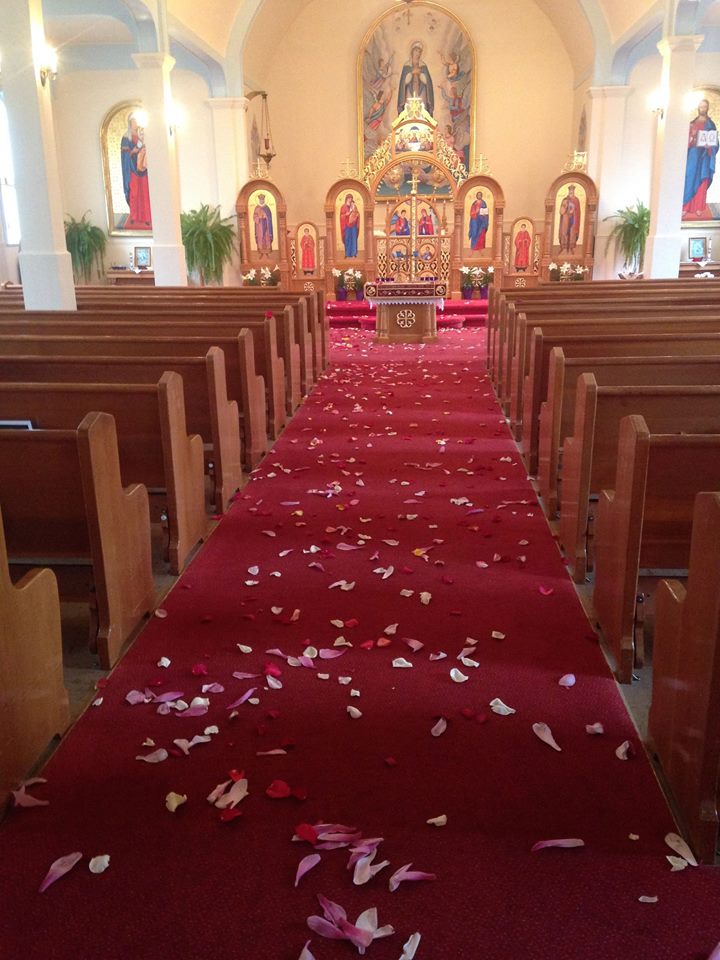
The result of ‘Arise, O G-d’ – Photo: Richmond Eastern Catholic Church, Holy Saturday 2016
Holy Saturday is interrupted.
During the Holy Saturday Liturgy, the Byzantine churches read passages from the Hebrew Scriptures, culminating in the words of the Holy Apostle Paul:
Do you not know that all of us who have been baptized into Christ Jesus were baptized into his death? Therefore we have been buried with him by baptism into death, so that, just as Christ was raised from the dead by the glory of the Father, so we too might walk in newness of life. For if we have been united with him in a death like his, we will certainly be united with him in a resurrection like his. We know that our old self was crucified with him so that they body of sin might be destroyed, and we might no longer be enslaved to sin. For whoever has died is freed from sin. But if we have died with Christ, we believe that we will also live with him. We know that Christ, being raised from the dead, will never die again; death no longer has dominion over him. The death he died, he died to sin, once for all; but the life he lives, he lives to God. So you also must consider yourselves dead to sin and alive to God in Christ Jesus. (Romans 6.3-11 NRSV).
Suddenly, as the women go to the tomb and find it empty, the temple breaks out into song. Flower petals are thrown as we sing in exultation, Arise, O G-d, and judge the earth; for to You belongs all the nations! Over and over and over again, we sing this: Arise, O G-d, and judge the earth; for to You belongs all the nations!
With petals strewn all over the ground, all over the tetrapod, all over the pews that shouldn’t even be there, the secret is all but out. Usually, Holy Saturday liturgies have rather small attendance; this year, because I was away at a conference, I could not even go. But I remember the one from my catechumenate – the effect is in fact the photo displayed above, which is my banner picture as well – and there we were, some old-timers and some interested Protestants, belting out, Arise, O G-d, as we watched our priest comically chuck bunches and bunches of petals from a basket he had brought out from behind the iconostas like a surprise.
Those who weren’t there – mostly everyone – came into the Pascha service that night bewildered. Who made such a mess of this place? What on earth happened here?
That is the point exactly.
Arise, O G-d is an interruption of the interruption. If Holy Saturday is the hiatus, the pause, the interruption of the world with the death of G-d, Arise, O G-d is the hidden interruption of that interruption, the surprise of the women who had been surprised that their Lord and God had died and now are surprised yet again – as Holy Mark the Evangelist puts it best, So they went out and fled from the tomb, for terror and amazement had seized them; and they said nothing to anyone, for they were afraid (16.8). The New Testament scholar Luke Timothy Johnson says that at this point, what you’re supposed to do is to read Mark’s Gospel all over again because it is through this moment of trembling fear – this interruption that interrupts even the interruption (my words, not his) – that this Gospel which features instance after instance of the disciples not understanding what Jesus is saying and doing finally makes sense.
For those of us younger Cantonese-speaking Protestants who first encountered Eastern Catholicism in Vancouver during the Hong Kong Umbrella Movement, Arise, O G-d was the first chant that we learned. We belted it in front of the Chinese Consulate in Vancouver, calling on the Chinese government to repent in the face of the Lord speaking through his people demanding their political dignity and agency. It should come as no surprise that for some of us in Vancouver, this political theology was what got us involved in the Eastern Catholic Church – in the Kyivan Church, in particular – because this was a church that did not only preach that Jesus was Lord, but actually practiced it without fear.
This is thus the song for our dangerous political times. When I write like this, I am sometimes charged with being partisan; I do not know which party I represent when I say these things, and I do not really understand why it seems to be ok for me to say political things about Hong Kong and not the United States. What I am doing is affirming the orthodoxy of the Protestant theologian Karl Barth, who writes:
The Gospel of the Resurrection is the – power of God, His virtus (Vulgate), the disclosing and apprehending of His meaning, His effective pre-eminence over all gods. The Gospel of the Resurrection is the action, the supreme miracle, by which God, the unknown God dwelling in light unapproachable, the Holy One, Creator, and Redeemer, makes himself known: What therefore ye worship in ignorance, this set I forth unto you (Acts xvii.23). No divinity remaining on this side the line of resurrection; no divinity which dwells in temples made with hands or which is served by the hand of man; no divinity which NEEDS ANYTHING, any human propaganda (Acts xvii.24, 25), – can be God. God is the unknown God, and precisely because He is unknown, He bestows life and breath and all things. Therefore the power of God can be detected neither in the world of nature nor in the souls of men. it must not be confounded with any high, exalted force, known or knowable. The power of God is not the most exalted of observable forces, nor is it either their sum or their fount. Being completely different, it is the KRISIS of all power, that by which all power is measured, and by which it is pronounced to be something and — nothing, nothing and — something. It is that which sets all these powers in motion and fashions their eternal rest. It is the Primal Origin by which they all are dissolved, the consummation by which they all are established. (Barth, Epistle to the Romans, p. 35-36).
To speak in the genre of theological politics is not to be partisan; it is to speak of the Lordship of Christ in his definitive word spoke by his bodily resurrection, the word against which the words of the gods (or elsewhere, Barth writes, the no-gods) are measured. The Resurrection is judgment on human politics; it is the standard by which the church performs the acts of makrodiakonia, the exposure of the big-picture apparatus of colonizing discipline and the word of liberation from them.
And thus, as we hear of wars and rumours of wars – of the bombing of Syria, the heightening of tensions with between the United States and North Korea, the pivot to China, the stories that range from conspiracy theory to material truth about the Kremlin, the emergence of far-right politics couched in the language of perpetual warfare – the song that interrupts Holy Saturday is the song the Church sings in interruption. Without fear, let us throw flower petals in exuberance; with song bursting from our bowels, let us call on G-d the Lord to judge these hawks of nations; as peacemakers named by our Lord in his Sermon on the Mount as the children of the Lord, let this song of judgment be our anthem of peace, making a mess when we should be in the abyss of mourning and all but giving away the secret that…
…Christ is risen from the dead, trampling death by death…oh, shh!
Previous Post
April 15, 2017
Into the depths: reflections on a catechumenate relived
Next Post
April 16, 2017 Christ is risen from the dead, trampling death by death #Pascha2017
Browse Our Archives
Select a Category Academia Anglican Communion anti-racism Aristotle Asia-Pacific Asian American Asian Canadian BlackLivesMatter Cantonese Catholic China Chinglican church politics Church-State Politics Civil Society Conservative Eastern Christianity Evangelical Evangelical Left Feminist/Womanist Theology Food Greek-Catholic Church of Kyiv Hong Kong Housekeeping Kyivan Church Latin Catholicism Law Liberal Liberation Theology New Calvinism Pentecostal/Charismatic Protestant Psychoanalysis Publics Religion Ethnicity Wired Secular Sovereignty TPCIU Uncategorized
Select a Month July 2019 June 2019 May 2019 April 2019 March 2019 February 2019 January 2019 December 2018 November 2018 October 2018 September 2018 August 2018 July 2018 June 2018 May 2018 March 2018 February 2018 January 2018 December 2017 November 2017 October 2017 September 2017 August 2017 July 2017 June 2017 April 2017 March 2017 February 2017 January 2017 December 2016 November 2016 October 2016 September 2016 August 2016 July 2016 January 2016 December 2015 November 2015 October 2015 August 2015 April 2015 March 2015 February 2015 December 2014 November 2014 September 2014 August 2014 July 2014 June 2014 May 2014 April 2014 March 2014 December 2013 November 2013 October 2013 September 2013 August 2013 July 2013 June 2013 May 2013 April 2013 March 2013 February 2013 January 2013 December 2012 October 2012 June 2012 May 2012 April 2012 February 2012 January 2012
Follow Us!
TAKE THE
Religious Wisdom Quiz
Who does Paul say is the man of lawlessness who will exalt himself in God's temple?
Select your answer to see how you score.
The antichrist The one doomed to destruction The beast Satan
Related posts from Eastern Catholic Person

I've found my way home: on the unraveling...

This time, I have a tradition: on solidarity...

Patriyarkhat: 'Attending to the movements of my heart'

I'm flattered to be named an Asian American...
TRENDING AT PATHEOS Catholic

The Parable Of The Sower And The Word...
One of Christ’s most famous parables is that of the sower who...

Rejecting Doom: Christian Hope And Human Action
Christianity is a religion of hope. We are to have hope and...

Why I Choose the Eucharist Over the Sermon
Choose the Eucharist, Not the Sermon What are we supposed to get...

5 Design Elements Found in Spiritually Rooted Homes
Putting Spirituality Into Home Decor Our homes are more than our living...

Credo: A Story of God Told with the...
About 10 years ago, I began to imagine a personal "Credo" that...

The Anatomy of Divine Revelation in Catholic Thought
The claim that God has made Himself known to human beings is...
view all Catholic blogs
Ad-Free & Subscriber Log-In Subscription Support
- About Us
- 2026 Calendar
- Videos
- Podcasts
- Library of World Religions
- Faith In Media Tracker
- Advertise With Us
- Write for Us
- Privacy Policy
- Terms of Service
- Do Not Sell My Data
- Contact Us
- Radiant Digital
- Manage Newsletter Subscriptions
- Unsubscribe From Notifications
- Sitemap
Copyright 2008-2026, Patheos. All rights reserved.
Subscription Support Ad-Free & Subscriber Log-In
Follow Patheos