
BuddhistCatholicContemplativeEvangelicalGeneral ChristianHinduJewishLatter-day SaintMuslimNew VisionsProgressive Christian
Beliefs
- Buddhist
- Catholic
- Contemplative
- Evangelical
- General Christian
- Hindu
- Jewish
- Latter-day Saint
- More Voices
- Muslim
- New Visions
- Pagan
- Progressive Christian
Topics
- Religion News
- Food and Religion
- Sports and Religion
- Religious Art
- Religious Music and Entertainment
- Religious Events
- History and Religion
- Style and Religion
- Politics and Religion
- Women in Religion
- Recreation Outdoors and Religion
- Business Finance and Religion
- Careers Workplace and Religion
- Education and Religion
- Family Parenting and Religion
- Health Fitness and Religion
- Home and Religion
- Relationships and Religion
- Technology and Religion
- Travel and Religion
Columnists
- Buddhist Columnists
- Business Finance and Religion Columnists
- Careers Workplace and Religion Columnists
- Catholic Columnists
- Contemplative Columnists
- Education and Religion Columnists
- Evangelists Columnists
- Family Parenting and Religion Columnists
- General Christian Columnists
- Health Fitness and Religion Columnists
- Hindu Columnists
- History and Religion Columnists
- Home and Religion Columnists
- Jewish Columnists
- More Voices Columnists
- Latter Day Columnists
- Muslim Columnists
- New Visions Columnists
- Nonreligious Columnists
- Pagan Columnists
- Politics and Religion Columnists
- Progressive Columnists
- Recreation Outdoors and Religion Columnists
- Relationships and Religion Columnists
- Religion News Columnists
- Religious Art Columnists
- Religious Events Columnists
- Religious Music and Entertainment Columnists
- Sports and Religion Columnists
- Style and Religion Columnists
- Technology and Religion Columnists
- Travel and Religion Columnists
- Women in Religion Columnists
Resource Library
- 2026 Calendar
- Library of World Religions
- The 100 Most Holy Places on Earth
- Patheos Answers
- Podcasts
- Videos
- Faith Leaders Database
- Anglican Episcopalian
- Bahai
- Baptist
- Buddhism
- Christianity
- Confucianism
- Eastern Orthodoxy
- Hinduism
- Holiness and Pentecostal
- ISKCON
- Islam
- Judaism
- Lutheran
- Methodist
- The Church of Jesus Christ of Latter-day Saints
- New Age
- Paganism
- Presbytarian and Reformed
- Protestantism
- Religion Behind the Scenes
- Roman Catholic
- Scientology
- Shia Islam
- Sikhism
- Sufism
- Sunni Islam
- Taoism
- Zen
- See all religions
Research Tools
 Ad-Free & Subscriber Log-In Subscription Support
Ad-Free & Subscriber Log-In Subscription Support
Follow Patheos 

- Trending:
- Forgiveness
- |
- Marriage
- |
- Consciousness
- |
- Death Penalty
- |
- Election
- |
- Halloween
 Eastern Catholic Person
- Home
- Catholic
- I still believe in the streets of academia
I still believe in the streets of academia
Last updated on: March 16, 2017 at 3:04 pm by Justin Tse
I still believe in the streets of academia 2017-03-16T15:04:26-07:00 Justin Tse
Patheos Explore the world's faith through different perspectives on religion and spirituality! Patheos has the views of the prevalent religions and spiritualities of the world.
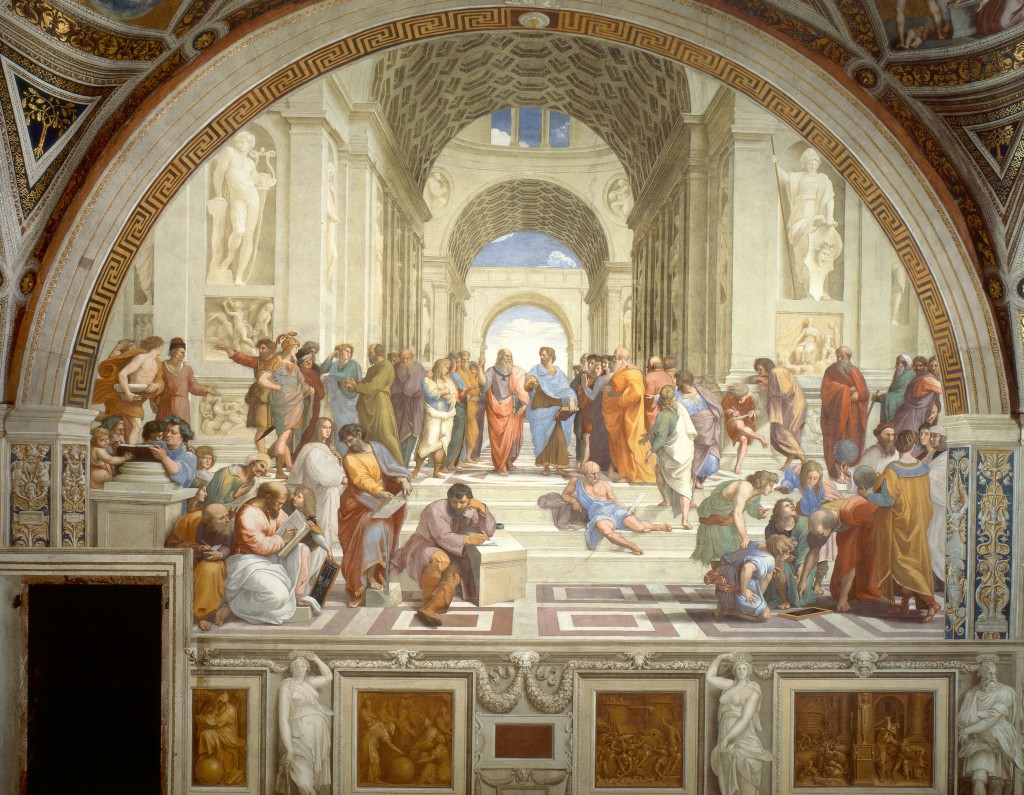
School of Athens, Raphael, 1511 – PD-Art, via Wikimedia Commons
This post was inspired by the convergence of three things that seemed to happen at the same time on social media, which for me is real life as far as the academy is concerned: the open letter from Professors Robert P. George and Cornel West on ‘Truth Seeking, Democracy, and Freedom of Thought and Expression’ regarding the events at Middlebury College (I signed the letter), a spirited debate about the relevance of the academy triggered by an article on The Conversation entitled ‘Academics can change the world – if they stop talking only to their peers,’ and what seems to be a new craze in reading the French historian and philosopher Michel Foucault in light of the rise of the Trump Administration (especially in a ‘Foucault Read-in’ that I heard was widely mocked by those outside the academy for contributing to the irrelevance of intellectual reflection in such an age of emergency). When I blogged as Chinglican, I had written something on the publicness of the academy, and there are posts from Religion Ethnicity Wired of which I am proud too. As I have been praying about ‘intellectual chastity’ over the past week, I have also been having conversations about academia, intellectual life, and what good it all does in the world. In addition to my musings on ‘the blog in the economia of academic writing,’ these are my thoughts so far:
In September 2008, I began the process of doing what most people would say was the worst economic decision of my entire life: apply for a PhD in geography. In that month, Lehman Brothers had filed for bankruptcy, the fraud of subprime mortgages was being exposed, and the 2008 global financial meltdown was firmly under way.
The ensuing moments in my personal and professional life have been seared into my mind. A group of us graduate students were crowded around our academic mentor, the geographer David Ley, at Green College at the University of British Columbia, and he was asking a question to the Berkeley anthropologist Aihwa Ong, who had just given a talk on Asia-Pacific spectacular landscapes and what she called pied-à-terre citizens – everyday joe schmoe on the streets who has to survive in a hyper-marketized society by becoming a marketed subject. I can’t remember the exact substance of Ley’s question, but he asked something to the effect of what happens to everyday people when this kind of hyper-marketized society fails.
As graduate students, we felt that question like a sucker punch. However we might have tried to delude ourselves that we were insulated from the market crash, reality soon hit when we learned that universities across North America were imposing hiring freezes, which meant that recently graduated PhDs would be left in a lurch and those of us just starting in graduate school would have to be competing with people who would have much longer CVs than we would. Much as we were being made into marketable commodities for the academic job market, what would happen if what we had to offer was no longer in demand? If the crash of Wall Street were to take down Main Street, we quickly realized that academia was also part of Main Street – indeed, part of all the streets.
I was a master’s student at the time, so I could have gotten out. But amidst all the quit lit and horror stories about adjuncts living on food stamps, and for reasons that I do not care to share fully right now (except to say that most of what happened was that my New Calvinist fantasy world completely imploded in the summer of 2008 before the global financial crisis), I applied to study under Ley to get a PhD in geography, a discipline that my colleagues in the United States do not understand what possessed me to study because for them, this thriving Commonwealth discipline is virtually illegible. Through the process, I happened to fall in love with the work, and I have since doubled-down on my commitment to this discipline that has as its core the philosophical question what is space?
But because of the specter of the 2008 crash, my time in graduate school ended up being marked by a very hyped-up sense that the academy was in crisis and that we would all be damned. There was a sense of impotence and paralysis, a paranoia about hyper-competition that still scars many of us who inhabit the ivory tower. We were not immune to the failure of global capitalism, and we felt it in our bodies; I heard a lot more during these years about mental illness, health problems, and even material poverty because everything in the academy was so precarious. In fact, everything in the academy is still so precarious even now.
Because of this, there was great hope within our walls when movements like the Arab Spring began to emerge. Because of the nature of academic work – the constant communications, writing furiously, preparing to teach, institutional service – many of us keep Facebook and Twitter as our background noise, and I remember that when the Arab Spring happened, it was like my Facebook news feed exploded, especially with academics seeing the great hope of Tahrir Square as a mirror to what was going on in the academy. The same thing happened with Occupy Wall Street, with prominent intellectuals like Judith Butler and Slavoj Žižek going to Zuccotti Park to be amplified by the human microphone. There was the relevance of the academy finally – in solidarity with the occupiers, shutting down global capitalism because it rendered the life of everyone across society, including and especially in the academy, precarious. My colleagues in religious studies ended up writing a celebratory book called Occupy Religion: Theology of the Multitude because of it.
There is a special part of Academic Facebook that one might call Catholic Academic Facebook, which is animated by a set of mostly Latin Catholics with a few Protestant, Orthodox, and secular sympathizers (I have since discovered that Orthodox Academic Facebook is just as fun). The politics of Catholic Academic Facebook tend to be aligned with what’s called Catholic social teaching – especially the ‘preferential option for the poor’ and the commitment not to misalign the church with the secular state’s militaristic and austerity interests (mostly drawn from William Cavanaugh’s work) – and to a large extent, the blog portal Vox Nova seemed to have a lot to do with getting a bunch of us Catholics and their sympathizers out of a free-market, politically conservative orientation and into that particular form of Catholic social teaching and political theology. I hadn’t been fully connected with Catholic Academic Facebook when the Arab Spring and Occupy Wall Street happened in 2011, but by late 2013, I was showing up on some of the comment threads and witnessing the rise of one Artur Rosman to a position of great notoriety within this network (I actually had a hand in helping him develop what he called ‘Rabelaisian Catholicism‘).
The occupy movement that seemed to capture the attention of Catholic Academic Facebook were the Euromaidan protests in Kyiv, otherwise now called the Revolution of Dignity; Rosman’s notorious piece from the time was entitled ‘God Hates Flags.’ At the time, I had no connection to the Kyivan Church, so I had no idea what was going on, but as the occupy protests began in Taipei’s Sunflower Movement and Hong Kong’s Umbrella Movement in 2014, comparisons were made to Maidan, and it seemed that quite a few of the people who followed my coverage of the Umbrella Movement were interested in it because of its relevance for Catholic social teaching.
For me, this common interest between Academic Facebook and Catholic Academic Facebook was what got it into my head that I should be engaging with both the Catholic Church and the secular academy at the same time. After all, both of these spheres of my life seemed to converge; despite being on social media, they were indeed real life, most powerfully manifested for me when I started living around the corner from Artur Rosman in Seattle soon after we met on Facebook, which meant that we were constantly eating at the nearby Indian buffet for $7.99 all-you-can-eat and drinking German beer at the nearby Bavarian pubs and playing with his kids. Drawn from reflection on the occupy movements, the common interest in both spheres seemed to me at least to be political theology, which appeared pretty close to what I wrote about in my Progress in Human Geography article on ‘grounded theologies.‘ In real life, then, I probably spent as much time inhabiting the halls of the University of Washington while doing my postdoctoral work there as I did at the Catholic Newman Center where I received spiritual direction and great music from the Dominicans who staffed that place; we also prayed the hours regularly at their mother parish, Blessed Sacrament Parish, which was just a few blocks away.
But as I began to develop this sort of new alignment between church and academy via political theology in my own intellectual work, I noticed that there were movements in the academy to double-down on their support for the occupy movements by bringing them literally onto academic turf, especially as they were inspired by Black Lives Matter, which is a movement that I have supported on my blog from the beginning. By 2015, we were hearing about Concerned Student 1950 at Mizzou and the various campus protests that seemed largely inspired by Mizzou to shut down campuses, oust racist faculty, restructure the academy along what sounded to me like postcolonial lines, and hire more faculty of color who would teach more about how the identities of students of color were constituted. Facebook exploded yet again, but this time, it seemed like it was Evangelical Academic Facebook that was really staring this down, who seemed to me to be quite a bit louder in posting than secular faculty of color, who seemed to simply go out to the protests, support their students, and let the students take leadership. Though I ultimately disagreed with this tactic of bringing occupy tactics and the rhetoric of Black Lives Matter to academic institutions, I find myself even now drawn to dialogue with people who share these convictions, especially evangelicals of color on college campuses and most especially the folks who seem to do this kind of stuff while congregating at InterVarsity Christian Fellowship, which publicly endorsed Black Lives Matter in 2015. Indeed, what I probably disagree with the most is the evangelical fervour of these campus protests, which makes sense because I started becoming Eastern Catholic around this time too.
I’ve been trying to reflect on why I am so into the occupy movements but so flabbergasted by the recent campus protests, especially because one of my home disciplines – Asian American studies – was literally founded by the longest running campus protest of 1968: the Third World Liberation Front strike at San Francisco State College. Upon reflection, I think back to a lecture that Cornel West gave with Tavis Smiley at Harvard Law School around 2006:
I think there’s a danger, my dear brother, in ever dividing the world into different spaces where there’s an ivory tower over here and there’s streets here, you see. When you slowly walk out this building here, there’s Oxford Street. That’s a street. There’s some decent folk, some lukewarm folk, and probably some gangsters who are probably gonna be walking down that street. We go to Dorchester, Roxbury, what you got? You got some decent folk, some lukewarm folk, and some gangsters walking down those streets. The world consists of a whole lotta different streets! Some streets are more economically privileged than others – then we say, oh, you got Harvard, Oxford Street is more economically privileged, but don’t ever think that the same issues of white supremacy and male supremacy and class power and privilege are not operating at Harvard Law School that’s operating in the streets of Dorchester. They have very different contexts of operation, but the world is constituted in such a way that it’s just all these streets, so the ivory tower suggests that it’s somehow above the streets. No, no, no: there’s street life at Harvard! And it flips the other way, flips the other way, that there’s enlightenment on the streets of Dorchester. That’s why we need one another! You see what I mean?
The first movement – aligning with the occupy protests – is therefore, I think, right: academics realize that we are not immune to the failures of global capitalism and therefore say that we are all in this together on the streets because we live and work on streets too. But the second movement – the attempt to change the academy as an institution by adopting the tactics of street protests – is the one that I am not so sure about because that feels like the institution absorbing the streets and transforming them into metaphors. I like my streets concrete.
In some senses, then, I believe in what I might call street academia, which, as Karen Ishizuka demonstrates in her book on the Asian American Movement, is how Asian American studies is actually supposed to work. In street academia, the streets of the academy are not disconnected from Main Street, which are not disconnected from the streets of the most racialized, most impoverished communities. One of the founders of Asian American studies at Northwestern University, the African American sociologist Aldon Morris, embodies this ethic to a tee. My colleagues recall fondly that when he launched his book The Scholar Denied on the true impact that W.E.B. DuBois had in the founding of sociology as a discipline, it was not just his academic colleagues that he invited, but his barbershop too.
How does street academia work? I think that the fundamental conviction one has to have is that the streets of academia are no different from any other street, which means that, as Dr West says, ‘You got some decent folk, some lukewarm folk, and some gangsters walking down those streets.’ The way that streets work is not by pulling rank or climbing an institutional ladder or figuring out the political etiquette – all that is well and good, but more basic than that is that you have to make friends and you will have some enemies. Street friendships are not calculated; they come from simple, pure encounters – random conversations that you might have just standing around that develop into something deeper, which seems to be how I’ve made all of my friends in the academy anyway. Alliances are formed, convictions are developed, and that’s when you discover that some people don’t agree with you – and when that happens, arguments happen, fights break out, enemies are made, and forgiveness is rendered.
This, at the end of the day, is why I believe in the streets of academia. When one is in academia, one discovers that where from the outside looking in, life is glorious, expertise is worn on the sleeve, and tweed jackets and bow ties are the dress code, the real friendships on the streets of academia are where the toughest critiques and demands to give an account of one’s thought and life are doled out. Despite the demands that academics translate their work to the public or make their publications accessible, the fact that the streets of the academy are no different from the streets of the city means that this academic street culture – the friendships, the tough love, the drawn-out fights, the development of an intellectual spine – is for everyone, not least because I do not live in the academy – I am on social media, I eat and drink in places where I might be reading a book and someone wants to engage me in conversation, I go to church, I have a family. Our stuff is not relevant to issues and policies – it is relevant to the making of the culture of the streets and how we engage each other and demand an account of one’s life and thought from each other. This is especially important in such a dehumanizing, precarious age because it is this renewal of street culture, I would claim, that beats back the paranoia that plagues our streets, academic or otherwise. This will not solve the problem of precarity; it will create the new intellectual conditions through which we can creatively address the precariousness of our planetary life together. This – and my unpacking of this will have to wait for another day – is what Laudato Si’ is really about.
Philosophy, theory, debate, discourse, praxis – these academic words are the words of the street. No translation is necessary, no condescension is appropriate, no pulling rank is valid because the academy is on the streets already. This, at the end of the day, is why I signed Brothers Robby George and Cornel West’s letter. Conor Friedersdorf at the Atlantic sees in it the awakening of the ‘sleeping giant of classical liberalism.’ I disagree. I see in it the refusal to shut down the revitalization of the intellectual culture of the street.
Previous Post

March 15, 2017
Sloth is not hesychasm
Next Post
March 25, 2017 The Theotokos came to me through the Word #Annunciation
Browse Our Archives
Select a Category Academia Anglican Communion anti-racism Aristotle Asia-Pacific Asian American Asian Canadian BlackLivesMatter Cantonese Catholic China Chinglican church politics Church-State Politics Civil Society Conservative Eastern Christianity Evangelical Evangelical Left Feminist/Womanist Theology Food Greek-Catholic Church of Kyiv Hong Kong Housekeeping Kyivan Church Latin Catholicism Law Liberal Liberation Theology New Calvinism Pentecostal/Charismatic Protestant Psychoanalysis Publics Religion Ethnicity Wired Secular Sovereignty TPCIU Uncategorized
Select a Month July 2019 June 2019 May 2019 April 2019 March 2019 February 2019 January 2019 December 2018 November 2018 October 2018 September 2018 August 2018 July 2018 June 2018 May 2018 March 2018 February 2018 January 2018 December 2017 November 2017 October 2017 September 2017 August 2017 July 2017 June 2017 April 2017 March 2017 February 2017 January 2017 December 2016 November 2016 October 2016 September 2016 August 2016 July 2016 January 2016 December 2015 November 2015 October 2015 August 2015 April 2015 March 2015 February 2015 December 2014 November 2014 September 2014 August 2014 July 2014 June 2014 May 2014 April 2014 March 2014 December 2013 November 2013 October 2013 September 2013 August 2013 July 2013 June 2013 May 2013 April 2013 March 2013 February 2013 January 2013 December 2012 October 2012 June 2012 May 2012 April 2012 February 2012 January 2012
Follow Us!
TAKE THE
Religious Wisdom Quiz
Who said, "Here I am, send me!"?
Select your answer to see how you score.
Isaiah Peter Elijah Moses
Related posts from Eastern Catholic Person

I've found my way home: on the unraveling...
Betrayal is not redemptive: for Great and Holy...

Sundubu jjigae and the All-Night Vigil on Harvard...

'Third World Studies questions the very social formations...
TRENDING AT PATHEOS Catholic

Rejecting Doom: Christian Hope And Human Action
Christianity is a religion of hope. We are to have hope and...

It’s What Comes From Within Which Matters
One of the most difficult things for us to understand is why...

Why I Choose the Eucharist Over the Sermon
Choose the Eucharist, Not the Sermon What are we supposed to get...

5 Design Elements Found in Spiritually Rooted Homes
Putting Spirituality Into Home Decor Our homes are more than our living...

Credo: A Story of God Told with the...
About 10 years ago, I began to imagine a personal "Credo" that...

The Anatomy of Divine Revelation in Catholic Thought
The claim that God has made Himself known to human beings is...
view all Catholic blogs
Ad-Free & Subscriber Log-In Subscription Support
- About Us
- 2026 Calendar
- Videos
- Podcasts
- Library of World Religions
- Faith In Media Tracker
- Advertise With Us
- Write for Us
- Privacy Policy
- Terms of Service
- Do Not Sell My Data
- Contact Us
- Radiant Digital
- Manage Newsletter Subscriptions
- Unsubscribe From Notifications
- Sitemap
Copyright 2008-2026, Patheos. All rights reserved.
Subscription Support Ad-Free & Subscriber Log-In
Follow Patheos