
BuddhistCatholicContemplativeEvangelicalGeneral ChristianHinduJewishLatter-day SaintMuslimNew VisionsProgressive Christian
Beliefs
- Buddhist
- Catholic
- Contemplative
- Evangelical
- General Christian
- Hindu
- Jewish
- Latter-day Saint
- More Voices
- Muslim
- New Visions
- Pagan
- Progressive Christian
Topics
- Religion News
- Food and Religion
- Sports and Religion
- Religious Art
- Religious Music and Entertainment
- Religious Events
- History and Religion
- Style and Religion
- Politics and Religion
- Women in Religion
- Recreation Outdoors and Religion
- Business Finance and Religion
- Careers Workplace and Religion
- Education and Religion
- Family Parenting and Religion
- Health Fitness and Religion
- Home and Religion
- Relationships and Religion
- Technology and Religion
- Travel and Religion
Columnists
- Buddhist Columnists
- Business Finance and Religion Columnists
- Careers Workplace and Religion Columnists
- Catholic Columnists
- Contemplative Columnists
- Education and Religion Columnists
- Evangelists Columnists
- Family Parenting and Religion Columnists
- General Christian Columnists
- Health Fitness and Religion Columnists
- Hindu Columnists
- History and Religion Columnists
- Home and Religion Columnists
- Jewish Columnists
- More Voices Columnists
- Latter Day Columnists
- Muslim Columnists
- New Visions Columnists
- Nonreligious Columnists
- Pagan Columnists
- Politics and Religion Columnists
- Progressive Columnists
- Recreation Outdoors and Religion Columnists
- Relationships and Religion Columnists
- Religion News Columnists
- Religious Art Columnists
- Religious Events Columnists
- Religious Music and Entertainment Columnists
- Sports and Religion Columnists
- Style and Religion Columnists
- Technology and Religion Columnists
- Travel and Religion Columnists
- Women in Religion Columnists
Resource Library
- 2026 Calendar
- Library of World Religions
- The 100 Most Holy Places on Earth
- Patheos Answers
- Podcasts
- Videos
- Faith Leaders Database
- Anglican Episcopalian
- Bahai
- Baptist
- Buddhism
- Christianity
- Confucianism
- Eastern Orthodoxy
- Hinduism
- Holiness and Pentecostal
- ISKCON
- Islam
- Judaism
- Lutheran
- Methodist
- The Church of Jesus Christ of Latter-day Saints
- New Age
- Paganism
- Presbytarian and Reformed
- Protestantism
- Religion Behind the Scenes
- Roman Catholic
- Scientology
- Shia Islam
- Sikhism
- Sufism
- Sunni Islam
- Taoism
- Zen
- See all religions
Research Tools
 Ad-Free & Subscriber Log-In Subscription Support
Ad-Free & Subscriber Log-In Subscription Support
Follow Patheos 

- Trending:
- Forgiveness
- |
- Marriage
- |
- Consciousness
- |
- Death Penalty
- |
- Election
- |
- Halloween
 Eastern Catholic Person
- Home
- Catholic
- Hesychasm is about the body
Hesychasm is about the body
Last updated on: March 12, 2017 at 4:23 pm by Justin Tse
Hesychasm is about the body 2017-03-12T16:23:06-07:00 Justin Tse
Patheos Explore the world's faith through different perspectives on religion and spirituality! Patheos has the views of the prevalent religions and spiritualities of the world.
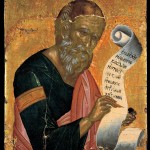
![Icona attuale di san Gregorio Palamas da me posseduta. Ne concedo l'immagine a Wikipedia ma ogni altro utilizzo dev'essere da me permesso. Rivendico perciò la proprietà personale di quest'immagine. - Lamprotes, 25 October 2011 (Gregorio_Palamas_-_(Proprietà_Pietro_Chiaranz).jpg) (CC BY-SA 3.0 [https://creativecommons.org/licenses/by-sa/3.0/deed.en]), via Wikimedia Commons](https://wp-media.patheos.com/blogs/sites/721/2017/03/Gregorio_Palamas_-_Proprieta%CC%80_Pietro_Chiaranz-751x1024.jpg)
Icona attuale di san Gregorio Palamas da me posseduta. Ne concedo l’immagine a Wikipedia ma ogni altro utilizzo dev’essere da me permesso. Rivendico perciò la proprietà personale di quest’immagine. – Lamprotes, 25 October 2011 (Gregorio_Palamas_-_(Proprietà_Pietro_Chiaranz).jpg) (CC BY-SA 3.0 [https://creativecommons.org/licenses/by-sa/3.0/deed.en]), via Wikimedia Commons
In the Byzantine churches, today is the Sunday of Holy Gregory Palamas, Archbishop of Thessaloniki in the fourteenth century. Among many things, Palamas is often seen as the guy who centered for the Byzantine churches the practice of hesychasm, the stilling of the heart as the intellect (Greek nous) enters into the heart through the negative repetition of the Jesus Prayer to meet with G-d there. Popularly speaking, what seems to mark a conventional conception of hesychasm is that it’s a negative tradition – you’re trying to say no to images that might appear in your mind, no to any concepts of God that might get in the way of the heart actually piercing through the haze of the intellect to union with G-d, no even to any good and positive thoughts that might come in to bring comfort and pleasure because this is all a distraction from mystical unity with the divine.
Because Palamas centered hesychasm as one of the primary ways that Byzantine Christians do theology, hesychasm is often thought of as some mystical Eastern practice where all of this negation is oh-so-romantic. We Western Christians, you might say if you’re a Latin or a Protestant (which technically just makes you a Latin discontent), are so obsessed with our affirmative positive concepts of God, and you Easterners are really where it’s at in terms of plunging yourselves into the all-so-mysterious mystery. In such a way, hesychasm often gets mistaken as just another one of those ‘Eastern religions’ that ranks as #2 in terms of ‘stuff white people like’ – ‘religions that their parents don’t belong to’ – most notably in J.D. Salinger’s Franny and Zooey where Zooey Glass literally goes crazy after spending her life submerged in a mentally toxic cocktail of Buddhist traditions read as hesychasm (I won’t spoil more of it for you, as everyone who is interested in hesychasm should probably read that book). Thankfully, there have been brilliant scholarly rebuttals to this kind of hesychastic orientalism, not least from Robert Taft SJ in his classic piece on ‘Eastern presuppositions’ and Western liturgical renewal (where Taft straight-up cites Edward Said, a point not lost on Peter Leithart) as well as Greek Orthodox theologian John Panteleimon Manoussakis showing that Palamas’s understanding of theophany is perfectly compatible with Augustine’s, especially via the one Latin theologian whose influence I still can’t shake to this day, Hans Urs von Balthasar (and after reading Manoussakis, Balthasar ain’t going anywhere from me now).
I confess that I myself, a teacher in the field of Asian American religions, fall into this trap all the time in practice. It’s because it’s so easy when conceiving of hesychasm as a negative tradition to get a little bit crazy with the negations and start deluding myself into thinking that my life just revolves around my mind, my intellect, my heart. It’s especially tempting since I work in academia to do this; my career, after all, depends on my curriculum vitae, which is a list of writings, speeches, and other intellectual activities that I have produced in many arenas, which technically all come out of my mind, my intellect, my nous.
When I fall into this trap, I find myself going for the Holy Mystery of Repentance, otherwise known as ‘confession.’ Some confessors are really nice about what I tell them and want me to focus on my spiritual life, what’s going on in my mind and in my heart. But the confessors who know me well are not one bit fooled by my pretensions. Every time after I confess my sins, which are many and frequent, they have taken to asking me not about the state of my intellect or of my heart, but the state of my body. Am I eating? Am I sleeping? Am I exercising? Am I taking care of my physical state? And most especially: am I getting enough rest? It may sound controversial to the easily offended that I am hinting at what has been said in the confessional, though I am not breaking any seal on my end, but I might point out that the Protestant theologian Stanley Hauerwas has noted that if you want to understand the origins of the fields of moral theology and Christian ethics, the best place to look is what is said in the penitential guides for confessors, the earlier in the history of the church, the better. It seems like the good confessors and spiritual directors these days are being trained to make their directees and penitent think about the body, and I have nothing but good things to say about this because it keeps me grounded on the receiving end of their counsel.
In this sense, I am the walking stereotype of the academic who is always tired, which is why it seems to me that some academics who are more senior than me are giving me some sound advice about the embodied work that goes on in what we do. Once asked about how to be a great scholar, Taft (the liturgist I quoted above on liturgical orientalism) said that the most important thing is to go to bed every night at the same time and to get up at the same time every morning. In another instance, here at Northwestern there is a senior scholar that I regularly consult about my career, but our conversations never start out with intellectual discussion: they have to do with cooking, family life, kids, marriage, friendships, and more food, before eventually weaving into the conversation my teaching and my research, as well as hers. In fact, as far as the academics whom I respect go, I have probably had more conversations with them about food and family than about the romanticism of the life of the mind. Intellectual work is embodied; academia is not really the life of the mind, but the work of the body. This is why, by the way, I adore that video of the children walking in on the political scientist being interviewed by the BBC about the recent political upheavals in Korea; it reminds me of how present our embodied lives are to the intellectual work that we do in the academy, which is the main feature of what academics actually say to each other when we really start talking.
Perhaps, then, what people like me need to do is to go beyond our imagination of what hesychasm is and what Palamas might have said about it to what Palamas actually says about it. For one, early on in his masterpiece The Triads, he denies that hesychasm is only about negativity: ‘Let no one think that these great men are referring to here to the ascent through the negative way,’ he writes of the hesychastic masters Dionysius the Areopagite and Holy Maximus the Confessor who have gone before in the tradition. ‘For the latter lies within the powers of whoever desires it; and it does not transform the soul so as to bestow on it the angelic dignity.’ In other words, anybody can be negative, even without the energies of G-d, so that is not the point of a hesychastic stilling of the heart. What is the point, he says, is the ‘purity of the passionate part of the soul’ so that the nous is united ‘through prayer to the grace of the Spirit; and through this grace the mind comes to enjoy the divine effulgence, and acquires an angelic and godlike form’ (Triads I.iii.20).
This kind of hesychasm, Palamas goes on to explain, makes no sense without the body. The body, Palamas reminds us, is what the Holy Apostle Paul called the ‘temple of the Holy Spirit’ – it is the temple in which the nous goes into the heart to meet G-d. With a magnificent image, Palamas even says that if the Holy Apostle Paul says that the body is ‘sold to sin,’ then ‘he who is sold is not a slave by nature.’ The point is not to forsake the body through hesychasm; it is to free it (Triads I.ii.1).
This means that the body is of paramount importance to the hesychast: ‘This is exactly the tradition, and our spiritual Fathers have also handed it down to us, and rightly so’ – and the spiritual father Palamas is referring to is Holy John of the Ladder, whom we will commemorate two weeks from now – ‘For if the hesychast does not circumscribe the mind in his body, how can he make to enter himself the One who has clothed himself in the body, and Who thus penetrates all organised matter, insofar as He is its natural form? For the external aspect and divisibility of matter is not compatible with the essence of the mind, unless matter itself truly begins to live, having acquired a form of life conformable to the union with Christ’ (Triads I.ii.6).
In other words, my regular confessors and my academic mentors are completely correct to always divert me from a pure intellectual life through conversations about everyday life in the body, the temple of the Holy Spirit that is the only site in which hesychastic practice can take place. Am I eating? Am I sleeping? Am I exercising? Am I resting? One Latin priest even asked me during the Great Fast: Are you getting enough protein? reminding me that even if my church has told me to give up meat, I have to make it up with beans and tofu in order to function properly as a human being. Of course, I could write off this priest as a Latin, but if I were to be honest, any Byzantine priest worth their salt would probably say the same thing. Ascesis, the discipline of the body through fasting, is all fine and good, but it cannot be a denial of the body either.
I may have written about ‘intellectual chastity,’ but the emphasis there on the chastity of the nous is only possible through what the Latins define as the point of real chastity, the ‘inner unity of man in his bodily and spiritual being’ that ‘involves ‘the integrity of the person and the integrality of the gift’ (Catechism of the Catholic Church, Part 3, Art. 6, II.2337). The intellectual life that flows out of a hesychastic practice is therefore at the end of the day centered around what Michel de Certeau SJ reminded us is the ‘practice of everyday life’ – living and cooking and sleeping. This is why it is often said that the hesychastic state is most clearly manifested when one is praying without ceasing while attending to many other physical tasks at the same time; the whole point of negation, hesychasm, and the possession of the Holy Spirit is that my body can be free to move about in the world as a temple of the Holy Spirit.
And thus we in the temples of the Holy Spirit called our bodies sing penitentially in the words of the kondak hymn for the Second Sunday of the Great Fast, in the fourth tone – the one that does not directly reference Palamas, but is in keeping with spirit of bodily emphasis: The time for action is now revealed; the Judge is at the door. Let us rise then and keep the fast, offering tears of contrition with alms and crying aloud: Our sins are more numerous than the sands of the sea, but forgive us, O Maker of all, that we may receive incorruptible crowns.
Previous Post
March 11, 2017
The Blog in the Economia of Academic Writing
Next Post
March 12, 2017 I am a terrible hesychast
Browse Our Archives
Select a Category Academia Anglican Communion anti-racism Aristotle Asia-Pacific Asian American Asian Canadian BlackLivesMatter Cantonese Catholic China Chinglican church politics Church-State Politics Civil Society Conservative Eastern Christianity Evangelical Evangelical Left Feminist/Womanist Theology Food Greek-Catholic Church of Kyiv Hong Kong Housekeeping Kyivan Church Latin Catholicism Law Liberal Liberation Theology New Calvinism Pentecostal/Charismatic Protestant Psychoanalysis Publics Religion Ethnicity Wired Secular Sovereignty TPCIU Uncategorized
Select a Month July 2019 June 2019 May 2019 April 2019 March 2019 February 2019 January 2019 December 2018 November 2018 October 2018 September 2018 August 2018 July 2018 June 2018 May 2018 March 2018 February 2018 January 2018 December 2017 November 2017 October 2017 September 2017 August 2017 July 2017 June 2017 April 2017 March 2017 February 2017 January 2017 December 2016 November 2016 October 2016 September 2016 August 2016 July 2016 January 2016 December 2015 November 2015 October 2015 August 2015 April 2015 March 2015 February 2015 December 2014 November 2014 September 2014 August 2014 July 2014 June 2014 May 2014 April 2014 March 2014 December 2013 November 2013 October 2013 September 2013 August 2013 July 2013 June 2013 May 2013 April 2013 March 2013 February 2013 January 2013 December 2012 October 2012 June 2012 May 2012 April 2012 February 2012 January 2012
Follow Us!
TAKE THE
Religious Wisdom Quiz
What does God question Job about, showing His wisdom in creation?
Select your answer to see how you score.
Battles Kingdoms Animals and nature Religious rituals
Related posts from Eastern Catholic Person

I've found my way home: on the unraveling...

Patriyarkhat: 'Attending to the movements of my heart'

I'm flattered to be named an Asian American...

The secular does not stop when your drive...
TRENDING AT PATHEOS Catholic

Rejecting Doom: Christian Hope And Human Action
Christianity is a religion of hope. We are to have hope and...

It’s What Comes From Within Which Matters
One of the most difficult things for us to understand is why...

Why I Choose the Eucharist Over the Sermon
Choose the Eucharist, Not the Sermon What are we supposed to get...

5 Design Elements Found in Spiritually Rooted Homes
Putting Spirituality Into Home Decor Our homes are more than our living...

Credo: A Story of God Told with the...
About 10 years ago, I began to imagine a personal "Credo" that...

The Anatomy of Divine Revelation in Catholic Thought
The claim that God has made Himself known to human beings is...
view all Catholic blogs
Ad-Free & Subscriber Log-In Subscription Support
- About Us
- 2026 Calendar
- Videos
- Podcasts
- Library of World Religions
- Faith In Media Tracker
- Advertise With Us
- Write for Us
- Privacy Policy
- Terms of Service
- Do Not Sell My Data
- Contact Us
- Radiant Digital
- Manage Newsletter Subscriptions
- Unsubscribe From Notifications
- Sitemap
Copyright 2008-2026, Patheos. All rights reserved.
Subscription Support Ad-Free & Subscriber Log-In
Follow Patheos