
BuddhistCatholicContemplativeEvangelicalGeneral ChristianHinduJewishLatter-day SaintMuslimNew VisionsProgressive Christian
Beliefs
- Buddhist
- Catholic
- Contemplative
- Evangelical
- General Christian
- Hindu
- Jewish
- Latter-day Saint
- More Voices
- Muslim
- New Visions
- Pagan
- Progressive Christian
Topics
- Religion News
- Food and Religion
- Sports and Religion
- Religious Art
- Religious Music and Entertainment
- Religious Events
- History and Religion
- Style and Religion
- Politics and Religion
- Women in Religion
- Recreation Outdoors and Religion
- Business Finance and Religion
- Careers Workplace and Religion
- Education and Religion
- Family Parenting and Religion
- Health Fitness and Religion
- Home and Religion
- Relationships and Religion
- Technology and Religion
- Travel and Religion
Columnists
- Buddhist Columnists
- Business Finance and Religion Columnists
- Careers Workplace and Religion Columnists
- Catholic Columnists
- Contemplative Columnists
- Education and Religion Columnists
- Evangelists Columnists
- Family Parenting and Religion Columnists
- General Christian Columnists
- Health Fitness and Religion Columnists
- Hindu Columnists
- History and Religion Columnists
- Home and Religion Columnists
- Jewish Columnists
- More Voices Columnists
- Latter Day Columnists
- Muslim Columnists
- New Visions Columnists
- Nonreligious Columnists
- Pagan Columnists
- Politics and Religion Columnists
- Progressive Columnists
- Recreation Outdoors and Religion Columnists
- Relationships and Religion Columnists
- Religion News Columnists
- Religious Art Columnists
- Religious Events Columnists
- Religious Music and Entertainment Columnists
- Sports and Religion Columnists
- Style and Religion Columnists
- Technology and Religion Columnists
- Travel and Religion Columnists
- Women in Religion Columnists
Resource Library
- 2026 Calendar
- Library of World Religions
- The 100 Most Holy Places on Earth
- Patheos Answers
- Podcasts
- Videos
- Faith Leaders Database
- Anglican Episcopalian
- Bahai
- Baptist
- Buddhism
- Christianity
- Confucianism
- Eastern Orthodoxy
- Hinduism
- Holiness and Pentecostal
- ISKCON
- Islam
- Judaism
- Lutheran
- Methodist
- The Church of Jesus Christ of Latter-day Saints
- New Age
- Paganism
- Presbytarian and Reformed
- Protestantism
- Religion Behind the Scenes
- Roman Catholic
- Scientology
- Shia Islam
- Sikhism
- Sufism
- Sunni Islam
- Taoism
- Zen
- See all religions
Research Tools
 Ad-Free & Subscriber Log-In Subscription Support
Ad-Free & Subscriber Log-In Subscription Support
Follow Patheos 

- Trending:
- Forgiveness
- |
- Marriage
- |
- Consciousness
- |
- Death Penalty
- |
- Election
- |
- Halloween
 Eastern Catholic Person
- Home
- Catholic
- Repenting of triumphalism on the Sunday of Orthodoxy
Repenting of triumphalism on the Sunday of Orthodoxy
Last updated on: March 5, 2017 at 11:52 am by Justin Tse
Repenting of triumphalism on the Sunday of Orthodoxy 2017-03-05T11:52:48-07:00 Justin Tse
Patheos Explore the world's faith through different perspectives on religion and spirituality! Patheos has the views of the prevalent religions and spiritualities of the world.
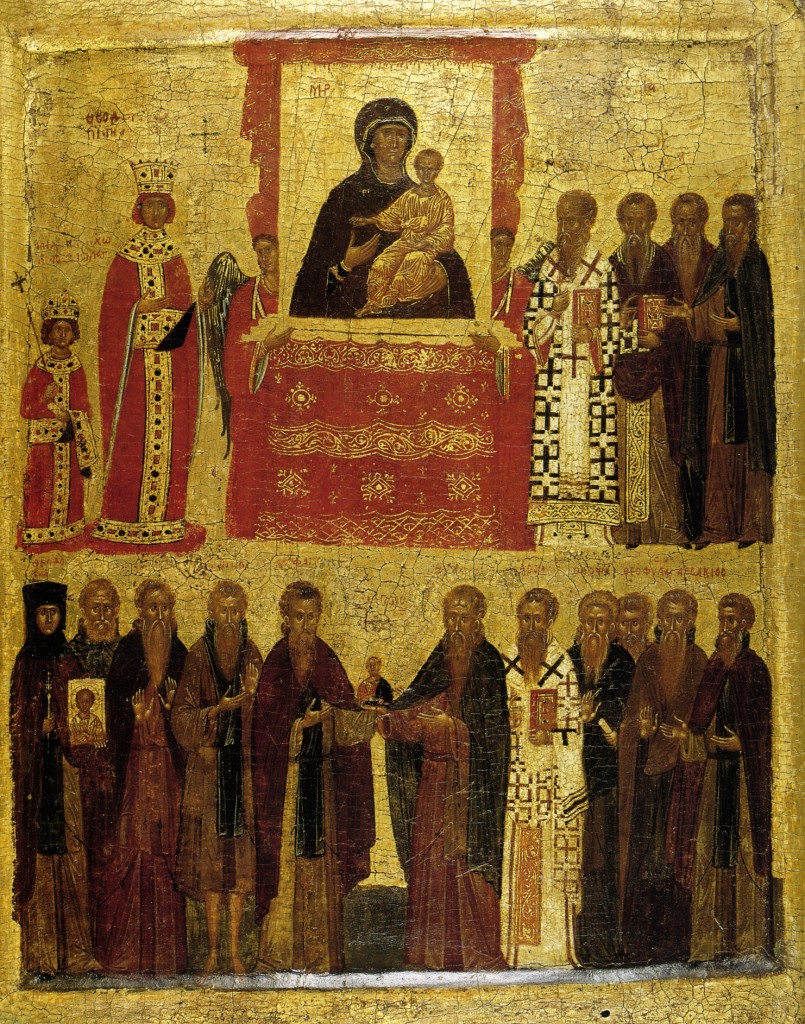
Late 14th-early 15th century icon illustrating the “Triumph of Orthodoxy” under the Byzantine empress Theodora over iconoclasm. Patriarch Methodios I of Constantinople is on the top right, close to the Virgin – PD-Art, via Wikimedia Commons
When I was doing my catechumenate, one of the things that my spiritual father got me really excited about was the Sunday of Orthodoxy. Bring all your icons, he said to all of us at the temple, assuming that we all had icons to bring; there are a bunch of Protestant seekers and Latin inquirers there, so this was a bit of a funny assumption to make, but I have always appreciated how Byzantine norms are his normal. We will bless all of them, he said, and then he posted a video of a Melkite church where the deacon led the people in the ‘anathemas’ song, reading out a bunch of ancient heresies and condemning all of them with a threefold, Anathema, anathema, anathemaaaaaaaaaaaa. To be clear, we have never done this song at the temple, but maybe it would be fun to do so someday.
For some reason, the heresy that still ticks me off the most is one that is going through the Protestant ecclesial communities right now: the ‘eternal subordination’ of the Son. For those who need a quick primer, it seems like some Protestants think that there is an analogy between ‘traditional’ gender roles of female subordination to relations within the Trinity, leading for some evangelical Protestant theologians to the bizarre claim that the Son has been ‘eternally subordinate’ to the Father. I realize, of course, that fans of Hans Urs von Balthasar should not throw too many rocks – Balthasar does, after all, talk about the Son’s eternal obedience and radical openness to the Father as the axis of history – but the debate within Protestant communities, especially in what are called New Calvinist circles, have highlighted for me the ongoing need to be clear about an orthodox stance on the ousia and hypostasis of the Son.
But as I reflect on why I am so ticked off by such a bizarrely modern Arian heresy, I think about the posts I have written over this last week about being an Eastern Catholic attentive to the mess that is my own ecclesial house even as I write about Protestants, who are part of different ecclesial houses. Although I really despise how the heresy that ticks me off the most right now provides Protestant theological justification for some forms of misogyny in our society more broadly, the fact remains that it is a debate that is affecting the Protestant ecclesial houses. I can honestly say, in other words, that the sphere that is affected by the problems with the eternal subordination of the Son in relation to the question of gender are not my church, not my bishops, and therefore not my problem.
As I consider this, I think about what the Sunday of Orthodoxy is really for. As Sister Vassa reminds us in a brilliant video about the Triumph of Orthodoxy, the triumph that we celebrate is the triumph in 843 of the veneration of icons; it has nothing to do with what she terms the triumphalism of Orthodoxy, the idea that we in the Byzantine churches are better than everyone else. In this vein, I recently read a very enlightening piece by the Greek Orthodox theologian John Panteleimon Manoussakis on what exactly was the triumph in the veneration of icons: it is that the image of the image of G-d pervades the natural order such that the materiality of the icons communicates the grace of G-d to us. In this sense, there is a clarifying movement (Manoussakis argues) from the economy of salvation to an iconomy of veneration. In fact, it is for this reason that an icon of the Theotokos of Iveron, the Keeper of the Door, hangs at my front door; the legend is that this icon escaped the wrath of the iconoclasts and swam across the sea to Mount Athos, where the monks quickly learned that it was not they who would have to protect the icon, but that the Theotokos would keep their gate. What this story tells me is that Orthodoxy is not me protecting the church against heresy; it is the Church as a mother who guards me from defacing the icons.
Whatever the heresies that irk me, then, and that deserve the anathemas we sing on this Sunday of Orthodoxy, these reflections lead me to reflect on whether my participation in my own church and in the Great Fast is actually making me shine myself as an icon reflecting the light of Christ. It is only in this iconomy, after all, that the anathemas pronounced against the heresies make any sense, for the heresies are the ideas that will cloud and confuse the light of Christ from enlightening the material order, the body that I have that is the temple of the Holy Spirit. The Sunday of Orthodoxy is thus a day for me to ask for mercy, to anathematize the heresies in my own life, especially the temptations within Byzantine Christianity toward ethno-nationalism (what is termed ‘ethnophyletism,’ or as my spiritual father likes to put it, ‘ecclesial racism’) where the politics of identity turn my body and my mind from the icon that I was created to be into an idol. As much as I despise the heterodoxy of the eternal subordination of the Son for its convergences with Arianism to justify defacing the female icon that fully reflects the light of Christ shining on her – I might point out here that the Triumph of Orthodoxy icon centers the image of the Most Holy Theotokos – what I really have to worry about is the constant problem in my own participation in the life of my church toward the triumphalistic idolatry of identity politics. Let my anathemas be against my own idolatry, and as I continue to pray the prayer of Holy Ephrem the Syrian, let me see my own sins and not judge my sisters and brothers, for You are blessed, both now and ever and for ages of ages, amen.
Previous Post
March 4, 2017
Listening to the 'model minority' because I know too much about it
Next Post

March 8, 2017 Why I Blog (Part 1)
Browse Our Archives
Select a Category Academia Anglican Communion anti-racism Aristotle Asia-Pacific Asian American Asian Canadian BlackLivesMatter Cantonese Catholic China Chinglican church politics Church-State Politics Civil Society Conservative Eastern Christianity Evangelical Evangelical Left Feminist/Womanist Theology Food Greek-Catholic Church of Kyiv Hong Kong Housekeeping Kyivan Church Latin Catholicism Law Liberal Liberation Theology New Calvinism Pentecostal/Charismatic Protestant Psychoanalysis Publics Religion Ethnicity Wired Secular Sovereignty TPCIU Uncategorized
Select a Month July 2019 June 2019 May 2019 April 2019 March 2019 February 2019 January 2019 December 2018 November 2018 October 2018 September 2018 August 2018 July 2018 June 2018 May 2018 March 2018 February 2018 January 2018 December 2017 November 2017 October 2017 September 2017 August 2017 July 2017 June 2017 April 2017 March 2017 February 2017 January 2017 December 2016 November 2016 October 2016 September 2016 August 2016 July 2016 January 2016 December 2015 November 2015 October 2015 August 2015 April 2015 March 2015 February 2015 December 2014 November 2014 September 2014 August 2014 July 2014 June 2014 May 2014 April 2014 March 2014 December 2013 November 2013 October 2013 September 2013 August 2013 July 2013 June 2013 May 2013 April 2013 March 2013 February 2013 January 2013 December 2012 October 2012 June 2012 May 2012 April 2012 February 2012 January 2012
Follow Us!
TAKE THE
Religious Wisdom Quiz
What is the Bible's advice on friendships?
Select your answer to see how you score.
Never have friends Choose many friends Trust anyone Bad company corrupts good character
Related posts from Eastern Catholic Person

I've found my way home: on the unraveling...

Patriyarkhat: 'Attending to the movements of my heart'

I'm flattered to be named an Asian American...

The secular does not stop when your drive...
TRENDING AT PATHEOS Catholic

Rejecting Doom: Christian Hope And Human Action
Christianity is a religion of hope. We are to have hope and...

It’s What Comes From Within Which Matters
One of the most difficult things for us to understand is why...

Why I Choose the Eucharist Over the Sermon
Choose the Eucharist, Not the Sermon What are we supposed to get...

5 Design Elements Found in Spiritually Rooted Homes
Putting Spirituality Into Home Decor Our homes are more than our living...

Credo: A Story of God Told with the...
About 10 years ago, I began to imagine a personal "Credo" that...

The Anatomy of Divine Revelation in Catholic Thought
The claim that God has made Himself known to human beings is...
view all Catholic blogs
Ad-Free & Subscriber Log-In Subscription Support
- About Us
- 2026 Calendar
- Videos
- Podcasts
- Library of World Religions
- Faith In Media Tracker
- Advertise With Us
- Write for Us
- Privacy Policy
- Terms of Service
- Do Not Sell My Data
- Contact Us
- Radiant Digital
- Manage Newsletter Subscriptions
- Unsubscribe From Notifications
- Sitemap
Copyright 2008-2026, Patheos. All rights reserved.
Subscription Support Ad-Free & Subscriber Log-In
Follow Patheos