
BuddhistCatholicContemplativeEvangelicalGeneral ChristianHinduJewishLatter-day SaintMuslimNew VisionsProgressive Christian
Beliefs
- Buddhist
- Catholic
- Contemplative
- Evangelical
- General Christian
- Hindu
- Jewish
- Latter-day Saint
- More Voices
- Muslim
- New Visions
- Pagan
- Progressive Christian
Topics
- Religion News
- Food and Religion
- Sports and Religion
- Religious Art
- Religious Music and Entertainment
- Religious Events
- History and Religion
- Style and Religion
- Politics and Religion
- Women in Religion
- Recreation Outdoors and Religion
- Business Finance and Religion
- Careers Workplace and Religion
- Education and Religion
- Family Parenting and Religion
- Health Fitness and Religion
- Home and Religion
- Relationships and Religion
- Technology and Religion
- Travel and Religion
Columnists
- Buddhist Columnists
- Business Finance and Religion Columnists
- Careers Workplace and Religion Columnists
- Catholic Columnists
- Contemplative Columnists
- Education and Religion Columnists
- Evangelists Columnists
- Family Parenting and Religion Columnists
- General Christian Columnists
- Health Fitness and Religion Columnists
- Hindu Columnists
- History and Religion Columnists
- Home and Religion Columnists
- Jewish Columnists
- More Voices Columnists
- Latter Day Columnists
- Muslim Columnists
- New Visions Columnists
- Nonreligious Columnists
- Pagan Columnists
- Politics and Religion Columnists
- Progressive Columnists
- Recreation Outdoors and Religion Columnists
- Relationships and Religion Columnists
- Religion News Columnists
- Religious Art Columnists
- Religious Events Columnists
- Religious Music and Entertainment Columnists
- Sports and Religion Columnists
- Style and Religion Columnists
- Technology and Religion Columnists
- Travel and Religion Columnists
- Women in Religion Columnists
Resource Library
- 2026 Calendar
- Library of World Religions
- The 100 Most Holy Places on Earth
- Patheos Answers
- Podcasts
- Videos
- Faith Leaders Database
- Anglican Episcopalian
- Bahai
- Baptist
- Buddhism
- Christianity
- Confucianism
- Eastern Orthodoxy
- Hinduism
- Holiness and Pentecostal
- ISKCON
- Islam
- Judaism
- Lutheran
- Methodist
- The Church of Jesus Christ of Latter-day Saints
- New Age
- Paganism
- Presbytarian and Reformed
- Protestantism
- Religion Behind the Scenes
- Roman Catholic
- Scientology
- Shia Islam
- Sikhism
- Sufism
- Sunni Islam
- Taoism
- Zen
- See all religions
Research Tools
 Ad-Free & Subscriber Log-In Subscription Support
Ad-Free & Subscriber Log-In Subscription Support
Follow Patheos 

- Trending:
- Forgiveness
- |
- Marriage
- |
- Consciousness
- |
- Death Penalty
- |
- Election
- |
- Halloween
 Eastern Catholic Person
- Home
- Catholic
- Lord, even as I write about Protestants, drive from me the spirit of sloth, despair, lust for power, and idle chatter
Lord, even as I write about Protestants, drive from me the spirit of sloth, despair, lust for power, and idle chatter
Last updated on: March 3, 2017 at 11:18 pm by Justin Tse
Lord, even as I write about Protestants, drive from me the spirit of sloth, despair, lust for power, and idle chatter 2017-03-03T23:18:28-07:00 Justin Tse
Patheos Explore the world's faith through different perspectives on religion and spirituality! Patheos has the views of the prevalent religions and spiritualities of the world.
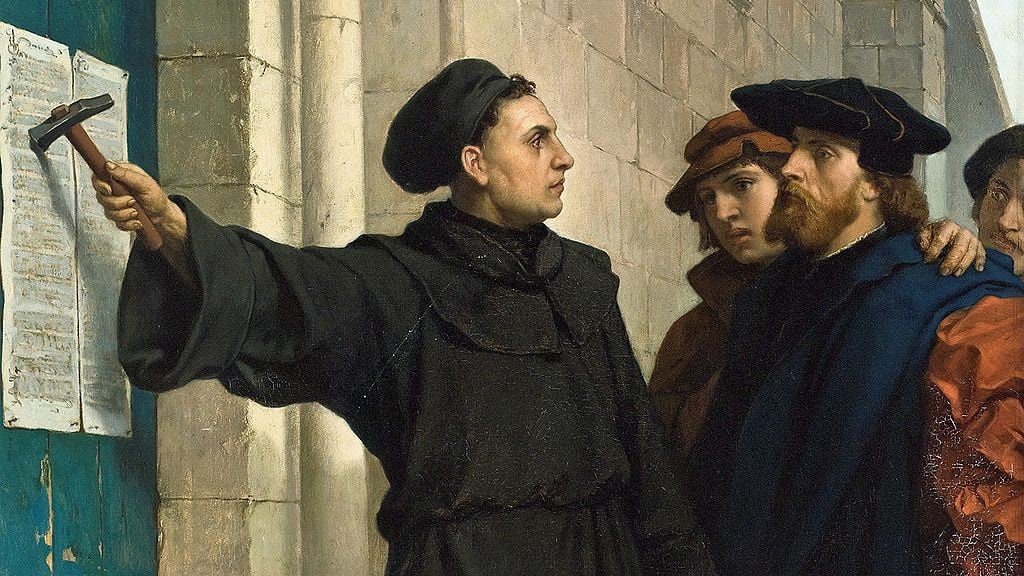
Luther posting his 95 theses in 1517 (1872) – PD-Art, via Wikimedia Commons
The origins of the Great Fast, I am told, lie in the catechumenate. In anticipation of baptism at Pascha, catechumens were instructed to fast in preparation, and as I was told during my catechumenate, the entire church began to fast in solidarity with the catechumens, using the time as a penitential season to prepare together for the celebration of the Lord’s resurrection. When we fast from vertebrates and anything that comes from a vertebrate (including the olive oil and wine that used to be held in animal skins), we remember our own catechumenates, our own journey to baptism into the fullness of the Catholic Church.
For me to remember my catechumenate – in my case, a journey toward chrismation, as my evangelical baptism with water and the Trinitarian formula is considered valid in the Church – is also to remember from where I came: Protestantism. My Protestant journey is very complicated: one could say that I was from Chinese evangelicalism, but this is only partially true, with all the various intersections of Latino Pentecostalism and the black church through it; for the last eight years of my Protestant life, I had been received by confirmation into the Anglican Communion and therefore into all of its various and glorious fractures as well.
This last week, I have been plunged into the memory of from where I came in a very visceral way. Indignant at how both the Latin hierarch in Vancouver with whom I am in full communion and my evangelical friends were victims of what I called the ‘double blackmail’ of the Franklin Graham visitation to Vancouver, I wrote one very long piece against the ineffective ‘ecumenical’ opposition to Graham, one short reflective piece reflecting on the ‘hollow completeness’ I felt while writing it, and another long piece on the ‘double blackmail’ itself. Although I have tried to be very careful to locate myself within the Kyivan Church where my hierarch in Vancouver did not sign any of the letters, I have found that at best Protestants reading these pieces think I’m quirky and at worse think I have an axe to grind.
Being plunged back into the discursive world of contemporary Protestantism has reminded me of the paranoia of much of this world that I used to inhabit. For some reason, anything that one writes publicly in such a world must have an ‘end game’ or an ‘end goal,’ an agenda that one wants to accomplish and that one’s readers seek to discern in order to pin one down and expose one’s impurity. While many of my friends expressed their gratefulness for my analysis, others were not so happy, seeking instead to perform a kind of perverse therapy in order to make me confess my agenda almost as a damnable sin.
This kind of objective-based thinking strikes me as very odd, and I do not know whether it is because I am Eastern Catholic and therefore really couldn’t care less about helping Protestants get their house in order or because I am an academic and really can’t be bothered to give practical solutions to anything. After all, I wrote out of love for my fellow Catholics because the Latin hierarch has been implicated, and while I am happy that so many Protestants seem to be reading, I really have no idea how I can be helpful to Protestants because I am most certainly not one and not interested in being one again, except to say that perhaps we might work together as persons in Christ walking together to maybe one day renew communion between our churches. I am sure that not all Protestants think this way and ask these kinds of questions about end goals, end games, and agendas because of the graciousness of some of my friends, but it is a reality that I am being asked these questions that are foreign to my consciousness right now, and the honest truth is that it all feels very weird.
At the same time, I find myself here at a conference with InterVarsity Christian Fellowship at the University of Illinois, Urbana-Champaign. I have been cultivating friendships with some of the staff and students as part of my work as a faculty member in the Asian American Studies Program at Northwestern University, and this has resulted in me getting invited to offer a ‘seminar’ here on the model minority, something that I study and for which I do not even have to prepare. In fact, speaking of speaking about the model minority with evangelicals, I in fact gave the Carl G. Westerdahl Lectures on Evangelism at North Park Theological Seminary on Tuesday on this exact topic, so I am very prepared for what I have to say tomorrow to the students.
And yet for this, I suppose I am again interloping in Protestant circles, now in my capacity as a secular academic who happens to be Eastern Catholic. In contemporary Protestant terms, what is my end goal, my end game, my agenda?
Because I have found myself thinking about this, I am realizing increasingly that I have been – in the words of the critical theorist Louis Althusser – interpellated. Althusser insightfully says that the way that one falls into an ideology is as if an institution shouts, ‘Hey you!’ to one on the street, and one turns around, recognizing oneself in the ‘you.’ I am Eastern Catholic, but this constant badgering about my end goal, end game, and agenda may be interpellating me.
And thus I have to pray as an Eastern Catholic again this Great Fast. The Prayer of Holy Ephrem the Syrian, prayed at Wednesday and Friday’s Liturgy of the Presanctified Gifts and in daily prayers, is thus the prayer of my heart now:
O Lord and Master of my life, drive from me the spirit of indifference, despair, lust for power, and idle chatter.
Instead, bestow on me your servant the spirit of integrity, humility, patience, and love.
Yes, O Lord and King, grant me to see my own sins and not to judge my sisters and brothers, for you are blessed, both now and ever and for ages of ages, amen.
As I prostrate between the verses, make twelve reverences as I say, ‘God, cleanse me, a sinner,’ and read through the whole thing again so as to end with a prostration, I remember the start of my catechumenate, the point at which I left behind the institutions of Protestantism that had asked me such questions that seemed to challenge my lust for power while stroking it all along all of my life. Again, these are only some Protestant institutions – again, the graciousness of some of my evangelical friends about my posts reveals that the Spirit indeed moves across the churches and ecclesial communities like the wind, and I hear its sound and feel where it blows, but I do not know where it comes from – but the reality is that I can feel the interpellation happening.
I do not know what the Lord is teaching me in this moment. My academic work still is about Protestants, and I have no doubt that having opened this door on my blog, I will continue to write about Protestants, especially when Catholics and Orthodox are implicated in their actions. Because of this, stopping my writing about Protestants and Protestantism is not an option. Indeed, pretending that Protestants don’t exist and not writing about them is not only a fool’s errand; it is a denial of Byzantine history – the dialogues of Patriarch Jeremias II with the Lutherans, the false accusations that the Eastern Catholic unions with Rome were owed to Protestant ideologies, the Calvinist provocation of Cyril Lukaris’s Confession necessitating the replies of Petro Mohyla and Dositheus of Jerusalem. The trick is not to stop writing about Protestants; the real question is – what does it mean to write about someone else’s ecclesial house, and what are the ecumenical implications of doing so?
But I must be clear: the Protestant ecclesial communities are not my ecclesial house, I have no business getting their house in order, not least because my own house has much to be ordered. When I feel interpellated about questions about end games, end goals, and agendas, then, let me not turn around and answer the question, Hey you! Let me instead fall prostrate before the Lord for mercy, asking him to drive even further for me the spirit of indifference, despair, lust for power, and idle chatter. Let me beg the Lord for the spirit of integrity, humility, patience, and love, asking him for the grace to love my Protestant sisters and brothers simply as persons created in the image of G-d and not as agents of institutional ideologies. Let me ask the Lord that I may see my own sins and not those of my sisters and brothers, to work for the order of my own ecclesial house with the hope against hope for the restoration of the ecumene someday.
G-d, cleanse me, a sinner!
G-d, cleanse me, a sinner!
G-d, cleanse me, a sinner!
G-d, cleanse me, a sinner!
G-d, cleanse me, a sinner!
G-d, cleanse me, a sinner!
G-d, cleanse me, a sinner!
G-d, cleanse me, a sinner!
G-d, cleanse me, a sinner!
G-d, cleanse me, a sinner!
G-d, cleanse me, a sinner!
G-d, cleanse me, a sinner!
Previous Post

March 2, 2017
Against the Franklin Graham blackmail
Next Post
March 4, 2017 Listening to the 'model minority' because I know too much about it
Browse Our Archives
Select a Category Academia Anglican Communion anti-racism Aristotle Asia-Pacific Asian American Asian Canadian BlackLivesMatter Cantonese Catholic China Chinglican church politics Church-State Politics Civil Society Conservative Eastern Christianity Evangelical Evangelical Left Feminist/Womanist Theology Food Greek-Catholic Church of Kyiv Hong Kong Housekeeping Kyivan Church Latin Catholicism Law Liberal Liberation Theology New Calvinism Pentecostal/Charismatic Protestant Psychoanalysis Publics Religion Ethnicity Wired Secular Sovereignty TPCIU Uncategorized
Select a Month July 2019 June 2019 May 2019 April 2019 March 2019 February 2019 January 2019 December 2018 November 2018 October 2018 September 2018 August 2018 July 2018 June 2018 May 2018 March 2018 February 2018 January 2018 December 2017 November 2017 October 2017 September 2017 August 2017 July 2017 June 2017 April 2017 March 2017 February 2017 January 2017 December 2016 November 2016 October 2016 September 2016 August 2016 July 2016 January 2016 December 2015 November 2015 October 2015 August 2015 April 2015 March 2015 February 2015 December 2014 November 2014 September 2014 August 2014 July 2014 June 2014 May 2014 April 2014 March 2014 December 2013 November 2013 October 2013 September 2013 August 2013 July 2013 June 2013 May 2013 April 2013 March 2013 February 2013 January 2013 December 2012 October 2012 June 2012 May 2012 April 2012 February 2012 January 2012
Follow Us!
TAKE THE
Religious Wisdom Quiz
Who was Abraham's brother?
Select your answer to see how you score.
Jacob Lot Nahor Isaac
Related posts from Eastern Catholic Person

I've found my way home: on the unraveling...

Patriyarkhat: 'Attending to the movements of my heart'

I'm flattered to be named an Asian American...

The secular does not stop when your drive...
TRENDING AT PATHEOS Catholic

Creation, Preservation, and Teleology in Catholic Theology
As I write this, it is very early Monday morning. Like millions...

The Parable Of The Sower And The Word...
One of Christ’s most famous parables is that of the sower who...

Rejecting Doom: Christian Hope And Human Action
Christianity is a religion of hope. We are to have hope and...

Why I Choose the Eucharist Over the Sermon
Choose the Eucharist, Not the Sermon What are we supposed to get...

5 Design Elements Found in Spiritually Rooted Homes
Putting Spirituality Into Home Decor Our homes are more than our living...

Credo: A Story of God Told with the...
About 10 years ago, I began to imagine a personal "Credo" that...
view all Catholic blogs
Ad-Free & Subscriber Log-In Subscription Support
- About Us
- 2026 Calendar
- Videos
- Podcasts
- Library of World Religions
- Faith In Media Tracker
- Advertise With Us
- Write for Us
- Privacy Policy
- Terms of Service
- Do Not Sell My Data
- Contact Us
- Radiant Digital
- Manage Newsletter Subscriptions
- Unsubscribe From Notifications
- Sitemap
Copyright 2008-2026, Patheos. All rights reserved.
Subscription Support Ad-Free & Subscriber Log-In
Follow Patheos