
BuddhistCatholicContemplativeEvangelicalGeneral ChristianHinduJewishLatter-day SaintMuslimNew VisionsProgressive Christian
Beliefs
- Buddhist
- Catholic
- Contemplative
- Evangelical
- General Christian
- Hindu
- Jewish
- Latter-day Saint
- More Voices
- Muslim
- New Visions
- Pagan
- Progressive Christian
Topics
- Religion News
- Food and Religion
- Sports and Religion
- Religious Art
- Religious Music and Entertainment
- Religious Events
- History and Religion
- Style and Religion
- Politics and Religion
- Women in Religion
- Recreation Outdoors and Religion
- Business Finance and Religion
- Careers Workplace and Religion
- Education and Religion
- Family Parenting and Religion
- Health Fitness and Religion
- Home and Religion
- Relationships and Religion
- Technology and Religion
- Travel and Religion
Columnists
- Buddhist Columnists
- Business Finance and Religion Columnists
- Careers Workplace and Religion Columnists
- Catholic Columnists
- Contemplative Columnists
- Education and Religion Columnists
- Evangelists Columnists
- Family Parenting and Religion Columnists
- General Christian Columnists
- Health Fitness and Religion Columnists
- Hindu Columnists
- History and Religion Columnists
- Home and Religion Columnists
- Jewish Columnists
- More Voices Columnists
- Latter Day Columnists
- Muslim Columnists
- New Visions Columnists
- Nonreligious Columnists
- Pagan Columnists
- Politics and Religion Columnists
- Progressive Columnists
- Recreation Outdoors and Religion Columnists
- Relationships and Religion Columnists
- Religion News Columnists
- Religious Art Columnists
- Religious Events Columnists
- Religious Music and Entertainment Columnists
- Sports and Religion Columnists
- Style and Religion Columnists
- Technology and Religion Columnists
- Travel and Religion Columnists
- Women in Religion Columnists
Resource Library
- 2026 Calendar
- Library of World Religions
- The 100 Most Holy Places on Earth
- Patheos Answers
- Podcasts
- Videos
- Faith Leaders Database
- Anglican Episcopalian
- Bahai
- Baptist
- Buddhism
- Christianity
- Confucianism
- Eastern Orthodoxy
- Hinduism
- Holiness and Pentecostal
- ISKCON
- Islam
- Judaism
- Lutheran
- Methodist
- The Church of Jesus Christ of Latter-day Saints
- New Age
- Paganism
- Presbytarian and Reformed
- Protestantism
- Religion Behind the Scenes
- Roman Catholic
- Scientology
- Shia Islam
- Sikhism
- Sufism
- Sunni Islam
- Taoism
- Zen
- See all religions
Research Tools
 Ad-Free & Subscriber Log-In Subscription Support
Ad-Free & Subscriber Log-In Subscription Support
Follow Patheos 

- Trending:
- Forgiveness
- |
- Marriage
- |
- Consciousness
- |
- Death Penalty
- |
- Election
- |
- Halloween
 Eastern Catholic Person
- Home
- Catholic
- I’ll never do that again: reflecting on criticizing Protestants on Forgiveness Sunday
I’ll never do that again: reflecting on criticizing Protestants on Forgiveness Sunday
Last updated on: February 26, 2017 at 9:07 am by Justin Tse
I’ll never do that again: reflecting on criticizing Protestants on Forgiveness Sunday 2017-02-26T09:07:40-07:00 Justin Tse
Patheos Explore the world's faith through different perspectives on religion and spirituality! Patheos has the views of the prevalent religions and spiritualities of the world.
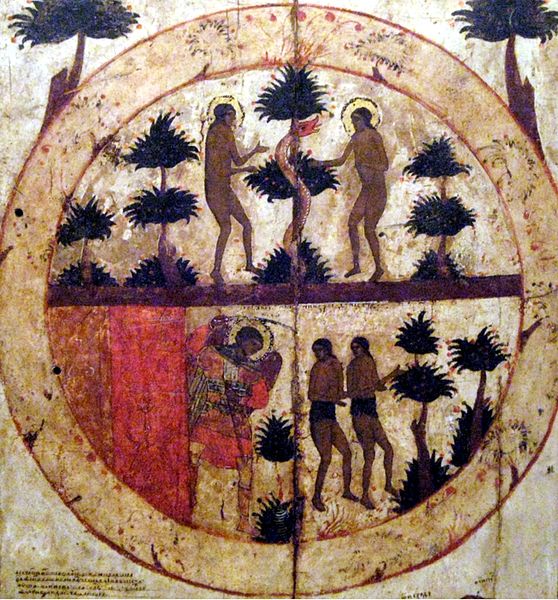
North door of iconostasis: fragment. Adam and Eve in Eden, Banishment from the Eden, Novgorod – PD-Art, via Wikimedia Commons
Today is Forgiveness Sunday. For us in the Byzantine churches, today is the start of the Great Fast, what the Latins have called ‘Lent’ (which is a word that simply means ‘Spring’). It is also known as Cheesefare Sunday, as it is the day that we give up dairy, eggs, wine, and (olive) oil as we proceed into the Fast.
Last night, I spent some time writing up some of my very convoluted and detailed thoughts about a letter that has been circulating around Vancouver regarding the coming of the controversial Protestant evangelist Franklin Graham to headline the city’s ‘Festival of Hope.’ You may read it at your own risk. As I say in that post, I was hesitant to write about Protestants on this blog because it is, as a rule, unseemly for me as someone who joined an Eastern Catholic Church to criticize Protestants. We are not in the same church; they should be able to get their own house in order, even as my church has plenty of things to work on in getting our house in order. However, I ended up writing about my dissent from the letter, even while I also criticize Graham and do not want him to go to my hometown of Vancouver. That was because the Latin hierarch in Vancouver signed the letter. Although my own bishop did not sign it, the letter was reported to be supported by Catholics. However, the case I made yesterday was that the liberalism of the letter hamstrung its efforts to form a truly effective resistance toward Graham, not least because its emphasis on developing private overlapping consensus ends up making it beholden to both Graham and the municipal government in Vancouver, which in this case clearly wants the churches to become the proxy arm of its police state. Out of love for the whole church in Vancouver, I wrote my dissent, and I hope that those who manage to understand it will see that I am not spreading disunity, but am committed to ecumenical relations in Vancouver, albeit not to the philosophically liberal tune of developing private overlapping consensuses.
This morning, I woke up to Forgiveness Sunday, and as the thought of attending Forgiveness Vespers tonight came into my head, a fellow Eastern Catholic messaged me to say: Forgive me a sinner, and pray for me. These are the words that are used at Forgiveness Vespers at the start of the Great Fast: beginning with the presider over the service, we go around asking for forgiveness from everyone in the temple, and we are given forgiveness in turn.
With these words, I thought about how I felt about writing what I did last night. With some discernment, I think I am able to say that I am glad that I did it because I had literally worked through the complications of being in the Kyivan Church motivated out of love for the Latin hierarch to criticize a Protestant open letter because it espoused a legitimately Protestant (but neither validly Catholic nor Orthodox) mode of doing theology through the liberal philosophical approach of developing overlapping consensuses through private conversations. This gave me a sense of completion, as finally, I was able to articulate how I felt not only about the letter, but about the ways in which I had been frustrated by Protestants during my own time as a Protestant when ecumenism was confused with philosophical liberalism, even by people who might have described themselves as ‘evangelicals’ and therefore ‘conservative’ in their theology.
However, I also have to say that I will never write that kind of thing again, hopefully. This is because, as I say in the piece, writing a theological critique is not at all like the way that I write about Protestants in my scholarly work – in a detached, albeit both sympathetic and critical, way. To criticize Protestants means that in some way, I had to get back into the skin of Protestantism to write within it, and whatever I said about being in the Kyivan church and writing out of love for the Latin hierarch, it was a lot of emotional and psychological labor to be Catholic while thinking through a Protestant mess. After I wrote it, the payoff felt a bit empty, and to boot, because I can only write as a person formed in my own church, some of my Protestant friends complained that they couldn’t understand it, mostly because the truth is that it wasn’t written for them although it was written within a struggle that they were dealing with in their own ecclesial communities.
It was the feeling of hollow completion. I am glad I did it, but I will never do it again.
Instead, I want use that feeling of hollow completion to turn my thoughts to Forgiveness Sunday and the start of the Great Fast. Part of the pain of my experience of writing what I wrote last night is that while I was once Protestant, there is no way of putting nicely the fact that I have left Protestantism and I am not in communion with their ecclesial communities. I am now Catholic, which means that I am in communion with the Latin Church from within my Kyivan Church. As a person in the Kyivan Church, I am also Orthodox-in-communion-with-Rome, which means that the pain that I feel with regard to my separation from my sisters and brothers in the same Byzantine theological and liturgical tradition motivates me, as well as others in my church, to heal the wounds of schism and to restore full communion with the Orthodox even while keeping our full communion with the Latin Church.
I think part of that feeling of hollow completion after writing last night’s post comes from having written across schismatic lines. It is gratifying to be able to articulate what those lines of schism are and to write about my sisters and brothers across the schism so sympathetically that I am able to criticize them. While I claimed to have been writing about the Latin bishop with whom I am in full communion, the truth is that the letter in question was a Protestant letter, and I am not in communion with the letter writers.
But to be able to write with such sympathetic criticism does not re-establish communion. Even if they were to come to Forgiveness Vespers and ask for forgiveness, the forgiveness of Forgiveness Vespers does not seem to be able to extend yet across schism. Like Adam and Eve, whose banishment from the garden we remember at Forgiveness Vespers, any paradise that I experience as part of the joy of a Byzantine service remains marred by the knowledge that there are those sundered from our body and that we ourselves have, like everyone else, been contributors to this state of affairs. This is painful, which makes any completion that is felt about writing and criticizing modes of ecumenism seem hollow.
I am never doing that kind of writing again, I am saying now, and it is probably because I have enough of this feeling of hollow completion to carry me through the Great Fast. Anything more, and I would melt under the weight of total despair at how shattered the Body of Christ is. Maybe in the future, when I have grown in holiness, I may be able to do something again like it. But I am tired, I am weary, I am worn. Forgive me a sinner, and pray for me.

Next Post

March 2, 2017 Against the Franklin Graham blackmail
Browse Our Archives
Select a Category Academia Anglican Communion anti-racism Aristotle Asia-Pacific Asian American Asian Canadian BlackLivesMatter Cantonese Catholic China Chinglican church politics Church-State Politics Civil Society Conservative Eastern Christianity Evangelical Evangelical Left Feminist/Womanist Theology Food Greek-Catholic Church of Kyiv Hong Kong Housekeeping Kyivan Church Latin Catholicism Law Liberal Liberation Theology New Calvinism Pentecostal/Charismatic Protestant Psychoanalysis Publics Religion Ethnicity Wired Secular Sovereignty TPCIU Uncategorized
Select a Month July 2019 June 2019 May 2019 April 2019 March 2019 February 2019 January 2019 December 2018 November 2018 October 2018 September 2018 August 2018 July 2018 June 2018 May 2018 March 2018 February 2018 January 2018 December 2017 November 2017 October 2017 September 2017 August 2017 July 2017 June 2017 April 2017 March 2017 February 2017 January 2017 December 2016 November 2016 October 2016 September 2016 August 2016 July 2016 January 2016 December 2015 November 2015 October 2015 August 2015 April 2015 March 2015 February 2015 December 2014 November 2014 September 2014 August 2014 July 2014 June 2014 May 2014 April 2014 March 2014 December 2013 November 2013 October 2013 September 2013 August 2013 July 2013 June 2013 May 2013 April 2013 March 2013 February 2013 January 2013 December 2012 October 2012 June 2012 May 2012 April 2012 February 2012 January 2012
Follow Us!
TAKE THE
Religious Wisdom Quiz
Which Christian group is associated with the "Anabaptist" tradition?
Select your answer to see how you score.
Episcopalians Lutherans Mennonites Calvinists
Related posts from Eastern Catholic Person

I've found my way home: on the unraveling...

Patriyarkhat: 'Attending to the movements of my heart'

I'm flattered to be named an Asian American...

The secular does not stop when your drive...
TRENDING AT PATHEOS Catholic

Rejecting Doom: Christian Hope And Human Action
Christianity is a religion of hope. We are to have hope and...

It’s What Comes From Within Which Matters
One of the most difficult things for us to understand is why...

Why I Choose the Eucharist Over the Sermon
Choose the Eucharist, Not the Sermon What are we supposed to get...

5 Design Elements Found in Spiritually Rooted Homes
Putting Spirituality Into Home Decor Our homes are more than our living...

Credo: A Story of God Told with the...
About 10 years ago, I began to imagine a personal "Credo" that...

The Anatomy of Divine Revelation in Catholic Thought
The claim that God has made Himself known to human beings is...
view all Catholic blogs
Ad-Free & Subscriber Log-In Subscription Support
- About Us
- 2026 Calendar
- Videos
- Podcasts
- Library of World Religions
- Faith In Media Tracker
- Advertise With Us
- Write for Us
- Privacy Policy
- Terms of Service
- Do Not Sell My Data
- Contact Us
- Radiant Digital
- Manage Newsletter Subscriptions
- Unsubscribe From Notifications
- Sitemap
Copyright 2008-2026, Patheos. All rights reserved.
Subscription Support Ad-Free & Subscriber Log-In
Follow Patheos