
BuddhistCatholicContemplativeEvangelicalGeneral ChristianHinduJewishLatter-day SaintMuslimNew VisionsProgressive Christian
Beliefs
- Buddhist
- Catholic
- Contemplative
- Evangelical
- General Christian
- Hindu
- Jewish
- Latter-day Saint
- More Voices
- Muslim
- New Visions
- Pagan
- Progressive Christian
Topics
- Religion News
- Food and Religion
- Sports and Religion
- Religious Art
- Religious Music and Entertainment
- Religious Events
- History and Religion
- Style and Religion
- Politics and Religion
- Women in Religion
- Recreation Outdoors and Religion
- Business Finance and Religion
- Careers Workplace and Religion
- Education and Religion
- Family Parenting and Religion
- Health Fitness and Religion
- Home and Religion
- Relationships and Religion
- Technology and Religion
- Travel and Religion
Columnists
- Buddhist Columnists
- Business Finance and Religion Columnists
- Careers Workplace and Religion Columnists
- Catholic Columnists
- Contemplative Columnists
- Education and Religion Columnists
- Evangelists Columnists
- Family Parenting and Religion Columnists
- General Christian Columnists
- Health Fitness and Religion Columnists
- Hindu Columnists
- History and Religion Columnists
- Home and Religion Columnists
- Jewish Columnists
- More Voices Columnists
- Latter Day Columnists
- Muslim Columnists
- New Visions Columnists
- Nonreligious Columnists
- Pagan Columnists
- Politics and Religion Columnists
- Progressive Columnists
- Recreation Outdoors and Religion Columnists
- Relationships and Religion Columnists
- Religion News Columnists
- Religious Art Columnists
- Religious Events Columnists
- Religious Music and Entertainment Columnists
- Sports and Religion Columnists
- Style and Religion Columnists
- Technology and Religion Columnists
- Travel and Religion Columnists
- Women in Religion Columnists
Resource Library
- 2026 Calendar
- Library of World Religions
- The 100 Most Holy Places on Earth
- Patheos Answers
- Podcasts
- Videos
- Faith Leaders Database
- Anglican Episcopalian
- Bahai
- Baptist
- Buddhism
- Christianity
- Confucianism
- Eastern Orthodoxy
- Hinduism
- Holiness and Pentecostal
- ISKCON
- Islam
- Judaism
- Lutheran
- Methodist
- The Church of Jesus Christ of Latter-day Saints
- New Age
- Paganism
- Presbytarian and Reformed
- Protestantism
- Religion Behind the Scenes
- Roman Catholic
- Scientology
- Shia Islam
- Sikhism
- Sufism
- Sunni Islam
- Taoism
- Zen
- See all religions
Research Tools
 Ad-Free & Subscriber Log-In Subscription Support
Ad-Free & Subscriber Log-In Subscription Support
Follow Patheos 

- Trending:
- Forgiveness
- |
- Marriage
- |
- Consciousness
- |
- Death Penalty
- |
- Election
- |
- Halloween
 Eastern Catholic Person
- Home
- Catholic
- For 2017: what the Holy Hierarch Basil taught me about ‘economia’ in 2016
For 2017: what the Holy Hierarch Basil taught me about ‘economia’ in 2016
Last updated on: January 1, 2017 at 5:30 pm by Justin Tse
For 2017: what the Holy Hierarch Basil taught me about ‘economia’ in 2016 2017-01-01T17:30:56-07:00 Justin Tse
Patheos Explore the world's faith through different perspectives on religion and spirituality! Patheos has the views of the prevalent religions and spiritualities of the world.
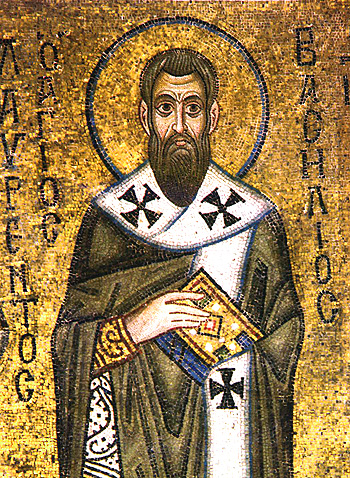
Holy Basil of Caesarea, PD-ART, via Wikimedia Commons
Last year just before midnight on New Year’s Eve, I wanted to post something clever on social media. I had just become a catechumen at my local Eastern Catholic temple, and I thought I’d put something different up. ‘Mary, the Mother of God,’ I discovered, was a ‘solemnity’ (whatever that is) only for the Latins, and I thought it’d be appropriate to make a circumcision joke (e.g. on New Year’s, they do them half off).
That’s when I discovered that in my tradition, January 1 is the Feast of Holy Basil the Great, which sent me on a wild goose chase to find a good icon of Holy Basil to post on Facebook. I had learned about Basil as an evangelical because everybody knows that he was great on the Holy Spirit (I only hung out with cool evangelicals who knew about this stuff and whose bookstores stock St Vladimir Seminary Press’s stuff).
But it wasn’t till after January 1 last year that I really got into the Holy Hierarch Basil’s stuff, and that was not just because I survived the very, very long Divine Liturgy of St Basil the Great a few days later at the Theophany service.
Here’s the story of how the influence of Holy Basil the Great became very personal to me during my Eastern Catholic catechumenate:
I’ve written before (and I will probably reiterate again) that it was around the fifth week of this year’s Great Fast that I really began to take seriously that my catechumenate was making me admit that I was more Byzantine than I had admitted in the past. I attended the Great Canon of St Andrew of Crete, where we did 250 prostrations in three hours (making me sore for five days), after which the reverencing that we do in our churches became an automatic bodily impulse. This was soon followed by a profound experience of Great Week, where I attended the whole series of services from Great Wednesday onwards and even convinced some of my evangelical friends to come along.
Late March and April is also academic conference season for me; it’s when the American Association of Geographers (AAG) meets, and this was especially pronounced for me because I was finishing up teaching an advanced course on cultural geography at Simon Fraser University. Cultural geography is sometimes a difficult field to encapsulate in a simple way, but suffice it to say for our purposes that our flagship journal used to be called for the longest time Ecumene, and by this, the journal didn’t refer so much to the task of ecumenism in an ecclesial way, but to the study of the oikoumene as the inhabited world.
It was while heading to this conference on the heels of teaching this course that I came across a Facebook post from my spiritual father exclaiming that all the time that he had been watching Coffee with Sister Vassa had paid off. I have seldom seen him so excited. ‘Everyone’s favourite book the Pedalion, LOL,’ he wrote cryptically. ‘Economia, the purpose of the canons, WOW! And “hello Uniates”? Hahaha.’
In truly spiritual father fashion, he had also forgotten to post the link to what he was watching. But these cryptic lines led me to start searching on Google to find out who on earth this ‘Sister Vassa’ person he was talking about was.
This video came up, and as I think about it now, it has everything to do with Holy Basil the Great:
Here’s a transcription of the lines especially pertaining to Holy Basil the Great, which was what the initial reference to the Pedalion (the ‘Rudder’ – the big Byzantine book of canons) was about:
Now let’s look at the First Canon of St Basil the Great. What does St Basil talk about in the first canon? He talks about that he himself disagreed with bishops from Asia who decided to accept certain schismatics without rebaptism. Basil himself, along with someone who lived over a century earlier – St Cyprian of Carthage – St Basil thought the whole lot of them – schismatics, heretics – should be rebaptized. However, he says that for the sake of *economia* – the building up of God’s house – because economia is not just a method of interpreting canons – it is *the purpose* of all the canons, as St Basil shows us – he says for the sake of the building up of God’s house, he’ll accept this decision.
So is there just one way of interpreting, of implementing, canons? No. Why not? Because we are the church of the Holy Spirit, and the ministry of our hierarchy and indeed of everyone under the hierarchy is a ministry of the Spirit. As St Paul does remind us in 2 Corinthians 3.6 – what does St Paul say in 2 Corinthians 3.6? The apostle says that we have the ministry that the Lord made us, he gave us the ministry of the Spirit, not the letter, because the Spirit gives life, and the letter kills. So this is something to consider, that the holy canons are in no wise fetters that have the Church chained up for all the ages. No. The church implements canons in her freedom, which is a freedom of the Spirit.
I wrote immediately to my spiritual father. This is great, I said. ‘RIGHT?!?!’ he answered. He really liked several lines that followed, especially: ”Do you sit down at a table, for example, with Greek Catholics and call them “uniates”? “Hello, Uniates?” Is this a good beginning of a dialogue? Does any civilized person who is sane not understand that? We call people what they call themselves.’
I was in fact stunned. Here I had been teaching about the oikoumene in geography en route to a geography conference, and here’s an Orthodox nun lecturing me on economia on YouTube. I had never heard economia used in this sense before, either as the building up of God’s house or as ‘extraordinary concession’ (as I like to call it, ‘wiggle room’), as some of the translations have it.
Sister Vassa was indeed beyond accurate when she referred to our church as a ‘church of the Holy Spirit.’ It was at the end of the conference in San Francisco that I visited Our Lady of Fatima Russian Byzantine Catholic Church and met the Missionaries of Charity there. On my way back to Vancouver, I also stopped by Seattle where I visited my Latin Catholic friends Eugenia Geisel and Lawrence Lam (both of whom have now been mentioned on this blog) who took me to a Divine Mercy Holy Hour, where I started reflecting quite a bit on Divine Mercy and Byzantine spirituality (as Eugenia has also written about on this blog). The Holy Spirit was giving me so many ‘house-building’ experiences, as Sister Vassa would put it.
For me, then, Holy Basil the Great is a key starting point when I think about economia and the canons that are the measuring rods for the building up of G-d’s house. But as I reflect on this even more today, it strikes me that, even though some of this is coming from my subsequent reading of the Holy Hierarch Basil’s writings, the impetus for this reflection simply comes out of my personal encounters brokered through the mysterious work of the Holy Spirit. As one of my astuter critics once said of my blog, I should perhaps consider how much knowledge of Eastern Christianity I have that I’d have audacity to have a blog about Eastern Catholicism. My response is that perhaps I am a typical Byzantine Christian who has not done much reading but only has a simple, shallow knowledge of these profound mysterious from these personal spiritual encounters.
To that end, let us ask the Holy Hierarch Basil to pray to G-d for us. In the last year, we have witnessed so much fragmentation in our contemporary oikoumene. May it be that in 2017, those of us who are called ‘Christians’ may be filled with the Holy Spirit as we participate in the makrodiakonia of economia, the building up of G-d’s house as an act of service to the whole world.
Next Post
January 5, 2017 Theophany with the Orthodox in the cold
Browse Our Archives
Select a Category Academia Anglican Communion anti-racism Aristotle Asia-Pacific Asian American Asian Canadian BlackLivesMatter Cantonese Catholic China Chinglican church politics Church-State Politics Civil Society Conservative Eastern Christianity Evangelical Evangelical Left Feminist/Womanist Theology Food Greek-Catholic Church of Kyiv Hong Kong Housekeeping Kyivan Church Latin Catholicism Law Liberal Liberation Theology New Calvinism Pentecostal/Charismatic Protestant Psychoanalysis Publics Religion Ethnicity Wired Secular Sovereignty TPCIU Uncategorized
Select a Month July 2019 June 2019 May 2019 April 2019 March 2019 February 2019 January 2019 December 2018 November 2018 October 2018 September 2018 August 2018 July 2018 June 2018 May 2018 March 2018 February 2018 January 2018 December 2017 November 2017 October 2017 September 2017 August 2017 July 2017 June 2017 April 2017 March 2017 February 2017 January 2017 December 2016 November 2016 October 2016 September 2016 August 2016 July 2016 January 2016 December 2015 November 2015 October 2015 August 2015 April 2015 March 2015 February 2015 December 2014 November 2014 September 2014 August 2014 July 2014 June 2014 May 2014 April 2014 March 2014 December 2013 November 2013 October 2013 September 2013 August 2013 July 2013 June 2013 May 2013 April 2013 March 2013 February 2013 January 2013 December 2012 October 2012 June 2012 May 2012 April 2012 February 2012 January 2012
Follow Us!
TAKE THE
Religious Wisdom Quiz
Which major biblical covenant is first introduced in Genesis?
Select your answer to see how you score.
Davidic Covenant New Covenant Mosaic Covenant Abrahamic Covenant
Related posts from Eastern Catholic Person

I've found my way home: on the unraveling...

Patriyarkhat: 'Attending to the movements of my heart'

I'm flattered to be named an Asian American...

The secular does not stop when your drive...
TRENDING AT PATHEOS Catholic

The Parable Of The Sower And The Word...
One of Christ’s most famous parables is that of the sower who...

Rejecting Doom: Christian Hope And Human Action
Christianity is a religion of hope. We are to have hope and...

Why I Choose the Eucharist Over the Sermon
Choose the Eucharist, Not the Sermon What are we supposed to get...

5 Design Elements Found in Spiritually Rooted Homes
Putting Spirituality Into Home Decor Our homes are more than our living...

Credo: A Story of God Told with the...
About 10 years ago, I began to imagine a personal "Credo" that...

The Anatomy of Divine Revelation in Catholic Thought
The claim that God has made Himself known to human beings is...
view all Catholic blogs
Ad-Free & Subscriber Log-In Subscription Support
- About Us
- 2026 Calendar
- Videos
- Podcasts
- Library of World Religions
- Faith In Media Tracker
- Advertise With Us
- Write for Us
- Privacy Policy
- Terms of Service
- Do Not Sell My Data
- Contact Us
- Radiant Digital
- Manage Newsletter Subscriptions
- Unsubscribe From Notifications
- Sitemap
Copyright 2008-2026, Patheos. All rights reserved.
Subscription Support Ad-Free & Subscriber Log-In
Follow Patheos