
BuddhistCatholicContemplativeEvangelicalGeneral ChristianHinduJewishLatter-day SaintMuslimNew VisionsProgressive Christian
Beliefs
- Buddhist
- Catholic
- Contemplative
- Evangelical
- General Christian
- Hindu
- Jewish
- Latter-day Saint
- More Voices
- Muslim
- New Visions
- Pagan
- Progressive Christian
Topics
- Religion News
- Food and Religion
- Sports and Religion
- Religious Art
- Religious Music and Entertainment
- Religious Events
- History and Religion
- Style and Religion
- Politics and Religion
- Women in Religion
- Recreation Outdoors and Religion
- Business Finance and Religion
- Careers Workplace and Religion
- Education and Religion
- Family Parenting and Religion
- Health Fitness and Religion
- Home and Religion
- Relationships and Religion
- Technology and Religion
- Travel and Religion
Columnists
- Buddhist Columnists
- Business Finance and Religion Columnists
- Careers Workplace and Religion Columnists
- Catholic Columnists
- Contemplative Columnists
- Education and Religion Columnists
- Evangelists Columnists
- Family Parenting and Religion Columnists
- General Christian Columnists
- Health Fitness and Religion Columnists
- Hindu Columnists
- History and Religion Columnists
- Home and Religion Columnists
- Jewish Columnists
- More Voices Columnists
- Latter Day Columnists
- Muslim Columnists
- New Visions Columnists
- Nonreligious Columnists
- Pagan Columnists
- Politics and Religion Columnists
- Progressive Columnists
- Recreation Outdoors and Religion Columnists
- Relationships and Religion Columnists
- Religion News Columnists
- Religious Art Columnists
- Religious Events Columnists
- Religious Music and Entertainment Columnists
- Sports and Religion Columnists
- Style and Religion Columnists
- Technology and Religion Columnists
- Travel and Religion Columnists
- Women in Religion Columnists
Resource Library
- 2026 Calendar
- Library of World Religions
- The 100 Most Holy Places on Earth
- Patheos Answers
- Podcasts
- Videos
- Faith Leaders Database
- Anglican Episcopalian
- Bahai
- Baptist
- Buddhism
- Christianity
- Confucianism
- Eastern Orthodoxy
- Hinduism
- Holiness and Pentecostal
- ISKCON
- Islam
- Judaism
- Lutheran
- Methodist
- The Church of Jesus Christ of Latter-day Saints
- New Age
- Paganism
- Presbytarian and Reformed
- Protestantism
- Religion Behind the Scenes
- Roman Catholic
- Scientology
- Shia Islam
- Sikhism
- Sufism
- Sunni Islam
- Taoism
- Zen
- See all religions
Research Tools
 Ad-Free & Subscriber Log-In Subscription Support
Ad-Free & Subscriber Log-In Subscription Support
Follow Patheos 

- Trending:
- Forgiveness
- |
- Marriage
- |
- Consciousness
- |
- Death Penalty
- |
- Election
- |
- Halloween
 Eastern Catholic Person
- Home
- Catholic
- Taking the secret of the Nativity everywhere with the portable icon I got at my chrismation
Taking the secret of the Nativity everywhere with the portable icon I got at my chrismation
Last updated on: December 24, 2016 at 11:04 pm by Justin Tse
Taking the secret of the Nativity everywhere with the portable icon I got at my chrismation 2016-12-24T23:04:52-07:00 Justin Tse
Patheos Explore the world's faith through different perspectives on religion and spirituality! Patheos has the views of the prevalent religions and spiritualities of the world.
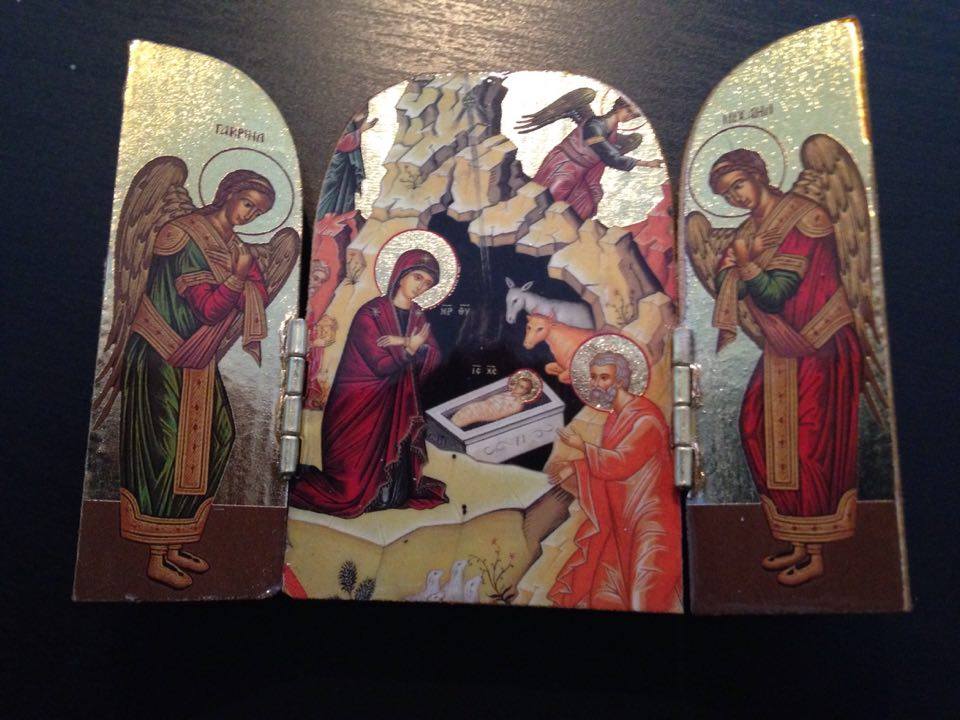
Miniature portable icon of the Nativity I received at my chrismation, 28 June 2016 – photo by me
A Byzantine priest told me recently that Nativity is not as great of a feast as Theophany, which for us on the Newer Calendar comes on January 6. Theophany, he said, was Christ’s public revelation to the world, whereas Nativity wasn’t that big of a deal when it happened. I mean, who really knew about Nativity at the time? he was saying. Wasn’t it just a couple of shepherds and three guys from China?
I think I like that. For all that has been said in the past on ‘the war on Christmas‘ and for all that I polemicized in my last post about the post-truth nations submitting themselves to the G-d who walks among the poor, Nativity is supposed to be a little bit of a secret.
I think the parishioners at the temple where I was chrismated implicitly know this. I’ve written previously about how I struggled with the Latin rosary in my Anglican past enough to really enjoy meditating on the Nativity, so after my spiritual father thankfully took me off that devotion (it really wasn’t working for me – too much mental multitasking), it was good of my parishioner friends to get me an icon of the Nativity so that I could continue contemplating this event without the rosary.
As they gave me this icon, they told me that it was a portable icon that opens up into a kind of three-panelled screen. Portable icons are very useful, our temple’s cantor told me, especially when you are traveling. This one, he said, was particularly useful because you can close it up to keep it from getting scratched. At this point I had not yet opened it, so they told me to open it. I was stunned to see that it was an icon of the Nativity, and I quickly venerated it. That’s when they told me that this meant that I could take the Nativity with me everywhere.
I usually keep this icon in my icon corner. It’s the smallest one I have in there, so when I kiss them all after morning prayers (this is just something I like to do to start the day off right), sometimes I forget about this one. I do usually remember it during my prayers to my guardian angel, though, because it so happens to be the only icon that I currently have that has angels in a prominent position, even if the angels displayed are the Holy Archangels Gabriel and Michael and not my own personal guardian.
Forgetful as I am about it at home, I always bring it with me when I go on trips. I had it with me, for example, on my trip to see the consecration of St Elias Brampton, and I always remember to pack it especially for academic conferences. On this most recent trip back up to Vancouver, it really came in handy: a Chinese evangelical friend of mine who is very interested in Eastern Catholicism had his house blessed, but doesn’t have any icons yet. I remembered as we were about to start Vespers that I still had this icon in my bag (we did a full-on Byzantine daily vespers service in his house before the blessing) and put it up on their fireplace mantelpiece. In fact, I forgot about it, left it there, and before my friend went away for a short trip, he gave it to my spiritual father, who delivered it to me right after the Little Entrance during a recent liturgy (he came back out of the deacon door and personally handed it to me). For some reason, that particular moment felt very meaningful to me at the time, but I still can’t put my finger on what meaning it had exactly.
What I liked immediately about the icon is that the cave looks like it’s in a mountain that looks a little bit like Sinai. Obviously, I am free-associating here – it could easily have been Tabor or Zion or the Mount of Olives too, as mountains are terribly important in Byzantine iconography and spirituality – but at the moment I first saw this particular icon, it reminded me of the icons of the Holy Prophet Elias. In fact, my friends will remember that it took me a little while to discover that it was the Nativity that was being displayed because I was so sure this was about some desert encounter on a mountain. What I learned since receiving this icon is that all the icons of the Nativity sort of look like this.
Going off my free associations, the secrecy of the Nativity really begins to shine. But G-d was not in the wind, the writers of Kings tell us about Elias on Horeb. G-d was not in the earthquake. G-d was not in the fire.
G-d, as I learned even when I was an evangelical, spoke to Elijah (as it says in my still beloved King James Version) in a still, small voice. The great hesychasts of old, our mothers and fathers in the desert, knew this voice too; G-d is not in the noise, but in the secret place of the heart to which the hesychast must bring the ‘intellect,’ the ‘soul,’ the nous.
Christmas is often littered with condemnations about consumerism. These condemnations, I’ve found in my own experience, don’t really put the Christ back into Christmas or help us to remember the reason for season or make Linus appear out of nowhere to read the second chapter of Luke’s Gospel to Charlie Brown; they simply induce guilt and more consumerism.
But the point of the Nativity is that it is secret, and as the icon accompanies me in my travels, it is often placed in the secret of my hotel rooms or in a side pocket in my bag; it is so secret at home that I sometimes even forget to kiss it when I kiss my other icons. And yet it is in such secrecy, I am starting to think, that I am supposed to hear the Nativity as the very Word of G-d. Long ago, the writer to the Hebrews says, God spoke to our ancestors in many and various ways by the prophets, but in these last days he has spoken to us by a Son, whom he appointed heir of all things, through whom he also created the worlds. He is the reflection of God’s glory and the exact imprint of God’s very being, and he sustains all things by his powerful word. On the Holy Mountain, the Holy Prophet Elias heard the voice of G-d as a still small voice; before Elijah on that same Holy Mountain, the Holy Prophet Moses heard this voice out of the bush that burned but was not consumed. If in these days G-d speaks to us by a Son, then it is in the cleft of the rock as depicted in the icon of the Nativity that the still small voice of the living G-d is whispering as a baby wrapped in swaddling clothes lying in a manger.
But I am not very good at hesychasm. I do not retreat into the desert to make it a city, and while I have been taught spiritual discernment by Eastern Jesuits, I am not very good about turning the city into a desert either. G-d himself dwells within me, but I often have trouble bringing my nous into my heart to meet him there and to hear his voice.
So in this secret encounter with the still small voice of G-d in the Nativity, let me (as before when I prayed the rosary) approach the Most Holy Theotokos to ask her what she is pondering. Let me travel with her on this pilgrim journey to the New Jerusalem; let the icon of her having given birth to the Son of G-d be not only carried in my bag, but written on my heart. Maybe she, the fulfillment of the prophetess Miriam, will tell me what I am supposed to hear, and by her guidance, perhaps one day finally my heart will be still enough to ponder with the Theotokos what it means that angelic choirs announce the birth of the Son of G-d, shepherds are going through town giving glory to G-d, and the Nativity is still very much still a secret.
God is with us! Understand, all you nations! And submit yourselves! For God is with us!
Next Post
January 1, 2017 For 2017: what the Holy Hierarch Basil taught me about 'economia' in 2016
Browse Our Archives
Select a Category Academia Anglican Communion anti-racism Aristotle Asia-Pacific Asian American Asian Canadian BlackLivesMatter Cantonese Catholic China Chinglican church politics Church-State Politics Civil Society Conservative Eastern Christianity Evangelical Evangelical Left Feminist/Womanist Theology Food Greek-Catholic Church of Kyiv Hong Kong Housekeeping Kyivan Church Latin Catholicism Law Liberal Liberation Theology New Calvinism Pentecostal/Charismatic Protestant Psychoanalysis Publics Religion Ethnicity Wired Secular Sovereignty TPCIU Uncategorized
Select a Month July 2019 June 2019 May 2019 April 2019 March 2019 February 2019 January 2019 December 2018 November 2018 October 2018 September 2018 August 2018 July 2018 June 2018 May 2018 March 2018 February 2018 January 2018 December 2017 November 2017 October 2017 September 2017 August 2017 July 2017 June 2017 April 2017 March 2017 February 2017 January 2017 December 2016 November 2016 October 2016 September 2016 August 2016 July 2016 January 2016 December 2015 November 2015 October 2015 August 2015 April 2015 March 2015 February 2015 December 2014 November 2014 September 2014 August 2014 July 2014 June 2014 May 2014 April 2014 March 2014 December 2013 November 2013 October 2013 September 2013 August 2013 July 2013 June 2013 May 2013 April 2013 March 2013 February 2013 January 2013 December 2012 October 2012 June 2012 May 2012 April 2012 February 2012 January 2012
Follow Us!
TAKE THE
Religious Wisdom Quiz
Which major prophet book is directly after Isaiah?
Select your answer to see how you score.
Lamentations Jeremiah Ezekiel Daniel
Related posts from Eastern Catholic Person

I've found my way home: on the unraveling...

Patriyarkhat: 'Attending to the movements of my heart'

I'm flattered to be named an Asian American...

The secular does not stop when your drive...
TRENDING AT PATHEOS Catholic

Rejecting Doom: Christian Hope And Human Action
Christianity is a religion of hope. We are to have hope and...

It’s What Comes From Within Which Matters
One of the most difficult things for us to understand is why...

Why I Choose the Eucharist Over the Sermon
Choose the Eucharist, Not the Sermon What are we supposed to get...

5 Design Elements Found in Spiritually Rooted Homes
Putting Spirituality Into Home Decor Our homes are more than our living...

Credo: A Story of God Told with the...
About 10 years ago, I began to imagine a personal "Credo" that...

The Anatomy of Divine Revelation in Catholic Thought
The claim that God has made Himself known to human beings is...
view all Catholic blogs
Ad-Free & Subscriber Log-In Subscription Support
- About Us
- 2026 Calendar
- Videos
- Podcasts
- Library of World Religions
- Faith In Media Tracker
- Advertise With Us
- Write for Us
- Privacy Policy
- Terms of Service
- Do Not Sell My Data
- Contact Us
- Radiant Digital
- Manage Newsletter Subscriptions
- Unsubscribe From Notifications
- Sitemap
Copyright 2008-2026, Patheos. All rights reserved.
Subscription Support Ad-Free & Subscriber Log-In
Follow Patheos