
BuddhistCatholicContemplativeEvangelicalGeneral ChristianHinduJewishLatter-day SaintMuslimNew VisionsProgressive Christian
Beliefs
- Buddhist
- Catholic
- Contemplative
- Evangelical
- General Christian
- Hindu
- Jewish
- Latter-day Saint
- More Voices
- Muslim
- New Visions
- Pagan
- Progressive Christian
Topics
- Religion News
- Food and Religion
- Sports and Religion
- Religious Art
- Religious Music and Entertainment
- Religious Events
- History and Religion
- Style and Religion
- Politics and Religion
- Women in Religion
- Recreation Outdoors and Religion
- Business Finance and Religion
- Careers Workplace and Religion
- Education and Religion
- Family Parenting and Religion
- Health Fitness and Religion
- Home and Religion
- Relationships and Religion
- Technology and Religion
- Travel and Religion
Columnists
- Buddhist Columnists
- Business Finance and Religion Columnists
- Careers Workplace and Religion Columnists
- Catholic Columnists
- Contemplative Columnists
- Education and Religion Columnists
- Evangelists Columnists
- Family Parenting and Religion Columnists
- General Christian Columnists
- Health Fitness and Religion Columnists
- Hindu Columnists
- History and Religion Columnists
- Home and Religion Columnists
- Jewish Columnists
- More Voices Columnists
- Latter Day Columnists
- Muslim Columnists
- New Visions Columnists
- Nonreligious Columnists
- Pagan Columnists
- Politics and Religion Columnists
- Progressive Columnists
- Recreation Outdoors and Religion Columnists
- Relationships and Religion Columnists
- Religion News Columnists
- Religious Art Columnists
- Religious Events Columnists
- Religious Music and Entertainment Columnists
- Sports and Religion Columnists
- Style and Religion Columnists
- Technology and Religion Columnists
- Travel and Religion Columnists
- Women in Religion Columnists
Resource Library
- 2026 Calendar
- Library of World Religions
- The 100 Most Holy Places on Earth
- Patheos Answers
- Podcasts
- Videos
- Faith Leaders Database
- Anglican Episcopalian
- Bahai
- Baptist
- Buddhism
- Christianity
- Confucianism
- Eastern Orthodoxy
- Hinduism
- Holiness and Pentecostal
- ISKCON
- Islam
- Judaism
- Lutheran
- Methodist
- The Church of Jesus Christ of Latter-day Saints
- New Age
- Paganism
- Presbytarian and Reformed
- Protestantism
- Religion Behind the Scenes
- Roman Catholic
- Scientology
- Shia Islam
- Sikhism
- Sufism
- Sunni Islam
- Taoism
- Zen
- See all religions
Research Tools
 Ad-Free & Subscriber Log-In Subscription Support
Ad-Free & Subscriber Log-In Subscription Support
Follow Patheos 

- Trending:
- Forgiveness
- |
- Marriage
- |
- Consciousness
- |
- Death Penalty
- |
- Election
- |
- Halloween
 Eastern Catholic Person
- Home
- Catholic
- On discovering that the use of the atomic bomb was a moral problem
On discovering that the use of the atomic bomb was a moral problem
Last updated on: August 6, 2016 at 9:16 pm by Justin Tse
On discovering that the use of the atomic bomb was a moral problem 2016-08-06T21:16:39-07:00 Justin Tse
Patheos Explore the world's faith through different perspectives on religion and spirituality! Patheos has the views of the prevalent religions and spiritualities of the world.
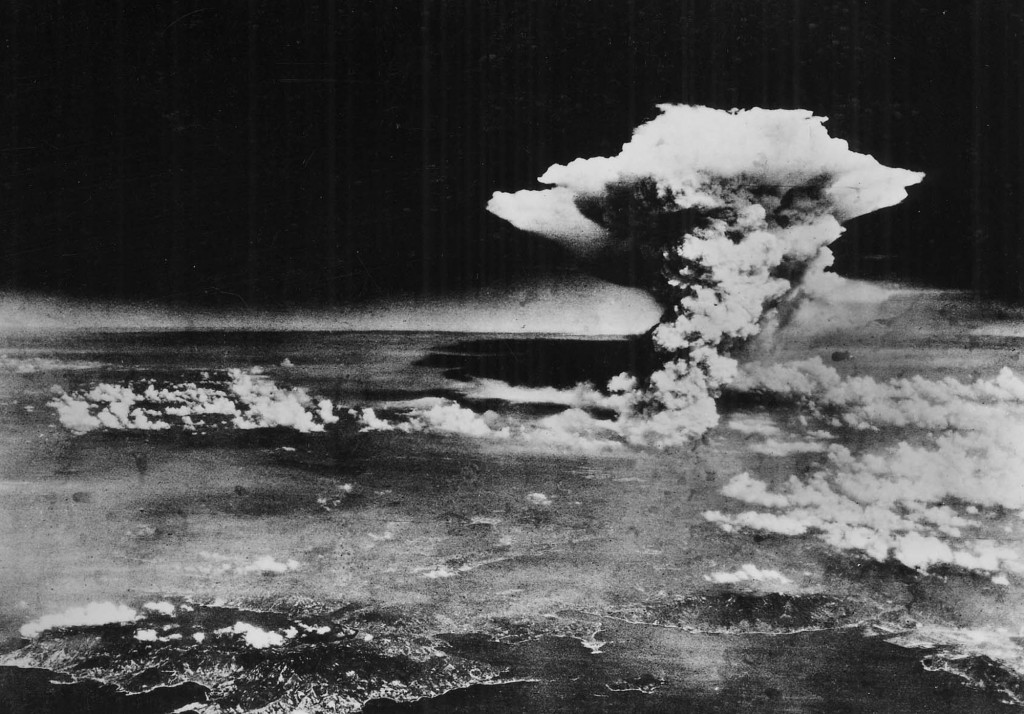
Atomic cloud over Hiroshima, taken from “Enola Gay” flying over Matsuyama, Shikoku (commentary by Chugoku Shimbun), 6 August 1945 – by 509th Operations Group (PD-US), via Wikimedia Commons
NOTE: This is a story of trauma. There are therefore traumatic details that I will give if you read on.
My grandfather hated Japan. He hated Communists too, but that will take me a whole other post to work through. But it was my grandfather who first told me about the atomic bomb, and when he first told me about it, it was a story of triumph.
I suppose there are many Americans who also hear about the atomic bomb as a story of triumph, an act that saved many American lives from a land invasion of Japan. My grandfather was from Shanghai, which makes me one-quarter Shanghainese through my mom; in fact, I do know the odd Shanghainese turn of phrase and not-so-secretly love Shanghainese food a little more than the Cantonese stuff I usually talk about. From the little that I know of Grandpa’s life before he arrived penniless in Hong Kong, he grew up in the outskirts of Shanghai in a big house with servants. Not only does he remember his father being married to his mother, but he recalled that there was a Eurasian woman who hung around the house and occasionally took him into the city that he had to call ‘Miss.’
All of this was taken away – first by the invading imperial Japanese army, then by the Communists. My grandfather was not around to see his parents reduced from aristocracy to scrubbing toilets in humiliation by the Communist liberators (no one really knows what happened to ‘Miss’), but he was there to see babies tossed by the Japanese and caught by their bayonets.
This was the way he told the story of the atomic bomb, then. There was a sadistic invading force that devastated all that he held dear. And then the Americans came to the rescue. First they bombed Hiroshima, he said, but the emperor refused to surrender. Then they bombed Nagasaki, but the emperor refused to surrender. Then they set their sights on Tokyo, and that’s when the emperor surrendered.
My grandfather loved to tell stories – in fact, I owe my knowledge of the Chinese classics to him – so of course the Tokyo bit is an embellishment. But the point is that it was a victory, payback for what the Japanese did to him and those babies and the rest of China (I was unaware until much later of how big the Greater East Asian Co-Prosperity Sphere really was).
It would be glib of me, I think, to point out that the anniversary of the bombing of Hiroshima takes place on the Feast of the Transfiguration; in fact, I had this pointed out to me when I visited the Episcopal Cathedral in Portland on last year’s August 6. Given my grandfather’s story, it is also impossible for me to reflect dispassionately on the bombings; it is perhaps more appropriately to write through how I came to let go of my grandfather’s hate.
I did not encounter the notion that using the atomic bomb presented an ethical dilemma until I attended Catholic school. I remember how it suddenly dawned on me that bombing Hiroshima and Nagasaki may not have been moral. I was a sophomore when 9/11 happened, and the talk of war – even of instating the draft – was on everyone’s lips. I remember my French teacher suddenly at the beginning of class speaking in English in frustration after Bush’s 2002 State of the Union about how labeling Iraq, Iran, and North Korea the ‘axis of evil’ was the height of stupidity. When I was a junior, I took AP US History at the same time that the lead-up to the 2003 Iraq War was happening, and I remember saying to my friend – who later joined the Air Force – that to my own surprise, I might be turning anti-war. He replied, Yeah, and I’m pro-war.
One of the scary things about the claim that Saddam might have had weapons of mass destruction was that, among other things, he’d be able to do to us what we once did to the Japanese. It’s what made a good deal of the evangelicals I was around – both Chinese and white Americans – quite supportive of this war. What if he has weapons of mass destruction? they opined. Do we want to take that chance? It bears remembering after the passage of more than a decade that much of the opining during that time was just as speculative as we now know it was. Besides, the justification was, Desert Storm was over so quickly; we could finish the job quick and dirty there too. Many of my friends and family were therefore quite excited when the first ‘bunker busters’ were dropped on Baghdad; with all the crowds there cheering, ‘Thank you, America,’ and the American soldier conducting Iraqi children singing ‘Jesus, Name Above All Names’ with his AK-47, it would truly be over soon.
Nervously, I had my doubts. My teachers at the Catholic school had, after all, taught me to use a word called ‘dehumanization.’ Dehumanization, they said, was when you stop seeing someone as a person and start seeing them as an object, a thing. It occurred to me that just as there were persons in Shanghai when it was invaded and New York on 9/11, there were also persons that were incinerated by those bunker busters. When it was put to us first in the moral theology class, and then in AP US History, that the use of the atomic bomb may have been morally dubious, it occurred to me also that the persons in Hiroshima and Nagasaki were not the same people who shattered my grandfather’s life in Shanghai. Hiroshima and Nagasaki, like Shanghai, New York, and Baghdad, are cities. I too lived in a city, or at least a suburb of a few in the Bay Area. It could well have been me there. That was, after all, what we were afraid of Saddam doing, whether with nuclear weapons, or chemical weapons, or biological weapons, or whatever those aluminum tubes were for.
Over a decade later, we find ourselves talking about these events as the seeds of what Pope Francis calls the ‘piecemeal third world war.’ But the Bishop of Rome, as I said when I wrote about him earlier this week, is thinking of a much longer history, one where the seeds were sown in no small part by the dropping of the bomb on Hiroshima and Nagasaki. My awakening to this war happened in 2003; perhaps my older readers will remember the Cuban Missile Crisis. Of course, this war is also being fought piecemeal, and it would have been easy for me to feel isolated from it, if only I had not become Eastern Catholic, and joined a church where our litany prayers constantly revolve around our brothers and sisters in our church and our sister sui juris churches who are being killed all the day long.
My grandfather was hardened by the violence that he experienced at the hands of Japanese aggression. Because of it, he was unable to see the persons in Hiroshima and Nagasaki as persons – bodies, faces, shining with the light of life – and though he passed on many stories of love to me, he also gave me his hate. It took many years, a lot of patience from my teachers, and the grace of the Holy Spirit to dislodge, but now I find myself in my own generation in another war where I too may have to face the temptations of my grandfather. There is indeed the ideology that makes for the perpetration of violence – the Greater East Asian Co-Prosperity Sphere, American exceptionalism (especially in its interventionist neoconservative form), fantasies of Eurasia, ISIS. But like my grandfather, there is the ideology that is generated from having been marked with violence, the hatred for the aggressor where ‘liberation,’ as Paulo Freire puts it, is nothing but wanting to be the oppressor in our own right. It would be true to say that Eastern Europe and the Middle East are the opposite side of the globe from me, but the things that hit home for me are not so different: political tensions in Hong Kong generated by an increasingly openly authoritarian government, the urgency of Asian American solidarity with Black Lives Matter with the concomitant circulation of ideologies of privatization in Asian American communities, increasing class polarization in the cities that I know and love wrought by property bubbles with no end in sight. Such, perhaps, is also the temptation for us in the Eastern Catholic Churches, to be so hardened by both the historic and contemporary aggression against us that we in turn wish the cities of our enemies – with women and children going about their everyday lives – to be bombed to smithereens. Certainly, our own hierarchs have warned us against going in this direction – see here, for example, for Bishop Borys Gudziak’s urgent call to reconciliation in light of historic reconciliations in Europe since World War II between Ukrainians and Russians even while war in Ukraine rages – but we in the pews, whether we have pews or not, are only human. It is easy, all too easy, to defy our God-loving bishops and to close the gap between the denunciation of an aggressive ideology and the identification of persons with this ideology such that we wish also for their non-existence.
As we remember Hiroshima today along with the Feast of the Transfiguration – as we have been doing every year and will continue to do every year – let me therefore be a person, especially as we collectively find ourselves even now in the midst of a piecemeal war of aggression, misinformation, and the stirrings of new hatreds that take hold because we are fooled into thinking that they are primordial. Let me have the grace not to identify my neighbour or even my enemy with an ideology, even while I denounce aggression. Let me work, as James Baldwin once instructed his nephew with regard to Americans so blinded by an ideology of whiteness that they forgot that black lives matter, ‘with love’ to ‘force our brothers [and sisters] to see themselves as they are, to cease fleeing from reality and begin to change it.’ Save, O Lord, and have mercy on those that hate and wrong me, and make temptation for me, and let them not perish because of me, a sinner (‘Morning Prayers,’ Jordanville Prayer Book, p. 31).
Previous Post
August 6, 2016
I was late to the Vigil of the Transfiguration, but I finally heard it
Next Post
August 7, 2016 I'm getting my chrismation icons blessed!
Browse Our Archives
Select a Category Academia Anglican Communion anti-racism Aristotle Asia-Pacific Asian American Asian Canadian BlackLivesMatter Cantonese Catholic China Chinglican church politics Church-State Politics Civil Society Conservative Eastern Christianity Evangelical Evangelical Left Feminist/Womanist Theology Food Greek-Catholic Church of Kyiv Hong Kong Housekeeping Kyivan Church Latin Catholicism Law Liberal Liberation Theology New Calvinism Pentecostal/Charismatic Protestant Psychoanalysis Publics Religion Ethnicity Wired Secular Sovereignty TPCIU Uncategorized
Select a Month July 2019 June 2019 May 2019 April 2019 March 2019 February 2019 January 2019 December 2018 November 2018 October 2018 September 2018 August 2018 July 2018 June 2018 May 2018 March 2018 February 2018 January 2018 December 2017 November 2017 October 2017 September 2017 August 2017 July 2017 June 2017 April 2017 March 2017 February 2017 January 2017 December 2016 November 2016 October 2016 September 2016 August 2016 July 2016 January 2016 December 2015 November 2015 October 2015 August 2015 April 2015 March 2015 February 2015 December 2014 November 2014 September 2014 August 2014 July 2014 June 2014 May 2014 April 2014 March 2014 December 2013 November 2013 October 2013 September 2013 August 2013 July 2013 June 2013 May 2013 April 2013 March 2013 February 2013 January 2013 December 2012 October 2012 June 2012 May 2012 April 2012 February 2012 January 2012
Follow Us!
TAKE THE
Religious Wisdom Quiz
What did Solomon famously judge between"two women and what disputed item?
Select your answer to see how you score.
A house A sheep A baby A ring
Related posts from Eastern Catholic Person

I've found my way home: on the unraveling...

The Bay Area of the nineties is where...
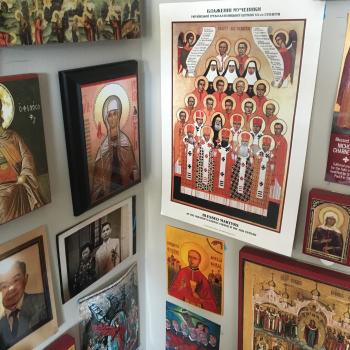
The enthronement of Metropolitan Borys before the New-Martyrs

Home is where your food is: a speech...
TRENDING AT PATHEOS Catholic

The Parable Of The Sower And The Word...
One of Christ’s most famous parables is that of the sower who...

Rejecting Doom: Christian Hope And Human Action
Christianity is a religion of hope. We are to have hope and...

Why I Choose the Eucharist Over the Sermon
Choose the Eucharist, Not the Sermon What are we supposed to get...

5 Design Elements Found in Spiritually Rooted Homes
Putting Spirituality Into Home Decor Our homes are more than our living...

Credo: A Story of God Told with the...
About 10 years ago, I began to imagine a personal "Credo" that...

The Anatomy of Divine Revelation in Catholic Thought
The claim that God has made Himself known to human beings is...
view all Catholic blogs
Ad-Free & Subscriber Log-In Subscription Support
- About Us
- 2026 Calendar
- Videos
- Podcasts
- Library of World Religions
- Faith In Media Tracker
- Advertise With Us
- Write for Us
- Privacy Policy
- Terms of Service
- Do Not Sell My Data
- Contact Us
- Radiant Digital
- Manage Newsletter Subscriptions
- Unsubscribe From Notifications
- Sitemap
Copyright 2008-2026, Patheos. All rights reserved.
Subscription Support Ad-Free & Subscriber Log-In
Follow Patheos