
BuddhistCatholicContemplativeEvangelicalGeneral ChristianHinduJewishLatter-day SaintMuslimNew VisionsProgressive Christian
Beliefs
- Buddhist
- Catholic
- Contemplative
- Evangelical
- General Christian
- Hindu
- Jewish
- Latter-day Saint
- More Voices
- Muslim
- New Visions
- Pagan
- Progressive Christian
Topics
- Religion News
- Food and Religion
- Sports and Religion
- Religious Art
- Religious Music and Entertainment
- Religious Events
- History and Religion
- Style and Religion
- Politics and Religion
- Women in Religion
- Recreation Outdoors and Religion
- Business Finance and Religion
- Careers Workplace and Religion
- Education and Religion
- Family Parenting and Religion
- Health Fitness and Religion
- Home and Religion
- Relationships and Religion
- Technology and Religion
- Travel and Religion
Columnists
- Buddhist Columnists
- Business Finance and Religion Columnists
- Careers Workplace and Religion Columnists
- Catholic Columnists
- Contemplative Columnists
- Education and Religion Columnists
- Evangelists Columnists
- Family Parenting and Religion Columnists
- General Christian Columnists
- Health Fitness and Religion Columnists
- Hindu Columnists
- History and Religion Columnists
- Home and Religion Columnists
- Jewish Columnists
- More Voices Columnists
- Latter Day Columnists
- Muslim Columnists
- New Visions Columnists
- Nonreligious Columnists
- Pagan Columnists
- Politics and Religion Columnists
- Progressive Columnists
- Recreation Outdoors and Religion Columnists
- Relationships and Religion Columnists
- Religion News Columnists
- Religious Art Columnists
- Religious Events Columnists
- Religious Music and Entertainment Columnists
- Sports and Religion Columnists
- Style and Religion Columnists
- Technology and Religion Columnists
- Travel and Religion Columnists
- Women in Religion Columnists
Resource Library
- 2026 Calendar
- Library of World Religions
- The 100 Most Holy Places on Earth
- Patheos Answers
- Podcasts
- Videos
- Faith Leaders Database
- Anglican Episcopalian
- Bahai
- Baptist
- Buddhism
- Christianity
- Confucianism
- Eastern Orthodoxy
- Hinduism
- Holiness and Pentecostal
- ISKCON
- Islam
- Judaism
- Lutheran
- Methodist
- The Church of Jesus Christ of Latter-day Saints
- New Age
- Paganism
- Presbytarian and Reformed
- Protestantism
- Religion Behind the Scenes
- Roman Catholic
- Scientology
- Shia Islam
- Sikhism
- Sufism
- Sunni Islam
- Taoism
- Zen
- See all religions
Research Tools
 Ad-Free & Subscriber Log-In Subscription Support
Ad-Free & Subscriber Log-In Subscription Support
Follow Patheos 

- Trending:
- Forgiveness
- |
- Marriage
- |
- Consciousness
- |
- Death Penalty
- |
- Election
- |
- Halloween
 Eastern Catholic Person
- Home
- Catholic
- This is what a normal Jesuit looks like
This is what a normal Jesuit looks like
Last updated on: August 1, 2016 at 12:34 am by Justin Tse
This is what a normal Jesuit looks like 2016-08-01T00:34:51-07:00 Justin Tse
Patheos Explore the world's faith through different perspectives on religion and spirituality! Patheos has the views of the prevalent religions and spiritualities of the world.
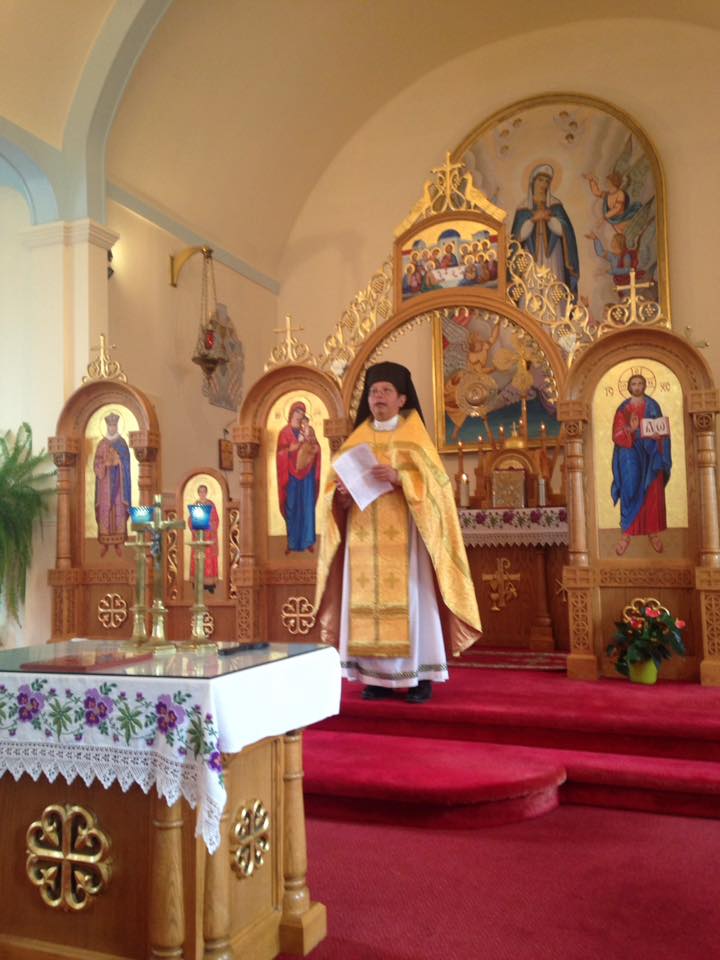
Photo by me
The Feast of St Ignatius of Loyola is just winding down to a close. I thought that by the end of tonight, I would be able to publish a post about how I used to be completely deluded about the Jesuits. It’s still a post that I plan on finishing some day, but it unfortunately turned into a bit of a Protestant confession, therefore rendering it unpublishable. Perhaps one day, I will become a more mature Eastern Catholic person, and then I will understand how to write it better.
Instead of publishing that piece, I want to publish one photograph. It is a photo of an Eastern Jesuit. It is therefore a photo of a normal Jesuit. That is because I have come to understand that Jesuits are persons.
I will not say much more about this person, not even his name. Some will know who he is, and others will not, but that is not the point. The reason I can publish his photo is because I’ve already done so on Facebook and Twitter to say that he is what a normal Jesuit looks like. However, his story is not mine to tell; it is his, and perhaps he will tell us his name and his story one day. Or perhaps not. I am not publishing this photo to tell his story. I am just saying that he is a normal-looking Jesuit.
Fr James Martin SJ says that the joke about Jesuits is that if you’ve met one Jesuit, you’ve met one Jesuit. I have learned, in turn, that the Society of Jesus is truly a singular order in the Catholic Church. It turns out that it’s one of the only religious societies in the Catholic Church, if not the only one, that originated with the Latin Church but does not require its members to be ‘biritual.’ In other words, there is no need for Jesuits to be simultaneously part of the Latin Church if they belong to another sui juris church in the Catholic communion.
As I’ve begun to walk with Jesus in an Eastern Catholic church, Eastern Jesuits are starting to make a lot of sense to me. Let’s leave aside for a moment the politics of the Society of Jesus with Eastern Catholic churches, including how it was Polish Jesuits who reformed the Basilian Order for Ukrainian Catholics or the intimate ties between the Jesuits and the Russian Catholic Church. I hope, of course, to return to such events in due course, as learning about them (and other events) was important during my catechumenate for discerning whether I should enter into communion with the Bishop of Rome through a Byzantine church. Instead of talking about those things here, I want to say more simply that it seems to me at least that Jesuit spiritual sensibilities – built around, says, the daily examen, the Exercises, and the study of philosophy – are uniquely suited for Eastern Christian practices like hesychasm and the various services of the Byzantine church.
At least as far as I understand it (which may not be too much, since I am not a Jesuit), what Jesuit spirituality seems to be about is the person as a subject in a world in which invisible supernatural forces act. In order to be an acting subject in this world, a person needs to be taught how to discern the spirits, as the spirits are already acting on the person as a subject. The Holy Spirit, for example, gives graces that are consolations to a person, while desolations refers to how evil spirits act to take away the joy of a person. Jesuit spirituality and spiritual direction therefore does not boil down to a few techniques or slogans; it is instead a complete picture of a person acting intentionally and reflexively in a world suspended between nature and grace, as John Milbank presents the thought of Henri de Lubac SJ’s Surnaturel.
Is this not what Byzantine practice is also about? I am admittedly a neophyte when it comes to such matters. But it does strike me that if, say, the Divine Liturgy is about bringing heaven to earth, the icons are peering into heaven as a window, and hesychasm is bringing the intellect (the νους) into the heart, then it is at least also about situating the person as a subject to act intentionally and reflexively in the world of the surnaturel.
I am thus indebted to the Jesuits for my ongoing formation as an Eastern Catholic person, and I am especially thankful that the Jesuit who is the Bishop of Rome agrees enough with this analysis to have a Ukrainian Greco-Catholic protodeacon read the Gospel in Old Church Slavonic at the closing mass of World Youth Day as if it they had somehow morphed into a Divine Liturgy. In this way, an Eastern Jesuit is a normal Jesuit, because all that a Jesuit is – and all that an Eastern Christian is – is a person who is situated in a world that is supernatural. In this way, there is indeed no separation between analysis and devotion, politics and spirituality. Therefore, as we wind down on this Feast of St Ignatius, I am thankful to the Jesuits for continuing to teach me that all I can be in this mysterious world is a person.
Next Post

August 1, 2016 Pope Francis, Mother Teresa, and Year of Mercy on the secular radio
Browse Our Archives
Select a Category Academia Anglican Communion anti-racism Aristotle Asia-Pacific Asian American Asian Canadian BlackLivesMatter Cantonese Catholic China Chinglican church politics Church-State Politics Civil Society Conservative Eastern Christianity Evangelical Evangelical Left Feminist/Womanist Theology Food Greek-Catholic Church of Kyiv Hong Kong Housekeeping Kyivan Church Latin Catholicism Law Liberal Liberation Theology New Calvinism Pentecostal/Charismatic Protestant Psychoanalysis Publics Religion Ethnicity Wired Secular Sovereignty TPCIU Uncategorized
Select a Month July 2019 June 2019 May 2019 April 2019 March 2019 February 2019 January 2019 December 2018 November 2018 October 2018 September 2018 August 2018 July 2018 June 2018 May 2018 March 2018 February 2018 January 2018 December 2017 November 2017 October 2017 September 2017 August 2017 July 2017 June 2017 April 2017 March 2017 February 2017 January 2017 December 2016 November 2016 October 2016 September 2016 August 2016 July 2016 January 2016 December 2015 November 2015 October 2015 August 2015 April 2015 March 2015 February 2015 December 2014 November 2014 September 2014 August 2014 July 2014 June 2014 May 2014 April 2014 March 2014 December 2013 November 2013 October 2013 September 2013 August 2013 July 2013 June 2013 May 2013 April 2013 March 2013 February 2013 January 2013 December 2012 October 2012 June 2012 May 2012 April 2012 February 2012 January 2012
Follow Us!
TAKE THE
Religious Wisdom Quiz
What is the longest verse in the Bible?
Select your answer to see how you score.
Romans 8:28 John 3:16 Esther 8:9 Psalm 119:105
Related posts from Eastern Catholic Person

I've found my way home: on the unraveling...

Patriyarkhat: 'Attending to the movements of my heart'

I'm flattered to be named an Asian American...

The secular does not stop when your drive...
TRENDING AT PATHEOS Catholic

Rejecting Doom: Christian Hope And Human Action
Christianity is a religion of hope. We are to have hope and...

It’s What Comes From Within Which Matters
One of the most difficult things for us to understand is why...

Why I Choose the Eucharist Over the Sermon
Choose the Eucharist, Not the Sermon What are we supposed to get...

5 Design Elements Found in Spiritually Rooted Homes
Putting Spirituality Into Home Decor Our homes are more than our living...

Credo: A Story of God Told with the...
About 10 years ago, I began to imagine a personal "Credo" that...

The Anatomy of Divine Revelation in Catholic Thought
The claim that God has made Himself known to human beings is...
view all Catholic blogs
Ad-Free & Subscriber Log-In Subscription Support
- About Us
- 2026 Calendar
- Videos
- Podcasts
- Library of World Religions
- Faith In Media Tracker
- Advertise With Us
- Write for Us
- Privacy Policy
- Terms of Service
- Do Not Sell My Data
- Contact Us
- Radiant Digital
- Manage Newsletter Subscriptions
- Unsubscribe From Notifications
- Sitemap
Copyright 2008-2026, Patheos. All rights reserved.
Subscription Support Ad-Free & Subscriber Log-In
Follow Patheos