
BuddhistCatholicContemplativeEvangelicalGeneral ChristianHinduJewishLatter-day SaintMuslimNew VisionsProgressive Christian
Beliefs
- Buddhist
- Catholic
- Contemplative
- Evangelical
- General Christian
- Hindu
- Jewish
- Latter-day Saint
- More Voices
- Muslim
- New Visions
- Pagan
- Progressive Christian
Topics
- Religion News
- Food and Religion
- Sports and Religion
- Religious Art
- Religious Music and Entertainment
- Religious Events
- History and Religion
- Style and Religion
- Politics and Religion
- Women in Religion
- Recreation Outdoors and Religion
- Business Finance and Religion
- Careers Workplace and Religion
- Education and Religion
- Family Parenting and Religion
- Health Fitness and Religion
- Home and Religion
- Relationships and Religion
- Technology and Religion
- Travel and Religion
Columnists
- Buddhist Columnists
- Business Finance and Religion Columnists
- Careers Workplace and Religion Columnists
- Catholic Columnists
- Contemplative Columnists
- Education and Religion Columnists
- Evangelists Columnists
- Family Parenting and Religion Columnists
- General Christian Columnists
- Health Fitness and Religion Columnists
- Hindu Columnists
- History and Religion Columnists
- Home and Religion Columnists
- Jewish Columnists
- More Voices Columnists
- Latter Day Columnists
- Muslim Columnists
- New Visions Columnists
- Nonreligious Columnists
- Pagan Columnists
- Politics and Religion Columnists
- Progressive Columnists
- Recreation Outdoors and Religion Columnists
- Relationships and Religion Columnists
- Religion News Columnists
- Religious Art Columnists
- Religious Events Columnists
- Religious Music and Entertainment Columnists
- Sports and Religion Columnists
- Style and Religion Columnists
- Technology and Religion Columnists
- Travel and Religion Columnists
- Women in Religion Columnists
Resource Library
- 2026 Calendar
- Library of World Religions
- The 100 Most Holy Places on Earth
- Patheos Answers
- Podcasts
- Videos
- Faith Leaders Database
- Anglican Episcopalian
- Bahai
- Baptist
- Buddhism
- Christianity
- Confucianism
- Eastern Orthodoxy
- Hinduism
- Holiness and Pentecostal
- ISKCON
- Islam
- Judaism
- Lutheran
- Methodist
- The Church of Jesus Christ of Latter-day Saints
- New Age
- Paganism
- Presbytarian and Reformed
- Protestantism
- Religion Behind the Scenes
- Roman Catholic
- Scientology
- Shia Islam
- Sikhism
- Sufism
- Sunni Islam
- Taoism
- Zen
- See all religions
Research Tools
 Ad-Free & Subscriber Log-In Subscription Support
Ad-Free & Subscriber Log-In Subscription Support
Follow Patheos 

- Trending:
- Forgiveness
- |
- Marriage
- |
- Consciousness
- |
- Death Penalty
- |
- Election
- |
- Halloween
 Eastern Catholic Person
- Home
- Catholic
- The BCTF, the BC Liberals, and Occupy Central
The BCTF, the BC Liberals, and Occupy Central
Last updated on: July 28, 2016 at 2:42 am by Justin Tse
The BCTF, the BC Liberals, and Occupy Central 2016-07-28T02:42:53-07:00 Justin Tse
Patheos Explore the world's faith through different perspectives on religion and spirituality! Patheos has the views of the prevalent religions and spiritualities of the world.
![Premier Christy Clark opens Agriculture Centre of Excellence - by University of the Fraser Valley (13647995634_15fefecf31_b.jpg) [CC BY 2.0 (https://creativecommons.org/licenses/by/2.0/)], via Flickr](https://wp-media.patheos.com/blogs/sites/721/2014/09/13647995634_15fefecf31_b.jpg)
Premier Christy Clark opens Agriculture Centre of Excellence – by University of the Fraser Valley (13647995634_15fefecf31_b.jpg) [CC BY 2.0 (https://creativecommons.org/licenses/by/2.0/)], via Flickr
On September 2, the BC Liberal government made an astonishing concession about the teachers’ strike held by the BC Teachers’ Federation (BCTF). Please forgive my Facebook Pirate English settings:

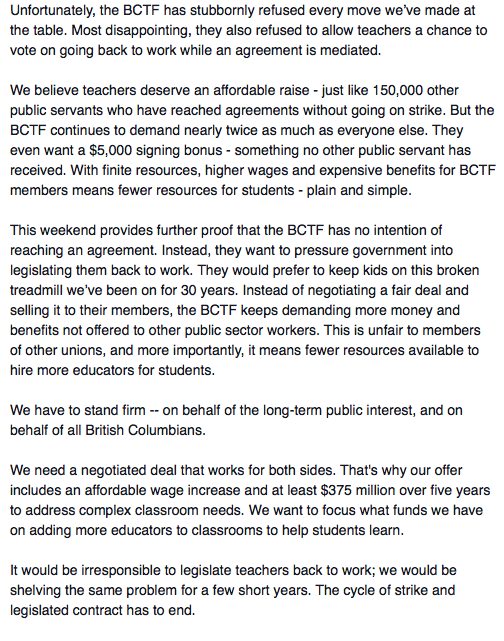


For those who have not eyes to see, here is the concession:
This week I called the head of the BCTF, Jim Iker, and the lead negotiator for school districts, Peter Cameron, to my office. I mapped out a path to settlement: set aside the grievances associated with the ongoing court case. That’s before the court so let the courts decide. Focus instead on the issues we can agree on like wages, benefits and putting more educators into classrooms for students.
Considering the rulings of two previous BC Supreme Court judges on how the BC Liberals have not bargained in good faith with the BCTF, this is an astonishing admission. This statement puts to rest all the rumours that the BC Liberals do not care about the rule of law. That’s because they are no longer rumours. They are a matter of public record.
In fact, to make the record absolutely clear, there has been an even more detailed document dump about the 2011 BC Supreme Court case that made it clear that the BC Liberals acted unconstitutionally when it passed legislation to hamstring the BCTF’s freedom for collective bargaining.
Such developments in the BCTF strike form an interesting rejoinder to Douglas Todd’s column that argued that ‘we must stand on guard for Canada’ because (as he alleges) non-Western immigrants may not share our liberal, Western values of tolerance, multiculturalism, and the rule of law. With the recent (geo)political unrest in Hong Kong, Todd may well be worried that there is a new influx of migration coming from that Special Administrative Region. In fact, there is a very recent piece in the South China Morning Post expressing sentiments that it would probably not be a good idea to live in Hong Kong right now.
However, given a trans-Pacific view that straddles Hong Kong and Vancouver, it seems to me that if migrants were to arrive in Vancouver from Hong Kong, they’d have a lot to teach British Columbians about the rule of law. That’s because the democratic movement that’s been all the rage recently, Occupy Central with Love and Peace, is all about constitutional law.
I will grant you that not every migrant from Hong Kong will be associated with Occupy Central. Far from it: if the SCMP piece is to be believed, many will use migration as an ‘insurance plan’ to avoid geopolitical unrest and potential business instability.
But if things go south with Occupy Central, what’s happening in Hong Kong may also produce a set of political exiles. Those people will have a lot to say about the rule of law. Indeed, they will have a lot to teach the BC Liberals.
In fact, there are some remarkable parallels between the BCTF strike and Occupy Central. In both cases, the democratic parties seek to educate the public about their grievances with a pro-business government. In both cases, the pro-business government then begins to rearticulate these grievances as inimical to the public interest. The public interest, we are told by both Beijing and the BC Liberals, is if business is allowed to remain unhindered and the flow of money stay unobstructed. This is a remarkable political tactic, indeed producing putatively wide-ranging public support.
The problem is that this is not actually an appeal to the public interest. It’s an appeal to the private interests of individual citizens. It is indeed in the interest of individual business owners with investments to have their economic transactions unobstructed. But get the terms right. These are private interests. Therefore, there is no ‘public’ supporting these governments. There are only individual citizens whose interests are for themselves, not for the common public good.
The public interest is the rule of law. That’s because what’s at stake in the rule of law is a society, a people whose association has a constitution, an articulation of what a body politic takes to be the common good. In Hong Kong, the constitution that sets the framework for its ‘one country, two systems’ relationship with the mainland is called Basic Law. In Canada, the constitution, as passed by the 1982 Constitution Act, is called the Charter of Rights and Freedoms.
In Hong Kong, the Occupy Central protesters argue that the Basic Law framework is being eroded because of constitutional violations. As Benny Tai made it known in an interview with Bloomberg, these constitutional violations cannot be dealt with in court. That’s because in 1999, the Ng Ka Ling case, a human rights/migration case that was decided by Hong Kong’s Court of Final Appeal, was overruled by Beijing, demonstrating the limits of ‘one country, two systems’ — certainly, the judiciary is not autonomous. Therefore, when Occupy Central discusses Basic Law’s Article 45, the part that says that Hong Kong people have the political agency to choose their own Chief Executive, the activists realize that Article 45’s integrity is being eroded by an erosion to the ‘one country, two systems’ framework, namely through the White Paper released in June in which Beijing asserted its unequivocal sovereignty over the territory. That’s why Occupy Central is prepared to engage in acts of civil disobedience: it is prepared to use public protests to draw attention to these flaunted constitutional violations.
The same is true for the BCTF. In the 2011 BC Supreme Court case, the judge ruled that the BC Liberals had violated the Charter of Rights and Freedoms by passing legislation that obstructed the BCTF’s right to assembly — and thus collective bargaining. However, what’s at stake between the BCTF and the BC Liberals at the moment is a contract that would do the same thing with two clauses, E80 and E81, that basically eviscerate the teachers’ right to collective bargaining. In other words, just like Beijing, the BC Liberals are publicly flaunting their disregard for the Canadian constitution, which is what is provoking the very public BCTF strike. In fact, the analysis of such constitutional flaunting is fairly damning: it suggests that the BC Liberals are trying to bankrupt the BCTF through a waiting game instead of respecting the rule of law.
What this means is that Douglas Todd points his finger at the wrong people when he asserts that Canadian values are under attack. For Todd, it’s the immigrants. But cast in this light, those from Hong Kong who understand the constitutional issues at stake in Occupy Central have a great deal to say about the importance of the rule of law and constitutional integrity. If they become political exiles, they should be welcomed to British Columbia, precisely because they would make Canada’s constitutional civil society stronger. That’s because unlike the BC Liberals, their experience with Occupy Central means that they would understand that the constitutional rule of law is a public good.
In other words, the clear implication of Todd’s logic to stand on guard for Canada is this: immigrants should be in, and the BC Liberals should be out.
Occupy Central with Love and Peace
Next Post

September 18, 2014 Putting Brad Salzberg First
Browse Our Archives
Select a Category Academia Anglican Communion anti-racism Aristotle Asia-Pacific Asian American Asian Canadian BlackLivesMatter Cantonese Catholic China Chinglican church politics Church-State Politics Civil Society Conservative Eastern Christianity Evangelical Evangelical Left Feminist/Womanist Theology Food Greek-Catholic Church of Kyiv Hong Kong Housekeeping Kyivan Church Latin Catholicism Law Liberal Liberation Theology New Calvinism Pentecostal/Charismatic Protestant Psychoanalysis Publics Religion Ethnicity Wired Secular Sovereignty TPCIU Uncategorized
Select a Month July 2019 June 2019 May 2019 April 2019 March 2019 February 2019 January 2019 December 2018 November 2018 October 2018 September 2018 August 2018 July 2018 June 2018 May 2018 March 2018 February 2018 January 2018 December 2017 November 2017 October 2017 September 2017 August 2017 July 2017 June 2017 April 2017 March 2017 February 2017 January 2017 December 2016 November 2016 October 2016 September 2016 August 2016 July 2016 January 2016 December 2015 November 2015 October 2015 August 2015 April 2015 March 2015 February 2015 December 2014 November 2014 September 2014 August 2014 July 2014 June 2014 May 2014 April 2014 March 2014 December 2013 November 2013 October 2013 September 2013 August 2013 July 2013 June 2013 May 2013 April 2013 March 2013 February 2013 January 2013 December 2012 October 2012 June 2012 May 2012 April 2012 February 2012 January 2012
Follow Us!
TAKE THE
Religious Wisdom Quiz
True or False: Mark records Jesus' birth narrative in Bethlehem.
Select your answer to see how you score.
TRUE FALSE
Related posts from Eastern Catholic Person

I've found my way home: on the unraveling...
Please do not ask me about Jung: for...
To sing the world in a career: on...
Ego and the complicities of the Jesus Prayer:...
TRENDING AT PATHEOS Catholic

Creation, Preservation, and Teleology in Catholic Theology
As I write this, it is very early Monday morning. Like millions...

The Parable Of The Sower And The Word...
One of Christ’s most famous parables is that of the sower who...

Rejecting Doom: Christian Hope And Human Action
Christianity is a religion of hope. We are to have hope and...

Why I Choose the Eucharist Over the Sermon
Choose the Eucharist, Not the Sermon What are we supposed to get...

5 Design Elements Found in Spiritually Rooted Homes
Putting Spirituality Into Home Decor Our homes are more than our living...

Credo: A Story of God Told with the...
About 10 years ago, I began to imagine a personal "Credo" that...
view all Catholic blogs
Ad-Free & Subscriber Log-In Subscription Support
- About Us
- 2026 Calendar
- Videos
- Podcasts
- Library of World Religions
- Faith In Media Tracker
- Advertise With Us
- Write for Us
- Privacy Policy
- Terms of Service
- Do Not Sell My Data
- Contact Us
- Radiant Digital
- Manage Newsletter Subscriptions
- Unsubscribe From Notifications
- Sitemap
Copyright 2008-2026, Patheos. All rights reserved.
Subscription Support Ad-Free & Subscriber Log-In
Follow Patheos