
BuddhistCatholicContemplativeEvangelicalGeneral ChristianHinduJewishLatter-day SaintMuslimNew VisionsProgressive Christian
Beliefs
- Buddhist
- Catholic
- Contemplative
- Evangelical
- General Christian
- Hindu
- Jewish
- Latter-day Saint
- More Voices
- Muslim
- New Visions
- Pagan
- Progressive Christian
Topics
- Religion News
- Food and Religion
- Sports and Religion
- Religious Art
- Religious Music and Entertainment
- Religious Events
- History and Religion
- Style and Religion
- Politics and Religion
- Women in Religion
- Recreation Outdoors and Religion
- Business Finance and Religion
- Careers Workplace and Religion
- Education and Religion
- Family Parenting and Religion
- Health Fitness and Religion
- Home and Religion
- Relationships and Religion
- Technology and Religion
- Travel and Religion
Columnists
- Buddhist Columnists
- Business Finance and Religion Columnists
- Careers Workplace and Religion Columnists
- Catholic Columnists
- Contemplative Columnists
- Education and Religion Columnists
- Evangelists Columnists
- Family Parenting and Religion Columnists
- General Christian Columnists
- Health Fitness and Religion Columnists
- Hindu Columnists
- History and Religion Columnists
- Home and Religion Columnists
- Jewish Columnists
- More Voices Columnists
- Latter Day Columnists
- Muslim Columnists
- New Visions Columnists
- Nonreligious Columnists
- Pagan Columnists
- Politics and Religion Columnists
- Progressive Columnists
- Recreation Outdoors and Religion Columnists
- Relationships and Religion Columnists
- Religion News Columnists
- Religious Art Columnists
- Religious Events Columnists
- Religious Music and Entertainment Columnists
- Sports and Religion Columnists
- Style and Religion Columnists
- Technology and Religion Columnists
- Travel and Religion Columnists
- Women in Religion Columnists
Resource Library
- 2026 Calendar
- Library of World Religions
- The 100 Most Holy Places on Earth
- Patheos Answers
- Podcasts
- Videos
- Faith Leaders Database
- Anglican Episcopalian
- Bahai
- Baptist
- Buddhism
- Christianity
- Confucianism
- Eastern Orthodoxy
- Hinduism
- Holiness and Pentecostal
- ISKCON
- Islam
- Judaism
- Lutheran
- Methodist
- The Church of Jesus Christ of Latter-day Saints
- New Age
- Paganism
- Presbytarian and Reformed
- Protestantism
- Religion Behind the Scenes
- Roman Catholic
- Scientology
- Shia Islam
- Sikhism
- Sufism
- Sunni Islam
- Taoism
- Zen
- See all religions
Research Tools
 Ad-Free & Subscriber Log-In Subscription Support
Ad-Free & Subscriber Log-In Subscription Support
Follow Patheos 

- Trending:
- Forgiveness
- |
- Marriage
- |
- Consciousness
- |
- Death Penalty
- |
- Election
- |
- Halloween
 Eastern Catholic Person
- Home
- Catholic
- Sam Rocha: Love always comes too late.
Sam Rocha: Love always comes too late.
Last updated on: July 28, 2016 at 2:28 am by Justin Tse
Sam Rocha: Love always comes too late. 2016-07-28T02:28:01-07:00 Justin Tse
Patheos Explore the world's faith through different perspectives on religion and spirituality! Patheos has the views of the prevalent religions and spiritualities of the world.
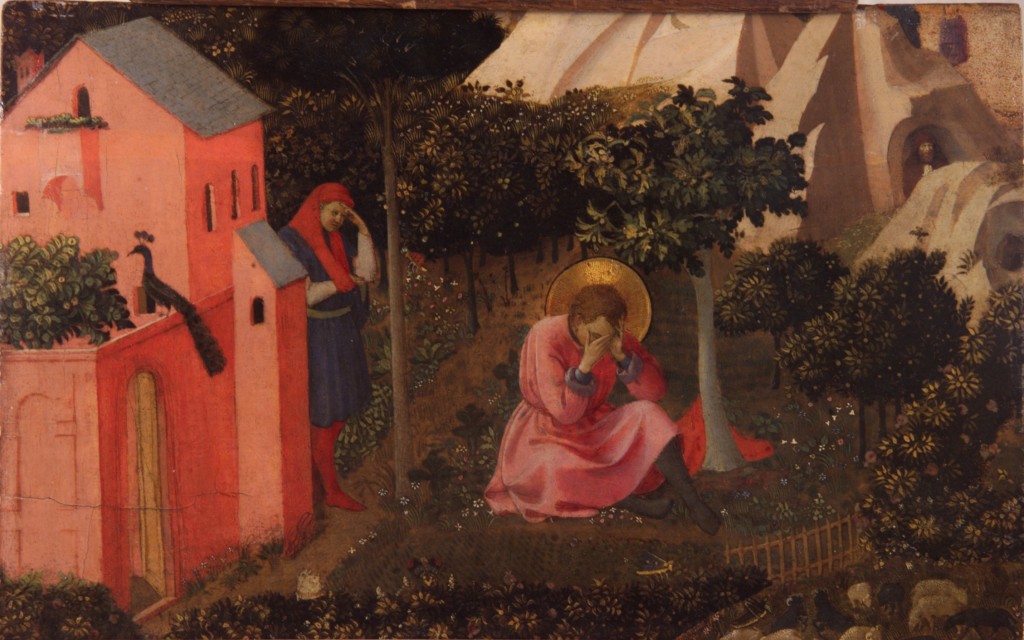
Fra Angelico – The Conversion of St Augustine – Public Domain (Fra_angelico_-_conversion_de_saint_augustin.jpg), via Wikimedia Commons
Let me tell you about my friend Sam Rocha. He has a stellar soul/jazz album called Late to Love that has just come out today from Wiseblood Records. This album has been endorsed by pretty much everyone across the board on Patheos. We might as well talk about him.
The thing is, Sam is not supposed to be a professional musician. He is a philosopher, a philosopher of education, to be precise. He teaches at my alma mater, the University of British Columbia at Vancouver.
What’s more, the philosophy he works on isn’t some rehash of fancy-sounding big-wig European names. Sam hates that stuff. He says that rehashing the big wigs is just talking about philosophy. He’s interested in doing philosophy.
In particular, he’s interested in doing philosophy from the perspective of the poor. That’s what he calls ‘folk phenomenology,’ a philosophical immersion into the perceptive experience of the folk. That’s also what this album is. As a soul, jazz, and blues album, this is the music of the folk, of the racialized, of the poor. (If you want to hear folk music from Sam, check out his EP).
But this album is not only a tribute to the (neo)soul greats on whose shoulders Sam stands. It’s a tribute to Augustine.
Augustine?! some might say, aghast. As one colleague who works on race and religion quipped to me not long ago when I dared to mention the name, Augustine Schmaugustine.
So let me tell you about Augustine and his Confessions.
I first encountered Augustine’s Confessions on my father’s bookshelf. My father, as those who read this blog know, is a Chinese evangelical pastor ordained in the progressive black church. I pulled the book down from the shelf and asked my father whether it was worth my time. He said, ‘Son, you are smarter than I am. I was assigned this book in seminary, but I did not understand it. Maybe you will.’
I was sixteen at the time. I decided to give it a try; after all, the Catholic school I attended had a ten-minute daily ‘sustained silent reading’ time.
I couldn’t get past the first ten pages. It was like nothing I had read before, beautiful theology, yes, and those were the terms I knew to use about Augustine because I didn’t know that Augustine would roll over in his grave if he were called a ‘theologian’ by profession (he was a philosopher). But suddenly, that beautiful theological prose gave way to a nauseating confession that he was a demanding baby who cried a lot. That was annoying. Augustine Schmaugustine.
The next time I heard of Augustine was at the University of British Columbia. I was a history honours student, which meant that my cohort was in a special program where we had lots of seminars, no exams, and about 600 pages of reading a week.
One course I took was called Religion and the Body (with no relation to John Paul II’s theology of the body). It was taught by a historian in the department, Joy Dixon, who specializes in the history of religion and sexuality, particularly around the turn of the twentieth century. I think I learned more in this class that shaped my approach to religious studies than I have in any other class. That’s because in the first class, we had to compare Clifford Geertz’s ‘Religion as a cultural system’ to Robert Orsi’s ‘Snakes alive’: the former had an anthropological account of religion that basically held that it was a symbolic system of induced moods and perceptions, but the latter took seriously the theological imaginations and practices of religious practitioners no matter how distasteful their lived religious practices might seem to the modern gaze. If you read this blog regularly, you can guess into which camp I fall.
And then we read Augustine. To be honest, we didn’t really read the Confessions — we read enough of it and the accompanying literature in order to set up a midterm book report on Leo Steinberg’s Sexuality of Christ in Renaissance Art and in Modern Oblivion. To this day, then, my view of Augustine has been shaped (some may say ‘twisted’) by this approach, as my first impression of Augustine was in fact through an academic article that quoted his Literal Commentary on the Book of Genesis, where Augustine asserts that before the fall, a male erection was voluntary, but after the fall, it became involuntary — and thus irrational, which was a sign of original sin. Having been shaped thus, it disappoints me every time I read the Confessions now that pears, but not erections, are discussed.
The grotesqueness of the previous paragraph has a point. It was around this time that I also encountered the work of Mark Driscoll, for as chance and fate would have it, I happened to be involved in Asian Canadian evangelical circles as well, and that was what was circulating circa 2005 and 2006 — this was in fact prior to the term ‘New Calvinist’ entering the evangelical lexicon, thanks to the work of Collin Hansen. As A Christian Thing’s Chinglican at Table has pointed out, Driscoll made it very apparent that much of his frequent talk about sex had to do with his reading of Catholic tradition as anti-sex:
Driscoll also reads the Tradition’s emphasis on sex as procreative as suggesting that sexual pleasure is gross and sinful, and to wit, he quotes a Canadian Catholic bishops’ statement on chastity and procreative sex as the definitive word from the magisterium that “sex is gross” (Real Marriage, 116). Apparently, he doesn’t have much time for Augustine’s understanding of “concupiscence,” that sin sometimes is when you have too much of a good thing (which is a theme that John of the Cross interestingly carries into The Ascent of Mount Carmel where he says that too much spiritual reading is spiritual gluttony).
In other words, Augustine was seared into Driscoll’s consciousness, and because his materials began circulating in earnest among Asian Canadian evangelical circles at the time, that was another channel by which Augustine’s Confessions circulated to me.
So I decided to read the Confessions. I read it on the bus. I read it at home. I read it on retreats. I annotated it. I picked apart what it was trying to do philosophically. I learned about a guy called Plotinus. I felt sorry for Monica. I discovered that Genesis was actually a pretty important book for Augustine. I finally finished it in a Catholic retreat centre with lots of interfaith trappings because my Chinese Canadian evangelical ‘spiritual grandmother’ wanted to take my friend and me for a undergraduate graduation retreat.
The next time I read the Confessions, I had forsaken the Mark Driscoll ‘New Calvinist’ craze (the term had by then come out) in an effort to experiment with the phenomenon of ‘evangelicals getting high‘ (church). To date, one of the most striking analyses of that ‘evangelicals getting high’ movement has been by a feminist blogger who observes that the hard gender roles prescribed by the New Calvinists often get imported into the practices of those who become Anglican, Catholic, or Orthodox. But these were again the days before this phenomenon had a name, and these were also the days when I began in my academic work to become convinced by feminist geographers that the division between public and private spheres were incredibly gendered.
I read the Confessions then because I was taking an online class on the History of Christianity from Regent College, which is a Christian graduate school on the campus of the University of British Columbia where I was doing my real graduate work. The assignment was to read the Confessions and then wrestle personally with it. I won’t tell you how I wrestled with it — that’s private — but on this reading of the Confessions, I finally felt like I moved past my own ideological blinkers and let Augustine talk to me, even though, because of my increasing feminist commitments, I shuddered every so often at how he would talk about women.
A year went by, and I discovered that in the midst of doing academic work, I needed to take weekly breaks for self care. Enter the Confessions again. I remember taking the book out on a long walk in Steveston (ahem, Storybrooke!), sitting on a bench, and reading the whole thing for some eight straight hours with Brooke Fraser’s album Albertine playing in my headphones. That was a bit of a trip.
Back to Sam Rocha.
By the time I met Sam Rocha, I was a newly minted PhD. A PhD does strange things to oneself. For example, because I researched how Chinese Christians in the Pacific region became so privatized and yet tried to engage the public sphere, I became extremely conscious of geographical processes by which communities come to see themselves as private. Because my research subjects were grappling with complicated issues in sexuality politics, democracy movements, postcolonial agency, and the fuzzy line between ‘religion’ and the ‘secular,’ I had to deal with all of these things too, which meant that my academic work became a source of transformation for me.
All that is to say that when I met Sam Rocha, I discovered that he and I talked the same way. We had the same intuitions about racialization, postcolonialism, democratic participation, secularities, and critical theory, except he was coming at it from a philosophical perspective whereas because of my geographical training under David Ley, I always wanted to get the hard qualitative empirical data through fieldwork, key informant interviews, focus groups, and archival research. I also discovered that Sam was the new hire in philosophy of education at my alma mater, the University of British Columbia.
He then dropped into a conversation that he — the folk phenomenologist — was working on a soul/jazz album on Augustine’s Confessions. My jaw hit the floor.
Read through my account of how I encountered Augustine’s Confessions again. My encounter with Augustine has been a very modern, even elitist, encounter with him — surpassing my Chinese father who couldn’t understand him in seminary, setting up academic theory, reinforcing gender categories, moving on up the liturgical ladder, caring for the interior soul. No wonder my colleague in race and religion said, Augustine Schmaugustine — Augustine is the path to elite advancement as I encountered him, not as the voice of the poor and the racialized.
And here comes Sam Rocha to insist that Augustine speaks soul, jazz, and blues fluently. Coming right to the very university where I encountered Augustine in all these various ways, Sam Rocha’s Late to Love hits me right where it hurts, because he suggests that if we read Augustine to reinforce our racial hierarchies, gender norms, and class privileges, then we have seriously misread Augustine. It’s often quipped that Augustine was himself an African, a claim that scholars of race take as a bit of a farce because he predates the modern invention of the color line. But Sam even intuits this — I don’t think he intends to incorporate it — as he sings, ‘Late / have I loved you / Beauty so old / Beauty so new.’
I sing along. I even dance. It’s because Sam has made me realize that I am very late to love with my twisted readings of St. Augustine. In the words of James Baldwin:
Try to imagine how you would feel if you woke up one morning to find the sun shining and all the stars aflame. You would be frightened because it is out of the order of nature. Any upheaval in the universe is terrifying because it so profoundly attacks one’s sense of one’s own reality. (The Fire Next Time, in Baldwin: Collected Essays, p. 294).
Baldwin wrote this about race in America, about why the possibilities of actions born of love to re-imagine the racial order in America has always stalled.
Come to think of it, everything I have just written is actually about race. Sam would wink at me. He knows that Late to Love is music that is fundamentally about race.
POSTSCRIPT: Because I seldom write so personally on Religion Ethnicity Wired, some may wonder how I came to use this style. It’s Sam Rocha’s fault. If his album is a tribute to St. Augustine, my post is a tribute to Sam’s final talk at Wabash College.
University of British Columbia
Previous Post

August 28, 2014
In praise of Vicky Beeching, evangelical Anglican (Part 2)
Next Post

August 29, 2014 EXAM REVIEW: Hong Kong's Occupy Central with Love and Peace
Browse Our Archives
Select a Category Academia Anglican Communion anti-racism Aristotle Asia-Pacific Asian American Asian Canadian BlackLivesMatter Cantonese Catholic China Chinglican church politics Church-State Politics Civil Society Conservative Eastern Christianity Evangelical Evangelical Left Feminist/Womanist Theology Food Greek-Catholic Church of Kyiv Hong Kong Housekeeping Kyivan Church Latin Catholicism Law Liberal Liberation Theology New Calvinism Pentecostal/Charismatic Protestant Psychoanalysis Publics Religion Ethnicity Wired Secular Sovereignty TPCIU Uncategorized
Select a Month July 2019 June 2019 May 2019 April 2019 March 2019 February 2019 January 2019 December 2018 November 2018 October 2018 September 2018 August 2018 July 2018 June 2018 May 2018 March 2018 February 2018 January 2018 December 2017 November 2017 October 2017 September 2017 August 2017 July 2017 June 2017 April 2017 March 2017 February 2017 January 2017 December 2016 November 2016 October 2016 September 2016 August 2016 July 2016 January 2016 December 2015 November 2015 October 2015 August 2015 April 2015 March 2015 February 2015 December 2014 November 2014 September 2014 August 2014 July 2014 June 2014 May 2014 April 2014 March 2014 December 2013 November 2013 October 2013 September 2013 August 2013 July 2013 June 2013 May 2013 April 2013 March 2013 February 2013 January 2013 December 2012 October 2012 June 2012 May 2012 April 2012 February 2012 January 2012
Follow Us!
TAKE THE
Religious Wisdom Quiz
How many men did Gideon keep from the 32,000?
Select your answer to see how you score.
400 500 200 300
Related posts from Eastern Catholic Person

I've found my way home: on the unraveling...

The Bay Area of the nineties is where...

This time, I have a tradition: on solidarity...

Home is where your food is: a speech...
TRENDING AT PATHEOS Catholic

Rejecting Doom: Christian Hope And Human Action
Christianity is a religion of hope. We are to have hope and...

It’s What Comes From Within Which Matters
One of the most difficult things for us to understand is why...

Why I Choose the Eucharist Over the Sermon
Choose the Eucharist, Not the Sermon What are we supposed to get...

5 Design Elements Found in Spiritually Rooted Homes
Putting Spirituality Into Home Decor Our homes are more than our living...

Credo: A Story of God Told with the...
About 10 years ago, I began to imagine a personal "Credo" that...

The Anatomy of Divine Revelation in Catholic Thought
The claim that God has made Himself known to human beings is...
view all Catholic blogs
Ad-Free & Subscriber Log-In Subscription Support
- About Us
- 2026 Calendar
- Videos
- Podcasts
- Library of World Religions
- Faith In Media Tracker
- Advertise With Us
- Write for Us
- Privacy Policy
- Terms of Service
- Do Not Sell My Data
- Contact Us
- Radiant Digital
- Manage Newsletter Subscriptions
- Unsubscribe From Notifications
- Sitemap
Copyright 2008-2026, Patheos. All rights reserved.
Subscription Support Ad-Free & Subscriber Log-In
Follow Patheos