
BuddhistCatholicContemplativeEvangelicalGeneral ChristianHinduJewishLatter-day SaintMuslimNew VisionsProgressive Christian
Beliefs
- Buddhist
- Catholic
- Contemplative
- Evangelical
- General Christian
- Hindu
- Jewish
- Latter-day Saint
- More Voices
- Muslim
- New Visions
- Pagan
- Progressive Christian
Topics
- Religion News
- Food and Religion
- Sports and Religion
- Religious Art
- Religious Music and Entertainment
- Religious Events
- History and Religion
- Style and Religion
- Politics and Religion
- Women in Religion
- Recreation Outdoors and Religion
- Business Finance and Religion
- Careers Workplace and Religion
- Education and Religion
- Family Parenting and Religion
- Health Fitness and Religion
- Home and Religion
- Relationships and Religion
- Technology and Religion
- Travel and Religion
Columnists
- Buddhist Columnists
- Business Finance and Religion Columnists
- Careers Workplace and Religion Columnists
- Catholic Columnists
- Contemplative Columnists
- Education and Religion Columnists
- Evangelists Columnists
- Family Parenting and Religion Columnists
- General Christian Columnists
- Health Fitness and Religion Columnists
- Hindu Columnists
- History and Religion Columnists
- Home and Religion Columnists
- Jewish Columnists
- More Voices Columnists
- Latter Day Columnists
- Muslim Columnists
- New Visions Columnists
- Nonreligious Columnists
- Pagan Columnists
- Politics and Religion Columnists
- Progressive Columnists
- Recreation Outdoors and Religion Columnists
- Relationships and Religion Columnists
- Religion News Columnists
- Religious Art Columnists
- Religious Events Columnists
- Religious Music and Entertainment Columnists
- Sports and Religion Columnists
- Style and Religion Columnists
- Technology and Religion Columnists
- Travel and Religion Columnists
- Women in Religion Columnists
Resource Library
- 2026 Calendar
- Library of World Religions
- The 100 Most Holy Places on Earth
- Patheos Answers
- Podcasts
- Videos
- Faith Leaders Database
- Anglican Episcopalian
- Bahai
- Baptist
- Buddhism
- Christianity
- Confucianism
- Eastern Orthodoxy
- Hinduism
- Holiness and Pentecostal
- ISKCON
- Islam
- Judaism
- Lutheran
- Methodist
- The Church of Jesus Christ of Latter-day Saints
- New Age
- Paganism
- Presbytarian and Reformed
- Protestantism
- Religion Behind the Scenes
- Roman Catholic
- Scientology
- Shia Islam
- Sikhism
- Sufism
- Sunni Islam
- Taoism
- Zen
- See all religions
Research Tools
 Ad-Free & Subscriber Log-In Subscription Support
Ad-Free & Subscriber Log-In Subscription Support
Follow Patheos 

- Trending:
- Forgiveness
- |
- Marriage
- |
- Consciousness
- |
- Death Penalty
- |
- Election
- |
- Halloween
 Eastern Catholic Person
- Home
- Catholic
- If #WeAreN, then solidarity with the dispossessed is a must
If #WeAreN, then solidarity with the dispossessed is a must
Last updated on: July 28, 2016 at 1:49 am by Justin Tse
If #WeAreN, then solidarity with the dispossessed is a must 2016-07-28T01:49:08-07:00 Justin Tse
Patheos Explore the world's faith through different perspectives on religion and spirituality! Patheos has the views of the prevalent religions and spiritualities of the world.
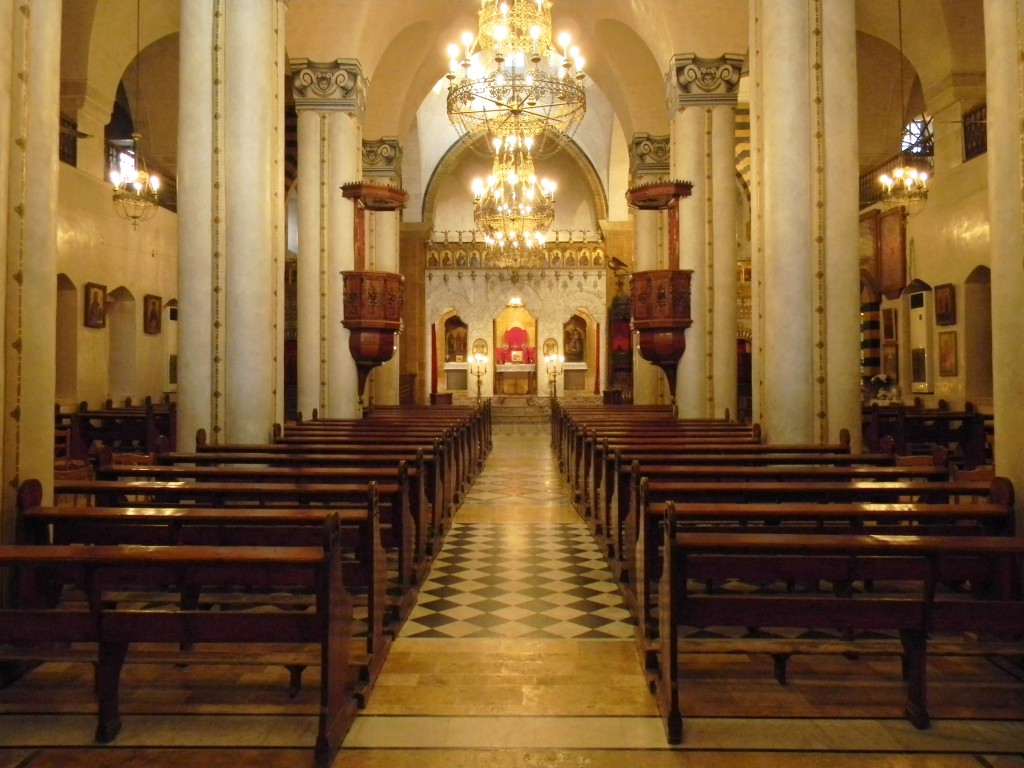
Holy Virgin Melkite Greek Cathedral of Aleppo – by Preacher lad (Holy Virgin Melkite Greek Cathedral of Aleppo, interior view.JPG) [GFDL (https://commons.wikimedia.org/wiki/Commons:GNU_Free_Documentation_License,_version_1.2 and https://creativecommons.org/licenses/by-sa/3.0/deed.en), via Wikimedia Commons
I have been reluctant to join #WeAreN because I am not sure that the Islamic State’s objectives merely center on Christian persecution.
I am a Christian. My views are fairly ecumenical, broadly catholic, generally evangelical, and politically comical, and in the next week or so, I will probably participate in some prayer meetings regarding the Islamic State and the situation in Iraq and Syria. I am writing this to clarify exactly what I am doing and what I am not doing.
I am not participating in an assertion of Christian identity politics. That would go against everything that Christian theology stands for.
It is so easy for something like #WeAreN to get co-opted into the game of religious identity politics. It is easy for those who believe that Christians are getting the stiff end of the rope in North America due to stances on human sexuality and religious freedom to make that the bond of solidarity with those who are being marked for the sword by the Islamic State. It is easy to attend a prayer meeting to express this solidarity, thinking that we in North America know what they are going through.
I reject this kind of solidarity. For one, the inflated rhetoric about Christian persecution happening in North America and Western Europe would make this sort of solidarity a global laughingstock. For another, this sort of irresponsible talk fails to take into account the actual solidarities that Christians have, as well as the complicities that Christians in North America share, in the making of the geopolitical terrors at which we currently weep.
I find my rejection of the inflated rhetoric of persecution corroborated by the originator of the #WeAreN hashtag and the Arabic ‘N’ Facebook campaign, Jeremy Courtney. While his open-heart surgery organization, Preemptive Love, makes dubious reference to neoconservative military doctrine, his comments interestingly veer in a pacifist direction:
We need a long-term plan, not just a short-term fix. There are agencies helping Christians, Yezidis, Turkmen, Shabak and others, and those services are necessary. But this isn’t only about what Obama or Maliki must do now. The Christian church needs to reconsider its relationship with violence; that is part of what has landed us and others in this dire situation. We cannot carp about Christian persecution and not talk about violence and our use of violent solutions. We need a 40- to 50-year plan so that when the time comes to overthrow the next dictator, we are not as blind to our own complicity and stuck with short-term gains.
In other words, Courtney himself rejects the notion that the #WeAreN campaign is a solidarity campaign based on religious identity and what Candida Moss calls ‘the myth of persecution.’ If anything, it is a confession of complicity, in which Christians must own up to our problematic assertions of colonial privilege for the last millennia — and if Anabaptist theologians are to be believed, since Constantine.
What am I doing when I go to a prayer meeting that is purportedly for the ‘persecuted church,’ then? First, I am there for confession. But second, and more importantly, I am there to practice what Andy Smith calls the ‘politics of rearticulation.’
If indeed the founding moment of Christian theology is in the dispossession of the God we claim to have become flesh, then it is crucial to stress the Christian church’s solidarity with the dispossessed — what liberation theologians have claimed as the ‘preferential option for the poor.’ This kind of solidarity would not be based on the identity politics of the group of people called ‘the Christian church’ that is being ‘persecuted.’ It would instead be based on how the Christian church is a vehicle by which the truth of the violence of the world is revealed.
If indeed Courtney is correct to say that Christians ourselves have been perpetrators of violence, then confession is not enough. To attend a prayer meeting for the persecuted church in Iraq and to believe that praying for so narrow a petition is sufficient would be to miss the point entirely. To practice the politics of rearticulation would be to unfocus this geographical focus.
If indeed Christian complicity with colonial violence is the elephant in the room, then fuller confessions must be made and deeper solidarities must be formed. As Courtney rightly hints, to pray for the persecuted Christian church would be overly narrow because the Islamic State is bent on cleansing its territory of all religious minorities. To pray simply about ‘Christian persecution’ when this larger issue looms so insidiously would be to miss the theological point that Christian theology is founded on dispossession and that the real issue is that the Islamic State has reduced religion to a identity politics. To play the identity/solidarity game would be to play by the same rules as the Islamic State.
But deeper still, Iraq would not be the only issue. The situation in the Gaza Strip would also require our prayers, as would the developing racial situation in Ferguson — and from those extensions of police brutality, we would also have to remember democratic struggles in Hong Kong and Taiwan, as well as the assertions of indigenous sovereignty in the Americas. Hannah Arendt is correct in The Origins of Totalitarianism to point out that the tactics of colonization in the making of global empire do not merely remain ‘over there’ — they come home to roost in the making of totalitarian regimes ‘over here.’
In other words, if I do end up going to a prayer meeting for ‘the persecuted church,’ I am attending subversively. I would be making a public statement to reject Christian colonial privilege. Without such rejection, solidarity with the dispossessed is simply not possible.
POSTSCRIPT: Because one of the prayer meetings I plan to attend is being conducted by evangelicals, I hope we’ll sing some Vicky Beeching songs.

Next Post

August 15, 2014 Assuming Catholic Geopolitics
Browse Our Archives
Select a Category Academia Anglican Communion anti-racism Aristotle Asia-Pacific Asian American Asian Canadian BlackLivesMatter Cantonese Catholic China Chinglican church politics Church-State Politics Civil Society Conservative Eastern Christianity Evangelical Evangelical Left Feminist/Womanist Theology Food Greek-Catholic Church of Kyiv Hong Kong Housekeeping Kyivan Church Latin Catholicism Law Liberal Liberation Theology New Calvinism Pentecostal/Charismatic Protestant Psychoanalysis Publics Religion Ethnicity Wired Secular Sovereignty TPCIU Uncategorized
Select a Month July 2019 June 2019 May 2019 April 2019 March 2019 February 2019 January 2019 December 2018 November 2018 October 2018 September 2018 August 2018 July 2018 June 2018 May 2018 March 2018 February 2018 January 2018 December 2017 November 2017 October 2017 September 2017 August 2017 July 2017 June 2017 April 2017 March 2017 February 2017 January 2017 December 2016 November 2016 October 2016 September 2016 August 2016 July 2016 January 2016 December 2015 November 2015 October 2015 August 2015 April 2015 March 2015 February 2015 December 2014 November 2014 September 2014 August 2014 July 2014 June 2014 May 2014 April 2014 March 2014 December 2013 November 2013 October 2013 September 2013 August 2013 July 2013 June 2013 May 2013 April 2013 March 2013 February 2013 January 2013 December 2012 October 2012 June 2012 May 2012 April 2012 February 2012 January 2012
Follow Us!
TAKE THE
Religious Wisdom Quiz
Who anointed David as king as a boy?
Select your answer to see how you score.
Samuel Saul Moses Nathan
Related posts from Eastern Catholic Person

I've found my way home: on the unraveling...

Patriyarkhat: 'Attending to the movements of my heart'

I'm flattered to be named an Asian American...

The secular does not stop when your drive...
TRENDING AT PATHEOS Catholic

Creation, Preservation, and Teleology in Catholic Theology
As I write this, it is very early Monday morning. Like millions...

The Parable Of The Sower And The Word...
One of Christ’s most famous parables is that of the sower who...

Rejecting Doom: Christian Hope And Human Action
Christianity is a religion of hope. We are to have hope and...

Why I Choose the Eucharist Over the Sermon
Choose the Eucharist, Not the Sermon What are we supposed to get...

5 Design Elements Found in Spiritually Rooted Homes
Putting Spirituality Into Home Decor Our homes are more than our living...

Credo: A Story of God Told with the...
About 10 years ago, I began to imagine a personal "Credo" that...
view all Catholic blogs
Ad-Free & Subscriber Log-In Subscription Support
- About Us
- 2026 Calendar
- Videos
- Podcasts
- Library of World Religions
- Faith In Media Tracker
- Advertise With Us
- Write for Us
- Privacy Policy
- Terms of Service
- Do Not Sell My Data
- Contact Us
- Radiant Digital
- Manage Newsletter Subscriptions
- Unsubscribe From Notifications
- Sitemap
Copyright 2008-2026, Patheos. All rights reserved.
Subscription Support Ad-Free & Subscriber Log-In
Follow Patheos