
BuddhistCatholicContemplativeEvangelicalGeneral ChristianHinduJewishLatter-day SaintMuslimNew VisionsProgressive Christian
Beliefs
- Buddhist
- Catholic
- Contemplative
- Evangelical
- General Christian
- Hindu
- Jewish
- Latter-day Saint
- More Voices
- Muslim
- New Visions
- Pagan
- Progressive Christian
Topics
- Religion News
- Food and Religion
- Sports and Religion
- Religious Art
- Religious Music and Entertainment
- Religious Events
- History and Religion
- Style and Religion
- Politics and Religion
- Women in Religion
- Recreation Outdoors and Religion
- Business Finance and Religion
- Careers Workplace and Religion
- Education and Religion
- Family Parenting and Religion
- Health Fitness and Religion
- Home and Religion
- Relationships and Religion
- Technology and Religion
- Travel and Religion
Columnists
- Buddhist Columnists
- Business Finance and Religion Columnists
- Careers Workplace and Religion Columnists
- Catholic Columnists
- Contemplative Columnists
- Education and Religion Columnists
- Evangelists Columnists
- Family Parenting and Religion Columnists
- General Christian Columnists
- Health Fitness and Religion Columnists
- Hindu Columnists
- History and Religion Columnists
- Home and Religion Columnists
- Jewish Columnists
- More Voices Columnists
- Latter Day Columnists
- Muslim Columnists
- New Visions Columnists
- Nonreligious Columnists
- Pagan Columnists
- Politics and Religion Columnists
- Progressive Columnists
- Recreation Outdoors and Religion Columnists
- Relationships and Religion Columnists
- Religion News Columnists
- Religious Art Columnists
- Religious Events Columnists
- Religious Music and Entertainment Columnists
- Sports and Religion Columnists
- Style and Religion Columnists
- Technology and Religion Columnists
- Travel and Religion Columnists
- Women in Religion Columnists
Resource Library
- 2026 Calendar
- Library of World Religions
- The 100 Most Holy Places on Earth
- Patheos Answers
- Podcasts
- Videos
- Faith Leaders Database
- Anglican Episcopalian
- Bahai
- Baptist
- Buddhism
- Christianity
- Confucianism
- Eastern Orthodoxy
- Hinduism
- Holiness and Pentecostal
- ISKCON
- Islam
- Judaism
- Lutheran
- Methodist
- The Church of Jesus Christ of Latter-day Saints
- New Age
- Paganism
- Presbytarian and Reformed
- Protestantism
- Religion Behind the Scenes
- Roman Catholic
- Scientology
- Shia Islam
- Sikhism
- Sufism
- Sunni Islam
- Taoism
- Zen
- See all religions
Research Tools
 Ad-Free & Subscriber Log-In Subscription Support
Ad-Free & Subscriber Log-In Subscription Support
Follow Patheos 

- Trending:
- Forgiveness
- |
- Marriage
- |
- Consciousness
- |
- Death Penalty
- |
- Election
- |
- Halloween
 Eastern Catholic Person
- Home
- Catholic
- ‘We Are Pissed Off Too!’ #HongKong #OccupyCentral #TPCIU
‘We Are Pissed Off Too!’ #HongKong #OccupyCentral #TPCIU
Last updated on: July 27, 2016 at 10:22 pm by Justin Tse
‘We Are Pissed Off Too!’ #HongKong #OccupyCentral #TPCIU 2016-07-27T22:22:37-07:00 Justin Tse
Patheos Explore the world's faith through different perspectives on religion and spirituality! Patheos has the views of the prevalent religions and spiritualities of the world.
On March 3, 2012, I marched from Hong Kong’s Victoria Park with a bunch of Christians under a banner that read, ‘We Are Pissed Off Too!’
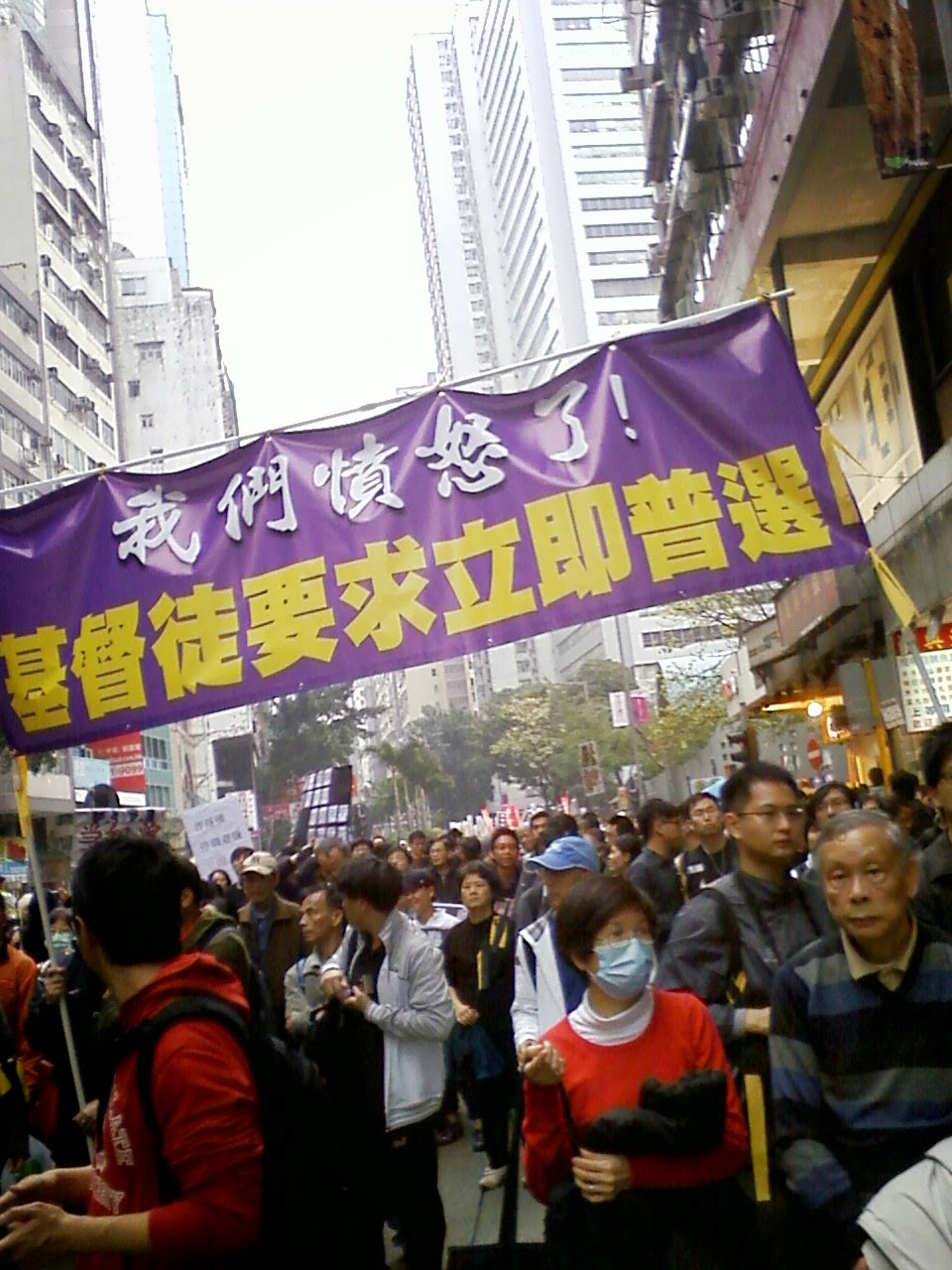
Photo by me
I was in the thick of field work in Hong Kong. For all the legends that I’d heard about Victoria Park and its history as a site for democratic demonstrations, I’d never actually been to Victoria Park, and as much as I wanted to be at the prayer meeting prior to the protest that was happening that day — it was the one where the people of Hong Kong called for the resignation of Chief Executive Donald Tsang after he had been discovered to be in collusion with Triads in Macau — I got lost.
I am obviously not really from Hong Kong. Thank God for other tardy friends. Because of them, I made it for the more colourful parts of the prayer meeting.
I’m writing this because I want to talk about why what is happening in Hong Kong is important, especially to those of us across the water. Like many of my friends and colleagues in North America, it wasn’t until I actually did the research that I discovered that there’s much that I should care about — the insanely #TPCIU Chief Executive elections in March 2012, the National Education controversy, the development of Occupy Central, Ms Lam’s WTF incident, protests around media channels, the physical assault of the former Ming Pao editor, the PopVote of 22-29 June, and this most recent 7/1 Demonstration.
And that’s just in the last two years.
Here’s a quick no-nonsense summary to catch you up if you’re not up to speed. I’ll put it in italics so that when you share this with all your friends, this part will stand out:
As Hong Kong returned under the sovereignty of the People’s Republic of China (PRC) in 1997 from over a hundred years of British colonial rule, the incoming government of Hong Kong worked with various civil societies to draft a constitution called Basic Law. The overall legal framework is that Hong Kong exists in a ‘one country, two systems’ arrangement with Beijing’s central government, which means that Hong Kong is a Special Administrative Region of China that makes policies that are in line with Basic Law as a legal constitution.
Most of the public controversies in Hong Kong since 1997 revolve around how Basic Law is actually put to work and whether Beijing is actually respecting Hong Kong’s autonomy under the ‘one country, two systems’ framework. Here are some examples:
- In 1999, the Court of Final Appeal case Ng Ka Ling v. Director of Immigration decided that children born of mothers not registered in Hong Kong still have the right of abode in Hong Kong as a basic human right. The ‘right of abode’ engages Article 24 of Basic Law. After the case was decided, the government of Hong Kong alleged that giving the right of abode to these kids would become a huge economic burden on Hong Kong. They sent the case up to Beijing’s National People’s Congress, where the decision was reversed. This meant two things: 1) Hong Kong’s judicial autonomy was undermined, and 2) economic conveniences trump human rights. In a related case, Filipina/o domestic workers were denied the right of abode even though they had abided by Article 24’s ‘seven year’ provision (i.e. anyone who has lived and worked in Hong Kong for seven years has the right of abode).
- In 2003, the Hong Kong Government started drafting anti-sedition legislation based on Basic Law’s Article 23. This led to a public outcry about press, speech, and religious freedoms, particularly as the legislation also had provisions to suppress various sects (implicitly, the Falun Gong). On 1 July 2003, the first 7/1 Demonstration brought a conservative estimate of 500,000 people onto the streets of Hong Kong to protest. This was the largest public protest in Hong Kong since the ‘Million Person March’ that happened on 4 June 1989 to protest Beijing’s actions in violently suppressing the student movement in Tiananmen Square.
- Basic Law’s Article 45 has a provision that states that Hong Kong will gradually transition toward democratic elections of its Chief Executive. The transition has been through an Election Committee, drawing initially 800 (later 1200) members from various sectors of civil society, to elect the Chief Executive. However, Beijing has repeatedly delayed universal suffrage in Hong Kong, first in 2005, then in 2007, and has now promised universal suffrage in 2017, but only among candidates chosen by the government without a civil nomination. In other words, there are accusations that Beijing and the Hong Kong government are both stalling and fudging Article 45. The question, in other words, is not whether Hong Kong should become a democracy, but when the constitutional guarantee that Hong Kong will be an autonomous democracy in a ‘one country, two systems’ arrangement will be realized.
These constitutional controversies bring us up to the last two years. The 2012 Chief Executive election was a political spectacle that revealed that both the sitting Chief Executive, Donald Tsang, and the two viable candidates, Henry Tang and C.Y. Leung, were all given to corruption of some sort — Tsang by associating with tycoons and triads, Tang by building an illegal structure at his home (he blamed his wife — and then it was revealed that he had had a mistress!), and Leung by being allegedly a secret Community Party member, allegedly proposing violent force to crack down on the 2003 7/1 Demonstration, and definitely also having an illegal structure in his house too (although this was discovered after the election). Despite the public unveiling of such corruption, the 1200-person Election Committee elected Leung as the Chief Executive. You can imagine how popular he has been.
Under Leung’s watch, there have been various episodes in which Beijing has been tightening its grip. The most clear one came in the summer of 2012, when a national education curriculum proposed by Beijing was decried by Hongkongers as a ‘brainwashing’ campaign. Also, with the various clarifications about the future Chief Executive candidates, the whole idea of democracy in Hong Kong is looking like it will have some serious ‘Chinese characteristics’ — and by that, one does not mean ‘cultural’ characteristics, but the unique political characteristic of everything being centrally orchestrated by Beijing.
Enter Occupy Central, or more properly, Occupy Central with Love and Peace. While pro-democratic activism has gone on for a long time and comprises many civil society groups that range the gamut from left to right, Occupy Central refocuses the key question on precisely what Basic Law means, what ‘one country, two systems’ means, and whether a democratic polity that abides by international standards per Article 45 can actually be achieved. This core question — phrased almost like an academic research question — is hardly a surprising approach given that the mastermind behind Occupy Central is University of Hong Kong constitutional law professor, Benny Tai Yiu-ting. Along with Chai Wan Baptist Church’s pastor emeritus Rev. Chu Yiuming and Chinese University sociologist Chan Kin-man, Tai has organized a series of events focused on educating the Hong Kong public as to what a ‘deliberative democracy’ looks like. Called ‘Deliberation Days’ (or in colloquy, ‘D-Days’), Occupy Central’s events attempt to bring together Hong Kong citizens to deliberate — i.e. to argue with each other and to hear each other’s different opinions — over how the Chief Executive should be elected. While the end goal is universal suffrage, Tai’s democratic public is not organized only by voting citizens, but deliberating citizens. From these deliberations, three proposals have emerged from various civil society groups as to how the elections should be conducted; all of them involve a civic nomination, i.e. instead of Beijing choosing the candidates, the candidates should be nominated by the people. These three proposals were put to vote between 22-29 June 2014 in an unofficial poll known as PopVote. The timing couldn’t have been better, as shortly before PopVote, Beijing’s State Council issued a white paper clarifying Beijing’s sovereignty over Hong Kong in the practice of ‘one country, two systems.’ In the ensuing furor, almost 800,000 votes were cast, a proposal was chosen, and the entire affair was roundly condemned by Beijing as ‘illegal’ (though Tai has said that he’s not precisely sure what exactly is ‘illegal’ about it, other than it is being called illegal). This year’s 1 July Demonstration has in turn focused on the question of Hong Kong’s autonomy, and a student group Scholarism also organized a rehearsal occupation of Chater Road, from which 511 people were arrested. This is because Tai has said that the end game of Occupy Central, should the Beijing government not heed the voice of the people, is to perform civil disobedience acts to occupy the Central district, i.e. the downtown central business district, later this year.
So that’s what we have on the table: Basic Law. One country, two systems. Political corruption. Occupy Central. All of these are constitutional questions.
Why do I care?
It’s not like I’m obligated to care, of course. Asian Australian scholar Ien Ang’s brilliant On Not Speaking Chinese puts a definitive end to any of that careless talk about how all Chinese people around the world should care about Chinese things because it’s in their blood. Really? she basically asks. After all, what does it mean to be ‘Chinese’? What does it mean to be part of a so-called ‘diaspora’ called Chinese when one hardly considers ‘the motherland’ to be China? What kind of logic, except a dangerously racist one, drives the notion that the Chinese care about the Chinese because they are Chinese by blood? Ang’s answer is that the ‘Chinese diaspora’ is a fiction, a claim corroborated by geographers Laurence Ma and Carolyn Cartier, and that appealing to ‘Chineseness’ as a claim to obligatory concern about all things happening to Chinese people in the world, especially in Greater China, not only holds very little water, but is an unnecessary distraction from the more necessary politics of ethnic Chinese people getting involved in their local civil societies — a form of participation which in turn will likely have a greater global impact. That’s exactly what I found during my PhD, by the way. Far from there being deep transnational political solidarities among Cantonese-speaking Protestants across San Francisco, Vancouver, and Hong Kong, one of my major findings was that Chinese Christians in San Francisco tend to be concerned about San Francisco things, Vancouver about Vancouver things, and Hong Kong about Hong Kong things. Not only is Ang perceptive at a prescriptive level, she is correct at an empirical one too.
The problem, though, is that I really do care about the recent events in Hong Kong.
Maybe it’s a function of the field work that I did in 2012, but more broadly, I think it’s because the transnational solidarities that should be developed with the nearly 800,000 people of Hong Kong who voted in the PopVote and the conservatively-estimated 510,000 who hit the streets on 1 July should not be based on some sort of racial fiction. There is a much more important linkage at stake.
That’s the question of whether private economic conveniences trump public political agency.
The public debate around the movement Occupy Central with Love and Peace, as well as around pro-democratic activism in Hong Kong more generally, tends to swirl around this question. Is it wise to disrupt business in a major economic hub for political purposes? some ask. Are ‘illegal’ acts ever justified? Should the public peace be disrupted for the sake of democracy?
But you see what kind of peace is being discussed here? The peace here needs a translation because what is meant by ‘peace’ is not all that meets the eye. It is the peace to conduct business freely and securely. It is the sort of peace that scholars of neoliberal political economies — that is, economic systems in which the state simply yields to market forces by providing police security for the market — have long decried as a sort of peace by violence, using fears, threats, and police surveillance to stifle dissent in the name of guaranteeing market freedoms.
What Tai, and much of Hong Kong civil society, sees through is that this sort of neoliberal peace is not peace at all. It’s premised on what geographer David Harvey calls ‘creative destruction.’ Just before the 7/1 Demonstration, an incident unrelated to Occupy Central took place in the halls of Legislative Council (LegCo). In the half-hour before chambers closed, LegCo forced a vote on whether existing villages in the New Territories should be razed to make room for two new towns. Reminiscent of the 2010 events in which a village, Choi Yuen Chuen, was razed to make room for a Pearl River Delta high-speed rail, this event galvanized democratic activists because — though this had nothing to do with Occupy Central and universal suffrage concerns — the premise of this issue was the same: when market forces are given freedom, it is the freedom to perform creative destruction at the people’s expense.
What is happening in Hong Kong, then, is of vital concern to all who contest current modes of neoliberal creative destruction and censorship around the world, regardless of race and ethnicity. From the contests around higher education in North America to advocacy for prison reform to solidarities for indigenous sovereignty, the overarching backdrop of neoliberalism links these various movements such that those who work for the revitalization of truly vibrant democratic public spheres over against faux democracies in which market actors and state officials in collusion with them consistently censor dissent must recognize their deep solidarities with each other.
In other words, Hong Kong is not only a place that Chinese people care about. Indeed, to chalk up authoritarianism, censorship, and creative destruction to some essentialist ‘Chinese culture’ is fudging at best and racist at worst. What is at stake in Hong Kong is nothing short of the same contestations around the ‘private consensus’ elsewhere. Its current politics must be recognized as vital to everyone who cares about how real public spheres are constituted. After all, if indeed our public spheres are democratically constituted, how then is the logic of the market sovereign?
#TPCIU
Ng Ka Ling v Director of Immigration
Previous Post

June 30, 2014
Chinglican Christianity: Sanctorum Communio
Browse Our Archives
Select a Category Academia Anglican Communion anti-racism Aristotle Asia-Pacific Asian American Asian Canadian BlackLivesMatter Cantonese Catholic China Chinglican church politics Church-State Politics Civil Society Conservative Eastern Christianity Evangelical Evangelical Left Feminist/Womanist Theology Food Greek-Catholic Church of Kyiv Hong Kong Housekeeping Kyivan Church Latin Catholicism Law Liberal Liberation Theology New Calvinism Pentecostal/Charismatic Protestant Psychoanalysis Publics Religion Ethnicity Wired Secular Sovereignty TPCIU Uncategorized
Select a Month July 2019 June 2019 May 2019 April 2019 March 2019 February 2019 January 2019 December 2018 November 2018 October 2018 September 2018 August 2018 July 2018 June 2018 May 2018 March 2018 February 2018 January 2018 December 2017 November 2017 October 2017 September 2017 August 2017 July 2017 June 2017 April 2017 March 2017 February 2017 January 2017 December 2016 November 2016 October 2016 September 2016 August 2016 July 2016 January 2016 December 2015 November 2015 October 2015 August 2015 April 2015 March 2015 February 2015 December 2014 November 2014 September 2014 August 2014 July 2014 June 2014 May 2014 April 2014 March 2014 December 2013 November 2013 October 2013 September 2013 August 2013 July 2013 June 2013 May 2013 April 2013 March 2013 February 2013 January 2013 December 2012 October 2012 June 2012 May 2012 April 2012 February 2012 January 2012
Follow Us!
TAKE THE
Religious Wisdom Quiz
Who was the first Judge of Israel?
Select your answer to see how you score.
Deborah Gideon Samson Othniel
Related posts from Eastern Catholic Person

The Bay Area of the nineties is where...

This time, I have a tradition: on solidarity...
Tiananmen is my first childhood memory: reflections on...

Home is where your food is: a speech...
TRENDING AT PATHEOS Catholic

Creation, Preservation, and Teleology in Catholic Theology
As I write this, it is very early Monday morning. Like millions...

The Parable Of The Sower And The Word...
One of Christ’s most famous parables is that of the sower who...

Rejecting Doom: Christian Hope And Human Action
Christianity is a religion of hope. We are to have hope and...

Why I Choose the Eucharist Over the Sermon
Choose the Eucharist, Not the Sermon What are we supposed to get...

5 Design Elements Found in Spiritually Rooted Homes
Putting Spirituality Into Home Decor Our homes are more than our living...

Credo: A Story of God Told with the...
About 10 years ago, I began to imagine a personal "Credo" that...
view all Catholic blogs
Ad-Free & Subscriber Log-In Subscription Support
- About Us
- 2026 Calendar
- Videos
- Podcasts
- Library of World Religions
- Faith In Media Tracker
- Advertise With Us
- Write for Us
- Privacy Policy
- Terms of Service
- Do Not Sell My Data
- Contact Us
- Radiant Digital
- Manage Newsletter Subscriptions
- Unsubscribe From Notifications
- Sitemap
Copyright 2008-2026, Patheos. All rights reserved.
Subscription Support Ad-Free & Subscriber Log-In
Follow Patheos