
BuddhistCatholicContemplativeEvangelicalGeneral ChristianHinduJewishLatter-day SaintMuslimNew VisionsProgressive Christian
Beliefs
- Buddhist
- Catholic
- Contemplative
- Evangelical
- General Christian
- Hindu
- Jewish
- Latter-day Saint
- More Voices
- Muslim
- New Visions
- Pagan
- Progressive Christian
Topics
- Religion News
- Food and Religion
- Sports and Religion
- Religious Art
- Religious Music and Entertainment
- Religious Events
- History and Religion
- Style and Religion
- Politics and Religion
- Women in Religion
- Recreation Outdoors and Religion
- Business Finance and Religion
- Careers Workplace and Religion
- Education and Religion
- Family Parenting and Religion
- Health Fitness and Religion
- Home and Religion
- Relationships and Religion
- Technology and Religion
- Travel and Religion
Columnists
- Buddhist Columnists
- Business Finance and Religion Columnists
- Careers Workplace and Religion Columnists
- Catholic Columnists
- Contemplative Columnists
- Education and Religion Columnists
- Evangelists Columnists
- Family Parenting and Religion Columnists
- General Christian Columnists
- Health Fitness and Religion Columnists
- Hindu Columnists
- History and Religion Columnists
- Home and Religion Columnists
- Jewish Columnists
- More Voices Columnists
- Latter Day Columnists
- Muslim Columnists
- New Visions Columnists
- Nonreligious Columnists
- Pagan Columnists
- Politics and Religion Columnists
- Progressive Columnists
- Recreation Outdoors and Religion Columnists
- Relationships and Religion Columnists
- Religion News Columnists
- Religious Art Columnists
- Religious Events Columnists
- Religious Music and Entertainment Columnists
- Sports and Religion Columnists
- Style and Religion Columnists
- Technology and Religion Columnists
- Travel and Religion Columnists
- Women in Religion Columnists
Resource Library
- 2026 Calendar
- Library of World Religions
- The 100 Most Holy Places on Earth
- Patheos Answers
- Podcasts
- Videos
- Faith Leaders Database
- Anglican Episcopalian
- Bahai
- Baptist
- Buddhism
- Christianity
- Confucianism
- Eastern Orthodoxy
- Hinduism
- Holiness and Pentecostal
- ISKCON
- Islam
- Judaism
- Lutheran
- Methodist
- The Church of Jesus Christ of Latter-day Saints
- New Age
- Paganism
- Presbytarian and Reformed
- Protestantism
- Religion Behind the Scenes
- Roman Catholic
- Scientology
- Shia Islam
- Sikhism
- Sufism
- Sunni Islam
- Taoism
- Zen
- See all religions
Research Tools
 Ad-Free & Subscriber Log-In Subscription Support
Ad-Free & Subscriber Log-In Subscription Support
Follow Patheos 

- Trending:
- Forgiveness
- |
- Marriage
- |
- Consciousness
- |
- Death Penalty
- |
- Election
- |
- Halloween
 Eastern Catholic Person
- Home
- Catholic
- Chinglican Christianity: Sanctorum Communio
Chinglican Christianity: Sanctorum Communio
Last updated on: July 27, 2016 at 10:18 pm by Justin Tse
Chinglican Christianity: Sanctorum Communio 2016-07-27T22:18:08-07:00 Justin Tse
Patheos Explore the world's faith through different perspectives on religion and spirituality! Patheos has the views of the prevalent religions and spiritualities of the world.
Roger Revell has hit the nail right on the head. There is nothing like full-bodied orthodox Christianity that elicits a rousing ‘Amen!’ from across the spectrum of those who are part of the diverse chorus of what St. Peter’s Fireside calls ‘classical Christianity.’
Revell’s brilliant response takes the wind right out of the sails of Douglas Todd’s suggestion that ‘conservative’ Christians are too heavenly minded for earthly good. Here’s Todd:
This might shock those who assume the main reason Christians become Christian, and embrace the Easter account of the resurrection of Jesus, is to be guaranteed a spot in heaven. But belief in heaven, or otherwise, is not a deal-breaker for entry into this camp. Some liberal Christians don’t think it is possible to have individual consciousness after death. That said, most liberal Christians appreciate how the story of Jesus’ resurrection exemplifies how “death is not the final word.” Even if they don’t believe Jesus physically rose from the grave, they buy into the metaphor. They accept Jesus’ followers had mystical visions of him after his death and that the love people show on earth lives on eternally after their body dies.
One might have expected that Revell’s ‘classically Christian’ answer would take us back to St. Paul in his first letter to the Corinthians where he castigates the Corinthian church for entertaining the idea that the bodily resurrection may not have happened. Certainly, within evangelical circles, a certain reading of this passage has yielded a cottage industry of apologetics (one thinks, for example, of Frank Morrison’s Who Moved the Stone?, Josh McDowell’s Evidence That Demands a Verdict, and Lee Strobel’s Case for Christ) seeking to demonstrate from putatively incontrovertible evidence that Jesus in fact was raised bodily from the dead and that classically orthodox Christianity must be believed. For these people, ‘belief in heaven’ and the physical resurrection are indeed ‘deal-breakers,’ and a response from this camp would have dragged Todd through the coals for a seeming denial of the necessity of Jesus’ resurrection.
Not so Revell. Quite obviously influenced not only by N.T. Wright’s Surprised by Hope (which he cites), as well as Wright’s tome The Resurrection of the Son of God (which he is too modest to cite), Revell’s first argument is that Christians who are too heavenly minded for earthly good are in fact shirking their Christian obligation to be present and alive as, in the words of St. Irenaeus, ‘human beings fully alive’ and that ‘liberal Christians’ (say, Rob Bell) as well as their secular counterparts (say, Jean-Jacques Rousseau) are right to be disgusted at these freeloaders mooching off the rest of us who are working for the common good. As Revell explains, the only problem with applying this logic to all classically-oriented Christians is that that’s not how the logic classically works. Emphasizing that classically-oriented Christians are not completely agreed on what it means to share in the risen life (say, whether or not to venerate the saints who have fallen asleep but are still alive, or whether the Bible talks about only about life after death or a life after life after death), Revell suggests that one point of convergence is that, according to Christoph Cardinal Schönborn, the prize of eternal life is precisely what makes life in the present possible, exciting, and creative, making even prophetic statements in physical martyrdom (say, St. Perpetua or Dietrich Bonhoeffer) completely possible. Revell ends with a bang: life after life is not a ‘pleasant and fanciful idea’ but the path of full-bodied Christian discipleship.
Here, Revell is certainly influenced by orthodox theologian John Zizioulas’s Being as Communion. At the risk of oversimplification (I’m not going to deal with the whole hypostasis and ousios thing, for example, because it gave me a splitting headache), Zizioulas argues that human planes of existence can be divided between the ‘biological’ and the ‘ecclesial.’ At a basic ‘biological’ level of living, people tend to be concerned about their own survival, literally stayin’ alive (ah, ha, ha, ha, ha…sorry…). But what happens when one gets baptized is that one gets immersed into the risen life of Jesus Christ — one quite literally, and not just metaphorically, participates in the resurrection. Because the ‘death factor’ gets taken out of the equation, one’s existence is not merely biological and oriented toward survival; it is now ecclesial and eucharistic. In other words, one continues to participate in the risen life of Christ by sacramentally eating his flesh and drinking his blood. This doesn’t just happen at an individual level. It happens together with the whole church — the ekklesia — which makes one’s existence ecclesial, which means that one’s existence is not merely oriented toward biological survival, but toward communion with the other.
Drawing from Dietrich Bonhoeffer, a Lutheran theologian from a completely different theological tradition (and indeed, historical period!) from Zizioulas, this means that a Christian mode of social relations is marked by the sanctorum communio, the communion of saints. Indeed, Bonhoeffer goes as far as to say that the church is Christ literally and actually made manifest in the world: ‘Now the objective spirit of the church really has become the Holy Spirit, the experience of the “religious” community now really is the experience of the church, and the collective person of the church now really is “Christ existing as church-community”‘ (Sanctorum Communio, p. 288). As Revell suggests, a Christian is cut out to be the best kind of citizen, ‘the type who forgoes personal interest and entitlement because in due course, she will exist in a place devoid of want and lack.’ That’s because a Christian’s primary locus of existence is in the church, which is not a private voluntary association, but a public display of a new mode of social relations marked by always being for the other and not for one’s own survival.
Which brings us to that scandalous thing that Revell talks about halfway through his post: the veneration of the saints. Except that it’s not very scandalous…
In fact, that Revell seems almost unfazed by the scandal that his mentioning of this practice might cause indicates how central the veneration of the saints is to putting the resurrection to work. After all, when in the Synoptic Gospels Jesus defends the resurrection over against the Sadducees’ denial of it, he does it by saying that the reference to the God of the burning bush as the ‘God of Abraham, Isaac, and Jacob’ indicates that Abraham, Isaac, and Jacob are not dead but alive, for God is God of the living, not the dead. What this means is that saints like Abraham, Isaac, and Jacob, and their descendants as numerous as the sand on the seashore and the stars in the sky, are not only alive, but can quite literally continue to intervene in the present world. A ‘classical Christian’ view, embraced by Catholic and Orthodox Christians especially, takes this radically catholic view, that the communion of saints not only comprises the living and the dead in Christ, but that all are in fact still alive by virtue of their participation in Christ’s risen life. That Jesus himself shows that this can be a validly Christian practice from the beginnings of the Scriptural tradition suggests that while Protestants may have historically found this practice problematic (idolatry! one hears them cry), every Christian should in fact find this practice relatively uncontroversial.
The beauty of politics called ‘church,’ as theologian Stanley Hauerwas puts it, is that not everyone has to agree with precisely how to articulate this sensibility. Indeed, Revell’s ‘classical Christianity’ makes room even for Todd’s liberal articulation of a spiritual resurrection, a rare feat in the currently polarized Christian theological landscape. If there is room in the Body for Protestants who cannot endorse the resurrection practice of venerating the saints, then there is certainly also room for those who may articulate the resurrection differently without actually denying its effects. After all, Todd does not deny the resurrection: even if some of Todd’s ‘liberal Christians’ do not believe in the resurrection, ‘they still buy into the metaphor’ and agree that ‘death is not the final word.’ While full-bodied ‘orthodox’ Christians might chafe at this, Revell is correct not to take Todd to task explicitly for this because he recognizes the reality that theology has never really only been about articulation — it’s about practice.
What Revell finally shows, then, is that ‘classical Christianity’ simply cannot be ideological. If indeed theology is about practice, then the comparisons between ‘classical’ and ‘liberal’ Christianity do not end with how Todd and St. Peter’s Fireside express their theology. What has happened over the course of our conversation, then, is that what started out as a debate between two polarized ends of the theological spectrum have been brought together by convergences in practice — the doing of justice, the doing of the contemplative life, the doing of confession, the doing of silent presence, the doing of the resurrection — have trumped whatever divisions we might have. As Pope Francis once declared, ‘ideological Christianity’ is a ‘disease.’ We must work together.
Now the theological discussion is at an end. We have come together more closely than we ever thought possible. We have discovered our unlikely affinities in the sanctorum communio. The liturgical formula from which we get the word ‘mass’ is Ite, missa est. After having partaken of the sacrament of Christ’s body and blood in a deep sharing in the risen life of the God who became human, the people are dismissed. Go forth in the name of Christ, the deacon sometimes says. Or, go in peace to love and serve the Lord. Or, go forth into the world rejoicing in the power of the Spirit. Or, let us bless the Lord.
The people always respond: Thanks be to God.
Previous Post

June 30, 2014
We are now all sociologists of religion. #HobbyLobby
Next Post
July 2, 2014 'We Are Pissed Off Too!' #HongKong #OccupyCentral #TPCIU
Browse Our Archives
Select a Category Academia Anglican Communion anti-racism Aristotle Asia-Pacific Asian American Asian Canadian BlackLivesMatter Cantonese Catholic China Chinglican church politics Church-State Politics Civil Society Conservative Eastern Christianity Evangelical Evangelical Left Feminist/Womanist Theology Food Greek-Catholic Church of Kyiv Hong Kong Housekeeping Kyivan Church Latin Catholicism Law Liberal Liberation Theology New Calvinism Pentecostal/Charismatic Protestant Psychoanalysis Publics Religion Ethnicity Wired Secular Sovereignty TPCIU Uncategorized
Select a Month July 2019 June 2019 May 2019 April 2019 March 2019 February 2019 January 2019 December 2018 November 2018 October 2018 September 2018 August 2018 July 2018 June 2018 May 2018 March 2018 February 2018 January 2018 December 2017 November 2017 October 2017 September 2017 August 2017 July 2017 June 2017 April 2017 March 2017 February 2017 January 2017 December 2016 November 2016 October 2016 September 2016 August 2016 July 2016 January 2016 December 2015 November 2015 October 2015 August 2015 April 2015 March 2015 February 2015 December 2014 November 2014 September 2014 August 2014 July 2014 June 2014 May 2014 April 2014 March 2014 December 2013 November 2013 October 2013 September 2013 August 2013 July 2013 June 2013 May 2013 April 2013 March 2013 February 2013 January 2013 December 2012 October 2012 June 2012 May 2012 April 2012 February 2012 January 2012
Follow Us!
TAKE THE
Religious Wisdom Quiz
What animal was used to represent the Holy Spirit?
Select your answer to see how you score.
Sparrow Lamb Eagle Dove
Related posts from Eastern Catholic Person

I've found my way home: on the unraveling...
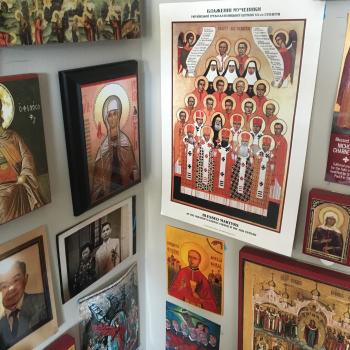
The enthronement of Metropolitan Borys before the New-Martyrs

I am no longer ashamed of being from...

Patriyarkhat: 'Attending to the movements of my heart'
TRENDING AT PATHEOS Catholic

Rejecting Doom: Christian Hope And Human Action
Christianity is a religion of hope. We are to have hope and...

It’s What Comes From Within Which Matters
One of the most difficult things for us to understand is why...

Why I Choose the Eucharist Over the Sermon
Choose the Eucharist, Not the Sermon What are we supposed to get...

5 Design Elements Found in Spiritually Rooted Homes
Putting Spirituality Into Home Decor Our homes are more than our living...

Credo: A Story of God Told with the...
About 10 years ago, I began to imagine a personal "Credo" that...

The Anatomy of Divine Revelation in Catholic Thought
The claim that God has made Himself known to human beings is...
view all Catholic blogs
Ad-Free & Subscriber Log-In Subscription Support
- About Us
- 2026 Calendar
- Videos
- Podcasts
- Library of World Religions
- Faith In Media Tracker
- Advertise With Us
- Write for Us
- Privacy Policy
- Terms of Service
- Do Not Sell My Data
- Contact Us
- Radiant Digital
- Manage Newsletter Subscriptions
- Unsubscribe From Notifications
- Sitemap
Copyright 2008-2026, Patheos. All rights reserved.
Subscription Support Ad-Free & Subscriber Log-In
Follow Patheos