
BuddhistCatholicContemplativeEvangelicalGeneral ChristianHinduJewishLatter-day SaintMuslimNew VisionsProgressive Christian
Beliefs
- Buddhist
- Catholic
- Contemplative
- Evangelical
- General Christian
- Hindu
- Jewish
- Latter-day Saint
- More Voices
- Muslim
- New Visions
- Pagan
- Progressive Christian
Topics
- Religion News
- Food and Religion
- Sports and Religion
- Religious Art
- Religious Music and Entertainment
- Religious Events
- History and Religion
- Style and Religion
- Politics and Religion
- Women in Religion
- Recreation Outdoors and Religion
- Business Finance and Religion
- Careers Workplace and Religion
- Education and Religion
- Family Parenting and Religion
- Health Fitness and Religion
- Home and Religion
- Relationships and Religion
- Technology and Religion
- Travel and Religion
Columnists
- Buddhist Columnists
- Business Finance and Religion Columnists
- Careers Workplace and Religion Columnists
- Catholic Columnists
- Contemplative Columnists
- Education and Religion Columnists
- Evangelists Columnists
- Family Parenting and Religion Columnists
- General Christian Columnists
- Health Fitness and Religion Columnists
- Hindu Columnists
- History and Religion Columnists
- Home and Religion Columnists
- Jewish Columnists
- More Voices Columnists
- Latter Day Columnists
- Muslim Columnists
- New Visions Columnists
- Nonreligious Columnists
- Pagan Columnists
- Politics and Religion Columnists
- Progressive Columnists
- Recreation Outdoors and Religion Columnists
- Relationships and Religion Columnists
- Religion News Columnists
- Religious Art Columnists
- Religious Events Columnists
- Religious Music and Entertainment Columnists
- Sports and Religion Columnists
- Style and Religion Columnists
- Technology and Religion Columnists
- Travel and Religion Columnists
- Women in Religion Columnists
Resource Library
- 2026 Calendar
- Library of World Religions
- The 100 Most Holy Places on Earth
- Patheos Answers
- Podcasts
- Videos
- Faith Leaders Database
- Anglican Episcopalian
- Bahai
- Baptist
- Buddhism
- Christianity
- Confucianism
- Eastern Orthodoxy
- Hinduism
- Holiness and Pentecostal
- ISKCON
- Islam
- Judaism
- Lutheran
- Methodist
- The Church of Jesus Christ of Latter-day Saints
- New Age
- Paganism
- Presbytarian and Reformed
- Protestantism
- Religion Behind the Scenes
- Roman Catholic
- Scientology
- Shia Islam
- Sikhism
- Sufism
- Sunni Islam
- Taoism
- Zen
- See all religions
Research Tools
 Ad-Free & Subscriber Log-In Subscription Support
Ad-Free & Subscriber Log-In Subscription Support
Follow Patheos 

- Trending:
- Forgiveness
- |
- Marriage
- |
- Consciousness
- |
- Death Penalty
- |
- Election
- |
- Halloween
 Eastern Catholic Person
- Home
- Catholic
- The New SCOTUS Prayer Case Is About Anglican Privilege
The New SCOTUS Prayer Case Is About Anglican Privilege
Last updated on: July 28, 2016 at 5:24 pm by Justin Tse
The New SCOTUS Prayer Case Is About Anglican Privilege 2016-07-28T17:24:19-07:00 Justin Tse
Patheos Explore the world's faith through different perspectives on religion and spirituality! Patheos has the views of the prevalent religions and spiritualities of the world.
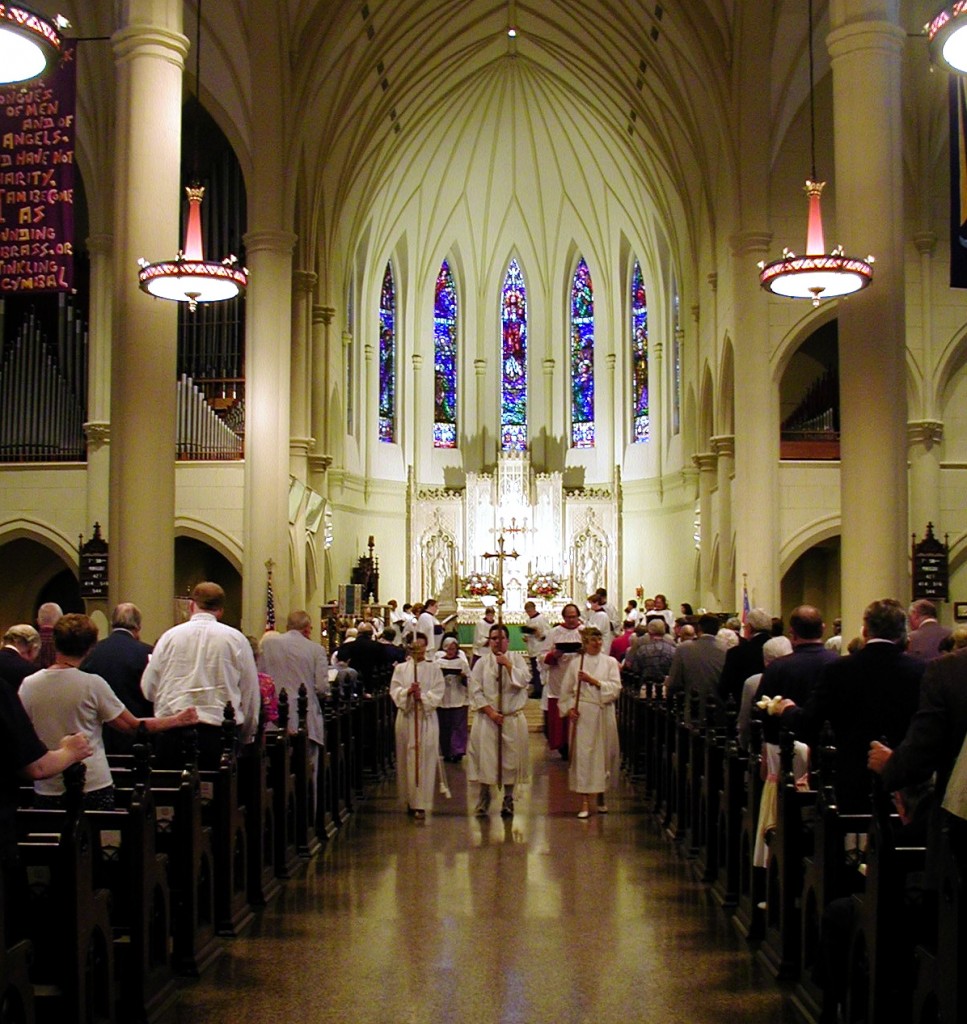
Recessional at St Mary’s Episcopal Cathedral, Memphis, Tennessee- by Gary Bridgman (Procession_at_St._Marys_Episcopal_Cathedral.jpg) [CC BY 2.5/3.0 (https://creativecommons.org/licenses/by/2.5/deed.en and https://creativecommons.org/licenses/by-sa/3.0/deed.en), via Wikimedia Commons
I had a student in my American Religion class who insisted, based on what she was reading and learning from both my lectures on early colonial America and her readings in David Hackett Fischer’s Albion’s Seed, that the American Constitution was laced with Anglican privilege.
As a guest content blogger for Logos Anglican, you’d think that I’d readily agree. It was a gutsy argument, to be sure, and to the extent that she made her argument with examples, I gave her a good grade; and in turn, when she didn’t make the argument well, I dinged her pretty bad (there were multiple assignments). The great thing about this student is that she was pretty consistent. Keeping with Fischer’s assessment of the Virginian cavaliers — whom Fischer himself calls ‘Anglicans’ because of their self-identification with the Church of England and the Book of Common Prayer — this student argued that the notion that the English nobility transferred their class hierarchies to the Americas then came to dominate the formation of the Constitution. While most accounts of American religion privilege the Puritans, this student emphasized the race and class interests at work in the 3/5 Compromise and the Article II ‘birther’ clause. For her, Anglicanism didn’t connote the sort of ‘getting high’ of younger evangelicals seeking sacramental theological pastures; it conveyed instead an elitist, public liturgical framework that bolstered the race and class interests of a ruling class.
The truth is that I didn’t completely buy it. After all, what about the Puritans in New England who had come up with completely different congregationalist polities from the hierarchical one prescribed by the Church of England? What about the Quakers and their emphases on the liberty of conscience? What about the Scots-Irish Presbyterians, the Baptist Dissenters, and the emergence of all those non-Christian occult mishmash of religious eclecticism that Jon Butler describes in Awash in a Sea of Faith? One could certainly point to Episcopalians as constructing a sort of white Anglo-Saxon Protestant ruling class (so also hinted Joseph Epstein in his controversial Wall Street Journal op-ed late last year), and one could definitely say that among all of these disparate groups, there was still an aura of Protestant privilege in America. But to say that Episcopal assumptions are laced into the fabric of the Constitution? I thought my student was pushing things a bit too far.
The Supreme Court of the United States seems to have vindicated my student.
On May 5, SCOTUS decided the case Town of Greece, New York v. Galloway et al., 572 U.S. ___ (2014). The case surrounded the opening prayers at town meetings in Greece, NY, a small town where the respondents, Susan Galloway and Linda Stephens, alleged that the prayers were too Christian.
They have a point. The prayers aren’t just prayed ‘in the name of Jesus’; there are references to ‘the celebration of Holy Week and Easter,’ the ‘saving sacrifice of Jesus Christ on the cross,’ ‘King of Kings and Lord of Lords,’ the Our Father, ‘Jesus Christ, who took away the sins of the world, destroyed our death, through his death and rising, restored our life,’ ‘you who will raise us, in our turn, and put us by His side,’ ‘Father, Son, and Holy Spirit,’ ‘the plan of redemption that is fulfilled in Jesus Christ,’ ‘the name of the Lord and Savior Jesus Christ, who lives with you and the Holy Spirit, one God for ever and ever,’ ‘the new life of the risen Christ,’ ‘the Holy Spirit’ in the context of Pentecost empowering the ‘courageous witnesses of the Good News to different regions of the Mediterranean world and beyond’ for ‘the guidance of the Holy Spirit as the Greece Town Board meets,’ etc. You get the point. This is some great Christian Trinitarian and Eucharistic theology in the public sphere; indeed, one gets the sense that the clergy in Greece, NY are far from being low-church evangelicals who don’t know how to spell liturgy and who get their rubrics from the Jesus Movement; there’s no ‘you’re all we want,’ ‘we just want to praise you,’ ‘sometimes alleluia,’ ‘draw me close to you,’ ‘light the fire again,’ ‘you hold our world in the palm of your hands and we are yours forever’ kind of fluff. These people take seriously the liturgical calendar, Eucharistic rubrics, Trinitarian theology, Hans Urs von Balthasar’s Gestalt, N.T. Wright’s life after life after death — all the stuff that seminary-educated clergy are proud of knowing, unlike those clueless evangelicals behind the Tea Party Machine! That’s what was on trial.
Let me put it another way. You know all that stuff out there about evangelicals ‘getting high‘ and doing ‘ancient-future liturgy‘ and all that stuff about Catholics thinking like evangelicals, reading the Bible, and becoming theologically informed with Robert Barron and George Weigel? All that stuff about Anglicanism being the new hot thing among people wanting to be sacramentally charged and all that disavowal of evangelical youth groups? Sounds to me like those are the kinds of clergy who were praying.
Put another way: what we have is Anglican privilege on trial…
…except that this isn’t your seventeenth- and eighteenth-century elite Anglicanism with its explicit interests in upholding the class and race privileges of the implicit American white Anglo-Saxon Protestant ruling class. This is twenty-first century ‘Ancient-Future’ ressourcement Anglicanism with its young seminary-educated clergy who, tired of evangelical youth-group fluff, got ‘high’ and theological. Of course, I am sure that not all the clergy who were praying were Episcopal. However, as those who know the Book of Common Prayer well and who have studied Anglophone theology, Episcopalians hold no monopoly on either the Anglican formularies or academic texts. It should be little surprise if seminary-educated clergy from other denominations are using Anglican language even if they cannot claim apostolic succession to Canterbury.
What’s fascinating, then, is that the case decision in its majority opinion, concurring opinions, and dissenting opinions descends into this cage fight about Anglicanism and the Founding Fathers. I’m serious. Sure, there’s the occasional Presbyterian who’s mentioned. But check this out:
-
Writing for the majority, Justice Kennedy observes, ‘One of the Senate’s first chaplains, the Rev. William White, gave prayers in a series that included the Lord’s Prayer, the Collect for Ash Wednesday, prayers for peace and grace, St. Chrysostom’s prayer, and a prayer seeking “the grace of our Lord Jesus Christ, &c.;”‘ If that sounds very close to the Book of Common Prayer’s Morning Prayer, it is. Analyzing the ‘decidedly Christian nature of these prayers,’ Kennedy gets this bit from a letter that White wrote as part of a collection that he preserved when he became Bishop of the Protestant Episcopal Church in Pennsylvania. Kennedy uses this to strengthen his case that ‘Congress continues to permit its appointed and visiting chaplains to express themselves in a religious idiom. It acknowledges our growing diversity not by proscribing sectarian content but by welcoming ministers of many creeds’ (p. 10). That religious idiom is not merely Christian. It is Anglican. After all, who else does the ‘prayers for peace and grace’ and calls their prayers ‘collects’? And who does them in that order?
-
Justice Alito goes even further on Anglicanism in his concurring opinion, which is joined by Justice Thomas. Describing the controversy of Samuel Adams having a local Anglican priest, the Rev. Jacob Duché, pray at the First Continental Congress in 1774 that was “‘so divided in religious sentiments, some Episcopalians, some Quakers, some Anabaptists, some Presbyterians, and some Congregationalists'” so that they ‘”could not join in the same act of worship,'” Alito emphasizes that Duché showed up the next day robed in full ‘pontificals’ (the Anglicans robes that especially the Quakers, Anabaptists, and Congregationalists would have balked at) and ‘delivered both the Anglican prayers for the day and an extemporaneous prayer.’ Writing about the event, Samuel’s brother, John Adams, expressed surprise:
For many of the delegates — members of religious groups that had come to America to escape persecution in Britain — listening to a distinctively Anglican prayer by a minister of the Church of England represented a noble act of ecumenism. But Duché’s prayer met with wide approval — John Adams wrote that it “filled the bosom of every man” in attendance — and the practice was continued. The first congressional prayer was emphatically Christian, and it was neither an empty informality nor strictly nondenominational. But one of its purposes, and presumably one of its effects, was not to divide, but to unite. (Alito, concurring, p. 11).
While that first Congress may have spent its energies declaring independence from England, Anglican liturgy still held priority of place among the delegates — a privileged position that doesn’t seem to have wavered up to the point of appointing William White as the first post-Constitutional congressional chaplain long after independence.
-
Justice Kagan doesn’t write much about Anglicanism in her dissent, and it would be a bit of a stretch to say that when she concludes with George Washington visiting a synagogue at the end of her account, she’s positioning Washington as an Episcopalian. Yet it’s telling that at the beginning of her dissent that she draws attention to two Anglican derivative denominations that seem to have had priority of place in American religion, if only to attempt to displace them in what Diana Eck would call a new religious America: ‘I respectfully dissent from the Court’s opinion because I think that the Town of Greece’s prayer practices violate that norm of religious equality–the breathtakingly generous constitutional idea that our public institutions belong no less to the Buddhist or Hindu than to the Methodist or Episcopalian’ (Kagan, dissenting, p. 1). Kagan has read the other opinions – could this be interpreted as a subtle jab at the majority and concurring opinions?
My point is that while the opinions seem to be couched in understanding the Judeo-Christian contexts out of which the First Amendment arose, what the debate seems to center on is Anglican privilege in early antebellum America. The disagreement between the four liberal justices and the five conservatives seem to turn on what that Anglican privilege means for Greece, NY: does it mean that Greece can go on privileging Christian liturgical rubrics (as in the majority opinion), or should it give way to a fuller understanding of disestablishmentarianism in a new religious America (as in Kagan’s dissent).
That that Anglican privilege still remains a point of contention is an element of this case that needs further discussion. While much has been said within Anglican studies circles that would differentiate seventeenth- and eighteenth-century Divine Right Anglicanism from the contemporary Anglican Communion and its broad theological influence on both Catholics and Protestants, the ‘ancient-future’ language of the prayers make me wonder whether this case is putting the remnants of Anglican privilege on trial. The question of privilege doesn’t have much to do with the structures of Anglican privilege, which have definitely changed. It’s about liturgical language.
What this means is that this case has got to cut really close to home. These are not small-town evangelicals defending that old-time religion, as much as the case seems to assume. These are not the social conservatives that Rachel Maddow, The Washington Post, and The New York Times insinuate that they are. The court may have voted along ‘conventional right-left lines,’ but chances are, it’s not as if the town of Greece is getting the Tea Party to lead prayers.
No, this means that this needs to cut really close to home for all the young evangelicals getting high, becoming clergy, and looking down their noses at people who don’t know how to spell liturgy. This cuts close to home for everyone who can name-drop Robert Webber, Jamie Smith, Eugene Peterson, and Stanley Hauerwas. This cuts close to home for people who can really recognize the classical liberalism of the respondents’ call for ‘inclusive and ecumenical’ prayers to a ‘generic God’ and oppose it not because they’ve read Machen, Henry, and LaHaye, but Barth, Hauerwas, and Milbank (p. 4, Kennedy). Put the way that Richard John Neuhaus had it in The Naked Public Square, these are not the crazies taking back the public sphere to set up a theocracy; they are the intellectual First Things subscribers who are simply concerned about what they see as the ideological marginalization of Christian orthodox language from the public sphere. Their response is not to take over the public sphere; no, they’ve read Jamie Smith and understand that they’re working in Christian liturgies into the interplay of secular ‘cultural liturgies’; they’ve read Hauerwas’s A Better Hope and are publicly speaking postliberal orthodoxy in a way that blasts secular liberal speech-policing. And so, while it has been a source of puzzlement that the conservative Catholic justices would side on the side of Protestants, it would not be as much of a surprise if people took time to sift through the prayers on trial and discover that they were all products of Protestant-Catholic evangelical-liturgical ecumenism.
This brings us back to Justice Kagan’s dissent. While Alito disdains her ‘rhetoric’ and ‘highly imaginative hypotheticals’ that insinuate that the decision leads ‘to a country in which religious minorities are denied the equal benefits of citizenship’ (Alito, concurring, p. 13), Kagan sustains her argument via a geographical analysis of public religion. Contending that the town meetings are public and secular spaces in which the ‘we’ who are led in prayer cannot be assumed to be Christian — and thus not all raised ‘in our turn’ and put by the side of God the Father (Kagan, dissenting, p. 22) — she argues that there is a power dynamic here that the other justices miss. A Muslim applying for urban re-zoning, a Buddhist immigrant being sworn in for citizenship, a Hindu suing for the rectification of violated rights, an atheist at a voting booth — all of these people will feel that a space being controlled by prayer that holds that ‘we’ as a secular public have been saved by the atoning death of Christ, share in the risen life of the Son, and are put by the Father’s side will experience a coercive dynamic. Here, Kagan goes much further than the white liberals who sued because they were offended by these prayers. She’s saying that racial minorities and disadvantaged classes will be further marginalized by Christian privilege.
And if indeed Kagan is saying that the evangelicals who have ‘gotten high’ are complicit in these continuing exclusions, then this case puts not only cavalier and early Episcopal Anglican privilege on trial, but it also interrogates the remnants of Anglican privilege in American Protestant circles. It asks, for example, whether there is a class dimension in the liturgical thing where the educated clergy look down their nose at low-church revivalist evangelicals. It asks whether the whole thing about Anglican liturgy being poetic is in fact an elitist leftover from antebellum Anglican privilege. It asks whether the assumption that the public sphere is liturgical is not in fact a new insight, but has always in fact been the unspoken norm in American religion all along. Though Christian orthodoxy may be couched in the language of postliberal marginalization, the examples in this case in fact paint these liturgical languages in positions of privilege. If there’s one thing on which all of the opinions — majority, concurring, and dissenting — can agree, it’s perhaps this.
Put in Hauerwasian language for hasty readers who may accuse me of taking a potshot at people I should consider friends, how does this sort of thing make the church ‘the church’ and the world ‘the world’? Theologically speaking, the issue was not the privatization of religion, per se; that’s in large part ruled out by the precedent in Marsh v. Chambers, 463 U.S. 783 (1983). It was whether the secular public sphere constitutes the ‘we’ of the Christian ekklesia.
This means, of course, that evangelicals getting high has never been apolitical. It could be interpreted as class assimilation with a few assumptions about race that few will want to discuss, a long-time American elite norm that has been upheld for now by a divided court. If that’s the case, then ‘getting high’ is really nothing new. It needs to be interrogated as part of the politics of American religion.
POSTSCRIPT: In this post, I have completely avoided referencing the Anglican Communion crisis. This was purposeful: my aim was to discuss the Greece case. But I am happy to discuss the question of — if what I’m saying holds any water — what this all does to position the importance of the Anglican realignment in American religion. As a point of fact, for example, why, if nobody cares about Anglicanism, is there such an uproar over Bishop Gene Robinson’s divorce from his same-sex partner?
Previous Post

May 6, 2014
Considering and Contesting Calvin
Next Post

May 11, 2014 Why Don't You Want to Build a Snowman?
Browse Our Archives
Select a Category Academia Anglican Communion anti-racism Aristotle Asia-Pacific Asian American Asian Canadian BlackLivesMatter Cantonese Catholic China Chinglican church politics Church-State Politics Civil Society Conservative Eastern Christianity Evangelical Evangelical Left Feminist/Womanist Theology Food Greek-Catholic Church of Kyiv Hong Kong Housekeeping Kyivan Church Latin Catholicism Law Liberal Liberation Theology New Calvinism Pentecostal/Charismatic Protestant Psychoanalysis Publics Religion Ethnicity Wired Secular Sovereignty TPCIU Uncategorized
Select a Month July 2019 June 2019 May 2019 April 2019 March 2019 February 2019 January 2019 December 2018 November 2018 October 2018 September 2018 August 2018 July 2018 June 2018 May 2018 March 2018 February 2018 January 2018 December 2017 November 2017 October 2017 September 2017 August 2017 July 2017 June 2017 April 2017 March 2017 February 2017 January 2017 December 2016 November 2016 October 2016 September 2016 August 2016 July 2016 January 2016 December 2015 November 2015 October 2015 August 2015 April 2015 March 2015 February 2015 December 2014 November 2014 September 2014 August 2014 July 2014 June 2014 May 2014 April 2014 March 2014 December 2013 November 2013 October 2013 September 2013 August 2013 July 2013 June 2013 May 2013 April 2013 March 2013 February 2013 January 2013 December 2012 October 2012 June 2012 May 2012 April 2012 February 2012 January 2012
Follow Us!
TAKE THE
Religious Wisdom Quiz
Who received the Ten Commandments from God?
Select your answer to see how you score.
Aaron Moses Joshua Abraham
Related posts from Eastern Catholic Person

Psychic connections are neither here nor there: on...
Please do not ask me about Jung: for...
The place of the problematic: for the Sunday...
'And we speak only what we know and...
TRENDING AT PATHEOS Catholic

Rejecting Doom: Christian Hope And Human Action
Christianity is a religion of hope. We are to have hope and...

It’s What Comes From Within Which Matters
One of the most difficult things for us to understand is why...

Why I Choose the Eucharist Over the Sermon
Choose the Eucharist, Not the Sermon What are we supposed to get...

5 Design Elements Found in Spiritually Rooted Homes
Putting Spirituality Into Home Decor Our homes are more than our living...

Credo: A Story of God Told with the...
About 10 years ago, I began to imagine a personal "Credo" that...

The Anatomy of Divine Revelation in Catholic Thought
The claim that God has made Himself known to human beings is...
view all Catholic blogs
Ad-Free & Subscriber Log-In Subscription Support
- About Us
- 2026 Calendar
- Videos
- Podcasts
- Library of World Religions
- Faith In Media Tracker
- Advertise With Us
- Write for Us
- Privacy Policy
- Terms of Service
- Do Not Sell My Data
- Contact Us
- Radiant Digital
- Manage Newsletter Subscriptions
- Unsubscribe From Notifications
- Sitemap
Copyright 2008-2026, Patheos. All rights reserved.
Subscription Support Ad-Free & Subscriber Log-In
Follow Patheos