
BuddhistCatholicContemplativeEvangelicalGeneral ChristianHinduJewishLatter-day SaintMuslimNew VisionsProgressive Christian
Beliefs
- Buddhist
- Catholic
- Contemplative
- Evangelical
- General Christian
- Hindu
- Jewish
- Latter-day Saint
- More Voices
- Muslim
- New Visions
- Pagan
- Progressive Christian
Topics
- Religion News
- Food and Religion
- Sports and Religion
- Religious Art
- Religious Music and Entertainment
- Religious Events
- History and Religion
- Style and Religion
- Politics and Religion
- Women in Religion
- Recreation Outdoors and Religion
- Business Finance and Religion
- Careers Workplace and Religion
- Education and Religion
- Family Parenting and Religion
- Health Fitness and Religion
- Home and Religion
- Relationships and Religion
- Technology and Religion
- Travel and Religion
Columnists
- Buddhist Columnists
- Business Finance and Religion Columnists
- Careers Workplace and Religion Columnists
- Catholic Columnists
- Contemplative Columnists
- Education and Religion Columnists
- Evangelists Columnists
- Family Parenting and Religion Columnists
- General Christian Columnists
- Health Fitness and Religion Columnists
- Hindu Columnists
- History and Religion Columnists
- Home and Religion Columnists
- Jewish Columnists
- More Voices Columnists
- Latter Day Columnists
- Muslim Columnists
- New Visions Columnists
- Nonreligious Columnists
- Pagan Columnists
- Politics and Religion Columnists
- Progressive Columnists
- Recreation Outdoors and Religion Columnists
- Relationships and Religion Columnists
- Religion News Columnists
- Religious Art Columnists
- Religious Events Columnists
- Religious Music and Entertainment Columnists
- Sports and Religion Columnists
- Style and Religion Columnists
- Technology and Religion Columnists
- Travel and Religion Columnists
- Women in Religion Columnists
Resource Library
- 2026 Calendar
- Library of World Religions
- The 100 Most Holy Places on Earth
- Patheos Answers
- Podcasts
- Videos
- Faith Leaders Database
- Anglican Episcopalian
- Bahai
- Baptist
- Buddhism
- Christianity
- Confucianism
- Eastern Orthodoxy
- Hinduism
- Holiness and Pentecostal
- ISKCON
- Islam
- Judaism
- Lutheran
- Methodist
- The Church of Jesus Christ of Latter-day Saints
- New Age
- Paganism
- Presbytarian and Reformed
- Protestantism
- Religion Behind the Scenes
- Roman Catholic
- Scientology
- Shia Islam
- Sikhism
- Sufism
- Sunni Islam
- Taoism
- Zen
- See all religions
Research Tools
 Ad-Free & Subscriber Log-In Subscription Support
Ad-Free & Subscriber Log-In Subscription Support
Follow Patheos 

- Trending:
- Forgiveness
- |
- Marriage
- |
- Consciousness
- |
- Death Penalty
- |
- Election
- |
- Halloween
 Eastern Catholic Person
- Home
- Catholic
- Why My Catholic Colleagues Should Care About Chinatown
Why My Catholic Colleagues Should Care About Chinatown
Last updated on: December 12, 2016 at 12:50 am by Justin Tse
Why My Catholic Colleagues Should Care About Chinatown 2016-12-12T00:50:10-07:00 Justin Tse
Patheos Explore the world's faith through different perspectives on religion and spirituality! Patheos has the views of the prevalent religions and spiritualities of the world.
![Chinatown in San Francisco, CA. In the background you can see the Bay Bridge. - by Christian Mehlführer, 27 November 2006 (San_Francisco_China_Town_MC.jpg) (CC BY 3.0 [https://creativecommons.org/licenses/by/3.0/deed.en]), via Wikimedia Commons](https://wp-media.patheos.com/blogs/sites/721/2013/12/San_Francisco_China_Town_MC.jpg)
It occurred to me when I mentioned Artur Rosman and Cosmos the in Lost in yesterday’s update on the Mark Driscoll plagiarism fiasco that I have a lot of friends who would identify as Roman Catholic theology and history buffs. Whether or not they are officially Roman Catholic or not remains an open question. If you want to know about my own convoluted theological history, you can read about the mess here.
The point, however, is that this group of Catholic theology and history friends and colleagues has often felt worlds apart from my real research interests in Asian American, Asian Canadian, and Asia-Pacific geographies of religion and secularization. To be sure, some have expressed private interest in what I am doing. But it is telling that they often confess ignorance, saying that they’d like to help and would be interested in reading my stuff, but what I’m doing is really far outside their research interests.
I’d like to issue a friendly and collegial challenge to them. It’s because today is the Solemnity of the Immaculate Conception for no apparent reason, it seems, except that it’s the anniversary of Pius IX’s promulgation of Ineffabilis Deus in 1854. I happen to think that precisely because of this reason, these Catholic scholars and writers should all suddenly care about San Francisco’s Chinatown.
I took a Holy Cross priest with me just for fun. We went into Chinatown to take pictures of the built environment, especially to identify what kind of religious geography we might be looking at. We saw all the sites that would become key places for me in terms of my study on Cantonese Protestants: First Chinese Baptist Church, the YMCA, Cumberland Presbyterian Chinese Church, the Presbyterian Church in Chinatown, Donaldina Cameron House, etc.
I discovered that Old St. Mary’s Cathedral in San Francisco’s Chinatown was the first church in the world named for the Immaculate Conception when I was conducting initial field work for my doctoral project in 2011. I took a Holy Cross priest with me just for fun. We went into Chinatown to take pictures of the built environment, especially to identify what kind of religious geography we might be looking at. We saw all the sites that would become key places for me in terms of my study on Cantonese Protestants: First Chinese Baptist Church, the YMCA, Cumberland Presbyterian Chinese Church, the Presbyterian Church in Chinatown, Donaldina Cameron House, etc.
As we ended our tour, we decided to pop into Old St. Mary’s. I’m glad we did.
There was a small museum that greeted us as we entered. The display explained that Old St. Mary’s was the first church in the world to be named for the Immaculate Conception. The dogma’s promulgation in 1854 coincided with the moments in which this cathedral–the first of its kind in California–was laying down its finishing touches. The museum display said that this church was also the tallest building in San Francisco at the time. Over time, however, the seat of the Catholic bishop moved to another St. Mary’s (this one named for the Assumption) because it was said that Chinatown was sort of a hotbed for prostitution and crime. You could say that episcopal power moved from dogma to dogma.
The museum display raises far more questions than answers.
For one thing, it suggests that the presence of Old St. Mary’s in early San Francisco Chinatown was a bit of a racializing and class presence. Yes, of course, prostitution and crime were a problem, but the museum display implies that those were nuisances, not missionary opportunities in which Protestant women like Donaldina Cameron at the Presbyterian Church worked.
But here’s the interesting thing: the ministry to Chinatown seemed to have grown since the seat of the bishop left and the Paulist Fathers came in. By the 1950s, the National Council of Churches’s Cayton and Lively Report on the Chinese Protestant churches in America suggested that Catholicism among Chinese Americans was far more prevalent than Protestant Christianity because Catholics allowed Chinese Americans to keep their popular beliefs, and the model for that sort of practice was the Paulist Fathers’ ministry at Old St. Mary’s. This then led to the formation of the National Conference of Chinese American Churches (CONFAB) in 1955 at First Chinese Baptist Church in Chinatown, where influential Chinese Protestant clergy such as the Rev. Edwar Lee, the Rev. James Chuck, and the YMCA’s Alan Wong proposed that Chinese churches should get involved in their local communities and tap their language and cultural heritage, almost precisely as the Catholics were doing. This launched CONFAB members into community work with the War on Poverty and the Asian American Movement’s strikes in solidarity with the Black Student Union at San Francisco State College in the 1960s. It also created the praxis-oriented field of Asian American liberation theology, whose institutional home was housed at the Pacific Asian Center for Theologies and Strategies (PACTS) at the Pacific School of Religion in Berkeley.
If Old St. Mary’s has been this influential, you would think that this would be all the rage among my Catholic colleagues. I mean, what we have here is the long precursor to Second Vatican Council documents like Nostra Aetate, the ‘Harmony in Faith‘ document on Asian American Catholics put out by the United States Conference of Catholic Bishops, and the increasingly influential and interesting work from Jonathan Tan on popular Asian Catholic practices, not to mention also the Congregation for the Doctrine of the Faith’s investigation into Georgetown’s Peter Phan.
But for all these connections with the Asian American Movement, my Catholic priest friend on the field trip didn’t even know that Old St. Mary’s was named for the Immaculate Conception. Sure, he could tell me lots about the politics around the Papal States around Pius IX’s time, but he couldn’t comment on anything about the Americas, let alone Asian Americans. My sense is that many of my Catholic theology and history colleagues might be in the same boat. Correct me, please, if I am wrong on this score.
Yet if Old St. Mary’s is this central to both Catholic and Asian American history, then it follows that Old St. Mary’s should be why Catholics care about Chinatown. It means that Asian American studies and the work of Catholic academia needs a rapprochement. After all, this is not just a ‘lived religion’ argument I’m advancing à la Robert Orsi, Meredith McGuire, Nancy Ammerman, or even Jonathan Tan himself. I’m saying that this cathedral was named for an official dogma, one that those with affinities with the most official of official Vatican pronouncements should care about. I’m saying that it’s this very official site that has deep linkages with Asian American religion, with deep spillovers even into Protestant circles. I’m saying that this matters because what happened in this site and its effects outside of Catholic circles foreshadowed precisely developments in very official Catholic theology at Vatican II and within a conservative USCCB. These linkages suggest, in short, that Asian American religion has mattered for a very long time right under everybody’s noses, and if Catholicism is as James Joyce put it (‘here comes everybody’), then everybody really ought to care much more about religion in Asian America.
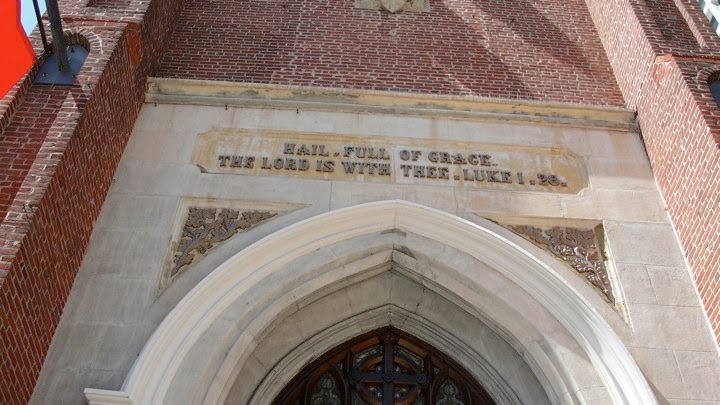
Photo by me
Previous Post

December 6, 2013
Mark Driscoll has been forensically justified
Next Post
December 12, 2013 Contesting the Americas with Our Lady of Guadalupe
Browse Our Archives
Select a Category Academia Anglican Communion anti-racism Aristotle Asia-Pacific Asian American Asian Canadian BlackLivesMatter Cantonese Catholic China Chinglican church politics Church-State Politics Civil Society Conservative Eastern Christianity Evangelical Evangelical Left Feminist/Womanist Theology Food Greek-Catholic Church of Kyiv Hong Kong Housekeeping Kyivan Church Latin Catholicism Law Liberal Liberation Theology New Calvinism Pentecostal/Charismatic Protestant Psychoanalysis Publics Religion Ethnicity Wired Secular Sovereignty TPCIU Uncategorized
Select a Month July 2019 June 2019 May 2019 April 2019 March 2019 February 2019 January 2019 December 2018 November 2018 October 2018 September 2018 August 2018 July 2018 June 2018 May 2018 March 2018 February 2018 January 2018 December 2017 November 2017 October 2017 September 2017 August 2017 July 2017 June 2017 April 2017 March 2017 February 2017 January 2017 December 2016 November 2016 October 2016 September 2016 August 2016 July 2016 January 2016 December 2015 November 2015 October 2015 August 2015 April 2015 March 2015 February 2015 December 2014 November 2014 September 2014 August 2014 July 2014 June 2014 May 2014 April 2014 March 2014 December 2013 November 2013 October 2013 September 2013 August 2013 July 2013 June 2013 May 2013 April 2013 March 2013 February 2013 January 2013 December 2012 October 2012 June 2012 May 2012 April 2012 February 2012 January 2012
Follow Us!
TAKE THE
Religious Wisdom Quiz
How many days did God take to create the world?
Select your answer to see how you score.
Ten Two Six Seven
Related posts from Eastern Catholic Person

The Bay Area of the nineties is where...

Home is where your food is: a speech...

I am no longer ashamed of being from...

Patriyarkhat: 'Attending to the movements of my heart'
TRENDING AT PATHEOS Catholic

Rejecting Doom: Christian Hope And Human Action
Christianity is a religion of hope. We are to have hope and...

It’s What Comes From Within Which Matters
One of the most difficult things for us to understand is why...

Why I Choose the Eucharist Over the Sermon
Choose the Eucharist, Not the Sermon What are we supposed to get...

5 Design Elements Found in Spiritually Rooted Homes
Putting Spirituality Into Home Decor Our homes are more than our living...

Credo: A Story of God Told with the...
About 10 years ago, I began to imagine a personal "Credo" that...

The Anatomy of Divine Revelation in Catholic Thought
The claim that God has made Himself known to human beings is...
view all Catholic blogs
Ad-Free & Subscriber Log-In Subscription Support
- About Us
- 2026 Calendar
- Videos
- Podcasts
- Library of World Religions
- Faith In Media Tracker
- Advertise With Us
- Write for Us
- Privacy Policy
- Terms of Service
- Do Not Sell My Data
- Contact Us
- Radiant Digital
- Manage Newsletter Subscriptions
- Unsubscribe From Notifications
- Sitemap
Copyright 2008-2026, Patheos. All rights reserved.
Subscription Support Ad-Free & Subscriber Log-In
Follow Patheos