
BuddhistCatholicContemplativeEvangelicalGeneral ChristianHinduJewishLatter-day SaintMuslimNew VisionsProgressive Christian
Beliefs
- Buddhist
- Catholic
- Contemplative
- Evangelical
- General Christian
- Hindu
- Jewish
- Latter-day Saint
- More Voices
- Muslim
- New Visions
- Pagan
- Progressive Christian
Topics
- Religion News
- Food and Religion
- Sports and Religion
- Religious Art
- Religious Music and Entertainment
- Religious Events
- History and Religion
- Style and Religion
- Politics and Religion
- Women in Religion
- Recreation Outdoors and Religion
- Business Finance and Religion
- Careers Workplace and Religion
- Education and Religion
- Family Parenting and Religion
- Health Fitness and Religion
- Home and Religion
- Relationships and Religion
- Technology and Religion
- Travel and Religion
Columnists
- Buddhist Columnists
- Business Finance and Religion Columnists
- Careers Workplace and Religion Columnists
- Catholic Columnists
- Contemplative Columnists
- Education and Religion Columnists
- Evangelists Columnists
- Family Parenting and Religion Columnists
- General Christian Columnists
- Health Fitness and Religion Columnists
- Hindu Columnists
- History and Religion Columnists
- Home and Religion Columnists
- Jewish Columnists
- More Voices Columnists
- Latter Day Columnists
- Muslim Columnists
- New Visions Columnists
- Nonreligious Columnists
- Pagan Columnists
- Politics and Religion Columnists
- Progressive Columnists
- Recreation Outdoors and Religion Columnists
- Relationships and Religion Columnists
- Religion News Columnists
- Religious Art Columnists
- Religious Events Columnists
- Religious Music and Entertainment Columnists
- Sports and Religion Columnists
- Style and Religion Columnists
- Technology and Religion Columnists
- Travel and Religion Columnists
- Women in Religion Columnists
Resource Library
- 2026 Calendar
- Library of World Religions
- The 100 Most Holy Places on Earth
- Patheos Answers
- Podcasts
- Videos
- Faith Leaders Database
- Anglican Episcopalian
- Bahai
- Baptist
- Buddhism
- Christianity
- Confucianism
- Eastern Orthodoxy
- Hinduism
- Holiness and Pentecostal
- ISKCON
- Islam
- Judaism
- Lutheran
- Methodist
- The Church of Jesus Christ of Latter-day Saints
- New Age
- Paganism
- Presbytarian and Reformed
- Protestantism
- Religion Behind the Scenes
- Roman Catholic
- Scientology
- Shia Islam
- Sikhism
- Sufism
- Sunni Islam
- Taoism
- Zen
- See all religions
Research Tools
 Ad-Free & Subscriber Log-In Subscription Support
Ad-Free & Subscriber Log-In Subscription Support
Follow Patheos 

- Trending:
- Forgiveness
- |
- Marriage
- |
- Consciousness
- |
- Death Penalty
- |
- Election
- |
- Halloween
 Eastern Catholic Person
- Home
- Catholic
- TPCIU, Part 2: Guess what? Evangelical social media spats actually matter.
TPCIU, Part 2: Guess what? Evangelical social media spats actually matter.
Last updated on: July 27, 2016 at 8:08 pm by Justin Tse
TPCIU, Part 2: Guess what? Evangelical social media spats actually matter. 2016-07-27T20:08:17-07:00 Justin Tse
Patheos Explore the world's faith through different perspectives on religion and spirituality! Patheos has the views of the prevalent religions and spiritualities of the world.
My apologies for the tardiness of this next post. When I started writing about this in late October, the open letter from Asian Americans to the evangelical church had just been published. Things have died down a bit now. In light of that, you’re probably expecting that I should ask you to forgive me for reviving the issue.
I make no apologies. This is because the central issue, as far as I’m concerned, is far from dead. After all, my question has always been: was the open letter just about Asian Americans contesting how they are represented within American evangelicalism? Or was it about so much more?
This post picks up my argument that the open letter is about so much more than Asian Americans picking a private identity politics bone with American evangelicals. We’ll first review what I said last time. And then we’ll begin a discussion of where the open letter fits into the world of American evangelical social media spats. I’m also going to tell you that there’s this one evangelical journalist, Sarah Pulliam Bailey, who’s really important in this whole story, but I’m not really going to tell you why…yet!
First, then, the open letter.
If you haven’t read part 1 yet, you should. Here’s what I said in a nutshell:
As I participated in some Asian American evangelical activism that produced an open letter to the evangelical church, I began to think about how something big was happening in American religion. What I’m basically trying to say in this series is that there was a consensus that was constructed around the 1970s and 1980s that religious institutions were private organizations. Private organizations are private operations: they’re not run by any form of external governance, especially not by the state, and while some may comment about them in the public sphere, they’re not really beholden to the ‘critics.’ Private religious institutions got to do their own private thing, and that was part of a privatizing trend within North American civil society more generally (and arguably, throughout the world; it’s certainly true of the Asia-Pacific). However, events in recent weeks have suggested that the private consensus may be unraveling. This is due to the ability of some who have rearticulated what the word ‘public’ actually means in American religion. I argued that the Asian American evangelical open letter certainly had the potential to participate in this larger process.
I don’t know what will come of the open letter itself. I know that Lifeway Ministries has officially apologized for their 2004 orientalizing Vacation Bible School curriculum, Rickshaw Rally. I do know that the letter has led to a series of posts about ‘cultural stereotypes’ on church planter Ed Stetzer’s blog on Christianity Today. I understand that most people think that it’s just about Asian Americans complaining about how they are represented, and I am aware that some in fact think that the mission is accomplished: we’re on the Stetz’s blog, we got an apology from Lifeway, we have the ear of evangelical organizations.
Done.
Or is it?
I don’t think so.
Framed as an exercise in the politics of representation, I can see where people might get the idea that Asian Americans formed a sort of private interest group to lobby the rest of American evangelicals to pay attention to them. The problem is, as far as I’m concerned, that’s not what the open letter was ever about. The open letter was, well, an open letter. We were saying that the organizations that we were writing about had gotten the whole thing about privatization wrong. By their actions, they were implying (likely unintentionally) that it’s OK for evangelicals writ large to treat Asian Americans as exotic others without voices, or that is, with voices that will always speak with some pan-Asian “I love you long time’ accent. By suggesting this, they were not offending a niche private identity group. They were addressing an evangelical public by showing everyone in that public how a racialized group should be treated. Beyond the vocal Asian American evangelicals themselves, then, the affirmation that it’s OK to treat Asian Americans as exotic others has massive implications for how American evangelicals might deal with race more generally, as well as with their involvement in economic development in the Global South, their newfound interest in international human trafficking issues, and their longtime work in missions. In short, we saw that the evangelical public being addressed was a bit of a mess.
However, the organizations that we wrote about still thought there was a private consensus going on. After all Rick Warren said, ‘If you take this seriously, you really shouldn’t be following me!’ However, he made that privatizing statement on a public fan page after he publicly posted a Red Guard photo. He was arguing, in short, that his public actions are actually private. Likewise, until they publicly apologized, it took some time for Exponential, youth specialties, Zondervan, and Lifeway Ministries (especially the last one on this list) to realize that publishing and performing orientalizing publications and skits are not private endeavours that only their targeted audience will see and hear. When you publish or perform something, you are making a public statement. This lack of realization indicates that they were operating within a private consensus. The open letter challenged this private consensus. The letter argued that if private actions are actually public, then more public accountability is required.

In short, we were saying that the private operations of private evangelical institutions are not really private. Because they have public implications and are usually set out to call publics into existence (see Michael Warner’s Publics and Counterpublics), their public actions should be accountable to a public.
But that’s only the race and orientalization slice of this whole not-really-private thing. Especially over the last year, this argument has in fact already been presented to private evangelical organizations along many other axes, especially sexuality. What I’m describing, then, is about so much more than Asian American evangelicals picking a private bone with American evangelical institutions. This is about a rearticulation of American evangelicalism altogether.
And that’s why evangelical social media spats are important.
Let’s use another evangelical social media spat to illustrate, one that runs along a sexuality axis.
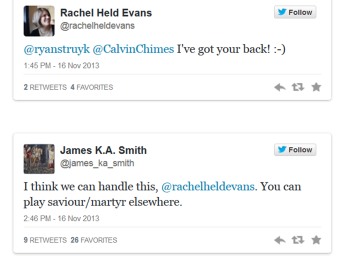
Screenshot by me
On 16 November, Reformed theologian James K.A. Smith and evangelical feminist blogger Rachel Held Evans had a Twitter spat. When Evans tweeted her support (‘I’ve got your back’) to an emerging LGBTQ+ group at Calvin College, Smith responded that Evans should take her ‘savior/martyr complex elsewhere.’ Puzzled by this response to her supportive tweet especially because she considered herself one of Smith’s ‘fans,’ Smith replied that Evans had presumed too much about Calvin College as an institution. As you’ll see from the link posted above, United Methodist pastor Morgan Guyton lost no time in castigating Smith for his ‘curmudgeonly’ ways, insinuating that the liturgies that had formed Smith into an online troll may have caused him to lose respect for him.
In many respects, the conversation that has ensued has moved forward per Guyton’s prescription. Guyton tells us that he has Evans’s back because she is an author that he has promoted; that is, Evans and Guyton have a private business pact that he is honouring. On the other hand, Guyton suggests that Smith is acting to defend his private academic institution, suggesting that it is the liturgies of the academy that have formed Smith into a curmudgeon.
In other words, Guyton frames the debate within the private consensus: it’s either Evans’s pet private cause (LGBTQ+ solidarity in evangelical colleges) or Smith’s pet private cause (defending the Calvin College brand).
Guyton doesn’t get it. While Guyton himself is certainly promoting his own pet private cause (the cause to promote Evans at all costs, including by taking a rhetorical strike-by-insinuation against ‘curmudgeonly’ academics more generally), neither Evans nor Smith are actually privatizing the conversation. They may be talking past each other, but this isn’t a clash of private interests. It’s a contest of different articulations of how an evangelical ‘public’ should work. Evans is defying what she thinks is a private institution’s default homophobia by declaring her public solidarity with LGBTQ+ students. For Evans, an evangelical public is de-institutionalized in favour of online solidarities. On the other hand, Smith is saying that Calvin College isn’t as private as Evans thinks it is. No one is getting in trouble. The LGBTQ+ group is making for great on-campus discussion. Calvin College is promoting public conversation.
In short, Smith and Evans are talking about two conceptions of how evangelical ‘publics’ should work. Evans thinks that the ‘public’ is a de-institutionalized solidarity. Smith thinks that institutions still matter but can be re-articulated outside the private consensus. Those two theories clashed. But they weren’t about their pet private causes. They were both about the operations of evangelical publics.
If Evans and Smith are both articulating new conceptions of an evangelical public, the real question is, how did they get to this new public articulation? After all, there was a private consensus, one into which Guyton still buys, and as I showed with the open letter, one in which many private evangelical organizations still exist. But if Evans and Smith are really saying what they’re saying about the public, how did they get past the private consensus?
Here’s what’s coming next, then. Both Asian American open letter and the Christian college sexuality Twitter spat point to work within evangelicalism in the last few years that is beginning to unravel the private consensus. A significant part of that work, I’ll suggest, has been accomplished by ground-breaking pieces authored by religion journalist Sarah Pulliam Bailey, including articles about LGBTQ+ activities on Christian college campuses and about Asian American evangelical activism. I’ll tell you why this is so in the next post. You’re probably also wondering why I’m singling out Bailey among all the other fine evangelical journalists out there. You’ll probably also want me to tell you what Rachel Held Evans and Jamie Smith have to do with an Asian American open letter.
Stay tuned. The private consensus is unraveling.
Next Post

December 6, 2013 Mark Driscoll has been forensically justified
Browse Our Archives
Select a Category Academia Anglican Communion anti-racism Aristotle Asia-Pacific Asian American Asian Canadian BlackLivesMatter Cantonese Catholic China Chinglican church politics Church-State Politics Civil Society Conservative Eastern Christianity Evangelical Evangelical Left Feminist/Womanist Theology Food Greek-Catholic Church of Kyiv Hong Kong Housekeeping Kyivan Church Latin Catholicism Law Liberal Liberation Theology New Calvinism Pentecostal/Charismatic Protestant Psychoanalysis Publics Religion Ethnicity Wired Secular Sovereignty TPCIU Uncategorized
Select a Month July 2019 June 2019 May 2019 April 2019 March 2019 February 2019 January 2019 December 2018 November 2018 October 2018 September 2018 August 2018 July 2018 June 2018 May 2018 March 2018 February 2018 January 2018 December 2017 November 2017 October 2017 September 2017 August 2017 July 2017 June 2017 April 2017 March 2017 February 2017 January 2017 December 2016 November 2016 October 2016 September 2016 August 2016 July 2016 January 2016 December 2015 November 2015 October 2015 August 2015 April 2015 March 2015 February 2015 December 2014 November 2014 September 2014 August 2014 July 2014 June 2014 May 2014 April 2014 March 2014 December 2013 November 2013 October 2013 September 2013 August 2013 July 2013 June 2013 May 2013 April 2013 March 2013 February 2013 January 2013 December 2012 October 2012 June 2012 May 2012 April 2012 February 2012 January 2012
Follow Us!
TAKE THE
Religious Wisdom Quiz
What does Revelation say about anyone who adds to the words of the prophecy?
Select your answer to see how you score.
They will be cursed God will add to them the plagues described in this scroll They will lose their salvation They will be judged
Related posts from Eastern Catholic Person

I've found my way home: on the unraveling...

The Bay Area of the nineties is where...

This time, I have a tradition: on solidarity...

Home is where your food is: a speech...
TRENDING AT PATHEOS Catholic

The Parable Of The Sower And The Word...
One of Christ’s most famous parables is that of the sower who...

Rejecting Doom: Christian Hope And Human Action
Christianity is a religion of hope. We are to have hope and...

Why I Choose the Eucharist Over the Sermon
Choose the Eucharist, Not the Sermon What are we supposed to get...

5 Design Elements Found in Spiritually Rooted Homes
Putting Spirituality Into Home Decor Our homes are more than our living...

Credo: A Story of God Told with the...
About 10 years ago, I began to imagine a personal "Credo" that...

The Anatomy of Divine Revelation in Catholic Thought
The claim that God has made Himself known to human beings is...
view all Catholic blogs
Ad-Free & Subscriber Log-In Subscription Support
- About Us
- 2026 Calendar
- Videos
- Podcasts
- Library of World Religions
- Faith In Media Tracker
- Advertise With Us
- Write for Us
- Privacy Policy
- Terms of Service
- Do Not Sell My Data
- Contact Us
- Radiant Digital
- Manage Newsletter Subscriptions
- Unsubscribe From Notifications
- Sitemap
Copyright 2008-2026, Patheos. All rights reserved.
Subscription Support Ad-Free & Subscriber Log-In
Follow Patheos