
BuddhistCatholicContemplativeEvangelicalGeneral ChristianHinduJewishLatter-day SaintMuslimNew VisionsProgressive Christian
Beliefs
- Buddhist
- Catholic
- Contemplative
- Evangelical
- General Christian
- Hindu
- Jewish
- Latter-day Saint
- More Voices
- Muslim
- New Visions
- Pagan
- Progressive Christian
Topics
- Religion News
- Food and Religion
- Sports and Religion
- Religious Art
- Religious Music and Entertainment
- Religious Events
- History and Religion
- Style and Religion
- Politics and Religion
- Women in Religion
- Recreation Outdoors and Religion
- Business Finance and Religion
- Careers Workplace and Religion
- Education and Religion
- Family Parenting and Religion
- Health Fitness and Religion
- Home and Religion
- Relationships and Religion
- Technology and Religion
- Travel and Religion
Columnists
- Buddhist Columnists
- Business Finance and Religion Columnists
- Careers Workplace and Religion Columnists
- Catholic Columnists
- Contemplative Columnists
- Education and Religion Columnists
- Evangelists Columnists
- Family Parenting and Religion Columnists
- General Christian Columnists
- Health Fitness and Religion Columnists
- Hindu Columnists
- History and Religion Columnists
- Home and Religion Columnists
- Jewish Columnists
- More Voices Columnists
- Latter Day Columnists
- Muslim Columnists
- New Visions Columnists
- Nonreligious Columnists
- Pagan Columnists
- Politics and Religion Columnists
- Progressive Columnists
- Recreation Outdoors and Religion Columnists
- Relationships and Religion Columnists
- Religion News Columnists
- Religious Art Columnists
- Religious Events Columnists
- Religious Music and Entertainment Columnists
- Sports and Religion Columnists
- Style and Religion Columnists
- Technology and Religion Columnists
- Travel and Religion Columnists
- Women in Religion Columnists
Resource Library
- 2026 Calendar
- Library of World Religions
- The 100 Most Holy Places on Earth
- Patheos Answers
- Podcasts
- Videos
- Faith Leaders Database
- Anglican Episcopalian
- Bahai
- Baptist
- Buddhism
- Christianity
- Confucianism
- Eastern Orthodoxy
- Hinduism
- Holiness and Pentecostal
- ISKCON
- Islam
- Judaism
- Lutheran
- Methodist
- The Church of Jesus Christ of Latter-day Saints
- New Age
- Paganism
- Presbytarian and Reformed
- Protestantism
- Religion Behind the Scenes
- Roman Catholic
- Scientology
- Shia Islam
- Sikhism
- Sufism
- Sunni Islam
- Taoism
- Zen
- See all religions
Research Tools
 Ad-Free & Subscriber Log-In Subscription Support
Ad-Free & Subscriber Log-In Subscription Support
Follow Patheos 

- Trending:
- Forgiveness
- |
- Marriage
- |
- Consciousness
- |
- Death Penalty
- |
- Election
- |
- Halloween
 Eastern Catholic Person
- Home
- Catholic
- It would not be funny if I said that Rick Warren was the ‘Rick’ in ‘Rickshaw Rally’
It would not be funny if I said that Rick Warren was the ‘Rick’ in ‘Rickshaw Rally’
Last updated on: July 27, 2016 at 6:06 pm by Justin Tse
It would not be funny if I said that Rick Warren was the ‘Rick’ in ‘Rickshaw Rally’ 2016-07-27T18:06:29-07:00 Justin Tse
Patheos Explore the world's faith through different perspectives on religion and spirituality! Patheos has the views of the prevalent religions and spiritualities of the world.
UPDATE: The contents of the following post concerned a post by Pastor Rick Warren that has been deleted on the afternoon of 24 September 2013. It also coincided with an apology on Sam Tsang’s blog, Engage the Pews, which Tsang has accepted and on which he has written further reflections. Following the examples of other bloggers such as Sam Tsang, Kathy Khang (More Than Serving Tea) and Wm. Darius Myers (Death Pastor), we will be leaving this post up in order to maintain the integrity of the public record. After all, contrary to the comment by L2 Foundation’s D.J. Chuang that appeared on all of our respective blogs that the post was ‘immediately and personally removed’ by Warren, we acknowledge that while the apology may have been personal and may indeed be encouraging for a catholic way forward, a response following two business days is not ‘immediate.’ Indeed, given this post’s attention to the historical genealogy of these Asian American interventions into the orientalizing practices of prominent American evangelicals, it is an imperative that this post, as well as the others, remain up as a record of this episode so that we can propel further conversation that would lead to a radical de-orientalization of American Protestant practice. As Tsang and Khang have said on their respective blogs, the apology may be accepted, but the conversation is far from over.
UPDATE #2: We recognize that Rick Warren has issued a public apology on his public Facebook page. We welcome this. Following the reflections given by Professor Sam Tsang and by Kathy Khang to this apology, we have also decided to maintain the integrity of the public record by leaving this post up.
The recent Facebook photo posted as a joke by Pastor Rick Warren describing the staff at Saddleback Church as members of the Red Guard at the height of the Cultural Revolution is a bit difficult to process. Indeed, its invocation of the Cultural Revolution has troubled many a Facebook friend of mine for what they are now terming ‘cultural insensitivity.’ I should thus post a trigger warning, for I have reproduced it here.
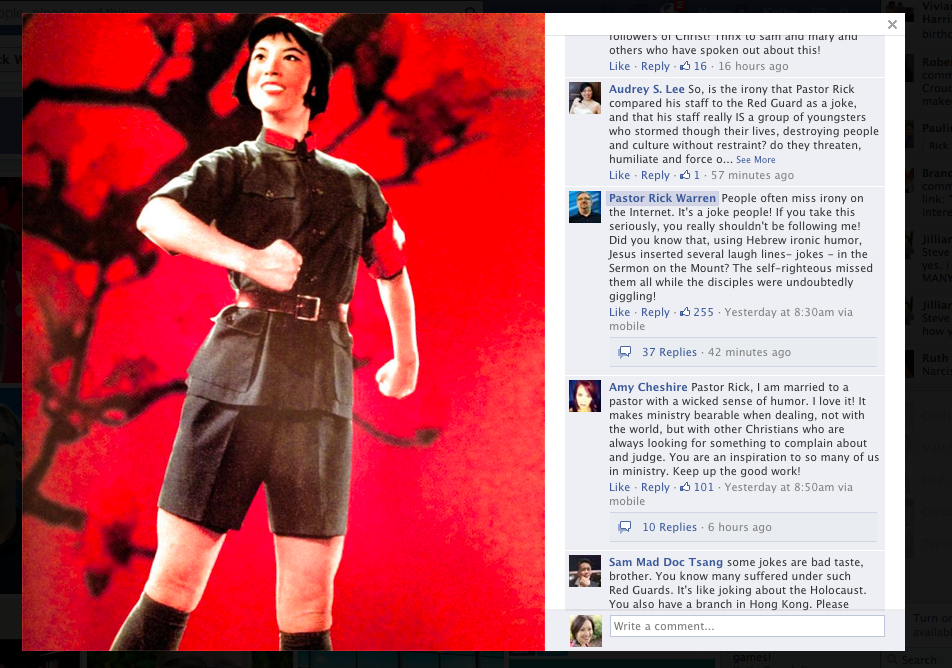
Image via Kathy Khang
Indeed, that he then used the comments section to lecture this Thing’s good friend Sam Tsang on humour in New Testament exegesis makes the situation even more ironic. I mean, one would have thought that Sam Tsang’s composition of the foreword to the new Chinese translation of N.T. Wright’s New Testament and the People of God would position Tsang as the exegete. To the extent that our friend was then incensed by this reply, he wrote a response lambasting Warren for his culturally insensitive humour.
To defend Rick Warren as ignorant of the concerns of Asians and Asian Americans (and by this, I include the Asian Canadians who are posting all over my news feed, as i take ‘American’ to be indicative of the ‘Americas,’ not only the nation-state styling itself as all-encompassing American) simply because he is an older white pastor living in Southern California is no defence at all. Indeed, at least as he is cited in geographer Justin Wilford’s Sacred Subdivisions, he claims that his own church is largely composed of Asian and Latina/o Americans. In fact, Wilford points out that Saddleback’s whole idea of the ‘small group’ where members meet in homes to discuss Christian spiritual formation is drawn from Korean megachurch pastor David Yonggi Cho’s ‘cell group’ model; whatever one may think of such a model, the point is that Warren is no stranger to Asia-Pacific churches. Moreover, Southern California itself could hardly be described as an Asian American terra incognita; in fact, Metro Los Angeles boasts a high concentration of Asian Americans, and one of its cities in the San Gabriel Valley, Monterey Park, in fact served as the key case study for geographer Wei Li’s doctoral work on Chinese ethnoburbs in North America. Finally, Saddleback has itself planted a church in Hong Kong, which itself is no small feat, for The Purpose-Driven Church calls church plants to research their social surroundings in order to be relevant in their local evangelism. Indeed, Justin Wilford’s Sacred Subdivisions reveals that Saddleback itself is ingenious in its transformation of the postsuburban landscape’s fragmented geographies into purpose-driven sites through which God teaches Saddleback members how to reframe their scattered lives into purpose-driven ones. One would expect no less of its Hong Kong incarnation.
Any question that we ask about this situation, then, should not focus on why Rick Warren is ignorant of the concerns of Asians and Asian Americans. It should instead interrogate why he ignores them.
After all, this is not the first Asian American challenge to orientalization in American evangelicalism. Indeed, in light of previous excursions into evangelical antiracism, one might be able to illustrate how Warren’s declaration that Asian Americans are humorless because of a joke taken at our expense might be understood if Asian Americans were to make a joke at his expense.
That joke is: who would find it funny if Warren were the ‘Rick’ in ‘Rickshaw Rally’?
That I now have to explain this joke suggests that it is probably not funny. In fact, now that I have likely offended you, I need to explain to you why you have been offended.
The Southern Baptist Convention’s Lifeway Publishers’ ‘Rickshaw Rally’ curriculum was but one of the episodes in contemporary Asian American evangelical challenges to the white privilege that has gone long uncontested in American evangelicalism. Published as the Vacation Bible School (VBS) material in 2004, the theme featured a white girl in a kimono with chopsticks in her hair, a karate-kid key chain, and name tags shaped as Chinese take-out boxes. As Soong-Chan Rah puts it in The Next Evangelicalism, Lifeway ‘caricatured and generalized all Asian cultures with various stereotypical images’ and was met with protests from Asian American pastors, some of whom were themselves Southern Baptist. However, instead of apologizing, Lifeway made a few minor changes and issued the material as its 2004 VBS curriculum all the same, all to the chagrin of those who decried the material both within and without the denomination.
Unsuccessful as the attempt to derail Rickshaw Rally may have seemed, though, it served as the first of several similar challenges that have propelled the conversation about orientalization in American evangelicalism forward. In 2007, Soong-Chan Rah wrote to Zondervan’s Youth Specialties for its book, Skits That Teach, that featured a skit similar to Rickshaw Rally, this one titled ‘Mee Maw.’ which featured a Chinese delivery person with a very demeaning accent as part of a church skit book. As Rah recalls, Zondervan recalled (to its credit) all of the extant copies and did away with them, issuing an apology on its blog. In 2009, Zondervan found itself again in hot water, this time over the publication of a book titled Deadly Vipers, a book for men that portrayed sins that men faced as ninjas sneaking up on them. Leading the charge this time was Seattle pastor Eugene Cho, whose campaign convinced Zondervan to again pull the book, destroy the copies, and have the authors remove their website.
What we should find hard to believe is that Rick Warren has not seemed to have heard of these high-profile cases, one of which affected his own denomination (the Southern Baptist Convention) and his own publisher (Zondervan).
But even more dumbfounding should be Warren’s inability to participate in solidarity with Asian Americans, even while many Asian Americans participated in solidarity with him and his family when they lost their son, Matthew, to a suicide due to mental illness. Contrary to popular perceptions that Asian Americans are unfamiliar with mental illness, the legacy of political and cultural trauma in the Asia-Pacific–including the Cultural Revolution–should itself be a signal that Asians and Asian Americans are all too familiar with mental illness, which is likely why we felt ourselves in such solidarity with the Warrens in the first place. The authoritarian rule of emerging nation-states in the Asia-Pacific were not the natural results of an ‘Asian culture’ that promotes hard work and obedience to authority. They were attempts at state formation whose efforts to dislodge these emerging nation-states from their traumatic pasts of European colonialism exacerbated the cultural trauma and psychological damage that began in the nineteenth century. If it weren’t from the direct trauma of elite state initiatives at nation-building–such as China’s Cultural Revolution, among many other similar projects in other nation-states–then there was the overwhelming sense that these nation-states and their citizens needed to catch up with the modernity of the West, resulting in authoritarian ideologies that framed citizens as patriotic hard workers whose objective was to make the nation modern overnight. While these efforts at subjectification led to some economic successes, one of the prices that was paid was the spread of mental illness; indeed, anthropologist Aihwa Ong argues that the frequency of demon possession reported on the Malaysian shop floor that she studied can be attributed to these efforts at capitalist state subjectification. The same could be said of the Cultural Revolution; in fact, my grandfather, who saw the decimation of his family in Shanghai through the double trauma of the Japanese invasion of China during the Second World War and the Communist takeover of his family’s property (not to mention the news of his surviving family’s treatment through the Mao years right on into the Cultural Revolution), was plagued with manic depression for the remainder of his life. Indeed, the first time that I ever learned as a kid that there were pills that you could take that helped you with your moods was from seeing him take them.
That the rise of early Asian American studies at the San Francisco State College Strike in 1968 was done by Mao-jacket-wearing students from the Third World Liberation Front in solidarity with the Cultural Revolution does not blunt this point. For one thing, they were protesting the trauma of racism that ghettoized their communities in America; as Ling-chi Wang points out, Chinatowns were the result both of racist planning policies that kept Chinese people literally in their place and Chinatown elites who used this ghettoization to maintain their own power. The strikers protested both. However, to post a picture of a woman wearing a Mao jacket cannot be justified even by this fact, for though even members of mainline Protestant churches in Chinatown participated in these protests, migrants who had experienced the Asia-Pacific traumas transformed these churches after the strikes, bringing their trauma to bear on the real life experience of even the most liberal churches in these Chinatowns. By the 1970s and 1980s, then, counseling psychology became a field of great concern among Asian and Asian American Protestants themselves as they dealt with the traumas of colonization, state subjectification, racism, modern ideologies of Asians needing to ‘catch up’ with the West, and the resulting family dysfunction, and it has now become a commonly discussed stereotype that second-generation Asian American evangelicals seem to be disproportionately interested in psychology as a field of study because of how often these traumas are discussed in our churches and parachurch organizations.
In short, we as Asians and Asian Americans know mental illness intimately. That was why we really felt ourselves to be in solidarity with the Warrens when Matthew died.
If what I am saying is true, then, what is needed is not simply ‘cultural intelligence’ or ‘sensitivity training.’ It is an acknowledgement that just as we as Asian and Asian American evangelicals stood in solidarity with the Warrens when they confronted the abyss caused by mental illness in their family, so the Warrens stand in solidarity with us when we confront mental illness and the memory of trauma in ours. Indeed, it would not be funny if I called Rick Warren the ‘Rick’ in ‘Rickshaw Rally’ precisely because of this solidarity that we have with him. By the same token, the trigger for memories of cultural trauma should not be funny if indeed he acknowledges his solidarity with us. That he then complains that we do not find his joke funny is not only a failure of ‘cultural sensitivity.’ It is a failure of catholicity, a denial of his participation with the church catholic that is composed in no small part by Asians and Asian Americans. Indeed, that is what’s at stake in choosing to ignore the protests of Asian Americans who have challenged the orientalization that is latent in much of American evangelicalism: it is to deny that the Spirit is moving the people of God into greater oneness by shattering the ideologies that have long kept us apart. To reduce this to ‘political correctness’ on the one hand while calling for ‘sensitivity training’ on the other would fail to comprehend the movement of God in making his children one, even as he is one, that the world may know that the Father has sent the Son. To fail to understand that such reconciled unity–such ecumenical catholicity!–lies at the heart of the evangelical mission is to miss the purpose for which the church exists, for she is a prophetic witness to a modern world traumatically divided by racializing ideologies (among many others) that Jesus Christ has come to reconcile all into one in his body.
To put it plainly, waving the trigger of our traumatic memories in our faces on Facebook is simply not funny. But even more curious is that Warren is neither a stranger to Asians and Asian Americans, and it is hard to believe that he hasn’t heard of the debacles like Rickshaw Rally, Mee Maw, and Deadly Vipers. The only conclusion that we can draw from this circumstantial evidence is thus that Warren is not ignorant, but is willfully ignoring Asians and Asian Americans in order to make a joke at our expense. And yet, hope against hope, we do not believe that in his heart, Warren is malicious enough to be that much of a schismatic; after all, to fail to have even a flicker of love for his Asian and Asian American brothers and sisters would jeopardize his own place in the church catholic, for he that does not love does not know God, for God is love. It is thus for the sake of the healing of the catholic union and continual solidarity that we share in Jesus Christ that we demand that Rick Warren issue an apology.
Correction update: the original version of this post read that the woman in the posted photo was from the People’s Liberation Army. This was an error because she was part of the Red Guard. We thank the readers of A Christian Thing for their vigilance. I am also thankful for the presence of Not a Dinner Party on this Thing, for she is a China scholar and a truly competent one at that. See for yourself.
Previous Post

September 7, 2013
Let Us Pray (for Syria)
Next Post
September 30, 2013 Orientalization is an objective offence: answering our objectors
Browse Our Archives
Select a Category Academia Anglican Communion anti-racism Aristotle Asia-Pacific Asian American Asian Canadian BlackLivesMatter Cantonese Catholic China Chinglican church politics Church-State Politics Civil Society Conservative Eastern Christianity Evangelical Evangelical Left Feminist/Womanist Theology Food Greek-Catholic Church of Kyiv Hong Kong Housekeeping Kyivan Church Latin Catholicism Law Liberal Liberation Theology New Calvinism Pentecostal/Charismatic Protestant Psychoanalysis Publics Religion Ethnicity Wired Secular Sovereignty TPCIU Uncategorized
Select a Month July 2019 June 2019 May 2019 April 2019 March 2019 February 2019 January 2019 December 2018 November 2018 October 2018 September 2018 August 2018 July 2018 June 2018 May 2018 March 2018 February 2018 January 2018 December 2017 November 2017 October 2017 September 2017 August 2017 July 2017 June 2017 April 2017 March 2017 February 2017 January 2017 December 2016 November 2016 October 2016 September 2016 August 2016 July 2016 January 2016 December 2015 November 2015 October 2015 August 2015 April 2015 March 2015 February 2015 December 2014 November 2014 September 2014 August 2014 July 2014 June 2014 May 2014 April 2014 March 2014 December 2013 November 2013 October 2013 September 2013 August 2013 July 2013 June 2013 May 2013 April 2013 March 2013 February 2013 January 2013 December 2012 October 2012 June 2012 May 2012 April 2012 February 2012 January 2012
Follow Us!
TAKE THE
Religious Wisdom Quiz
Who was Abraham's brother?
Select your answer to see how you score.
Jacob Lot Nahor Isaac
Related posts from Eastern Catholic Person

The Bay Area of the nineties is where...

Home is where your food is: a speech...

I am no longer ashamed of being from...

Patriyarkhat: 'Attending to the movements of my heart'
TRENDING AT PATHEOS Catholic

Creation, Preservation, and Teleology in Catholic Theology
As I write this, it is very early Monday morning. Like millions...

The Parable Of The Sower And The Word...
One of Christ’s most famous parables is that of the sower who...

Rejecting Doom: Christian Hope And Human Action
Christianity is a religion of hope. We are to have hope and...

Why I Choose the Eucharist Over the Sermon
Choose the Eucharist, Not the Sermon What are we supposed to get...

5 Design Elements Found in Spiritually Rooted Homes
Putting Spirituality Into Home Decor Our homes are more than our living...

Credo: A Story of God Told with the...
About 10 years ago, I began to imagine a personal "Credo" that...
view all Catholic blogs
Ad-Free & Subscriber Log-In Subscription Support
- About Us
- 2026 Calendar
- Videos
- Podcasts
- Library of World Religions
- Faith In Media Tracker
- Advertise With Us
- Write for Us
- Privacy Policy
- Terms of Service
- Do Not Sell My Data
- Contact Us
- Radiant Digital
- Manage Newsletter Subscriptions
- Unsubscribe From Notifications
- Sitemap
Copyright 2008-2026, Patheos. All rights reserved.
Subscription Support Ad-Free & Subscriber Log-In
Follow Patheos