
BuddhistCatholicContemplativeEvangelicalGeneral ChristianHinduJewishLatter-day SaintMuslimNew VisionsProgressive Christian
Beliefs
- Buddhist
- Catholic
- Contemplative
- Evangelical
- General Christian
- Hindu
- Jewish
- Latter-day Saint
- More Voices
- Muslim
- New Visions
- Pagan
- Progressive Christian
Topics
- Religion News
- Food and Religion
- Sports and Religion
- Religious Art
- Religious Music and Entertainment
- Religious Events
- History and Religion
- Style and Religion
- Politics and Religion
- Women in Religion
- Recreation Outdoors and Religion
- Business Finance and Religion
- Careers Workplace and Religion
- Education and Religion
- Family Parenting and Religion
- Health Fitness and Religion
- Home and Religion
- Relationships and Religion
- Technology and Religion
- Travel and Religion
Columnists
- Buddhist Columnists
- Business Finance and Religion Columnists
- Careers Workplace and Religion Columnists
- Catholic Columnists
- Contemplative Columnists
- Education and Religion Columnists
- Evangelists Columnists
- Family Parenting and Religion Columnists
- General Christian Columnists
- Health Fitness and Religion Columnists
- Hindu Columnists
- History and Religion Columnists
- Home and Religion Columnists
- Jewish Columnists
- More Voices Columnists
- Latter Day Columnists
- Muslim Columnists
- New Visions Columnists
- Nonreligious Columnists
- Pagan Columnists
- Politics and Religion Columnists
- Progressive Columnists
- Recreation Outdoors and Religion Columnists
- Relationships and Religion Columnists
- Religion News Columnists
- Religious Art Columnists
- Religious Events Columnists
- Religious Music and Entertainment Columnists
- Sports and Religion Columnists
- Style and Religion Columnists
- Technology and Religion Columnists
- Travel and Religion Columnists
- Women in Religion Columnists
Resource Library
- 2026 Calendar
- Library of World Religions
- The 100 Most Holy Places on Earth
- Patheos Answers
- Podcasts
- Videos
- Faith Leaders Database
- Anglican Episcopalian
- Bahai
- Baptist
- Buddhism
- Christianity
- Confucianism
- Eastern Orthodoxy
- Hinduism
- Holiness and Pentecostal
- ISKCON
- Islam
- Judaism
- Lutheran
- Methodist
- The Church of Jesus Christ of Latter-day Saints
- New Age
- Paganism
- Presbytarian and Reformed
- Protestantism
- Religion Behind the Scenes
- Roman Catholic
- Scientology
- Shia Islam
- Sikhism
- Sufism
- Sunni Islam
- Taoism
- Zen
- See all religions
Research Tools
 Ad-Free & Subscriber Log-In Subscription Support
Ad-Free & Subscriber Log-In Subscription Support
Follow Patheos 

- Trending:
- Forgiveness
- |
- Marriage
- |
- Consciousness
- |
- Death Penalty
- |
- Election
- |
- Halloween

- Home
- Progressive Christian
- Women in Religion
- Reclaiming 1 Peter 2:19-25 From Abuse: Sermon for Resistance
Reclaiming 1 Peter 2:19-25 From Abuse: Sermon for Resistance
Last updated on: April 21, 2026 at 3:54 pm by Leah D. Schade
Reclaiming 1 Peter 2:19-25 From Abuse: Sermon for Resistance 2026-04-21T15:54:51-04:00 Leah D. Schade
Patheos Explore the world's faith through different perspectives on religion and spirituality! Patheos has the views of the prevalent religions and spiritualities of the world.
It’s time to reclaim 1 Peter 2:19-25 from those who use it to normalize abuse and justify oppression.
1 Peter 2:19-25 is the Epistle reading in the Revised Common Lectionary for the Fourth Sunday of Easter, Year A. I preached this sermon for the gathering of pastors in the Bridge for Early Career Preachers program in April 2026.
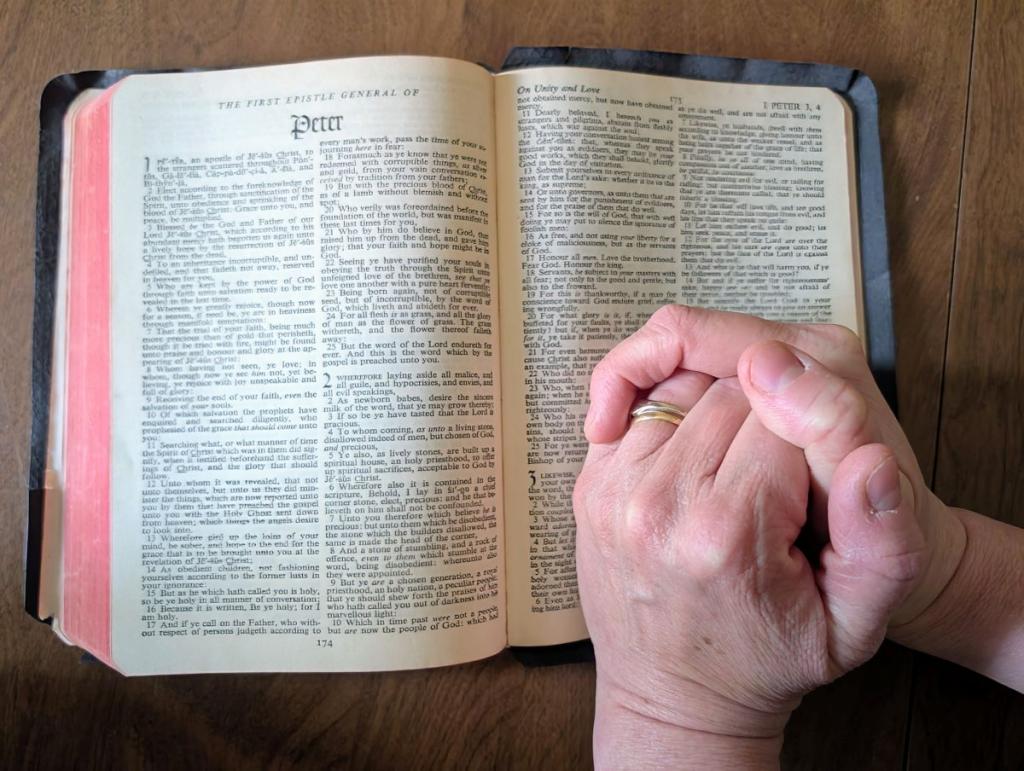
Reclaiming 1 Peter 2:19-25. Photo by Leah D. Schade
Using 1 Peter 2 to quell rebellion against abuses of rights
The sermon was preached in February 2024. The pastor said that Peter’s instructions meant his congregation should “think long and hard before participating in any kind of labor strike.” He went on to say: “Any rebellion against authority is ultimately rebellion against God.”
Using 1 Peter 2 to rationalize staying with abusive partners
On the Biblical Gender Roles website, you can find an article by an author who writes under the pen name “Larry Solomon” and claims to have reached over 7 million people. In “Why God Wants You to STAY in an Abusive Relationship,” he turns to 1 Peter 2 to help make his case.
When we endure grief or suffer wrongly at the hands of others, in other words when we endure mistreatment which is abuse and take it patiently, the Scriptures tell us “this is acceptable with God.” God is not excusing the actions of the abusers. But God is saying when we are on the receiving end of various kinds of abuse and we take it patiently, this is acceptable with God.
When it comes to this matter of suffering abuse – we, both men and women, actually model Christ when we suffer abuse from others taking it patiently as he did. And that is why God wants you to stay in an abusive relationship.
Using 1 Peter 2 to justify slavery and sanctify slaveowners
This is what we must keep in mind when the passage of 1 Peter 2:19-25 appears as the Epistle reading in the RCL for the 4th Sunday of Easter, often known as “Good Shepherd Sunday.”
We also need to note that this pericope carefully cuts out the verse that comes just before this reading:
Slaves, be subject to your masters with all respect, not only those who are good and gentle but also those who are dishonest.
So, we can’t read 1 Peter 2 without acknowledging that during the time of chattel slavery in the U.S., slave owners used this passage to make obedience to masters a religious duty.
We must be particularly alert to how this passage has been used against women and especially women of color in contexts of domestic abuse and racialized subordination. When read out of context, the pain of the abused gets normalized while the abuser’s actions are rationalized, excused, and even lifted up as revealing God’s glory.
So, why give any attention to 1 Peter 2?
It may seem strange for me to give this passage from Peter’s letter any attention at all.
But I assert that Peter’s words can be reclaimed to emphasize God’s solidarity with the abused. Using an interpretive lens informed by liberation theology reveals that 1 Peter 2 is about God’s concern for justice, rather than promoting a spirituality of silent suffering under abuse or oppression.
Consider the historical context of this passage. Peter’s letter contained “household codes” – instructions for Christians in small, house-church communities. As New Testament scholar, Jeannine K. Brown notes, “Christians were a small struggling messianic sect of Judaism in the first century. . . Their calling was to live out the gospel as those without much cultural power.”
Addressing wives and slaves in the household codes
Here’s the thing. In other historical documents of that time containing household codes, the instructions are only addressed to the head of the household, the paterfamilias, urging him to treat his wife, children, and slaves with fairness.
Yet Peter also addressed the wives and slaves. Why was this important?
Because addressing the people positioned below the male heads of the household may have been a subversive act of resistance. Peter intentionally addressed the people who had no power and no agency. Thus, he acknowledged them as persons, not property. Implicitly, this recognized a sense of agency for these vulnerable members of the household.
A tool for resistance — if you pay attention
Peter also embeds a tool for resistance within the letter to this vulnerable community. All this talk about the endurance of beatings being commendable to God seems to endorse the reign of paterfamilias. Until you get to: Christ.
Peter asserts that Christ calls us to follow his example of patient suffering and selfless sacrifice, trusting God’s justice. Through Christ’s wounds we are healed and empowered to live righteously.
In other words, the way of Christ is not the way of submission unto death to preserve the paterfamilias system. His death was so that we might live and live righteously. That means living without domination. Jesus absorbed violence without becoming violent himself. In this way, he exposed injustice while refusing to contribute to it or escalate it. And the resurrection repudiated the paterfamilias powers that killed him.
A path to healing and freedom
In this way, Christ opened a path toward healing and freedom. His wounds revealed both the depth of human cruelty and the possibility of restoration. The shepherd who was struck down becomes the one who gathers the wounded back into a life of justice, mercy, and wholeness.
What Peter is saying is that when people suffer for doing what is right, God takes notice. And others see it as well. This has important implications when applied to our own context today where Christian nationalism is the latest iteration of paterfamilias. Christian nationalism provides the underpinnings of religious authoritarianism and justifies crimes against humanity and our planet.
Nonviolence holds a mirror up to the violent system
Being willing to submit oneself to the retaliation of the state by doing things that align God’s purposes of justice and righteousness holds up a mirror and shows us the truth. It reveals the truth about the ideology at the heart of the state – an ideology of superiority that justifies misogyny, racism, ethnocentrism, domination, cruelty, and violence.
Today, Peter’s instructions point us not to submissiveness for the sake of preserving the power structures. Rather, they encourage strategic nonviolent resistance to that structure. It’s not about passive obedience to the Powers or sanctifying oppression. We can read the passage as supporting an ethic of nonviolent faithful witness in a hostile world. It is a letter of active, transformative resistance.
What does active, transformative resistance look like today?
As an example, consider a video that went viral in September of 2025. Presbyterian pastor David Black was praying outside of an ICE facility in Chicago when agents shot him in the head and body with pepper balls.
“They shoved us down, slammed protestors into the concrete and maced us with so many chemicals that I was drenched,” he said. “I want Chicagoans to be thinking: if this is what they are doing to pastors, journalists, teachers, mothers, and elders who are gathering to sing and pray outside of this facility, what might they be doing to our neighbors who are behind those walls?”
20If you endure when you are beaten for doing wrong, what credit is that? But if you endure when you do good and suffer for it, this is a commendable thing before God.
“Get your affairs in order.”
Consider another video that went viral in January 2026. Episcopal Bishop Rob Hirschfeld spoke in Concord, N.H. at a vigil for Renee Good just days after an ICE agent in Minneapolis shot and killed her.
Hirschfeld called out the “cruelty, the injustice and the horror … unleashed in Minneapolis,” and warned his clergy to prepare for “a new era of martyrdom.” He announced: “I’ve asked them to get their affairs in order to make sure they have their wills written because it may be that now is no longer the time for statements, but for us with our bodies to stand between the powers of this world and the most vulnerable.”
In other words, do the right thing, even if it results in your suffering.
For to this you have been called, because Christ also suffered for you, leaving you an example, so that you should follow in his steps.
Discern what actions are right for you
Now, I want to be clear. I am not saying that every Christian, or even every minister, is supposed to put their body in harm’s way. Each of us must determine what Christ’s call means for us in our ministry, given the risks that come with the body we inhabit and the responsibilities we have.
What I am saying is that just as Peter addressed those under the paterfamilias, we must find our agency under today’s structures of authoritarianism and Christian nationalism.

Clergy and congregations can assist with community organizing and spiritual support
Questions for discernment
Each of us has some questions to ask ourselves prayerfully and with trusted colleagues and mentors. Questions like:
- What is God calling me to do in this moment?
- Given my own social status, my personal risks and limitations, and my responsibilities to those who rely on me: what is appropriate for me to do in seeking the good to which God calls me?
- Am I willing to endure maybe not suffering but perhaps . . . discomfort? Awkwardness? Uneasiness? Angry emails? Anonymous notes slid under my door? The knowledge that I am not pleasantly pleasing everyone?
Or maybe your questions are:
- What suffering have I already endured to this point, and is it time for me to rest?
- Is my calling at this time to heal from those wounds? And to trust that Christ will lead others to step up in their prophetic witness?
- Can I offer the wisdom I have gained from my experience so that others can learn and receive guidance for their calling?
Count the cost
On Jan. 27, 2026, the Clergy Emergency League, an organization I co-founded, invited a panel of Minnesota pastors and faith leaders to share what they’ve learned about organizing faith-based resistance to ICE. Each of them shared what it was like for them: the exhaustion, the fear, the emotional and physical toll. But one of them said, “I have never felt so alive in my ministry. The sense of purpose I feel in this moment is incredible.”
The Minneapolis pastors and community organizers told us: You are not called to do everything. But everyone is called to do something. And God calls each of us to be faithful, prepared, and accountable. They reminded us that this work is collective—and it is holy.
1 Peter 2 does not sanctify abuse or oppression.
Rather, in a vulnerable house-church setting, it provided a nonviolent witness that entrusts justice to God and identifies Christ with the oppressed.
Today, Peter’s letter speaks to us with subversive yet powerful words — if we have ears to hear. When I read his letter, I hear him saying that this is a moment for faithfulness. This is the time for discipline, humility, and collective action.
May the Good Shepherd bless us with resolve, responsiveness, and resilience as we do the good to which God has called us. Amen.
Read also:
Thieves and Bandits, Shepherds and Gates – John 10:1-10
3 New Testament Messages for Resisting Autocracy
Palm Sunday Was a Protest March! Analysis of #NoKings Speech
Poetry to Resist Fascism? Hannah Arendt Shows the Way
The Bridge for Early Career Preachers seeks to support those who are in their first seven years of congregational ministry and preaching at least one third of the opportunities in a calendar year. To learn more or apply for the next cohort, click here.
The Rev. Dr. Leah D. Schade is a seminary professor, ordained minister, and co-founder of the Clergy Emergency League. Her opinions are her own.
Leah is the author of Preaching and Social Issues: Tools and Tactics for Empowering Your Prophetic Voice (Rowman & Littlefield, 2024), Preaching in the Purple Zone: Ministry in the Red-Blue Divide (Rowman & Littlefield, 2019) and Creation-Crisis Preaching: Ecology, Theology, and the Pulpit (Chalice Press, 2015). She is the co-editor of Rooted and Rising: Voices of Courage in a Time of Climate Crisis (Rowman & Littlefield, 2019). Her book, Introduction to Preaching: Scripture, Theology, and Sermon Preparation, was co-authored with Jerry L. Sumney and Emily Askew (Rowman & Littlefield, 2023).
General Christian
Women in Religion
Politics and Religion
countering abusive interpretations of scripture
Previous Post

April 15, 2026
Can Preachers Talk About Climate Change?
Next Post

April 21, 2026 Thieves and Bandits, Shepherds and Gates - John 10:1-10
Recent Comments
"Or, people could just realize our planet is also a living organism, a 4.5 billion ..."
Love Your Neighbor – Including Earth-Kin: ..."
"Climate change is getting attention but not enough. The study of the issue needs to ..."
Preaching About Climate Change: What Clergy ..."
"Yes! The Season of Creation is a month-long liturgical season to focus on all aspects ..."
Making Space for Eco-Grief—and Hope—in Your ..."
"The new Feast of Creation festival in the liturgical year offers an intentional opportunity for ..."
Making Space for Eco-Grief—and Hope—in Your ..."
Browse Our Archives
Select a Category Academy of Homiletics Addiction Advent AI (Artificial Intelligence) Animals Apocalypse Appalachia Ash Wednesday Baptism Bible Black Lives Matter Blade Runner Book review Children in church Christian Nationalism Christian/Islamic relations Christmas Church Clergy Climate change COVID-19 Creation Data Centers Death penalty Devotional Dialogue Doubt Earth Day Easter Ecofeminism EcoPreacher 1-2-3 ELCA ELCA Youth Gathering Election Environment/ecology Epiphany Faith Faith and Politics Feminism Film review Food Food and Faith Forgiveness Fracking Good Friday Good Omens Grief Gun violence Holy Humor Sunday Holy Week Howard Thurman ICE Immigration Indigenous wisdom Interview Jesus Kentucky Lafayette High School Marching Band Leadership Lent LGBTQIA+ Marching band Martin Luther Martin Luther King Jr. Mary Maundy Thursday Michael Sheen Mother of Jesus Nature New Year's Eve Palm Sunday Parables Pentecost Poem, Poetry Politics Poor People's Campaign Pop culture Prayers Preaching Progressive Christianity Public theology Purple Zone Racism and White Privilege Religion Religion and environment Religion and politics Religion and pop culture Religion and violence Rev. Nelson Rabell Gonzalez Sermons Spanish language resources for preaching Technology Thanksgiving Theological education theology Trees Trump Uncategorized Vegan War Women and religion Workshop Worship
Select a Month October 2026 September 2026 July 2026 June 2026 May 2026 April 2026 March 2026 February 2026 January 2026 December 2025 November 2025 October 2025 September 2025 May 2025 April 2025 March 2025 February 2025 January 2025 December 2024 November 2024 October 2024 September 2024 August 2024 July 2024 June 2024 May 2024 April 2024 March 2024 February 2024 January 2024 December 2023 November 2023 October 2023 September 2023 August 2023 July 2023 June 2023 May 2023 April 2023 March 2023 February 2023 January 2023 December 2022 November 2022 October 2022 August 2022 July 2022 June 2022 May 2022 April 2022 March 2022 February 2022 January 2022 December 2021 November 2021 October 2021 September 2021 August 2021 July 2021 June 2021 May 2021 April 2021 March 2021 January 2021 December 2020 November 2020 October 2020 September 2020 August 2020 July 2020 June 2020 May 2020 April 2020 February 2020 January 2020 December 2019 November 2019 October 2019 September 2019 August 2019 July 2019 June 2019 May 2019 April 2019 March 2019 January 2019 December 2018 November 2018 October 2018 September 2018 August 2018 July 2018 June 2018 May 2018 April 2018 March 2018 February 2018 January 2018 December 2017 November 2017 October 2017 September 2017 August 2017 July 2017 June 2017 May 2017 April 2017
Follow Us!
TAKE THE
Religious Wisdom Quiz
According to James, where does wisdom that is pure, peace-loving, and considerate come from?
Select your answer to see how you score.
From experience From study From heaven From Prayer
Books by This Author Books by Leah D. Schade
Related posts from EcoPreacher

Why Christians Have a Sacred Duty to Vote:...

Pastoral Wisdom for Responding to Sermon Pushback

"Render Unto Caesar": Faith, Politics, and Elections

What Matt. 21:23-32 Teaches About Integrity In An...
TRENDING AT PATHEOS Progressive Christian

Why Christians Have a Sacred Duty to Vote:...
The Bible offers strong support for the sacred duty to vote. Here...

What Being a Modern-Day Apostle Means to Me
In my last column, I discussed the ins and outs of modern-day...

Did Ancient China Once Worship the God of...
Across human history, a common thread weaves through the origins of the...

Love Your Neighbor – Including Earth-Kin: Lev. 19,...
God’s command to love your neighbor means acting in an ethical and...

Lead a Church Study of “Jesus and Lao...
Guest writer Jack Thomas (The Irreverent Reverend) reflects on leading his church...

Principles for Understanding the Apostolic Ministry Today
Whenever people discover that my formal ministry title is "apostle," as in...
view all Progressive Christian blogs
What Are Your Thoughts?leave a comment
Ad-Free & Subscriber Log-In Subscription Support
- About Us
- 2026 Calendar
- Videos
- Podcasts
- Library of World Religions
- Faith In Media Tracker
- Advertise With Us
- Write for Us
- Privacy Policy
- Terms of Service
- Do Not Sell My Data
- Contact Us
- Radiant Digital
- Manage Newsletter Subscriptions
- Unsubscribe From Notifications
- Sitemap
Copyright 2008-2026, Patheos. All rights reserved.
Subscription Support Ad-Free & Subscriber Log-In
Follow Patheos