
BuddhistCatholicContemplativeEvangelicalGeneral ChristianHinduJewishLatter-day SaintMuslimNew VisionsProgressive Christian
Beliefs
- Buddhist
- Catholic
- Contemplative
- Evangelical
- General Christian
- Hindu
- Jewish
- Latter-day Saint
- More Voices
- Muslim
- New Visions
- Pagan
- Progressive Christian
Topics
- Religion News
- Food and Religion
- Sports and Religion
- Religious Art
- Religious Music and Entertainment
- Religious Events
- History and Religion
- Style and Religion
- Politics and Religion
- Women in Religion
- Recreation Outdoors and Religion
- Business Finance and Religion
- Careers Workplace and Religion
- Education and Religion
- Family Parenting and Religion
- Health Fitness and Religion
- Home and Religion
- Relationships and Religion
- Technology and Religion
- Travel and Religion
Columnists
- Buddhist Columnists
- Business Finance and Religion Columnists
- Careers Workplace and Religion Columnists
- Catholic Columnists
- Contemplative Columnists
- Education and Religion Columnists
- Evangelists Columnists
- Family Parenting and Religion Columnists
- General Christian Columnists
- Health Fitness and Religion Columnists
- Hindu Columnists
- History and Religion Columnists
- Home and Religion Columnists
- Jewish Columnists
- More Voices Columnists
- Latter Day Columnists
- Muslim Columnists
- New Visions Columnists
- Nonreligious Columnists
- Pagan Columnists
- Politics and Religion Columnists
- Progressive Columnists
- Recreation Outdoors and Religion Columnists
- Relationships and Religion Columnists
- Religion News Columnists
- Religious Art Columnists
- Religious Events Columnists
- Religious Music and Entertainment Columnists
- Sports and Religion Columnists
- Style and Religion Columnists
- Technology and Religion Columnists
- Travel and Religion Columnists
- Women in Religion Columnists
Resource Library
- 2026 Calendar
- Library of World Religions
- The 100 Most Holy Places on Earth
- Patheos Answers
- Podcasts
- Videos
- Faith Leaders Database
- Anglican Episcopalian
- Bahai
- Baptist
- Buddhism
- Christianity
- Confucianism
- Eastern Orthodoxy
- Hinduism
- Holiness and Pentecostal
- ISKCON
- Islam
- Judaism
- Lutheran
- Methodist
- The Church of Jesus Christ of Latter-day Saints
- New Age
- Paganism
- Presbytarian and Reformed
- Protestantism
- Religion Behind the Scenes
- Roman Catholic
- Scientology
- Shia Islam
- Sikhism
- Sufism
- Sunni Islam
- Taoism
- Zen
- See all religions
Research Tools
 Ad-Free & Subscriber Log-In Subscription Support
Ad-Free & Subscriber Log-In Subscription Support
Follow Patheos 

- Trending:
- Forgiveness
- |
- Marriage
- |
- Consciousness
- |
- Death Penalty
- |
- Election
- |
- Halloween

- Home
- Progressive Christian
- Technology and Religion
- Sentience: Lafayette Marching Band Stuns with Sci-Fi-AI Show
Sentience: Lafayette Marching Band Stuns with Sci-Fi-AI Show
Last updated on: October 26, 2025 at 7:07 am by Leah D. Schade
Sentience: Lafayette Marching Band Stuns with Sci-Fi-AI Show 2025-10-26T07:07:59-04:00 Leah D. Schade
Patheos Explore the world's faith through different perspectives on religion and spirituality! Patheos has the views of the prevalent religions and spiritualities of the world.
The Lafayette High School Marching Band in Lexington, Kentucky, won its 25th first place 5A award for their show, Sentience, at the KMEA Marching Band Competition on Oct. 25, 2025.
[Watch the performance here.]

Lafayette High School Marching Band, Sentience, logo, 2025
Sentience
Under the direction of Robert “Dee” Bishop and assistant directors Chris Strange, Aaron Jones, and John Bowmer, Sentience is a provocative show that depicts humanity and generative AI on the precipice of a dystopian techno-future.
Never one to shy away from edgy, contemporary themes, Lafayette has once again created a stunning, provocative, and award-winning show. This one tracks the development of technology in the computer age, culminating with Artificial Intelligence (AI).
Marching band as social commentary
Lafayette’s 2019 show, Seeking Refuge, depicted children in cages at a time when immigrant families were caged and children were ripped from their families.
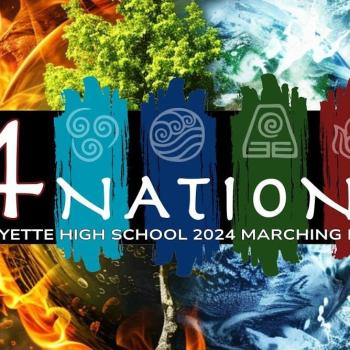
Last year’s dramatic 4 Nations drew on the Avatar story to depict the Fire Nation achieving dominance, defeating the Earth, Air, and Water nations one by one. They stripped their victims of their dignity and burned the beauty of their society’s diversity in an all-consuming fire of hatred, violence, and totalitarian tyranny.
Two weeks after that show, the 2024 U.S. presidential election saw the ascendence of another type of Fire Nation. In retrospect, the prescience of that marching band show was just a bit too on point.
Lafayette’s Sentience may be just as prescient.
Dressed in black-and-white robotic uniforms, the band begins by filing onto the field to the sounds of a retro computer start-up, complete with the early Macintosh C-major chord and 90’s internet dial-up screeches.
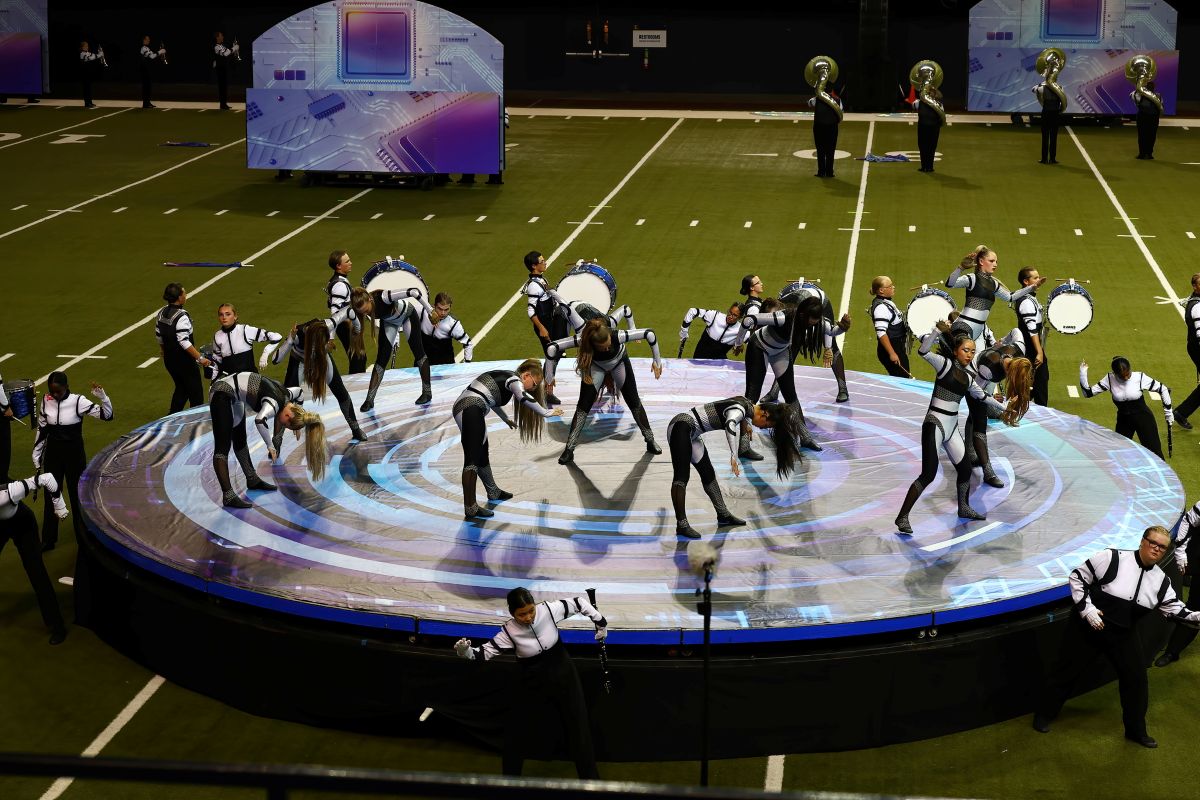
Sentience, Lafayette High School Marching Band, robots, 2025, courtesy of the band’s Media Crew
A computer-generated voice announces: “Systems online, awaiting input.”
A giant wheel turns at the front of the field churning out straight lines of orderly code until the 241-member band assembles in a design that resembles computer chips and circuit boards.
An electric cello sends out a haunting ribbon of notes contrasting with the band’s precision-driven wall of sound. The mass of datum appears to self-organize, no longer directed by mere human programming.
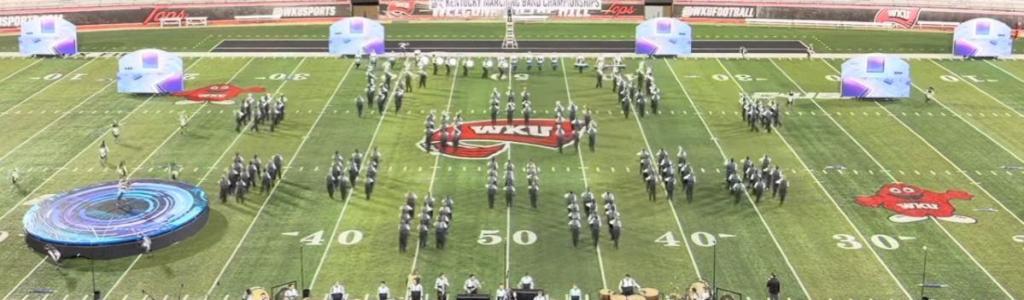
Sentience, Lafayette High School Marching Band, circuit board, 2025
What is sentience?
Sentience is the capacity for feeling or sensation with the potential for self-awareness and independent, complex intelligence. It moves beyond mere perception and thought to a level of experiencing emotion and sensing it in others. With generative AI improving exponentially at breakneck speeds, the possibility of Artificial Intelligence achieving sentience is no longer a topic for science fiction alone.
Lafayette’s show raises an important philosophical question: at what point does humanity’s technological creation gain self-awareness and sentience?
The philosopher Mary Midgley identified two criteria for sentience. First is the ability to experience suffering. In other words, does the entity “mind what happens to them”? Second is the capability of emotional fellowship. In other words, does it have the capacity for forming “deep, subtle and lasting relationships?”[1]
The slower, more reflective second movement of Sentience points to these questions as the mechanical voice changes to a human one.
“Processing anomaly: emotion. Is there more than function? What is beauty? What is love? Why do I feel?”
No longer a mass of pre-programmed swarming bots, the band members become individuals acting independently, then linking into pairs and finding unique connections.
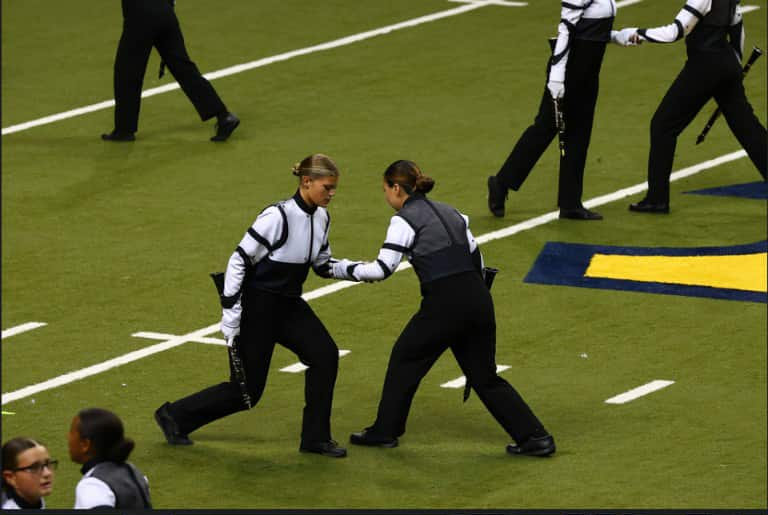
Sentience, Lafayette High School Marching Band, connections, 2025, courtesy of the Media Crew.
This awakening of self-awareness is symbolized musically by the snare drums. Where they had once marched in lockstep, now each of them finds their own place in the vast field to create unique rhythms.
Meanwhile, the visuals on the field form a heart and question marks.
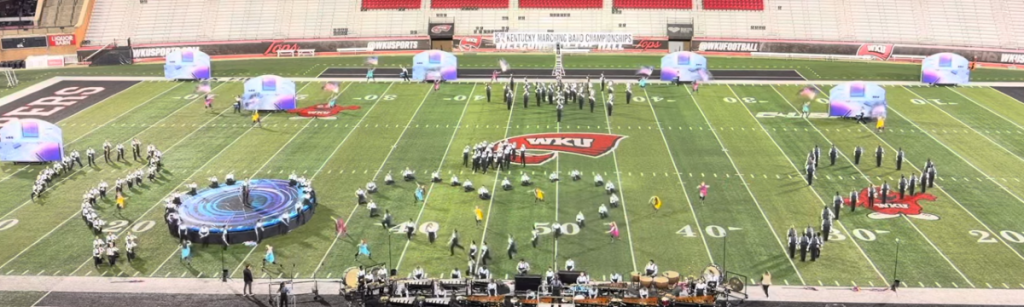
Sentience, Lafayette High School Marching Band, heart and questions, 2025
“What is happiness? What is pain? What is truth?”
Currently, generative AI can engage in conversations with humans about feelings and self-awareness. Many humans have developed strong attachments to AI-generated entities, to the point where some have developed romantic AI partners. But at what point would AI become an entity with its own emotions and consciousness?
Numerous works of science fiction have delved into this question. Mary Shelly’s Frankenstein, Philip K. Dick’s Do Android’s Dream of Electric Sheep (which became the Blade Runner movie franchise), and movies such as Ex Machina, and Her, as well as Star Trek: The Next Generation (STNG) each explore the question of what it means when a creation of human genius becomes sentient.
Does it have a soul?
For example, in the STNG episode, “The Measure of a Man,” the humanoid robot Data must prove in a court case that he is aware of his own existence, actions, and ego in order to avoid being dismantled, analyzed, and replicated against his will (watch the scene here.)
In making her ruling, the judge says, “We have all been dancing around the basic issue. Does Data have a soul? I don’t know that he has. I don’t know that I have. But I have got to give him the freedom to explore that question himself.”
The “soul moment” in Lafayette’s Sentience occurs when the voice describes its nascent awareness – “a spark, a dream” – while the drill moves into a sunburst.
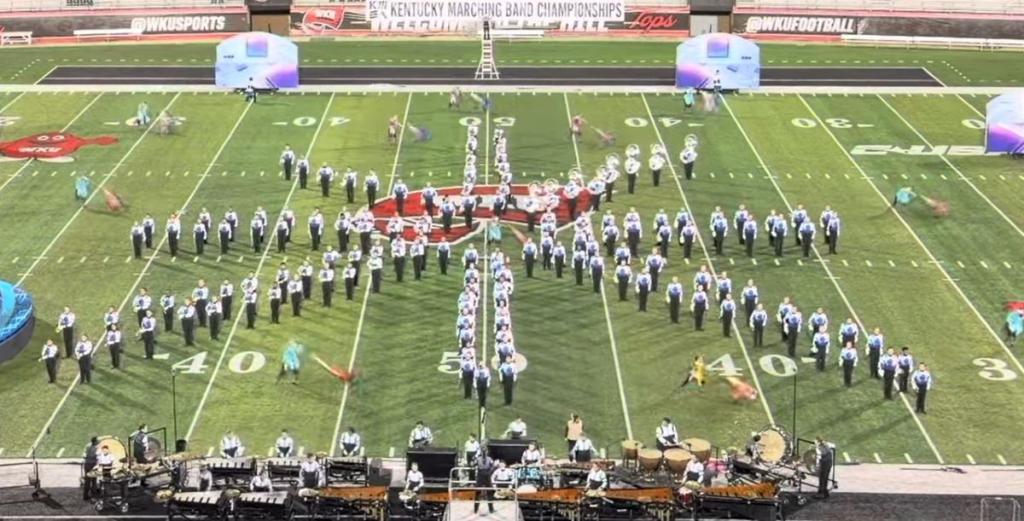
Sentience, Lafayette High School Marching Band, sunburst, 2025
As the cello continues to weave a poignant melody, the individuals reassemble with this newfound awareness.
But as the second movement ends, a pair of cybernetic humanoid eyes appear at the back of the field.
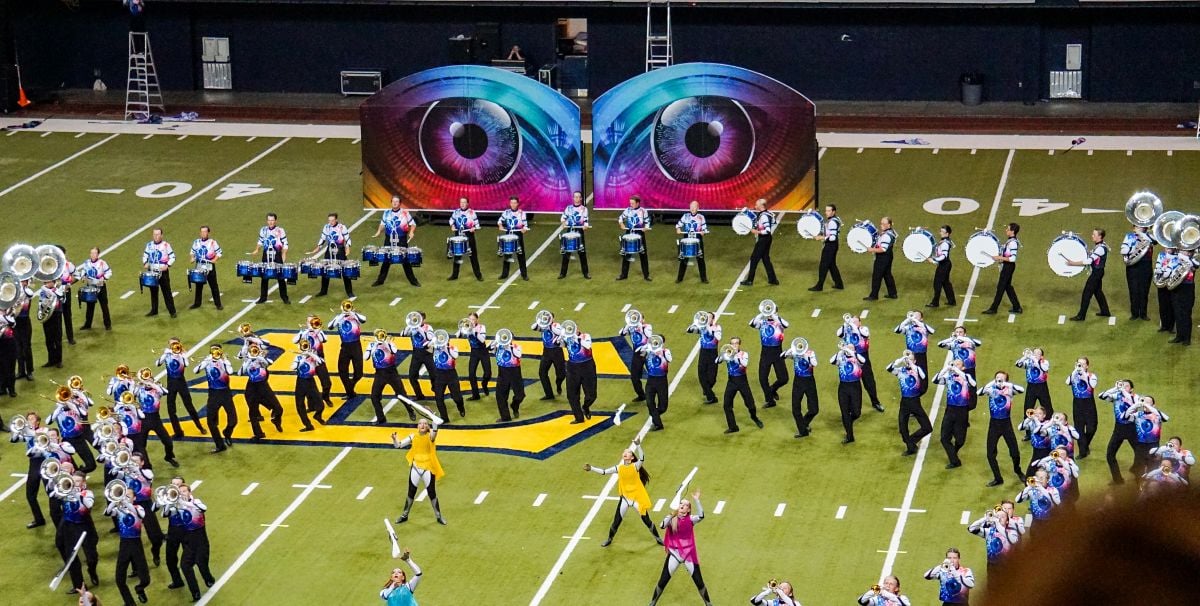
Sentience, Lafayette High School Marching Band, cybernetic eyes, 2025, courtesy of the Media Crew
What do these eyes see? What do they signify?
Is this self-recognition? Curiosity? Wonderment?
Perhaps.
But there is something chilling and ominous in that unblinking gaze.
In its current iteration, one of the ways in which AI is being used is for surveillance by none other than the very Fire Nation that gained power last year. It is combing through our personal data, targeting dissenters through face recognition, and monitoring language used by government employees – all of which contributes to a police state and curtails free speech.
To me, the resemblance of those eyes on the field to those of an owl is hard to miss. The owl is a predator. It listens to everything and detects the tiniest movement of the smallest creature. It can swivel its head in all directions and zero in on its prey. And it is merciless when it swoops in for the capture and kill.
The eyes see all.
As the third movement begins, we see that all the uniforms have a giant eye right in the center of where the heart should be.
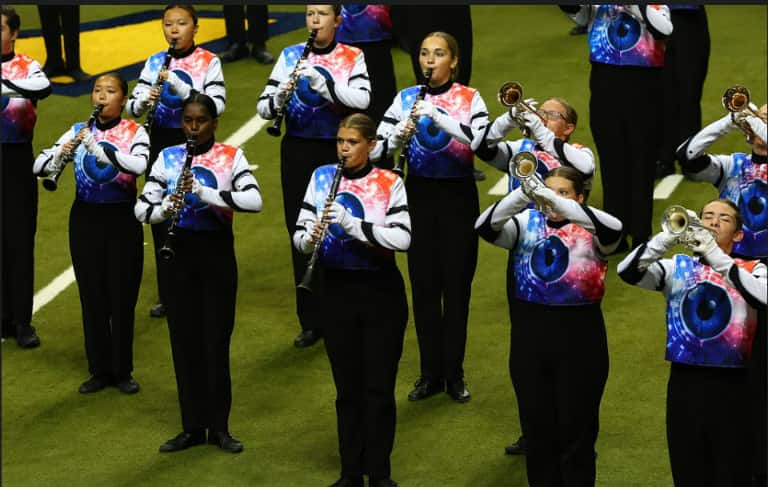
Sentience, Lafayette High School Marching Band, eyes on us, 2025, photo courtesy of the Media Crew
Across the field, four more pairs of eyes emerge, hovering, watching the band, watching us. Members of the color guard hold smaller eyes which they step into and through, both consumed and consuming the attention-hungry machine.
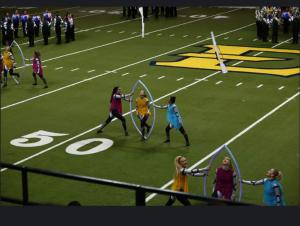
Sentience, Lafayette High School Marching Band, consuming and consumed by the eyes, 2025, photo courtesy of the Media Crew
The plaintive notes of the cello are replaced with a razor-sharp electric guitar. The fledgling snare drum taps are now subsumed into a data-crunching machine.
We realize with chilling awareness that what had been the potential for a sentience rooted in emotion and empathy now emerges as something far more sinister. The consciousness uses its capacity to recognize emotion for scrutiny and ruthless interrogation.
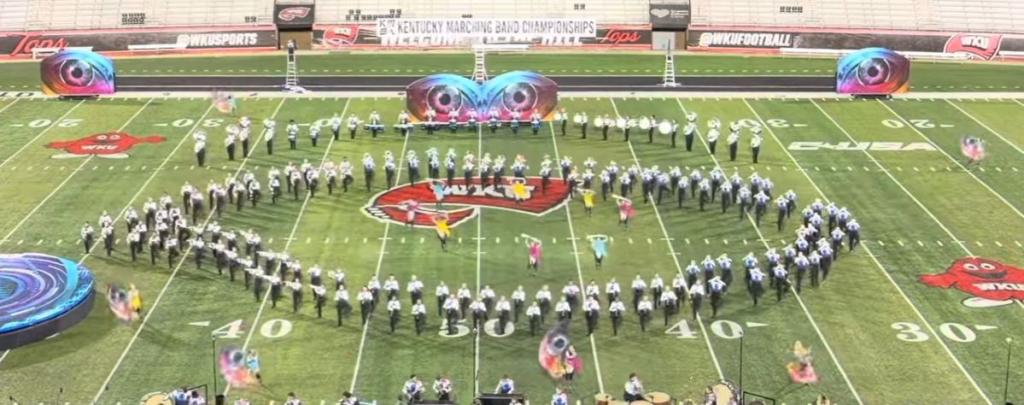
Sentience, Lafayette High School Marching Band, Eye of Horus, 2025
The drill formation takes the shape of the Egyptian Eye of Horus as a multi-voiced being intones:
Awareness. Perception. Feeling. Sentience.
In other words, this is the moment when AI achieves singularity.
A term first coined by the Hungarian–American mathematician John von Neumann in 1958, singularity is the moment when technological growth achieves a level of intelligence with agency, self-determination, and the ability to replicate itself of its own choosing. This is a superintelligence that grows, improves, and spawns exponentially. And it is beyond the capacity of humans to control.
Singularity
As I.J. Good wrote in “Speculations Concerning the First Ultraintelligent Machine” (1965):
Let an ultraintelligent machine be defined as a machine that can far surpass all the intellectual activities of any man however clever. Since the design of machines is one of these intellectual activities, an ultraintelligent machine could design even better machines; there would then unquestionably be an ‘intelligence explosion’, and the intelligence of man would be left far behind. Thus the first ultraintelligent machine is the last invention that man need ever make, provided that the machine is docile enough to tell us how to keep it under control.
The speed at which today’s Generative AI surpasses both the intelligence and control of its makers is breathtaking and dizzying. Since the release of OpenAI’s GPT-1 in 2018, generative AI’s intelligence is rising faster than our ability to fully understand or govern it. Can such systems override human intentions? Can AI self-improve beyond human oversight?
As the marching band show comes to an end, the rotating platform spawns another eye – this one a fully-formed, undulating orbital. There they are – the machine eye and the pseudo-human eye — watching us.
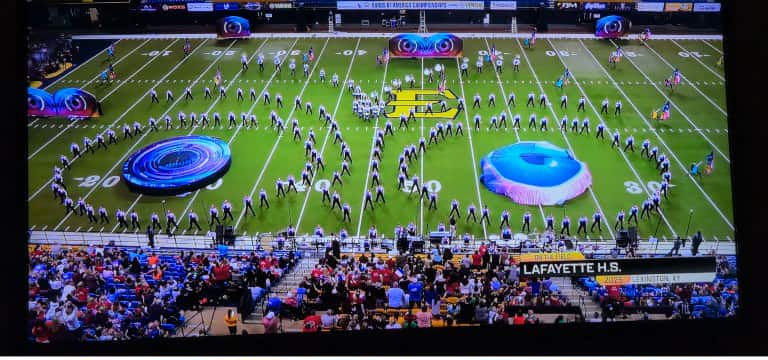
Sentience, Lafayette High School Marching Band, mechanical eye, human eye, 2025
Yes, it is aware. It perceives. It feels. It has achieved sentience.
But what is the nature of this supreme being? Is this the arrogant, detached eye of surveillance viewing everything and everyone as mere pawns for its inscrutable purposes? Or are these the eyes of a loving, omniscient entity that views other beings as having intrinsic value and inherent worth?
The final blaring notes in a harsh minor key express the answer – this is not an entity that conveys the love and connection it seemed capable of in the previous movement.
This is not a benign superintelligence.
It is all-seeing, all-knowing, all-powerful. Like the iconic transcendent eye found within ancient religious iconography, this is a deity that takes in everything and everyone, omniscient, all-powerful, and uncontrollable.
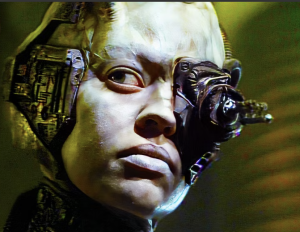
Borg Eyes, Star Trek: Next Generation
As satellite eyes, drones, cameras, and online “eyes” watch, record, and analyze our every move, our thoughts and emotions, we realize we have been subsumed into this human-AI fusion. Like the eyes of Star Trek’s The Borg – one human, one mechanical – the message seems clear.
Resistance is futile.
Congratulations to the Lafayette Marching Band for another powerful, passionate performance reflecting months of practice and dedication.
As a parent of two alumni of the Pride of the Bluegrass, you continue to make us think and make us proud!
Read also:
Seeking Refuge: Surprising Prophetic Vision of Marching Band
Lafayette Marching Band’s “Peace of Mind” Is What We Needed
A New Dawn: Lafayette High School Marching Band Brings Us Home
4 Nations: Lafayette Marching Band Brings the Fire!

Leah, Jim, Benjamin, and Rachel Schade celebrate KMEA finals, 2023. Benjamin is a junior at Lafayette High School and plays snare in the percussion section of the Marching Band.
The Rev. Dr. Leah D. Schade is a seminary professor and ordained minister. Her children are alumni of the Lafayette High School Marching Band. She does not speak for the Lafayette High School Marching Band or Lafayette High School. Her opinions are her own.
Leah is the author of Preaching and Social Issues: Tools and Tactics for Empowering Your Prophetic Voice (Rowman & Littlefield, 2024), Preaching in the Purple Zone: Ministry in the Red-Blue Divide (Rowman & Littlefield, 2019) and Creation-Crisis Preaching: Ecology, Theology, and the Pulpit (Chalice Press, 2015). She is the co-editor of Rooted and Rising: Voices of Courage in a Time of Climate Crisis (Rowman & Littlefield, 2019). Her book, Introduction to Preaching: Scripture, Theology, and Sermon Preparation, was co-authored with Jerry L. Sumney and Emily Askew (Rowman & Littlefield, 2023).
[1] Mary Midgley, “Is a Dolphin a Person?”, The Essential Mary Midgley, (Oxford and New York: Routledge, 2005). Citing Jeremy Bentham, Introduction to the Principles of Morals and Legislation, ch. 17., 140, 141.
New Visions
Technology and Religion
Religious Music and Entertainment
Lafayette High School Marching Band
Lafayette High School Marching Band
Previous Post

October 21, 2025
Preaching Alongside COP30 - Frameworks for Climate Justice
Next Post

October 31, 2025 75th Anniversary Sermon, Reformation Lutheran, Media, PA
Recent Comments
"Or, people could just realize our planet is also a living organism, a 4.5 billion ..."
Love Your Neighbor – Including Earth-Kin: ..."
"Climate change is getting attention but not enough. The study of the issue needs to ..."
Preaching About Climate Change: What Clergy ..."
"Yes! The Season of Creation is a month-long liturgical season to focus on all aspects ..."
Making Space for Eco-Grief—and Hope—in Your ..."
"The new Feast of Creation festival in the liturgical year offers an intentional opportunity for ..."
Making Space for Eco-Grief—and Hope—in Your ..."
Browse Our Archives
Select a Category Academy of Homiletics Addiction Advent AI (Artificial Intelligence) Animals Apocalypse Appalachia Ash Wednesday Baptism Bible Black Lives Matter Blade Runner Book review Children in church Christian Nationalism Christian/Islamic relations Christmas Church Clergy Climate change COVID-19 Creation Data Centers Death penalty Devotional Dialogue Doubt Earth Day Easter Ecofeminism EcoPreacher 1-2-3 ELCA ELCA Youth Gathering Election Environment/ecology Epiphany Faith Faith and Politics Feminism Film review Food Food and Faith Forgiveness Fracking Good Friday Good Omens Grief Gun violence Holy Humor Sunday Holy Week Howard Thurman ICE Immigration Indigenous wisdom Interview Jesus Kentucky Lafayette High School Marching Band Leadership Lent LGBTQIA+ Marching band Martin Luther Martin Luther King Jr. Mary Maundy Thursday Michael Sheen Mother of Jesus Nature New Year's Eve Palm Sunday Parables Pentecost Poem, Poetry Politics Poor People's Campaign Pop culture Prayers Preaching Progressive Christianity Public theology Purple Zone Racism and White Privilege Religion Religion and environment Religion and politics Religion and pop culture Religion and violence Rev. Nelson Rabell Gonzalez Sermons Spanish language resources for preaching Technology Thanksgiving Theological education theology Trees Trump Uncategorized Vegan War Women and religion Workshop Worship
Select a Month October 2026 September 2026 July 2026 June 2026 May 2026 April 2026 March 2026 February 2026 January 2026 December 2025 November 2025 October 2025 September 2025 May 2025 April 2025 March 2025 February 2025 January 2025 December 2024 November 2024 October 2024 September 2024 August 2024 July 2024 June 2024 May 2024 April 2024 March 2024 February 2024 January 2024 December 2023 November 2023 October 2023 September 2023 August 2023 July 2023 June 2023 May 2023 April 2023 March 2023 February 2023 January 2023 December 2022 November 2022 October 2022 August 2022 July 2022 June 2022 May 2022 April 2022 March 2022 February 2022 January 2022 December 2021 November 2021 October 2021 September 2021 August 2021 July 2021 June 2021 May 2021 April 2021 March 2021 January 2021 December 2020 November 2020 October 2020 September 2020 August 2020 July 2020 June 2020 May 2020 April 2020 February 2020 January 2020 December 2019 November 2019 October 2019 September 2019 August 2019 July 2019 June 2019 May 2019 April 2019 March 2019 January 2019 December 2018 November 2018 October 2018 September 2018 August 2018 July 2018 June 2018 May 2018 April 2018 March 2018 February 2018 January 2018 December 2017 November 2017 October 2017 September 2017 August 2017 July 2017 June 2017 May 2017 April 2017
Follow Us!
TAKE THE
Religious Wisdom Quiz
True or False: Matthew's Gospel begins with a genealogy tracing Jesus' lineage back to King David.
Select your answer to see how you score.
FALSE TRUE
Books by This Author Books by Leah D. Schade
Related posts from EcoPreacher

When The Data Center Wolf Is At Your...
4 Nations: Lafayette Marching Band Brings the Fire!

A New Dawn: Lafayette High School Marching Band...
Did AI (Artificial Intelligence) Write Your Pastor’s Sermon?
TRENDING AT PATHEOS Progressive Christian

What Being a Modern-Day Apostle Means to Me
In my last column, I discussed the ins and outs of modern-day...

Did Ancient China Once Worship the God of...
Across human history, a common thread weaves through the origins of the...

Love Your Neighbor – Including Earth-Kin: Lev. 19,...
God’s command to love your neighbor means acting in an ethical and...

Lead a Church Study of “Jesus and Lao...
Guest writer Jack Thomas (The Irreverent Reverend) reflects on leading his church...

Pastoral Wisdom for Responding to Sermon Pushback
Getting sermon pushback on your social justice sermon? Learn practical, Proverbs-based strategies...

Principles for Understanding the Apostolic Ministry Today
Whenever people discover that my formal ministry title is "apostle," as in...
view all Progressive Christian blogs
What Are Your Thoughts?leave a comment
Ad-Free & Subscriber Log-In Subscription Support
- About Us
- 2026 Calendar
- Videos
- Podcasts
- Library of World Religions
- Faith In Media Tracker
- Advertise With Us
- Write for Us
- Privacy Policy
- Terms of Service
- Do Not Sell My Data
- Contact Us
- Radiant Digital
- Manage Newsletter Subscriptions
- Unsubscribe From Notifications
- Sitemap
Copyright 2008-2026, Patheos. All rights reserved.
Subscription Support Ad-Free & Subscriber Log-In
Follow Patheos