
BuddhistCatholicContemplativeEvangelicalGeneral ChristianHinduJewishLatter-day SaintMuslimNew VisionsProgressive Christian
Beliefs
- Buddhist
- Catholic
- Contemplative
- Evangelical
- General Christian
- Hindu
- Jewish
- Latter-day Saint
- More Voices
- Muslim
- New Visions
- Pagan
- Progressive Christian
Topics
- Religion News
- Food and Religion
- Sports and Religion
- Religious Art
- Religious Music and Entertainment
- Religious Events
- History and Religion
- Style and Religion
- Politics and Religion
- Women in Religion
- Recreation Outdoors and Religion
- Business Finance and Religion
- Careers Workplace and Religion
- Education and Religion
- Family Parenting and Religion
- Health Fitness and Religion
- Home and Religion
- Relationships and Religion
- Technology and Religion
- Travel and Religion
Columnists
- Buddhist Columnists
- Business Finance and Religion Columnists
- Careers Workplace and Religion Columnists
- Catholic Columnists
- Contemplative Columnists
- Education and Religion Columnists
- Evangelists Columnists
- Family Parenting and Religion Columnists
- General Christian Columnists
- Health Fitness and Religion Columnists
- Hindu Columnists
- History and Religion Columnists
- Home and Religion Columnists
- Jewish Columnists
- More Voices Columnists
- Latter Day Columnists
- Muslim Columnists
- New Visions Columnists
- Nonreligious Columnists
- Pagan Columnists
- Politics and Religion Columnists
- Progressive Columnists
- Recreation Outdoors and Religion Columnists
- Relationships and Religion Columnists
- Religion News Columnists
- Religious Art Columnists
- Religious Events Columnists
- Religious Music and Entertainment Columnists
- Sports and Religion Columnists
- Style and Religion Columnists
- Technology and Religion Columnists
- Travel and Religion Columnists
- Women in Religion Columnists
Resource Library
- 2026 Calendar
- Library of World Religions
- The 100 Most Holy Places on Earth
- Patheos Answers
- Podcasts
- Videos
- Faith Leaders Database
- Anglican Episcopalian
- Bahai
- Baptist
- Buddhism
- Christianity
- Confucianism
- Eastern Orthodoxy
- Hinduism
- Holiness and Pentecostal
- ISKCON
- Islam
- Judaism
- Lutheran
- Methodist
- The Church of Jesus Christ of Latter-day Saints
- New Age
- Paganism
- Presbytarian and Reformed
- Protestantism
- Religion Behind the Scenes
- Roman Catholic
- Scientology
- Shia Islam
- Sikhism
- Sufism
- Sunni Islam
- Taoism
- Zen
- See all religions
Research Tools
 Ad-Free & Subscriber Log-In Subscription Support
Ad-Free & Subscriber Log-In Subscription Support
Follow Patheos 

- Trending:
- Forgiveness
- |
- Marriage
- |
- Consciousness
- |
- Death Penalty
- |
- Election
- |
- Halloween

- Home
- Progressive Christian
- Politics and Religion
- 4 Faithful Post-Election Messages for Clergy & Congregations
4 Faithful Post-Election Messages for Clergy & Congregations
Last updated on: November 7, 2024 at 11:54 am by Leah D. Schade
4 Faithful Post-Election Messages for Clergy & Congregations 2024-11-07T11:54:15-04:00 Leah D. Schade
Patheos Explore the world's faith through different perspectives on religion and spirituality! Patheos has the views of the prevalent religions and spiritualities of the world.
The Sundays after an election in the U.S. are often fraught for clergy and congregations. 2024 is likely to be even more contentious. So how can ministers talk with their congregations after the election? Here are 4 post-election messages that include practical, biblical, theological, and ethical advice.
[This article has been updated in light of the results of the 2024 election.]
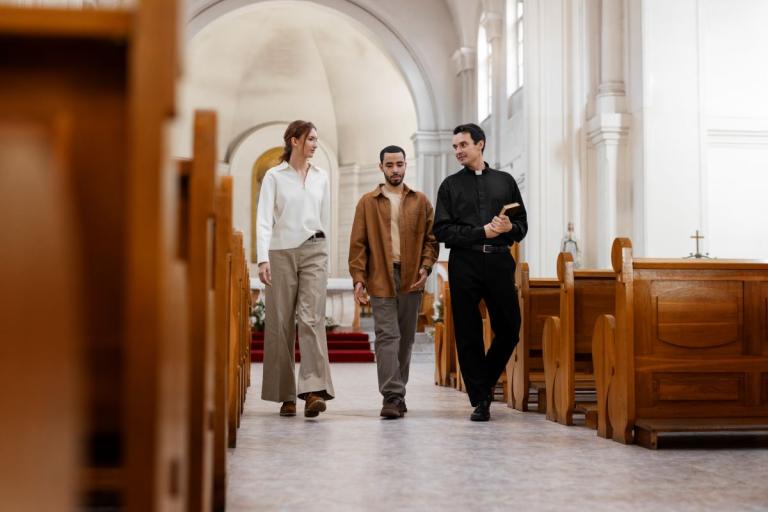
Post-election messages for clergy and congregations. Image by freepik.com
With emotions running high, many are turning to their faith communities for guidance, reassurance, and a path forward.
After the election and beyond, the role of clergy and churches is especially important. Ministers have the opportunity – and obligation – to offer ethical and moral leadership to their congregations and communities in the post-election season.
I recently sat down Rev. Breanna Illéné of the Wisconsin Council of Churches to discuss how clergy can help their congregations navigate this time of uncertainty and division. [Watch “Navigating the Election Season in Your Congregation.”] With heightened tensions, how do we respond with faith-centered messages that offer peace and hope?
Embracing faith amid uncertainty
In today’s highly-charged political climate, churches often find themselves navigating complex discussions at the heart of public concerns. While it might feel simpler to avoid election topics, silence can imply that our faith has little to say about crucial issues impacting families, communities, and society.
If we don’t want to inadvertently communicate through our silence that the church does not care about social issues, we need to find ways to say something about this election, because it will have a huge impact on the people we serve. So, if there was ever a time for clergy to speak openly about an election in a way that reflects Christianity’s core values, this is it.
Educating congregations about the election process
One way to dispel anxiety and restore confidence is to clarify the election process. Churches and clergy can serve as trusted messengers about what happens with vote counting and certification during the “interregnum,” the period between the election and inauguration. This can include educating congregants about where we are in the process, what has happened so far, and what is happening next.
This “map” created by Chris Crawford at Protect Democracy can be a useful resource.
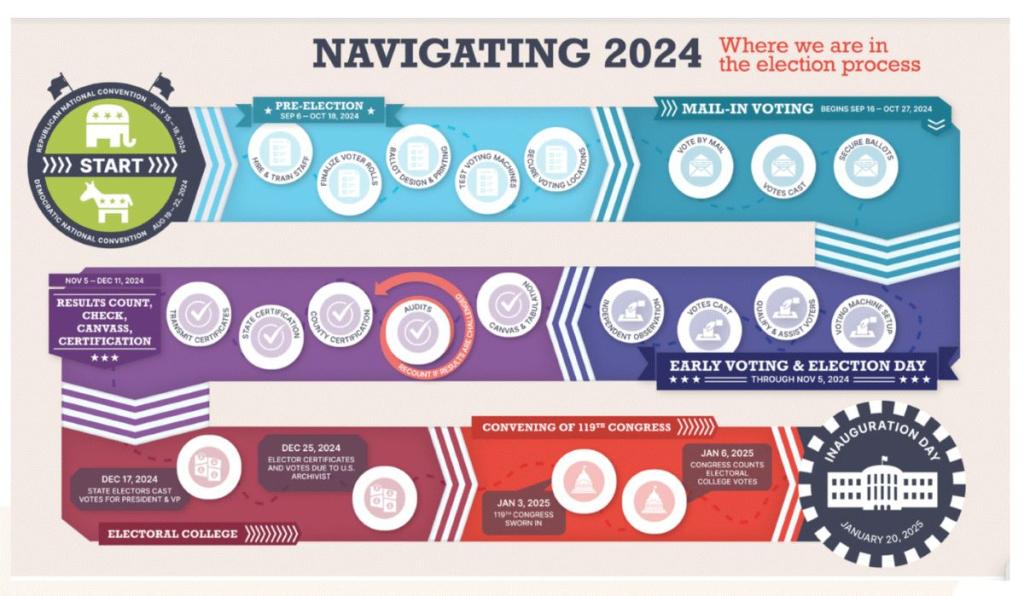
2024 Election Season timeline. Graphic by Chris Crawford at Protect Democracy
Information like this can be especially helpful if we see certain individuals or factions attempting to interrupt, delay, or disrupt this long-established and respected process. Understanding what is supposed to happen in a well-functioning post-election process helps us identify bad-faith actors and actions intending to dislocate the peaceful transfer of power in our democracy.
So, one of the most important points to convey is that there are many levels of checks and balances in the process to ensure that the elections are fair, honest, and correct.
And for clergy, it is vital to bring scripture, theology, and ethics to bear on the post-election season.
4 post-election messages for ministers to emphasize
During the post-election season, pastors can embody a non-anxious presence by staying grounded in biblical, theological, and ethical principles. As some will try to create or exacerbate conflict over the results of the election, moral messaging is a must.
Clergy need to be ethically centered, steady, composed, and resolved, during this time. This means concentrating on foundational principles such as honesty, integrity, nonviolence, compassion, and caring for the most vulnerable.
Here are four post-election messages to emphasize.
1 – Every person matters to God. So be a good neighbor.
Some people are angry, worried, and even despondent about the results of the election. Others are celebrating. It’s important that we listen deeply to the fears – and hopes – of those who are reacting to this election.
Why is this important from a biblical persepctive?
Because Genesis 1:26-27 tells us that every person is created in God’s image. This means that each individual has inherent dignity and value.
This also means that we must treat each person with respect, stand alongside and defend those who are being targeted or bullied, and comfort those who are hurting.
2 – God wants us and others to be safe.
The sad reality is that some people have disrupted the democratic process through intimidation, aggressive rhetoric, destruction of voting boxes, and physical threats. Keeping people from voting has been a key factor in this election, and it has been for centuries.
Right now, many people in our country disagree with each other about what should be happening in our country. Because our nation is deeply divided, intimidation and threats of violence are ongoing. This could escalate at any time, and it can be frightening.
Why is this important from a theological perspective?
We want to be clear that God wants everyone to be safe after the election and at all times. God wants people to tell the truth, solve their differences peacefully, and protect the vulnerable.
In Mark 12:31, Jesus says we need to love our neighbors. As a church, this should be our message as well. So, when encourage non-violence even as people express anger, we are doing our part to help keep people safe. Christians must follow Jesus’s command to show compassion and reject all forms of political violence.
3 – Our words matter to God.
During this election, some leaders have said mean, hurtful things. Words have been used to insult and bully certain individuals and groups as well as incite violence. Because of this, we as Christians need to be especially aware of what we say.
We need to ask ourselves important questions.
What is the impact of our words? How do we make sure we are speaking truth? How do we ensure we aren’t repeating rumors or lies? And how do we make sure our words are always loving?
Why is this important from a biblical perspective?
One of God’s commandments in Exodus 20:16 tells us not to use our words in dishonest and hurtful ways.
Proverbs 18:21 tells us that what people say has the power of life and death.
James 3:5-6 says that even though the tongue is a small part of the body, it’s like a tiny spark that can set a whole forest on fire.
Ephesians 4:29 tells us to only say things that are helpful and build others up. This applies even to those with whom we disagree we politically.
All of this is to say that we need to use our words constructively, both in the church and out in the world. If we represent Christ, then our words and actions need to reflect what Jesus taught us.
4 – Even though the election season brought out the worst in some people, it also brought out the best in others.
During the election season, people came together to encourage each other while voting. This includes pastors and congregations who supported the democratic process in many ways.
Some organized get-out-the-vote drives. Others provided space for voting. Still others handed out water and snacks in long lines. Also, some clergy were a calming presence serving as poll chaplains.
Why is this important from a biblical perspective?
These are examples of bearing the fruits of the Spirit, like kindness and faithfulness (Galatians 5:22-23). It also shows that people of faith are courageous in standing up for their beliefs, as Paul encouraged in 1 Corinthians 16:13-14. In the post-election season, we can continue to be part of God’s kindness, reaching out to those in need.
Now that we’ve covered these broad messages, here are three additional things to keep in mind when talking to your congregation in this post-election season.
Be cautious about “unity” language.
As much as we desire for there to be unity in our congregations and communities, be cautious about insisting people “come together” when some may not feel safe or when they are actually under threat or attack.
There are people living with the effects of harmful and violent political rhetoric and policies undergirded by transphobia, misogyny, anti-Semitism, Islamophobia, fear of immigrants, violence, racism, and white privilege. And the incoming administration has made plans to put policies in place that reflect these beliefs. So, encouraging people to come together with those who have supported harmful policies would be insensitive at best, harmful at worst.
Think about the people who have expressed fear or distress, regardless of their political position. Reach out and check in with people. But avoid urging them to engage with those who they feel may be threatening or harmful to them. Instead, offer space for people to share their feelings in a holy conversation.
Remember that liturgy is God’s holding space for us.
We are not the first people to experience political division or polarization. In the church, we have the advantage of rituals—ancient words and actions that have held the feelings and experiences of those before us. Encourage your congregation to embrace the rhythms of worship as God’s holding space for us.
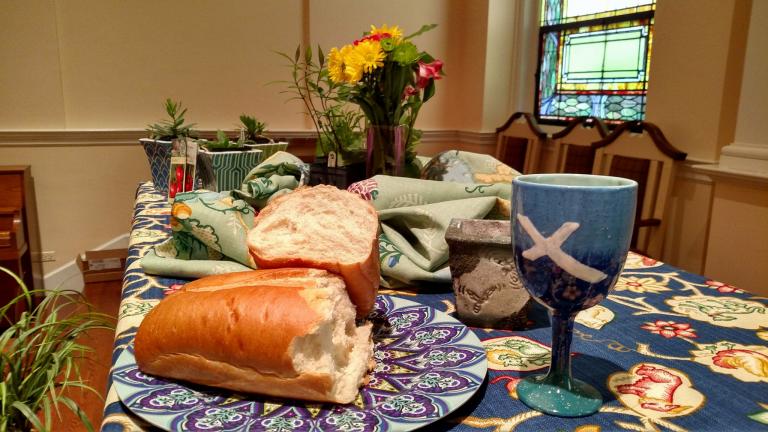
Communion table. Photo by Leah D. Schade. All rights reserved.
Whether through hearing God’s word, breaking bread, singing hymns, or lighting candles, these actions offer peace and remind us that God’s Spirit is with us, even in overwhelming times.
Finally, remember that the work of the church is ongoing, regardless of the election’s outcome.
God is still at work in the world, despite our political divides. Those who are poor, hurting, and ignored will still need the church’s attention, no matter who wins.
We must remind our congregations, and our selves, that just as Jesus continued his ministry, teaching, feeding, and healing, regardless of who was in power, so must we.
Elections come and go, but the work of God’s Church remains.
Know that you are not alone in this post-election season. If you are clergy looking for a network of progressive pastors to help navigate this divisive time, check out the Clergy Emergency League website for more resources, including Bible studies, webinars, and colleague check-ins.
Read also:
Clergy: Prepare for Post-Election Season in Mind, Body & Spirit
Fill Your Lamps, Church – Let’s Be Ready! Post-election Sermon
Post-Election Messaging & Preaching: Red, Blue & Purple Church Tactics
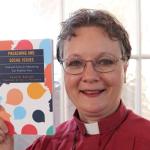
The Rev. Dr. Leah D. Schade is the Associate Professor of Preaching and Worship at Lexington Theological Seminary in Kentucky and ordained in the ELCA. Dr. Schade does not speak for LTS or the ELCA; her opinions are her own. She is the author of Preaching and Social Issues: Tools and Tactics for Empowering Your Prophetic Voice (Rowman & Littlefield, 2024), Preaching in the Purple Zone: Ministry in the Red-Blue Divide (Rowman & Littlefield, 2019) and Creation-Crisis Preaching: Ecology, Theology, and the Pulpit (Chalice Press, 2015). She is the co-editor of Rooted and Rising: Voices of Courage in a Time of Climate Crisis (Rowman & Littlefield, 2019). Her book, Introduction to Preaching: Scripture, Theology, and Sermon Preparation, was co-authored with Jerry L. Sumney and Emily Askew (Rowman & Littlefield, 2023).
General Christian
Politics and Religion
Previous Post

October 29, 2024
Love Your Neighbor: Vote! Sermon Ideas, Mark 12:28-34
Next Post

November 7, 2024 Preaching After the 2024 Election: Sermon & Ministry Tips
Recent Comments
"Or, people could just realize our planet is also a living organism, a 4.5 billion ..."
Love Your Neighbor – Including Earth-Kin: ..."
"Climate change is getting attention but not enough. The study of the issue needs to ..."
Preaching About Climate Change: What Clergy ..."
"Yes! The Season of Creation is a month-long liturgical season to focus on all aspects ..."
Making Space for Eco-Grief—and Hope—in Your ..."
"The new Feast of Creation festival in the liturgical year offers an intentional opportunity for ..."
Making Space for Eco-Grief—and Hope—in Your ..."
Browse Our Archives
Select a Category Academy of Homiletics Addiction Advent AI (Artificial Intelligence) Animals Apocalypse Appalachia Ash Wednesday Baptism Bible Black Lives Matter Blade Runner Book review Children in church Christian Nationalism Christian/Islamic relations Christmas Church Clergy Climate change COVID-19 Creation Data Centers Death penalty Devotional Dialogue Doubt Earth Day Easter Ecofeminism EcoPreacher 1-2-3 ELCA ELCA Youth Gathering Election Environment/ecology Epiphany Faith Faith and Politics Feminism Film review Food Food and Faith Forgiveness Fracking Good Friday Good Omens Grief Gun violence Holy Humor Sunday Holy Week Howard Thurman ICE Immigration Indigenous wisdom Interview Jesus Kentucky Lafayette High School Marching Band Leadership Lent LGBTQIA+ Marching band Martin Luther Martin Luther King Jr. Mary Maundy Thursday Michael Sheen Mother of Jesus Nature New Year's Eve Palm Sunday Parables Pentecost Poem, Poetry Politics Poor People's Campaign Pop culture Prayers Preaching Progressive Christianity Public theology Purple Zone Racism and White Privilege Religion Religion and environment Religion and politics Religion and pop culture Religion and violence Rev. Nelson Rabell Gonzalez Sermons Spanish language resources for preaching Technology Thanksgiving Theological education theology Trees Trump Uncategorized Vegan War Women and religion Workshop Worship
Select a Month October 2026 September 2026 July 2026 June 2026 May 2026 April 2026 March 2026 February 2026 January 2026 December 2025 November 2025 October 2025 September 2025 May 2025 April 2025 March 2025 February 2025 January 2025 December 2024 November 2024 October 2024 September 2024 August 2024 July 2024 June 2024 May 2024 April 2024 March 2024 February 2024 January 2024 December 2023 November 2023 October 2023 September 2023 August 2023 July 2023 June 2023 May 2023 April 2023 March 2023 February 2023 January 2023 December 2022 November 2022 October 2022 August 2022 July 2022 June 2022 May 2022 April 2022 March 2022 February 2022 January 2022 December 2021 November 2021 October 2021 September 2021 August 2021 July 2021 June 2021 May 2021 April 2021 March 2021 January 2021 December 2020 November 2020 October 2020 September 2020 August 2020 July 2020 June 2020 May 2020 April 2020 February 2020 January 2020 December 2019 November 2019 October 2019 September 2019 August 2019 July 2019 June 2019 May 2019 April 2019 March 2019 January 2019 December 2018 November 2018 October 2018 September 2018 August 2018 July 2018 June 2018 May 2018 April 2018 March 2018 February 2018 January 2018 December 2017 November 2017 October 2017 September 2017 August 2017 July 2017 June 2017 May 2017 April 2017
Follow Us!
TAKE THE
Religious Wisdom Quiz
What does Paul tell Timothy to fan into flame?
Select your answer to see how you score.
His zeal The gift of God The Holy Spirit His faith
Books by This Author Books by Leah D. Schade
Related posts from EcoPreacher

Pastoral Wisdom for Responding to Sermon Pushback

"Render Unto Caesar": Faith, Politics, and Elections

What Matt. 21:23-32 Teaches About Integrity In An...

Preaching About Climate Change: What Clergy Need Most
TRENDING AT PATHEOS Progressive Christian

What Being a Modern-Day Apostle Means to Me
In my last column, I discussed the ins and outs of modern-day...

Did Ancient China Once Worship the God of...
Across human history, a common thread weaves through the origins of the...

Love Your Neighbor – Including Earth-Kin: Lev. 19,...
God’s command to love your neighbor means acting in an ethical and...

Lead a Church Study of “Jesus and Lao...
Guest writer Jack Thomas (The Irreverent Reverend) reflects on leading his church...

Pastoral Wisdom for Responding to Sermon Pushback
Getting sermon pushback on your social justice sermon? Learn practical, Proverbs-based strategies...

Principles for Understanding the Apostolic Ministry Today
Whenever people discover that my formal ministry title is "apostle," as in...
view all Progressive Christian blogs
What Are Your Thoughts?leave a comment
Ad-Free & Subscriber Log-In Subscription Support
- About Us
- 2026 Calendar
- Videos
- Podcasts
- Library of World Religions
- Faith In Media Tracker
- Advertise With Us
- Write for Us
- Privacy Policy
- Terms of Service
- Do Not Sell My Data
- Contact Us
- Radiant Digital
- Manage Newsletter Subscriptions
- Unsubscribe From Notifications
- Sitemap
Copyright 2008-2026, Patheos. All rights reserved.
Subscription Support Ad-Free & Subscriber Log-In
Follow Patheos